

Training quizzes for staff recruitment: a systematic approach to hiring
One bad hire caused by a weak interviewer costs a business dozens of hours of team overtime, ruined projects, and indirect losses from having to search again.
Meanwhile, most recruiters evaluate candidates intuitively, relying on personal impressions rather than a proven system of questions and criteria. The result is a drawn-out search, lost job offers, and rising turnover.
The reason is not a lack of talent among recruiters, but the absence of a clear standard that everyone follows when conducting interviews. One person ignores warning signs, another is too harsh with an ideal candidate.
Mistakes become systemic and repeat from vacancy to vacancy, turning hiring into a lottery rather than a manageable process.
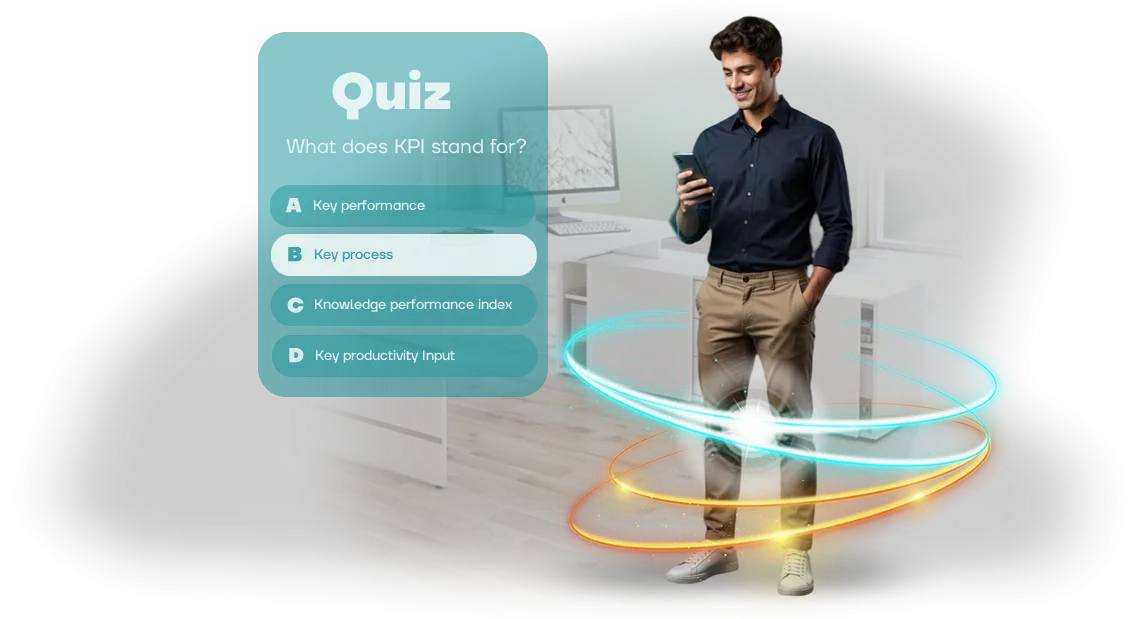
A training quiz on interviewing solves this problem through practice, not lectures.
Hiring team members work through typical scenarios in an interactive format: how to spot exaggerated experience, which questions provoke honest answers, how to filter out an unsuitable candidate early without wasting time on long meetings.
Every decision in the quiz is accompanied by an analysis of consequences, so the skill sticks faster and becomes part of the interviewer's daily routine.
A systematic approach to training provides what a one-off webinar cannot: a single evaluation standard for all employees, fewer hiring mistakes, and quality control at every stage of recruitment. Managers see team performance statistics and precisely close the weak spots of each specialist.
We address this need by turning hiring into a predictable process. We help reduce the cost of "expensive mistakes" as early as the interview stage and build a team of interviewers you can rely on.
Why test employees: restarting onboarding and growth
Employee assessment is not about finding someone to blame, but about understanding where the company is losing efficiency. A well-designed quiz turns knowledge checking into an engaging process and provides accurate data for decisions. Let's break down the key benefits.
Accurate skill assessment
Ordinary performance reviews often show not the actual level of training, but the ability to present oneself. A quiz with uniform scenarios for everyone gives an objective picture: who really masters the skill and who needs to improve.
This is especially important in recruitment—you see an employee's real readiness for tasks rather than their self-assessment.
Based on this data, you can make personnel decisions: who to trust with a complex project, who to promote, and who needs an individual development plan. Results are comparable across departments and branches, so evaluation stops being a "lottery."
Faster onboarding of new employees
When evaluation criteria are built into the scenario in advance, a newcomer understands from day one what standards the company uses. They don't spend months "floundering" waiting for feedback—the quiz immediately shows what they already know and what they should learn. As a result, time to full productivity shrinks and first results appear faster.
Onboarding changes from a drawn-out process into a manageable stage. The manager sees each newcomer's progress in numbers and can offer support or adjust the training plan in time.
Team engagement instead of boring tests
Employees don't resist a dialogue format with game elements. It's not a test paper but an interesting competition where everyone can check themselves and compare results with colleagues. Genuine interest replaces a formal attitude, and discussing results becomes part of team culture.
When people are engaged in learning, they are less likely to look for ways to "sit it out" and more willing to apply what they've learned in practice. This directly affects work quality and the atmosphere in the team.
Reduced load on managers
Instead of manually checking each employee and long approval processes, you get automated reports. Managers spend less time on evaluation and more on developing the team.
Unified standards eliminate arguments like "why can he and I can't" and make the system transparent for everyone.
Quiz formats for different team goals
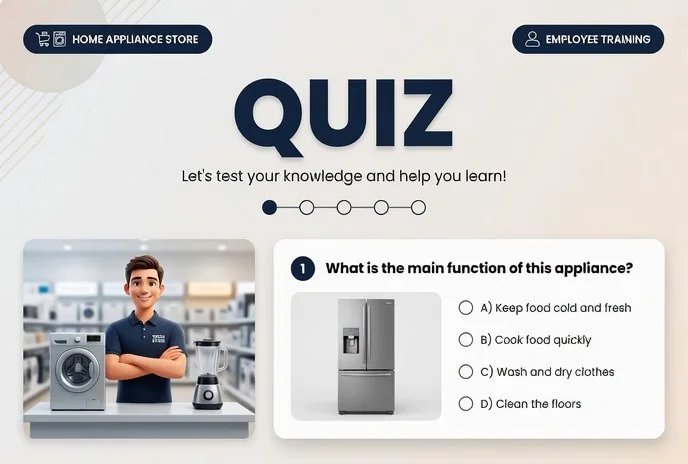
One quiz cannot cover all recruitment tasks: initial screening, training newcomers, and practicing complex interviews require different approaches. That's why we tailor the format to a specific goal—from a short test to in-depth skill assessment in a dialogue simulator.
Below are typical scenarios our clients choose. If your task is unique, we adapt the format to it.
| Quiz format | Who it's for | What it gives the client |
|---|---|---|
| Test for candidates for an HR specialist position | Head of recruitment | Quickly identify basic knowledge before the interview, reduce initial screening time |
| Training quiz for new hiring department employees | Mentor, HR director | Accelerate onboarding of newcomers, reduce mistakes in the first months of work |
| Dialogue simulator for an interview with a "difficult" candidate | Experienced recruiters | Practice handling objections and managing the conversation without risk to real interviews |
| Corporate team quiz game | Entire recruitment team | Build team spirit in a game format, review procedures without boring lectures |
| Final testing after training | Trainer, HR director | Measure employee progress, identify gaps, and adjust the training program |
Quiz launch stages: from brief to final report
Launching a training quiz is a transparent route where you understand at every stage what is happening and what you will get in the end. We start with a short brief and take the project to a working training tool, staying available for support after launch.
- Development brief — a short questionnaire that helps us understand training goals, the audience, and typical interviewer mistakes. Based on this, we build the quiz scenario.
- Scenario plan — we outline dialogue branches: how the quiz reacts to different candidate responses and which strategies are considered correct. You see the structure before programming begins.
- Prototype approval — we show a visual layout of the future simulator to clarify the logic and content. This avoids expensive revisions at later stages.
- Simulator development — we build a dialogue 3D quest on a professional engine, add voiceover and an intuitive interface. All materials are adapted to your corporate style.
- Testing with real employees — we test the quiz on a small group, making sure questions are clear and don't cause misinterpretations. We make final edits.
- Quiz launch — we deploy the solution in your system and provide access and instructions. Employees take the quiz immediately after launch.
- Post-launch support — we stay in touch: we help with scenario updates, technical questions, and refinements for new recruitment requirements.
In the end, you get a ready-made tool that is easy to integrate into training, plus confidence that the quiz will run without failures. The entire process takes two to four weeks—the exact timeline depends on the number of scenarios and the volume of voiceover.
What's included: scenarios, analytics, and recommendations
We've put together a delivery package so you can launch training without involving developers or technical specialists. Everything needed for startup and daily work is already included: from ready-made scenarios to analytics showing each employee's progress.
- Ready-made recruitment scenarios — dialogue situations with different types of candidates: from stress interviews to motivation assessment. Scenarios can be used as-is or adapted to your vacancies.
- Admin control panel — your HR department independently uploads questions, changes dialogue branches, adds new employees, and configures access.
- Analytics for HR — summary reports on each employee: number of attempts, mistakes, response speed, and progress. You can see who is ready for real interviews and who needs extra practice.
- Launch instructions — a step-by-step guide for administrators and a cheat sheet for employees. Training can be deployed in one day.
- Methodological recommendations — how to integrate the quiz into your existing training system, how to interpret results, and what decisions to make based on data.
- Updates and technical support — we support the project: update scenarios, add new questions, and help whenever questions arise.
Case study: how recruitment quizzes improved selection quality
A large retail chain faced the problem of different recruiters conducting interviews in their own way: some overwhelmed candidates with questions, others ignored warning signs. As a result, up to 20% of newcomers left within the first week.
We proposed not another lecture, but an interactive quiz simulator for interviews, where employees practiced scenarios with virtual interviewees.
The simulator is built on Unity, which made it possible to create dialogue scenes with actors and lively facial expressions.
The recruiter carries on a conversation, asks questions, responds to objections, and the system provides real-time feedback on how each decision affects the candidate's evaluation.
Correct actions lead to an experienced applicant; mistakes lead to a difficult and "quiet" candidate who is actually a top specialist.
Result
In the first month, the HR team completed 340 sessions. Two months later, candidate attrition for a key position dropped by a third, and the time for a newcomer to reach full productivity decreased from five weeks to three.
Managers also appreciated the versatility of the scenarios—they began using the quiz to quickly assess the interviewing skills of trainees.
After the pilot, the client expanded the project: they added scenarios for different positions and experience levels. Several company departments now reuse the simulator when hiring.
That's why we are confident: recruitment quizzes deliver measurable results—fewer chaotic decisions and more suitable employees.
How to choose the right quiz format for the desired result?
Choosing a quiz format starts not with mechanics but with what result the business needs. If the goal is for interviewers to ask the right questions and not lose candidates at the first stage, a scenario with answer choices and error analysis works well.
If you need to engage the entire recruitment team in training, it's worth adding a competitive element and short rounds.
The main guide is a specific HR pain point: weak preparation of newcomers, inconsistency in candidate evaluation, or a long path to independent interviews. When an employee chooses an answer and immediately sees why it's wrong, training stops being abstract theory.
The quiz becomes a simulator that builds a unified interview standard and reduces mistakes after just the first attempt.
If the task is more serious—to test not knowledge of rules but behavior in a live conversation—a dialogue quiz is the right fit. In it, the interviewer talks to a virtual candidate: chooses responses, reacts to unexpected answers, and gets a score for their strategy.
This format prepares for real situations better than a multiple-choice test because it forces thinking in the process rather than guessing afterward.
We help you navigate these formats and find the right fit for your tasks and budget. At the start, a short brief is enough: who will learn, what problem is interfering with hiring, and what result you expect.
The rest—choosing the scenario and setting up mechanics—we take on ourselves so that the quiz solves an HR task rather than being just entertainment.
Frequently asked questions before launching training programs
Before launching corporate quizzes, clients often have the same concerns: whether it will overload HR, whether employee data is protected, and how quickly the team will adapt to the new format.
We've been creating training programs for recruitment for more than 10 years, so we address these questions in advance.
Below are answers to the questions most often asked before starting training.
How long will implementation take, and will it overload the HR team?
We handle most of the work: we collect the brief, prepare the dialogue simulator scenario, and configure it to fit your recruitment tasks. The HR team only needs to send employees a link and check progress in a visual dashboard—this takes no more than 15–20 minutes a day.
Is employee data secure?
We work in a protected server environment: personal data is accessible only to authorized employees of your company, is not shared with third parties, and is not used outside the training program. Only you can see quiz results.
Will employees manage without preparation, and what if difficulties arise?
The quiz works like a dialogue simulator: participants answer questions as they would in a real interview and receive instant feedback. Everything runs in the browser from any device; your team gets a short cheat sheet and our support at all stages of launch.
When will training results be visible?
The report is generated automatically after every attempt: you see the progress of the team and individual interviewers, as well as typical mistakes. This helps quickly adjust the training program without unnecessary meetings.
Start with a pilot group: request a demo
Rolling out a new training program to the entire staff at once is risky: an unsuitable format demotivates employees and burns the budget. So it makes sense to start with a pilot group—gather feedback, see the results, and only then scale.
We suggest doing this without unnecessary costs: request a demo, and we'll prepare a pilot scenario for your task.
The demo is not just a presentation. At the meeting, we'll walk through a real case from your recruitment practice, show how the quiz engages participants and tests their skills, and together define metrics for evaluation. You'll get a working tool that can be tested on a small group in just a few days.
What's included in a demo request:
- A pilot quiz scenario based on your typical interview situations.
- A demonstration of the interface and question logic using a live example.
- Recommendations for integrating the quiz into your current employee training program.
- A calculation of timelines and scope of work for a full launch.
- Format options: from a short survey to a full dialogue simulator.
- A turnkey quiz with question preparation, configuration, and launch support.
This way, you'll see how employees react to the format and make a decision based on numbers, not assumptions. Request a demo—we'll discuss your task and send a pilot scenario. Let training become clear and measurable.