

Why Employees Freeze Up During Medical Consultations
An employee who knows the protocols flawlessly suddenly freezes up during a medical consultation when a patient asks an unexpected question or shows anxiety. Instead of a confident answer — a pause, a hesitant formulation, and sometimes an outright mistake.
It is precisely these communication breakdowns that cost the most: the patient remembers not the perfect procedure but the unpleasant conversation, and goes to competitors or leaves a negative review.
The cost of such mistakes is not only the damaged reputation of a particular specialist but also a blow to the entire brand. One failed dialogue can undo months of work by a clinic or medical center.
Yet a manager often learns about the problem after the fact, when a complaint has already been filed, and knowledge checks show that the employee was formally prepared for the consultation.
The problem is that classic training does not prepare staff for live dialogues. Lectures and briefings provide knowledge but do not train reactions in stressful situations.
When you need to quickly find the right words, calm a patient, or politely refuse an unreasonable request, theoretical preparation does not work. Staff learn from their own mistakes — and those mistakes happen on real patients.
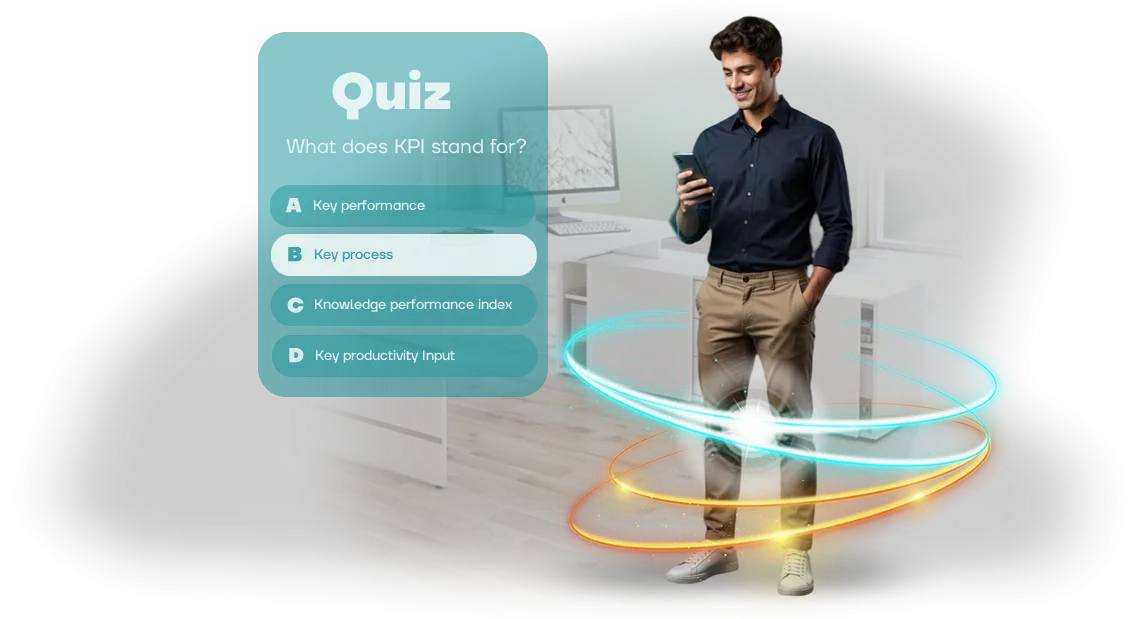
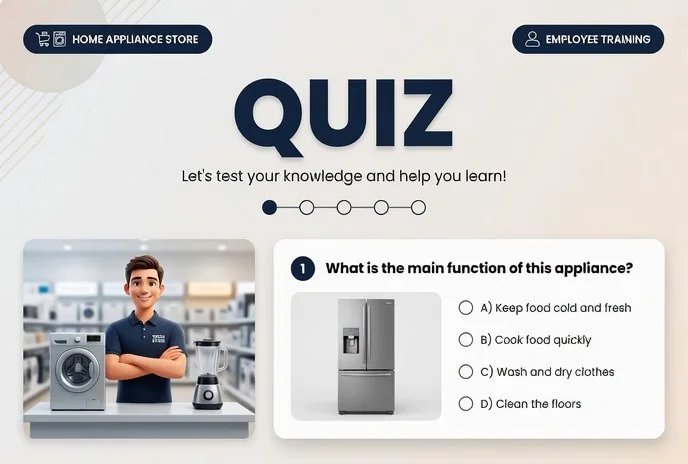
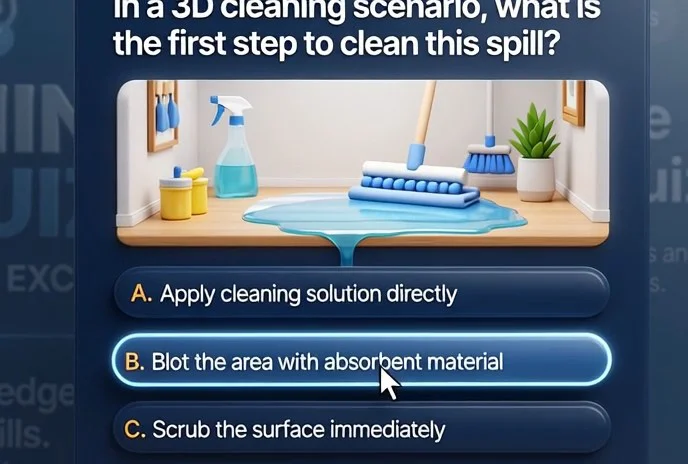
This is where training quizzes for staff come in. The dialogue format immerses the employee in a simulated medical consultation where every decision affects the course of the conversation.
In a safe environment, you can make mistakes, try different strategies, and bring the dialogue to the right outcome. Knowledge assessment becomes visual: you see exactly who gets stuck and at what stage, and can precisely close the weak points.
We have already helped medical clinics reduce the number of conflict situations through such quizzes. Staff stop fearing difficult questions, and patients feel confidence and care. We will analyze your consultation scenario and turn common mistakes into training scenarios.
How Quizzes Benefit the Business and the Team
Quizzes turn corporate training from a formal obligation into a clear and measurable process. A manager sees who has already mastered the standards and who needs additional support — and can make a quick decision without lengthy checks.
The main benefit of a quiz is the speed of onboarding new employees. Instead of spending several weeks studying instructions, a newcomer completes short interactive rounds and immediately starts applying knowledge in practice. The team reaches the required level faster, and the load on mentors decreases.
The second important benefit is fewer mistakes in real consultations. An employee trains on typical scenarios, works through difficult questions and objections in a safe environment rather than on a live client. This directly affects service quality and the number of repeat visits.
Quizzes set a single service standard for the entire team. Regardless of experience and tenure, every employee absorbs the same communication rules, protocols, and key scenarios.
The client receives consistently predictable service, and the manager gains confidence that the standards are actually being followed.
Finally, the game format boosts staff motivation to learn. Employees compete on a leaderboard, see their progress, and receive recognition for results — training stops being a boring obligation.
The company gets an engaged team that wants to grow, rather than completing a course just to tick a box.
Quiz Formats for Different Training Objectives
Training for medical consultations is not about memorizing instructions but about confident dialogues with the patient. The same material can be presented in different ways: from a quick knowledge check to full immersion in a conversation with a virtual patient. The right format determines how quickly an employee will apply the skills in real work.
The choice depends on the goal: reinforce a protocol, rehearse a difficult conversation, or assess a newcomer's readiness for an independent consultation. Below are the three formats we use and the scenarios in which each of them delivers maximum value.
| Quiz format | For whom | What the client gets |
|---|---|---|
| Express survey | The entire team, including new staff | Quick check of knowledge of regulations and protocols, instant snapshot of errors by department |
| Interactive scenario | Front-line employees and administrators | Practice of typical dialogues with a patient, handling objections and non-standard questions |
| 3D dialogue simulator | Medical staff working face-to-face with patients | Full immersion in the consultation, training empathy and confidence without risk to the real appointment |
We select the format for your task and combine them in one program when necessary. Express surveys are launched regularly and do not require taking time away from work, while the 3D simulator becomes the central element of in-person training.
To ensure a quiz truly changes employee behavior, we design it as part of a system: from short checks on a phone to deep scenarios. You get a ready-made tool that integrates into your current training processes — without the need to change the team's usual work rhythm. Contact us — we will help you choose the optimal format for your goals and budget.
How Quiz Development Works in 5 Steps
Transparent development stages are your guarantee that the project goes according to plan. We divided the work into five steps so that you can see at any moment what is happening with the quiz and when it will be ready. Below are the main stages a project goes through from the first request to launch.
-
Quiz brief. We find out which specialists the training is being created for, which medical consultation topics need to be covered, and which mistakes to emphasize. All data is documented for your approval.
-
Scenario approval. Based on the brief, we prepare questions, answer options, and explanations for each one. You see the structure in advance and make edits without unexpected extra charges.
-
Mechanics and design. We select interactive elements — from a simple answer choice to a patient dialogue review. We build a prototype so you can evaluate the quiz before launch.
-
Testing and revisions. We provide a link to the test version, and you check the logic and wording together with medical experts. We make adjustments before the training goes out to employees.
-
Training launch. We connect the quiz to your learning management system or place it on a convenient page, and set up access and completion deadlines.
-
Quiz support. After the launch, we stay in touch: we help with analytics, update questions, and add new topics when your employees need them.
What You Get in the Package After Launch
After launch, you receive not just a set of files but a complete training system for medical consultations. It integrates into the workflow right away and requires no technical knowledge from employees.
Everything needed for launch is already packed in the package — all you need to do is appoint a person in charge and hand out the links.
What is included in the delivery:
- A ready-made dialogue quiz with a 3D simulator — employees practice realistic medical consultation scenarios in the format of a live dialogue.
- A package of scenarios and questions adapted to your quality standards, typical mistakes, and client objections — this is not a template but content tailored to your specifics.
- Instructions for the team — how to get started, take the quiz, analyze their results, and use feedback.
- An admin panel for the manager — see each employee's progress, scenario success rates, problem topics, and receive ready-made reports.
- Training for employees and administrators — we conduct a short briefing, after which the team navigates the system without our support.
- Content updates — you can request new questions and scenarios so that the quiz remains relevant and evolves alongside your business objectives.
All elements work as a single system: employees train their medical consultation skills, you control the results, and the quiz becomes part of a regular training process. This is not a one-time task but a tool that pays for itself through long and stable service.
You get a transparent system that shows how the team masters the algorithms, and you can always adjust the course to new requirements.
Case Study: How a Quiz Improved the Quality of Medical Consultations
AlfaMed, a clinic network with eight branches, came to us with a complaint: consultants were losing up to a third of potential patients at the appointment booking stage.
The cause turned out to be not the scripts but the live dialogue — newcomers were afraid of clarifying questions, and experienced employees handled objections in a formulaic way, failing to sense the caller's mood. Classic lectures and knowledge tests changed nothing in real practice.
We developed a dialogue quiz trainer in which each employee conducts a conversation with a virtual patient.
The system reacts like a real person: it hesitates, interrupts, and raises typical objections such as "too expensive" or "I'll wait until payday." After each scenario, the employee receives an analysis of mistakes and ready-made phrasings for a confident response.
Training becomes safe practice where you can try, make mistakes, and transfer the skill to real calls.
Two months after launch, we measured the effect: the number of incomplete consultations fell by 40%, and patient satisfaction after a call rose from 4.6 to 4.8 points.
The department head also noted that newcomers began hitting target metrics twice as fast — previously adaptation took three months, now it takes less than six weeks.
A separate indicator was the repeat order: the clinic expanded the program with a module on handling complaints and claims. This confirms that the quiz solves not only a local task but also becomes an ongoing tool for team development.
This is exactly the result we build into every project: you get not an "entertainment test" but measurable growth in consultation quality.
How to Choose a Quiz Format for Your Task?
The first thing to do is to start from the training goal. If you need to check whether an employee remembers the protocol or standards, a classic quiz with answer options and explanations is sufficient.
If the task is to practice the skill of conducting a medical consultation, choose a dialogue simulator: it shows how a specialist leads the conversation, reacts to unexpected questions, and stays calm in difficult situations.
The second criterion is the audience. New employees need hints and clear feedback after each question; experienced ones need realistic cases and mistake analysis.
The same scenario can be adjusted to different depths, but the interface format and the amount of text are best determined for a specific group so that training does not become a formality.
The third criterion is the time employees actually have.
Training should not interrupt work: short rounds of five to seven minutes are easy to fit into the schedule, when an employee answers between appointments or at the end of the day, and the manager sees progress in the shared dashboard.
For sales departments, the quiz is often made competitive — with a leaderboard and analysis of typical mistakes — so the skill is reinforced without long lectures or time away from client tasks.
If you are unsure which option is right, describe the task in two or three sentences: who will be learning, what exactly, and how much time employees have per week.
By answering these questions before the call, you will immediately receive a format recommendation and a launch timeline estimate — without lengthy approvals and extra meetings.
Frequently Asked Questions About Implementation and ROI
Before launching a training quiz, a manager has the same doubts: how much time implementation will take, whether it will be difficult for employees, whether the technology will fail, and how soon everything will pay off.
We answer the five most frequent questions — briefly and without technical details, so you can make a decision today.
How long will implementation take?
From the moment content is handed over to launch, it usually takes 2–4 weeks. The timeline depends on the scope, but we fix it in the contract.
Will it be difficult for employees to figure out?
No. The quiz is structured like a messenger conversation: questions, options, hints. It takes a couple of minutes to learn, and it can be completed from a phone.
How reliable is it technically?
We use professional server architecture with redundancy. The system handles hundreds of employees working simultaneously, and on launch day we stay in touch to support you.
How do we integrate the quiz with our training system?
We configure the transfer of results to your learning management system or internal records. Integration does not require replacing existing processes.
When will the quiz pay off?
After the first cycle, you see knowledge gaps and reduce spending on in-person training. The content remains yours, so launching it for new employees requires no additional costs.
Order a Training Quiz and Get a Turnkey Tool
Ordering a training quiz should not turn into a long project with a deep dive into technical details.
We take on the full cycle: we develop the scenario based on real medical consultation cases, configure the quiz, prepare methodological materials, and hand over everything needed for launch. You save your team's time and get a tool that works right away.
The turnkey package includes:
- a quiz scenario adapted to your business processes;
- questions and dialogue situations for practicing consulting skills;
- methodological recommendations for the trainer;
- instructions for participants and the administrator;
- access setup and technical support;
- staff training on working with the platform;
- assistance with conducting the pilot launch.
This is not just a test for entertainment but a training tool: employees go through scenarios close to real patient dialogues and practice communication, argumentation, and objection-handling skills.
Launch takes from 2 weeks. To get started, submit a request — an expert will provide a consultation, clarify the tasks and the number of employees, calculate the cost, and suggest the optimal format. The work plan and cost estimate will be transparent and clear.
Fill out the form below to receive a ready-made quiz, methodological materials, and support at the start. In two weeks, your employees will begin training in a new interactive format.