

Why Hotel Staff Training Doesn't Deliver Results
In the hotel business, staff training often becomes a formality: employees sit through a lecture, pass a test, and two weeks later they're back to working the old way. The hotel's standards exist on their own, while the actual service is something else entirely.
Guests face a cold reception, front desk errors, and slow housekeeping — and the manager gets a stream of complaints instead of repeat bookings.
The cause is not lazy employees but the training format itself. Traditional trainings overload with information but don't build the skill to act in a specific situation — especially under pressure when a guest is standing right there.
With high staff turnover, training has to be restarted every few months, while effectiveness stays low: knowledge isn't retained and doesn't transfer into daily work.
This hits profitability directly — through reputation, fewer direct bookings, and rising recruitment and onboarding costs.
We close this gap with a dialogue-based 3D simulator where employees practice hotel service standards in a safe environment. Instead of lectures — live scenarios: guest check-in, a conflict situation, an unusual request.
Mistakes don't cost you customers but provide instant feedback, and the skill sticks after just a couple of short sessions.
Staff training stops being a check-the-box necessity and becomes a tool that raises service quality and reduces the load on mentors — even as the team keeps changing.
What Changes at a Hotel After Introducing Quizzes
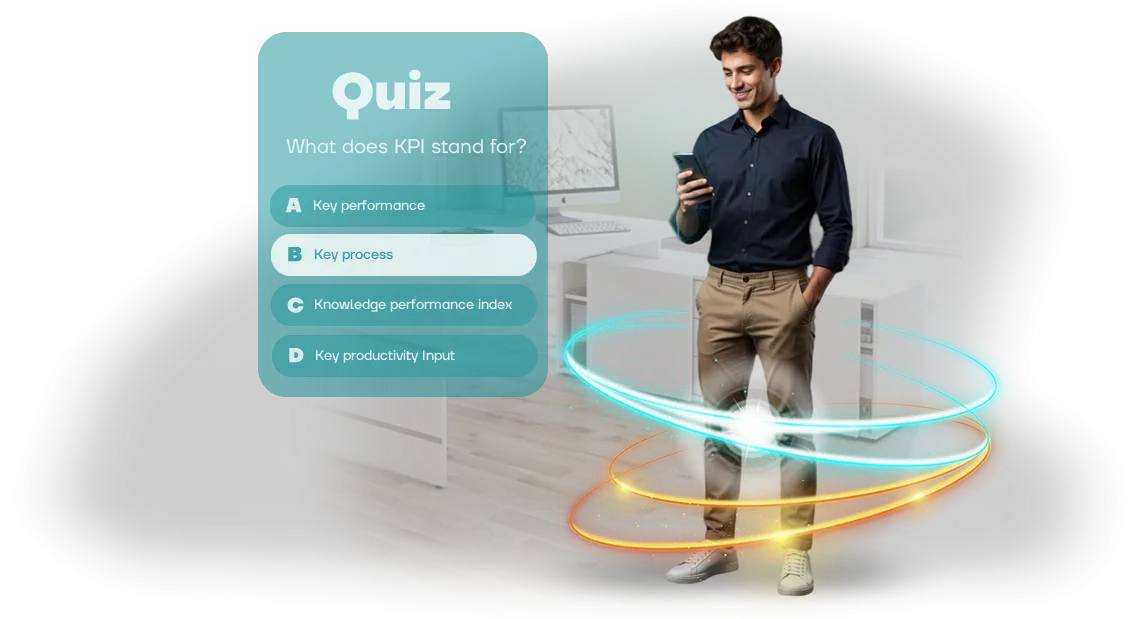
When training becomes a game, employees' attitude toward standards changes. Instead of another lecture — short quizzes that are easy to fit into a shift. The effect is visible within a month, and here's what the hotel gets.
- Higher engagement. Employees take quizzes voluntarily, discuss results between shifts, and compete by department. Training stops being an obligation and becomes part of corporate culture.
- Accurate knowledge assessment. You see who truly absorbed the standards and who is answering at random. This lets you retrain specific people instead of spending time on general meetings.
- Lower turnover. The game format removes the stress of checks and routine. People feel the company is investing in them — and are less likely to leave in search of "something interesting."
- A consistent service standard. All employees — from housekeeper to front desk manager — work by the same rules. Guests receive an equally high level of service, which strengthens brand recognition.
We've been configuring quizzes for hotels and hotel chains for over 10 years. We adapt questions to your standards and launch them without interrupting operations. The result — predictable service, fewer mistakes, and a team that truly knows its responsibilities.
Quiz Formats for Different Hotel Tasks
Each format solves its own problem: one team needs a quick knowledge check, another needs practice with difficult guest conversations. There's no one-size-fits-all option, so we match the format to the role and training goals — from a simple test to full immersion in a situation.
| Format | For whom | What it gives the hotel |
|---|---|---|
| Test | Line staff, new employees | Quick check of basic knowledge without stopping work |
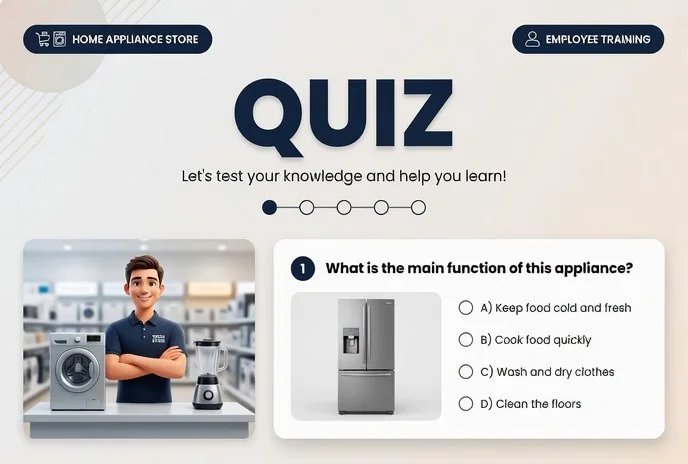
| Dialogue quiz | Front desk administrators, reception staff, sales managers | Practice for difficult guest situations and objections |
| 3D simulator | All staff, especially front office and management | Full immersion in a realistic hotel scenario with safe practice of mistakes |
Why the 3D Simulator Works Better
A newcomer may know the theory but gets lost when a guest raises their voice or asks an unusual question. The 3D simulator recreates the real hotel environment: the reception desk, the restaurant, the meeting room.
The employee works through a scenario where every decision shapes the dialogue — and receives instant feedback.
From a business perspective, the simulator saves mentor resources: instead of one-on-one training sessions, employees practice on their own at their own pace. All actions are logged, so you can see who is ready to work with guests and who needs additional training.
How to Choose a Format for Your Task
We usually combine formats: a test for initial certification, a dialogue quiz for practicing typical situations, and a 3D simulator for the final exam. This approach gives a complete training cycle — from theory to practice. If you already have training materials, we'll adapt them into scenarios without losing the meaning.
Get in touch — we'll find the right format for a specific role and show a demo on your scenario.
How We Develop and Launch a Quiz in 5 Steps
We keep technical complexity out of your way and break the project into clear stages. Below is the path from the first conversation to a working quiz, where you always know what's happening and what's needed from you.
-
Brief: we dive into your task. You tell us about your employees, training goals, and problem areas. We ask clarifying questions and gather the essentials: how many people, what topics, what outcome matters. The result — a clear understanding of what the quiz must do.
-
Plan and approval. We propose the structure: scenario, question types, difficulty levels, mechanics. You see a preview of the future game and make edits before development starts. This removes the risk of "that's not what I meant."
-
Development and testing. We build a dialogue quiz with 3D characters and a result scoring system. We test it ourselves with typical users so nothing hangs or breaks. We send you a trial version for final approval.
-
Launch. We connect the quiz to your system and set up employee access. You get a link or embed the module into your corporate portal. We launch and verify everything works under load.
-
Support and growth. After launch we stay in touch: fixes, new questions, scenario updates. You can change content as the team grows or standards evolve. Support is fixed in the contract, so you're never left alone with problems.
What's Included in the Corporate Quiz Package
Hotel staff training becomes a formality if no tool remains after the training to reinforce knowledge and engage employees. A corporate quiz is a ready-made package that works for your team from day one.
Below is the full delivery scope so you understand what you're getting and how it affects your service level.
The focus on hotel operations is fundamental here: every element of the package is adapted to your business realities, from regulations to guest communication scripts.
We deliver not just a game but a working training tool that is easy to update and use without involving developers.
- Quiz scenarios and logic. Ready-made storylines that play out real hotel situations: check-in, handling complaints, service standards, behavior in unusual situations.
- Question and answer bank. Professionally written questions with explanations of correct answers. You get a base you can expand and edit for new standards or changes to regulations.
- Branding for your hotel. Quiz design in your corporate style: logo, colors, atmosphere. Employees see their own brand, not an abstract game — this builds trust and engagement.
- Administrator instructions. A simple, clear guide on how to launch the quiz, assign sessions to different departments, and track progress. No technical expertise needed — your HR or administrator can handle it.
- Update rights. You get not a one-off game but a flexible tool. The package includes rights and documentation so your team can add new questions and change scenarios on its own as needs evolve.
- Reporting dashboard for managers. Data on quiz completion: who participated, which topics caused difficulty, how well the team absorbed the material. Ready-made analytics for decisions on further training.
This package covers the hotel's main need — rapid training for new employees and maintaining high standards. You get a system that saves managers' time and makes training clear and effective.
Case Study: Service Standards Up 30% in 2 Months
For a hotel chain, we developed a training quiz for housekeepers — an interactive simulator that practices hotel standards in real scenarios.
Before that, training was delivered through lectures and briefings: employees memorized the rules but kept making the same mistakes in practice.
On average, cleaning quality across the chain was rated 4.1 points, and guest complaints about stale towels and forgotten amenities did not go down.
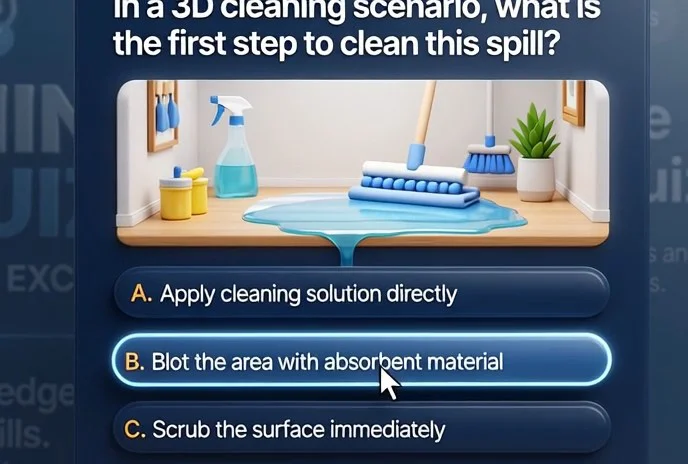
We replaced passive training with a hands-on format: each employee works through short case tasks where they must choose the correct cleaning sequence, allocate time properly, and resolve an unusual situation.
The simulator provides instant feedback and explains where the mistake was. For management, we built an analytics dashboard: it shows which standards are weakest and allows the material to be updated quickly.
Two months after launch: cleaning quality ratings rose to 5.0 points, and guest complaints about service dropped by 30%. Training time for the department was cut in half because housekeepers take the quiz individually and at convenient times, without interrupting their work.
For the hotel chain, this became the foundation of the onboarding program for new staff: mentor costs decreased, and consistent service standards boosted repeat bookings in season.
The simulator paid for itself within the first month, and the client made it part of the annual staff training program.
How to Choose a Quiz Format for Your Hotel's Needs
Choosing a quiz format for hotel operations starts not with a set of tools but with the hotel's goals. If the priority is an equally high service standard at the front desk, in the restaurant, and in housekeeping, short diagnostic quizzes on standards work well.
If you need to practice difficult situations — a hostile guest, early check-in, an unusual request — then scenarios with action choices and consequence analysis are more valuable.
The specifics of hotel work directly shape the format: staff works in shifts, often without breaking away from duties, and in high season there is almost no time for long courses.
That is why it's more effective to break training into 5–7 minute mini-quizzes that can be completed on a phone during a break between shifts.
This approach does not disrupt the work rhythm and improves consistency — employees reinforce knowledge in small portions instead of rare, lengthy trainings.
The type of personnel matters too. Front desk agents, waiters, and housekeepers rarely enjoy tedious tests — they need visual questions tied to real hotel situations.
Department heads and managers can be offered a format with case analysis and decision evaluation to test not memory but management skills. A universal rule: the higher the position, the more complex and longer the scenario; the closer to the guest, the shorter and more practical.
Budget determines scale, not quality: for a small hotel, a set of ready-made templates with basic configuration is enough; for a hotel chain, a platform with employee development and per-property analytics is more cost-effective.
The key is to build in the ability to update questions — hotel standards change, and the quiz must stay relevant.
The bottom line is simple: first define which hotel problem the quiz solves — service standardization, fewer errors, or onboarding new employees. Then match the format to the work schedule and staff level, and use the budget for consistency and scenario quality.
This is exactly the approach that lets you choose a format that pays off through higher service quality and guest loyalty.
Common Concerns Hotel Managers Have Before Starting
Hotel managers often postpone launching training quizzes because of three fears: "it will break," "it's hard to implement," "it's expensive." That is why we fix timelines, cost, and support in the contract from the very start.
What if the quiz fails during training?
We test the scenario before launch and build in an offline mode — the quiz works even without internet. After delivery, there is a warranty for bug fixes and technical support: during business hours we respond within a few hours.
How hard is it to integrate the quiz into existing training?
We implement remotely, without involving you in technical details. All we need is a contact person for a couple of hours — we handle the rest and prepare instructions for staff.
The quiz works as a standalone course or as a supplement to trainings, and results are collected into reports automatically.
Budget is limited — how do I know what I'm getting for the money?
We provide a detailed cost estimate before we start, and payment is made after each stage is accepted, so overspending is impossible. You can start with a pilot version for one shift and scale up later. Content updates and refinements during the first year of support are included.
Leave a Request — Get a Demo and a Commercial Proposal
Leave a request — and the very next day you'll receive a demo of a training quiz on real hotel examples. It's easier to judge whether the format suits your employees than to read descriptions.
We have been developing interactive formats for business for over ten years, so we don't sell "training for training's sake" — we show concrete results.
What you get right after reaching out:
- A quiz demo — an interactive scenario you can walk through yourself and show to colleagues. Not a PPT presentation but a working prototype.
- A commercial proposal with a cost estimate tailored to your scale: number of employees, branches, training formats. A precise figure with no hidden extras.
- Scenario consultation — we'll advise which hotel topics to cover first: service standards, handling objections, safety, sales scripts.
- A launch timeline estimate and the stages of integrating the quiz into your current training. You'll know when you'll have the finished result.
- Examples of our work in the service industry with engagement data: how many employees complete the quiz and how knowledge retention changes.
To get all of this, you don't need a technical brief or lengthy approvals. Just leave a request below or write to us in a messenger with your contact details.
A manager will get back to you within one business day, clarify a couple of questions about your team's goals — and prepare the demo, cost estimate, and commercial proposal.
The request is non-binding: you get material for a decision, and the decision stays with you. See for yourself how much an interactive quiz can boost training engagement — within a day you'll have the full picture of timelines, cost, and implementation steps.