

Weak Team Management Skills Are Costing You Profit
A weak manager loses profit imperceptibly: the best employees leave, deadlines slip, projects stall. Leadership problems rarely look like a direct expense item — they're the difference between a team that works for results and a team that works out of fear.
A manager without team management skills makes decisions at random, doesn't hear objections, and doesn't notice engagement slipping.
Often, the best specialists end up in leadership positions — people who excel at their individual work. But team management is a different task: setting goals, distributing workload, giving feedback, resolving conflicts, and developing people.
All of this can be learned — and training employees in management skills pays off faster than any other training.
A telling figure: the cost of replacing a valuable employee amounts to several months of their pay. And if a weak manager demotivates a team of ten, the losses multiply with every departure.
So gaps in team management are not a manager's personal failure but a systemic problem that hits profit.
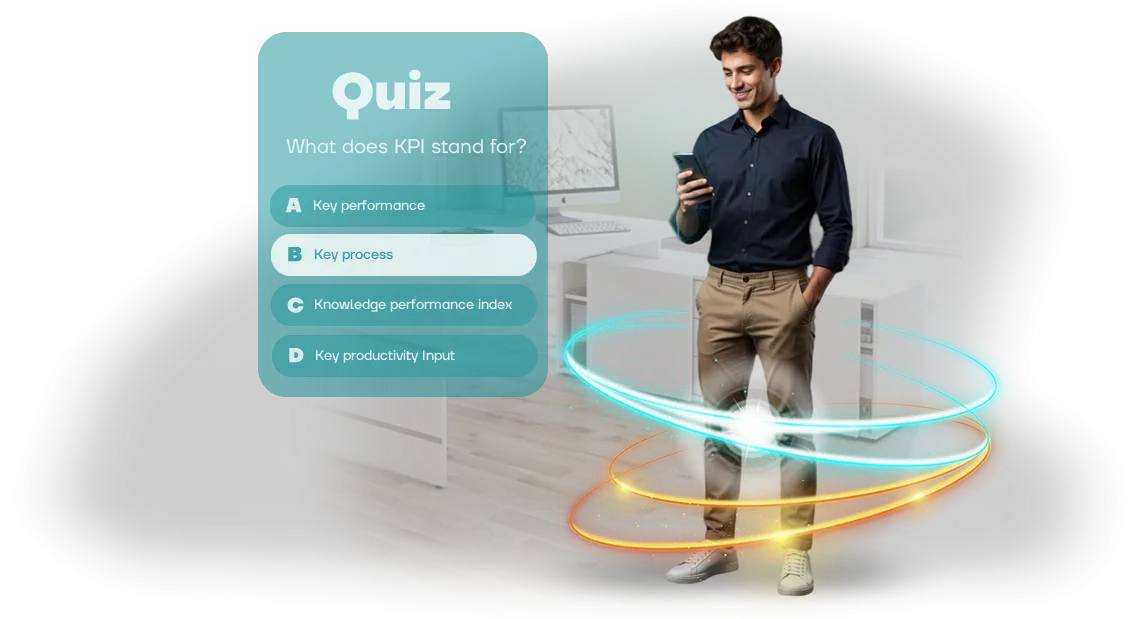
We close this gap with training quizzes that hone team management skills on real scenarios. Managers "play through" dialogues with employees, choose behavioral strategies, and see the consequences of decisions in a safe environment.
Such employee training turns weak leadership into strong leadership, and strong leadership into a driver of revenue growth and retention of valuable talent.
Team Management Training — Growth in Business Metrics
The skill of team management directly affects profit: the speed of task execution, staff turnover, and team atmosphere all depend on a manager's decisions. But knowledge gained at a lecture is forgotten within days, while habitual actions remain unchanged.
Training in an interactive quiz format turns theory into a practical skill that the employee applies the very next day.
Engagement is the first and most visible result. When a manager goes through dialogue scenarios with virtual subordinates, they aren't passively listening — they make decisions and see the consequences.
This format holds attention completely, not fragmentarily: the employee is personally interested in completing the scenario and finding the right strategy. Knowledge gained through one's own mistakes and their analysis sticks for the long term.
Management effectiveness grows through practicing difficult situations before they happen in reality. A conversation about missed KPIs, a demotivated employee, a conflict in the team — each such scenario in the simulator gives the manager a ready-made behavioral model.
They come to the real conversation prepared, spend less time and nerves, and the team gets clear, understandable decisions. Less friction — faster results.
The microclimate in the team changes when a manager starts acting consciously. Team management training helps spot employee burnout at an early stage, give feedback constructively, and distribute workload without imbalances.
People stay longer in such a team, which reduces the cost of recruiting and onboarding new specialists.
In the end, systematic manager training gives the business a measurable result: higher employee engagement, less turnover and fewer conflicts, plan targets reached faster.
This is not one-time motivation but sustainable growth that shows up in departmental numbers and team morale.
Training Formats: Choose What Fits Your Business
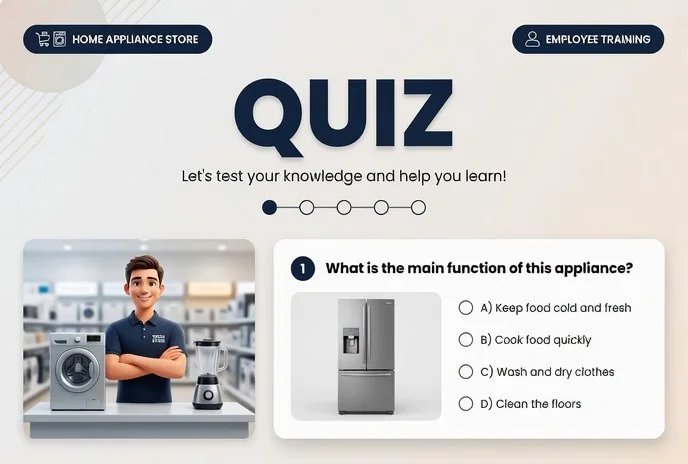
Employee training is not always lectures and tests. Game-based quizzes help reinforce team management skills without boredom and without disrupting work processes.
The key is to choose the format that solves your task: quickly refresh knowledge or deeply work through complex scenarios.
Different quiz formats work differently: some are good as regular warm-ups, others as full-fledged training. So you don't have to guess, we've compiled the main options into a single table.
| Format | For whom | What it gives the client |
|---|---|---|
| Short warm-ups (5–10 minutes) | For regular planning meetings and briefings | Quick immersion into the topic, rule review without taking time away from work |
| Scenario quizzes (30–40 minutes) | For new managers | Practice of real team management situations in a safe environment |
| Quizzes with game mechanics (levels, points) | For motivation and competitive spirit | Higher engagement, desire to complete the training to the end |
| Team quizzes | For team building | Strengthening ties between departments, joint problem solving |
| Dialogue simulators | For difficult negotiations and conflicts | Training reaction and emotional intelligence without risk to real relationships |
We understand that every business has its own tasks, so we don't offer templates. We'll match a format to your team, adapt quiz scenarios to your work specifics, and help implement training so it delivers measurable results.
Launch Stages: From Brief to Result
To make the launch go smoothly, we work according to a clear procedure. You always know what stage the project is at and what you'll get at the end — from the initial brief to the final result.
Stages of Work
-
Training brief — you tell us about your goals, audience, and team management challenges. We capture the requirements, timeline, and success criteria so that we can move forward according to an agreed plan.
-
Scenario design — we propose the quiz structure: which topics, questions, and formats will best lead to the desired manager behavior. You receive a document where every stage is justified and clear without technical details.
-
Scenario approval — together we refine the wording, add your corporate cases and typical work situations. At this stage, questions are adapted to your company so that employees see familiar contexts.
-
Development and assembly — based on the approved scenario, we build an interactive quiz with engaging scenarios and automatic feedback. You don't need to understand the details — you simply receive a working product.
-
Testing and launch preparation — we verify that everything works correctly on different devices and doesn't require special knowledge from employees. You get test access and can confirm that the quiz is easy to complete on the first try.
-
Quiz launch — we place the quiz in your system or via a link, help configure access, and briefly train administrators. After launch we stay in touch and make prompt edits when needed.
This sequence helps avoid surprises: you see in advance what the training will look like and control every step. In the end, you get a tool embedded in your processes that delivers a clear outcome — new team management skills, not just a formal knowledge check.
What's Included in an Employee Training Project
In an employee training project, we don't just make "another test" — we put together a complete package that is ready to launch and delivers measurable results.
Everything you need to engage the team and monitor knowledge comes in one project: from scenarios to analytics.
-
Team management quiz scenarios. Each scenario is a realistic work situation: a conflict in a department, task allocation, employee motivation. The participant makes decisions, and the quiz shows the consequences. This makes training practical rather than theoretical.
-
Game mechanics for engagement. Competitive elements, points, levels, and visible progress hold attention. Employees complete the training to the end because it's interesting, not because they "have to."
-
Training analytics for the manager. You see who completed the quiz, which questions caused difficulties, and where the team as a whole tends to make mistakes. This isn't just a report — it's a hint on what to cover in the next debrief or workshop.
-
Ready-made materials for HR and managers. A launch guide, communication templates for the team, and a reference on interpreting results. You don't need to come up with anything — everything is already prepared.
-
Measurable training results. Before and after the quiz, we build in control questions so you can see the growth in knowledge. After a series of quizzes, you get trend data for each employee and for the whole team.
-
Technical support and maintenance. We're on call at every stage: we adapt scenarios to your internal policies, help update questions, and analyze data. If you need to refine the mechanics — we'll do it quickly.
-
Administrator training. We'll teach your HR manager to launch quizzes independently, change questions, and export reports. The project doesn't depend on us: you fully control the process.
In the end, you get a system that integrates into ongoing training: new scenarios, fresh questions, and clear performance metrics. No "raw" files or half-finished products — only a working tool that delivers value from day one.
Result: Growth in Employee Engagement
For the retail chain Vershina with 350 employees, we developed an interactive team management quiz. Instead of a boring presentation, employees went through short dilemma scenarios: how to distribute tasks, what to say to a colleague who's late, how to motivate a new hire. Every answer instantly received an analysis and a practical recommendation.
In the first month, 82% of employees completed the quiz — while only 35% typically completed standard training. The time to complete one module dropped from 30 to 12 minutes.
But most importantly, engagement grew: 94% of participants reached the finale, and 68% asked for additional rounds on their own.
Two months later, we measured the business impact. The number of internal conflicts fell by 20%, and the engagement index in a survey rose from 3.4 to 4.6 points. Managers noted that teams reached agreements faster and were less likely to look for someone to blame. The result directly affected turnover: over six months, it dropped by 15%.
The chain ordered two more quiz blocks — for new managers and for working with remote teams. Now the quiz is a mandatory stage of onboarding.
This case shows: game-based training delivers measurable results that show up in the company's operational metrics, not just "employees completed the course."
How to Choose a Training Format for Your Task?
The right training format depends not on trendy fads but on the business problem you're solving. If employees need to master team management, a dialogue 3D simulator lets them practice difficult negotiations without risking real relationships in the team.
If you need to quickly introduce new hires to a product, an interactive course with short scenarios is enough. So first we define the goal, and only then do we pick the tool.
We start with a needs audit — together with you, we examine where exactly the breakdowns occur: in knowledge, skills, or employee motivation.
This is a key step because the same request "teach team management" can actually mean a planning problem, feedback difficulties, or a lack of unified standards.
The audit helps choose the format that addresses your specific pain point rather than copying someone else's success story.
Each format solves its own task. For example, a dialogue simulator is well suited for practicing difficult conversations — a manager learns to respond to conflict, motivate employees, and make personnel decisions in a safe environment.
Short quizzes are good for checking knowledge of policies, and video lectures for conveying basic theory. The key is not to mix goals: an attempt to teach and test "in one bottle" usually produces mediocre results for both training and assessment.
We'll help you choose a format that leads to measurable change: faster onboarding, fewer errors, more stable teams. Invite us to an audit — in a single call, it will become clear which option fits your task and why.
Frequently Asked Questions and Concerns
Ordering a training quiz is about trusting a contractor and making a budget commitment. We understand your doubts: what if employees don't like it, or data leaks? Below we answer the questions we hear most often before projects start.
What guarantees are there that the quiz will actually teach employees team management?
We design the scenario based on real management situations, not just to check a box. After the pilot, the quiz goes through a test run with a small group: we measure engagement and material retention, and adjust the difficulty.
The contract captures the metrics you'll receive — for example, completion rate and growth in test scores.
Is it safe to share employee data and internal company cases?
We work under a contract with an NDA. Scenarios and data are stored on a secure server architecture, and access is limited only to those working on your project. No employee can see anyone else's results — every login is identified and data is isolated. After the project is completed, all materials remain with you.
How quickly will we see results and when can we launch the training?
The brief and plan approval take a few days. Then scenario assembly, dialogues, and interface setup — typically 2–3 weeks depending on scope. You review intermediate versions at every stage and approve them, so the launch happens exactly when you're ready.
What if employees don't want to take the quiz?
The quiz is built as a dialogue simulator: the employee makes decisions and sees the consequences rather than simply answering test questions. This holds attention better than a lecture.
We also help with the announcement and a reward system — for example, a team leaderboard — so the launch sparks healthy interest rather than resistance.
Who supports us after launch?
You receive administrator instructions and technical support for the entire period of use. If employees change or new cases come up, we promptly update the scenarios. You're never left alone with the product.
Have your own question or a scenario that needs an individual approach? Write to us — we'll recommend a solution that fits your team specifically.Order Training and Get a Growth Plan
Team management training is not a lecture — it's practicing decisions on real-life situations. We build the program around your task: from analyzing managers' current skills to a simulator where each person tries managing a team without risk to the business.
Leave a request for a consultation — in 30 minutes we'll analyze where your managers lose effectiveness and which training format will deliver fast results. As a result, you'll receive a growth plan that can be embedded into your employee development system right away.
What's included in the growth plan after the consultation:
- diagnostics of team management skills among key employees;
- a personal development plan for the next 3–6 months;
- demo access to an interactive simulator with your scenarios;
- clear progress metrics: share of successful decisions, reaction speed, growth areas;
- methodical materials for reinforcing skills in daily work;
- recommendations on how to integrate training into your company's current processes.
After the consultation, you'll understand how to order training and launch the program within two weeks. The simulator doesn't require installation — employees complete scenarios from any device, and you see the results in your personal dashboard.
Book a consultation, and together we'll determine which team management skills need to be developed first. It will take half an hour, and the solution will stay with you for a long time.