

Onboarding New Employees: How Not to Lose Talent
Every new employee is an investment: time spent on recruiting, onboarding, and the first months of salary.
When onboarding is chaotic, the newcomer drowns in a flood of instructions, fails to see the value of their work, and within the first weeks decides whether to stay or leave.
The losses are tangible: up to a third of new employees leave during the probation period, and the cost of rehiring and retraining often exceeds the position's annual salary.
The problem is not the people, but the format of employee adaptation. Ordinary presentations and dry regulations do not engage: information is forgotten within a day, questions pile up, and mentor support is not always available.
As a result, the newcomer feels abandoned, makes mistakes due to unfamiliarity with processes, and loses motivation. The manager, in turn, sees rising staff turnover and a perpetual "talent shortage" that eats up the budget and the team's time.
Effective employee adaptation is not just about transferring knowledge; it is a fast path to independent work and the feeling of "I belong here." The faster a newcomer starts producing results, the lower the load on colleagues and the higher the return on hiring.
That is why new-hire training must be structured, interactive, and verifiable: so that every step is clear and progress is measurable.
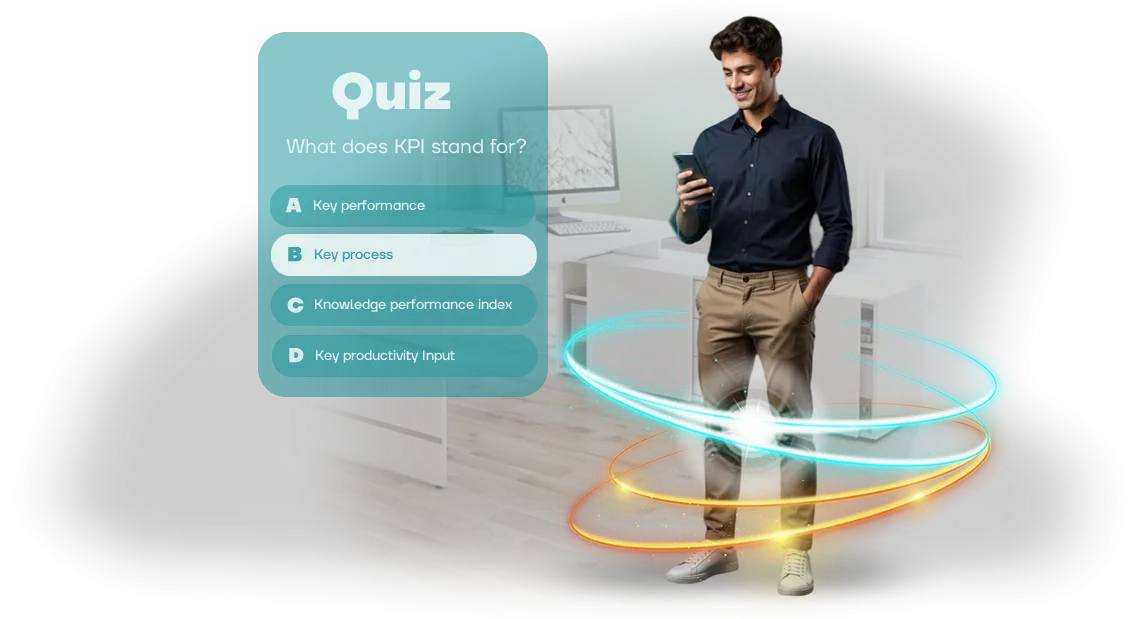
We address this need with training quizzes that turn onboarding into an engaging process. Instead of lectures, we use short scenarios where the employee immediately applies knowledge in practice and sees their results.
This format accelerates adaptation twofold, reduces the risk of early departure, and systematically prepares the newcomer for real tasks. Onboarding new employees stops being an HR headache and becomes a clear, manageable process with measurable effectiveness.
What a Game-Based Quiz Delivers: 4 Results for Business
A new employee spends the first weeks not on results, but on scattered instructions and questions to colleagues.
A game-based quiz solves this differently: it immediately immerses the person in the workflow, tests their knowledge in real scenarios, and shows exactly where they need to improve.
Gamification of learning turns the boring "study and memorize" into active practice — the employee starts contributing faster.
The first result is speed to proficiency. An employee quiz compresses onboarding from several weeks to several days: the person immediately understands key rules, standards, and typical situations.
Instead of passively reading regulations, they make decisions in the game and remember the correct actions at the level of habit. For the business, this means the newcomer reaches working pace faster, without a long period of "hovering" around the mentor.
The second result is a significant reduction in mentor workload. Usually, experienced employees explain the same things ten times to each newcomer.
The quiz takes over this routine: basic knowledge is honed in a game format, and the mentor only gets involved in complex questions and feedback.
This way, the team spends time on development rather than repeating elementary things — a direct saving of working time and company money.
The third result is high employee engagement. Competitive elements, points, levels, and dynamics make learning exciting. Employees complete the quiz not under duress, but because they find it interesting, and they willingly return to it to review the material.
Learning outcomes stick better thanks to emotional involvement: people remember what they experienced themselves, not what they skimmed through.
The fourth result is transparent metrics for the manager. You see which employees have mastered the material, which topics the team struggles with, and who needs extra attention. This allows you to adjust the onboarding program based on data rather than guesses.
The bottom line is simple: the quiz accelerates adaptation, relieves mentors, and delivers measurable growth in learning effectiveness — something that directly impacts profit.
Quiz Formats for Onboarding: Which One to Choose?
New employees absorb information differently: some need live contact with the team, some need the ability to learn at their own pace, and some remember better through interactive scenarios with decision-making.
Therefore, the quiz format for adaptation should be selected based on the specific task and audience.
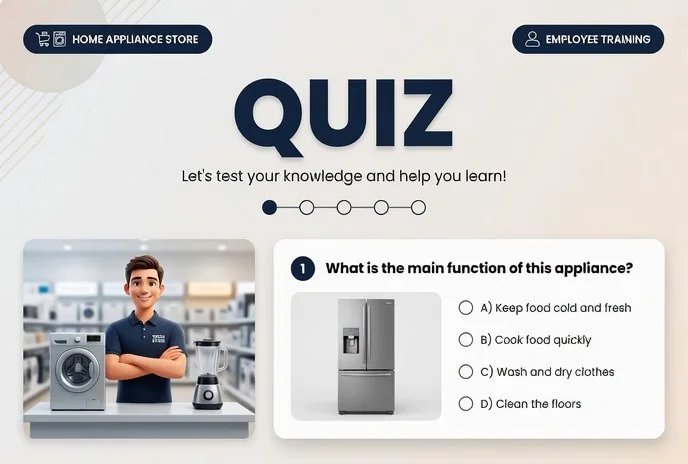
We develop three main formats — an in-person quiz, an online game, and a 3D simulator. Each has its own logic and strengths, which we build into the scenario.
| Format | For Whom | What It Gives the Client |
|---|---|---|
| In-person quiz | Teams up to 30 people, when live interaction matters | Quick introduction to colleagues, immersion in corporate culture, stress relief in the first days |
| Online game | Distributed teams, remote employees | A unified training standard independent of office or schedule, easy rollout across all branches |
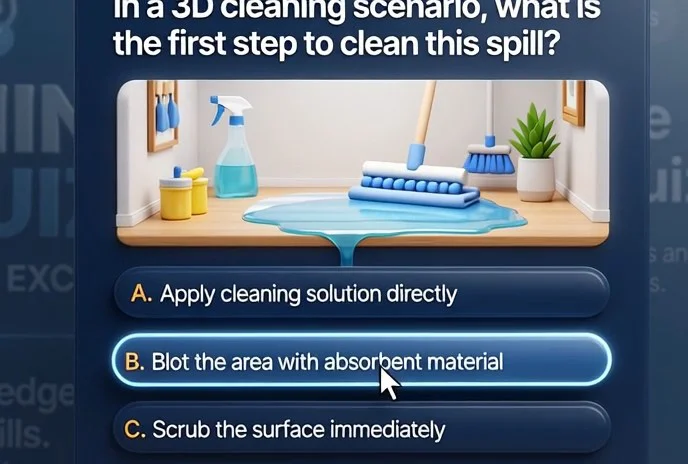
| 3D simulator | Mass onboarding, scenarios with dialogues and consequences | Safe practice of actions in complex situations, decision-making without risk to customers or the business |
Whichever format you choose, the quiz addresses the same pain point: new employees get into processes faster, make fewer mistakes in the first weeks, and feel part of the team.
We will prepare a structure for your scenario, fill it with questions from real company practice, and integrate the training into your existing adaptation program.
The main thing is not to chase a trendy format, but to base the choice on how your employees absorb information. If the company has both an office and remote work, a hybrid is often chosen: an in-person quiz for team bonding and an online game for basic knowledge.
A 3D simulator works when you need to practice customer dialogues or complex regulations — without consequences for real projects.
How a Quiz Launch Works: 6 Steps
We have structured the process so that you see results at every stage — from the first briefing to launching the quiz in your onboarding program.
No "black box": you always know what is happening, who is responsible for what, and when you will receive the finished product for new employees.
- Briefing and task immersion. We discuss exactly who needs training, what knowledge and skills to reinforce, and how much time newcomers can dedicate. We set goals and success criteria — for example, reducing the adaptation period or improving assessment results.
- Scenario and quiz plan. Based on the brief, we build the structure: topics, questions, difficulty levels, and branching logic. You receive a document that is easy to approve with an internal expert or methodologist — without diving into technical details.
- Quiz and game mechanics development. We create the quiz itself: interface, hint system, and feedback on answers. Professional tools allow us to build a game that runs consistently across all devices — your employees train without interruptions.
- Test run with your team. We launch a pilot version for a few newcomers or mentors. We collect feedback and adjust questions and scenarios. You see how real users go through the quiz before the official launch.
- Training launch. We integrate the quiz into your onboarding process: we grant access, set up notifications, and integrate with internal systems if needed. Employees start training immediately — without complicated instructions.
- Support and refinement. After the launch, we stay in touch: we monitor completion statistics, answer questions, and update content when your regulations change. If you need to add new questions or change difficulty, we do it quickly — without a full project restart.
This sequence guarantees that the quiz does not become an "empty questionnaire" but actually accelerates onboarding for new employees. You control every step, and we handle all the technical work — from quiz development to deploying the game in the workflow.
What's Included in the Delivery: A Complete Kit for the Training Department
When you order a training quiz, you get more than just a game — you get a complete kit for the training department. We handle development, content, and setup so that all you have to do is launch the onboarding and get results.
The delivery includes:
- Ready-made scenarios and questions for onboarding — a proven game logic that can be adapted to your specifics without diving into technical details.
- The quiz itself — runs on standard work computers, requires no complex installation, and employees won't wonder "how do I play this."
- Administrator tools — you can change questions, add new topics, and update materials yourself, without contacting developers.
- Instructions for the team — short guides for the facilitator, HR specialist, and participants: launch preparation takes minimal time.
- Methodological materials for staff training — recommendations on how to integrate the quiz into the adaptation program and reinforce knowledge after the game.
- Full rights to the game — you become the owner of the developed product and can use it without restrictions or additional payments.
- Technical support at launch — we join the first rollout, answer questions, and promptly make corrections if anything needs adjusting.
This kit covers the entire cycle: from the first minute of the game to result analysis. You don't need to improvise or refine anything on your own — everything is ready to use.
Case Study: Manager Adaptation Accelerated by 30%
When a sales manager starts a new job, the first two weeks are a stream of instructions and tests. At the retail chain «Meridian», adaptation took 14 days: five were spent on theory and scripts alone.
Newcomers lost motivation, and mentors spent a third of their working time answering the same questions.
We proposed replacing lectures with an interactive quiz — a dialogue simulator where the new employee talks to a virtual customer. Instead of memorizing a script, they learn to hear objections, choose arguments, and close the deal. The task is not to "pass a test" but to gain a skill — right away, in a safe environment.
The implementation result was measurable. The adaptation period dropped from 14 to 10 days — that is, by 30%. New managers made their first sales on day four instead of day seven, and probation-period attrition nearly halved.
Training effectiveness grew not only through speed. Mentors stopped spending time on typical questions — the simulator covers 80% of standard situations. And the manager can see from completion statistics which topics are hardest and add targeted practice.
Implementation Results
- Time to reach the plan reduced from 14 to 10 days (-30%).
- Probation-period attrition decreased by a factor of 1.8.
- Mentors freed up to 5 hours per week for live work with newcomers.
- The client ordered similar quizzes for the service and logistics departments.
This case is not a story about an "interesting game." It is proof that a well-designed quiz accelerates adaptation, reduces team workload, and pays for itself quickly.
That is why we always start with briefings and metrics — so you know what result you will get in a month.
How to Choose a Quiz Format for Your Company's Specifics?
A universal quiz that works equally well for every company does not exist — and that is normal.
The format should be chosen for the specific task: one thing is introducing a newcomer to regulations on the first day; another is checking how a manager has absorbed sales techniques after a month of work.
Therefore, the main criterion is not "what's trendy," but what goal the training pursues and how many resources you are willing to invest.
If the goal is to quickly and stresslessly immerse the employee in basic processes, a light text-based quiz with instant feedback is sufficient. It requires no development and launches within a few days, and the newcomer immediately sees their growth areas.
If the task is complex scenarios — such as handling objections or acting in unusual situations — you need a dialogue format where the employee makes decisions and sees the consequences. Such a quiz costs more, but it builds a skill rather than merely testing memory.
The budget also determines the format, but not linearly. For a small budget, you get a ready-made template with questions on your topic, covering the basic needs of onboarding.
A medium budget allows you to adapt the scenario to your real cases and add gamification elements for engagement.
If the task is ambitious — for example, the quiz becomes part of a corporate portal and reaches hundreds of employees — then it makes sense to invest in custom mechanics and integration with your CRM.
It's important to understand: an expensive format is justified when it solves a specific business problem, not just "to look impressive."
The most common misconception is that the format should be chosen once and for all.
In practice, companies often combine: a simple quiz for initial onboarding, a dialogue-based one for post-probationary assessment, and short surveys for regular knowledge checks without interrupting work. The key is that each format answers its own question and does not become an end in itself.
The final decision always comes down to three questions: who and what are we teaching, what result do we consider success, and how much are we willing to invest.
Once these parameters are clear, choosing a format stops being a problem — only the technical implementation remains, and we handle that. At the first briefing, we will help you define your goals and propose an option that solves your task without overpaying.
Frequently Asked Questions About Implementing Quizzes
Implementing a new training game always raises questions: will employees be skeptical, will updating content require constant effort, how soon can we expect the first results. Let's go through the most common concerns managers have before launching a corporate quiz.
Employees are adults — won't they get bored with a quiz?
The quiz is built on story and emotion: short rounds, excitement, visual hints. It doesn't resemble a lecture or a test. Participants compete, see their progress, and get instant feedback on every answer.
For many, it becomes an engaging game rather than a "must-do" — engagement sustains itself.
How difficult is it to update questions?
Content can be edited without a programmer. The client receives a simple panel where questions, answer options, and hints can be changed. A typical update — adding new material or changing a regulation — takes a few minutes. Everything else is handled automatically by the system.
How long does implementation take?
We launch the first quiz within 2–3 weeks of scenario approval. This timeframe includes preparing questions, setting up the game logic, and a test run with a small group. After that, the solution works without constant oversight from your team.
How will I know the quiz is delivering results?
You see how often employees complete the training, which topics cause difficulty, and how long each round takes. This data allows you to adjust the onboarding program and see real dynamics — from the first login to confident completion.
Order a Turnkey Training Quiz
New employee onboarding often stalls because of lengthy regulations and tedious presentations.
A quiz turns learning about the company into a lively process: newcomers memorize rules faster, get familiar with the corporate culture, and feel part of the team from the very first days.
We handle all development — from scenario to launch — so you get a working tool without diving into details.
Ordering a turnkey training quiz gives you:
- A custom scenario and questions based on your regulations and knowledge base — the game reflects your actual rules, not abstract theory.
- Cost and timeline calculated within one business day — you know the budget and completion date in advance and can plan the launch.
- Expert consultation on game mechanics — we help you choose a format: from a simple test to a dialogue simulator with branching storylines.
- A ready game for the browser or your internal portal — employees play it from any device, with nothing to install.
- Administrator training and full material handover — you can update questions yourself and run the game for new groups.
- Post-launch support and content updates — the quiz will evolve with your company.
We handle the technical side: development, testing, and integration. Your task is to provide the materials; we do the rest.
Leave a request to order a quiz and get a consultation on an onboarding game. We'll send you a cost estimate, propose a scenario, and show the results you can expect in the first month of use.