

Employee training mistakes cost businesses money and reputation
Standard trainings usually boil down to lectures and presentations: employees formally attend, but after a few weeks they forget most of the material. Knowledge does not turn into skills — and then staff mistakes repeat again and again.
Each such failure is lost time, dissatisfied customers, and damaged reputation. Employee training becomes a formality that brings no benefit to the business.
This is especially acute where the cost of an error is high. In police training, work with equipment, or in a support service, the slightest inaccuracy can cost too much.
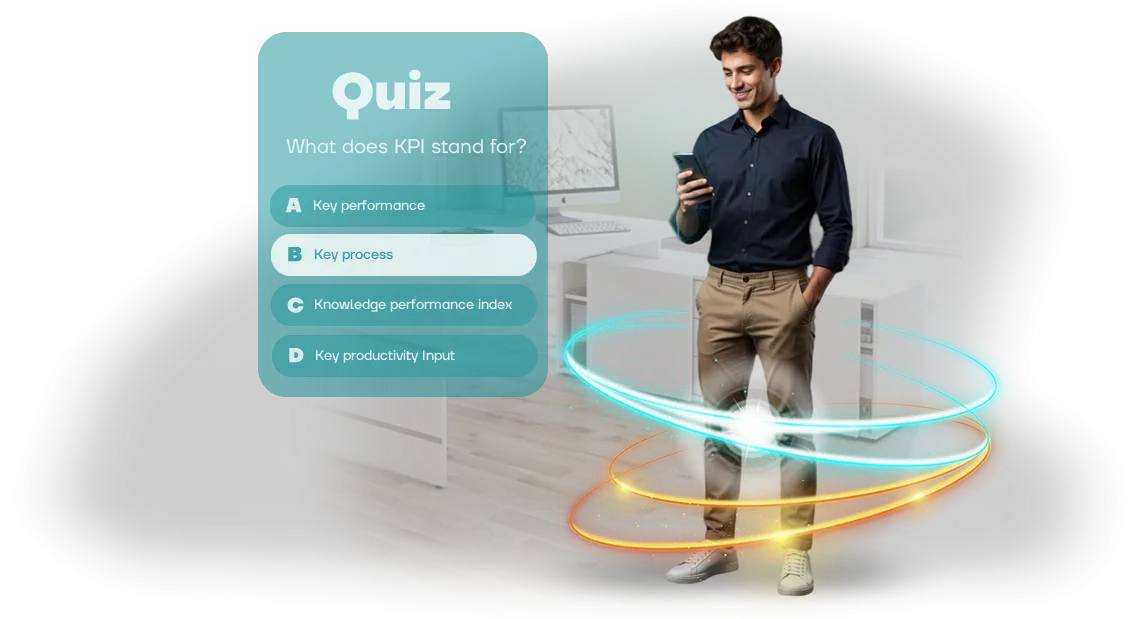
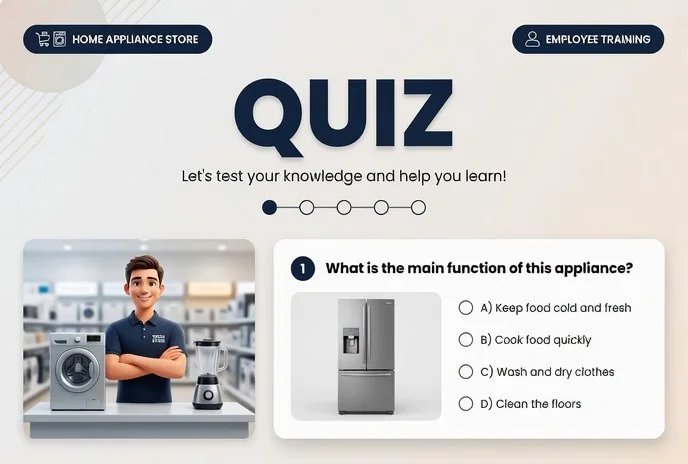
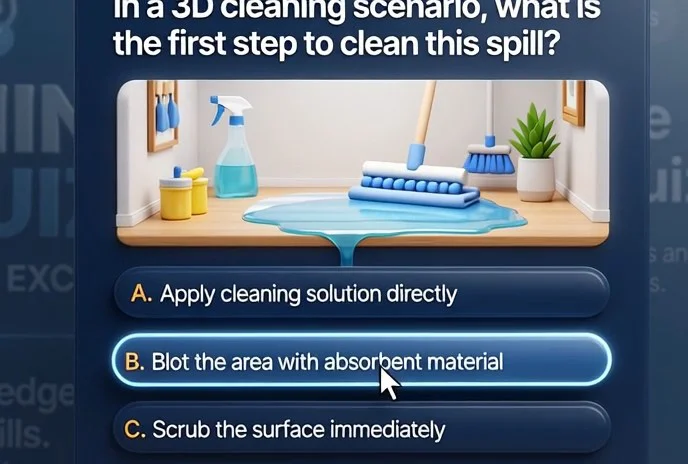
Quizzes change the very principle of training: instead of passive listening, the employee finds themselves in a situation of choice.
They answer questions, see the consequences of their decisions, and immediately receive feedback — this way the material is remembered reliably and transformed into a real skill.
Short scenarios with answer options and error analysis allow complex situations to be practiced in a safe environment, without risk to customers and processes.
The employee learns from their mistakes, and the supervisor sees an objective picture: who has truly absorbed the material and who needs additional attention. This is not another lecture, but a workout of thinking and actions — exactly what reduces the number of staff errors.
The interactive format holds attention and increases engagement even in topics that previously seemed boring. The competitive element and the desire to show a good result turn mandatory staff training into useful and memorable practice.
As a result, the business gets employee training that actually changes behavior, reduces costs from errors, and strengthens the company's reputation.
What implementing quizzes in police training provides
Personnel engagement
Standard lectures and paper tests are often perceived as a formality. Quizzes with a plot and dialogues immerse employees in work situations, so interest in learning grows noticeably. Training turns from an obligatory duty into conscious practice.
Memorization through practice
When knowledge is tested in the form of interactive scenarios, the brain works more actively than when simply reading instructions. The material is absorbed deeper and stays in memory for a long time. For actions in emergency situations, where seconds count, this is critical.
Knowledge control without extra paperwork
Management gets an objective picture: who has mastered the topic and who needs additional training. Results are visible for each employee and for the whole group as a whole. This allows the training program to be adjusted in time and weak points to be strengthened.
Unified training standard
Everyone goes through the same scenarios, so inconsistencies in the interpretation of rules and procedures are eliminated. Quizzes are easily updated when regulations change — new requirements instantly reach everyone. Training management becomes transparent and predictable.
Quiz formats: choose according to your task
The choice of format is the choice of learning depth. A simple test will check knowledge, and a 3D simulator will immerse the employee in an environment as close to reality as possible. We select a format for your task: from a quick survey to a full-fledged simulator.
The format determines not only the impression, but also the result: what skills the employee will consolidate and how quickly they will begin to apply them at work. Therefore, in the table we have collected typical scenarios — you can compare them with your situation.
| Format | For whom | What it gives the client |
|---|---|---|
| Classic test | For quick knowledge checks after a lecture or instruction | Saves time, gaps are immediately visible, assessment is set automatically |
| Interactive quiz | For engaging employees in learning | Increases interest, creates a competitive moment, holds attention |
| Scenario quiz | For practicing typical situations | Teaches to act according to an algorithm, reduces the number of mistakes in real work |
| 3D simulator | For practicing complex skills and emergency situations | Full immersion, risk-free training, staff confidence |
We will help you determine which format is right for you and, if necessary, combine them into one program: first a test, then a scenario, then a 3D simulator. This way training becomes a system, not a one-time event.
We work on professional equipment and proven tools — therefore even a complex 3D simulator works stably and is easily updated. You get a result that employees actually apply in practice.
How we create a quiz: the path from brief to launch
Developing a training quiz is not a “black box” but a sequential project with clear stages. We agree on each step in advance so that you can see how the work is moving and influence the outcome. Below is a typical path from brief to training launch, through which most of our projects go.
- Brief and immersion — we collect tasks, target audience, and real work scenarios. We determine what knowledge and skills the quiz should test, and what gaps it should close.
- Plan and development stages — we fix deadlines, work order, and areas of responsibility. You receive a calendar plan with clear checkpoints to understand what and when will be ready.
- Scenario and questions — we design the quiz structure, question wording, and answer options taking into account the specifics of your training. We agree on materials before programming begins, so we don’t have to redo them later.
- Prototype on real examples — we show a visual sample of the interface and logic on 2–3 questions. At this stage, you see how an employee will go through the quiz and can adjust details before full development.
- Full version assembly — we add all questions, dialogue elements, feedback, and explanations. The quiz becomes ready to use; only its verification remains.
- Testing and approval — we run all scenarios: correct answers, errors, hints, final results. We make edits and receive your final confirmation.
- Training launch — we hand over the quiz, connect access and instructions, and if necessary show how to track completions. After launch, we stay in touch and help with refinements.
This work order makes the process transparent: you always know at what stage the project is and can influence the result. The quiz is created for your task, not according to a template — so it really helps in staff training.
What is included in the delivery: a complete set for your training
After the project is completed, you receive not just a program, but a ready-made training tool that can be immediately used in staff training. We transfer everything necessary for launching, administering, and developing the quiz — without “tails” or hidden dependencies.
- A ready-made quiz with 3D scenes and dialogue situations, adapted to your regulations. Employees go through scenarios at their workplaces or in a training classroom.
- An administrative panel for independent content management: change questions, add scenarios, set passing thresholds without the involvement of programmers.
- A complete set of documentation: administrator guide, user manual, methodological recommendations for including the quiz in the training program.
- Training materials for your team: video instructions and presentations that will help quickly prepare trainers and employees.
- Source files of the project and usage rights. You become the full owner of the solution and can refine it with any contractor.
- Training for your specialists: practical sessions for administrators and methodologists so that they confidently work with the system.
- Warranty period and technical support: during the agreed period, we help with updates, questions, and troubleshooting.
Case study: how we doubled police training results
For the training center of a regional directorate, we developed a simulator for practicing employees’ actions in emergency situations. Previously, theory was studied from manuals, and knowledge testing took hours and gave subjective assessments.
We replaced traditional tests with a dialogue-based 3D simulator, where the employee acts in an environment close to reality.
What we did
Together with the customer, we analyzed typical scenarios — from communicating with an offender to acting in a conflict situation. Based on them, our team built interactive scenarios where each answer affects the course of events.
The employee does not guess an option from a list, but makes decisions and sees the consequences of their actions.
The simulator runs on ordinary computers in the training classroom, so the customer did not have to buy expensive equipment. The instructor receives a report for each participant: what decisions were made, where the errors are, and which skills should be improved.
Results after two months
First-time pass rates grew from 46% to 92% — police training results doubled. Checking one person takes 15 minutes instead of 40, so groups complete training three times faster.
Managers noted: employees act more confidently in training scenarios and react more quickly to changes in the situation.
We received a repeat order to expand the scenarios — the simulator proved itself as a working tool, not a bright toy. Do you want the same results in your team? We will tell you where to start and select a format for your task.
How to choose a quiz format for the specifics of your employees?
Choosing a quiz format always starts with the audience, not technical capabilities. For some employees, a compact test after instruction is enough; for others, a complex scenario with alternative consequences.
In police training, practicing decisions under conditions of time and information scarcity is especially important: that is why dialogue-based 3D formats work well here, rather than classic “question-answer.”
The specifics of employees are determined not only by job responsibilities, but also by the level of initial training, typical work situations, and the decision-making model.
A cadet and an active officer absorb material differently: the former needs a visual foundation, the latter — reflection on real cases.
If there is an age spread in the team, it is worth flexibly combining mechanics — from simple questions with explanations to branching plots with different outcomes.
We help select a format before development begins: we analyze how exactly employees encounter errors, which consequences are critical, and what learning pace is convenient.
Based on this, we determine the length of the quiz, the level of difficulty, the need for hints, and the degree of immersion. It is important that training does not turn into entertainment, but trains a skill that transfers to work.
For police training tasks, a simulator with role-playing scenarios and feedback after each choice is often optimal.
It gives the employee the opportunity to safely experience a difficult situation, see alternative options, and remember correct actions through experience, not rote text. This format is easily scalable: you can change scenarios to meet new regulations or operational environments.
As a result, the choice of format is a compromise between coverage, employee time, and the final skill. Based on the specifics of your people and their tasks, we select an option that gives a measurable result without overloading the team.
Frequent doubts: what if the quiz does not fit or does not work
The first doubt is that the quiz will not fit into your training programs. We build scenarios from your regulations and real service situations: difficulty levels and presentation are adjusted for a specific department. This is not a “boxed product,” but a constructor for your tasks.
The second is that something will go wrong on launch day. We conduct testing on your equipment, keep a specialist in touch on the start day, and prepare a backup option. The training process will not stop even in case of force majeure.
We answer frequently asked questions.
What if the quiz does not fit our training programs?
We start with a brief and analysis of your materials: statutes, regulations, typical errors. We assemble scenarios according to your tasks. If a trial run shows discrepancies, we change scenarios and interface without remaking the system.
What guarantees that everything will work on launch day?
We do a test run on your computers and on your network. On the start day, we connect technical support and keep a “Plan B” — a backup version of the quiz. You are not left alone with the problem.
What if employees take the quiz negatively?
We make the interface intuitive, add ratings and progress. Before launch, we conduct a trial run with one group — you see the reaction and adjust the presentation.
What if we need to change questions after launch?
Content is separated from the program, so you edit questions yourself without developers. We will train an administrator in an hour. Major changes — according to the regulations and within agreed timelines.
Order quiz development and receive a ready-made training system
Quiz development is not just a set of questions with answer options.
It is a ready-made training system that integrates into your professional training program: it helps practice action algorithms, check knowledge of instructions, and increase employees’ confidence before a real situation.
Where do we start? After a request for quiz development, we will:
- Conduct a short briefing and analyze situations important specifically for your employees.
- Prepare a scenario taking into account regulations and typical errors in work.
- Show how the interface and interaction with the system will look — you can make edits before launch.
- Hand over a ready-made tool with instructions for setup and operation.
- Train administrators to work with results and update questions.
- Stay in touch after delivery — we will supplement the quiz when regulatory documents change.
This is the next step: you order not “quiz development,” but a solution to the training task without the constant involvement of the IT department. We take on the technical part; you control the content and its development.
Leave a request on the website — we will contact you soon, clarify the tasks, and offer a plan with exact deadlines and format. Development will begin after the scenario is agreed, so you retain full control over the process and receive a system that works for your goals.