

Customers Are Leaving to Competitors: SaaS Sales Are Stalling
SaaS sales are stalling not because of a weak product, but because managers don't know how to communicate its value. Customers leave to competitors because those competitors speak to them in a language they understand.
Deals get stuck at the demo stage: the customer lacks the arguments needed to justify the budget within their own company.
Standard training materials—presentations and PDF guides—don't engage employees. They retain little, get lost in live conversations, and avoid questions about price and benefits.
According to CSO Insights, up to 70% of buyers choose the one who was first to explain the benefit of their solution.
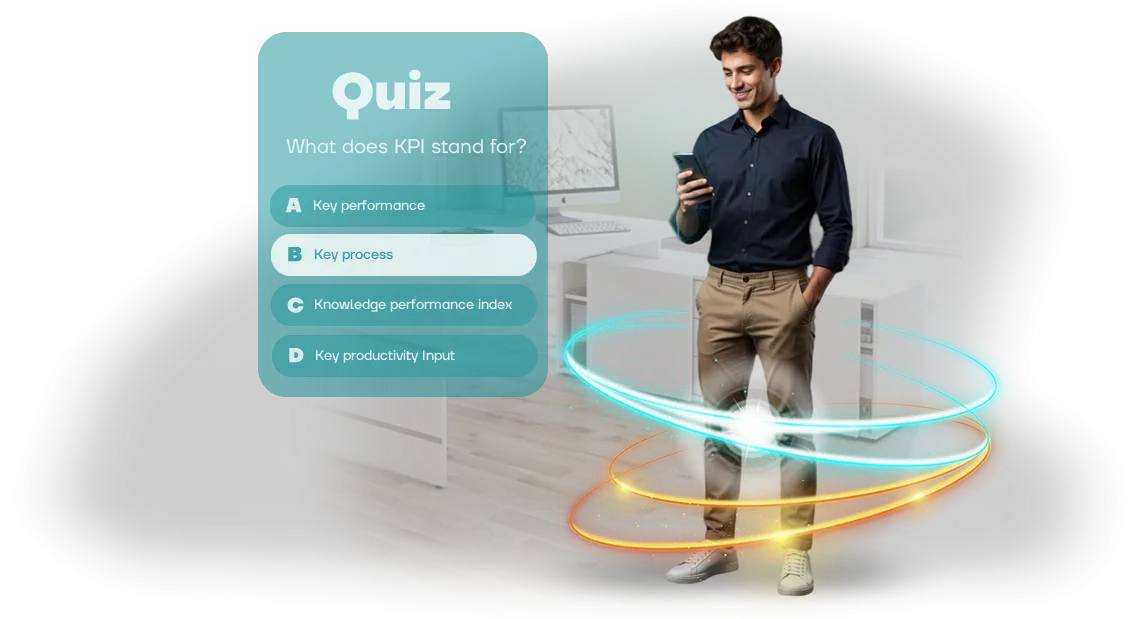
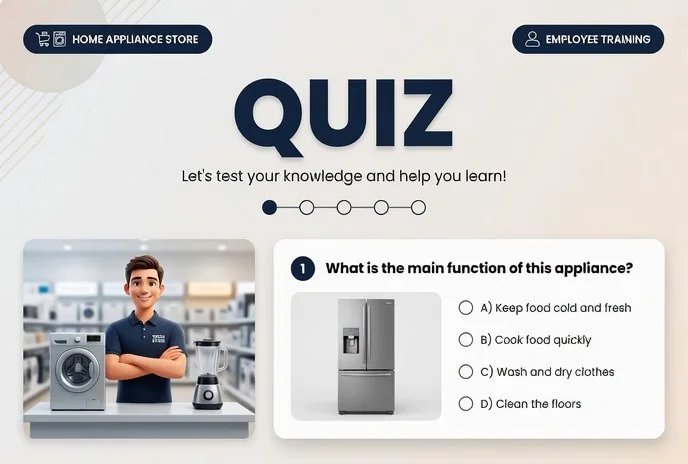
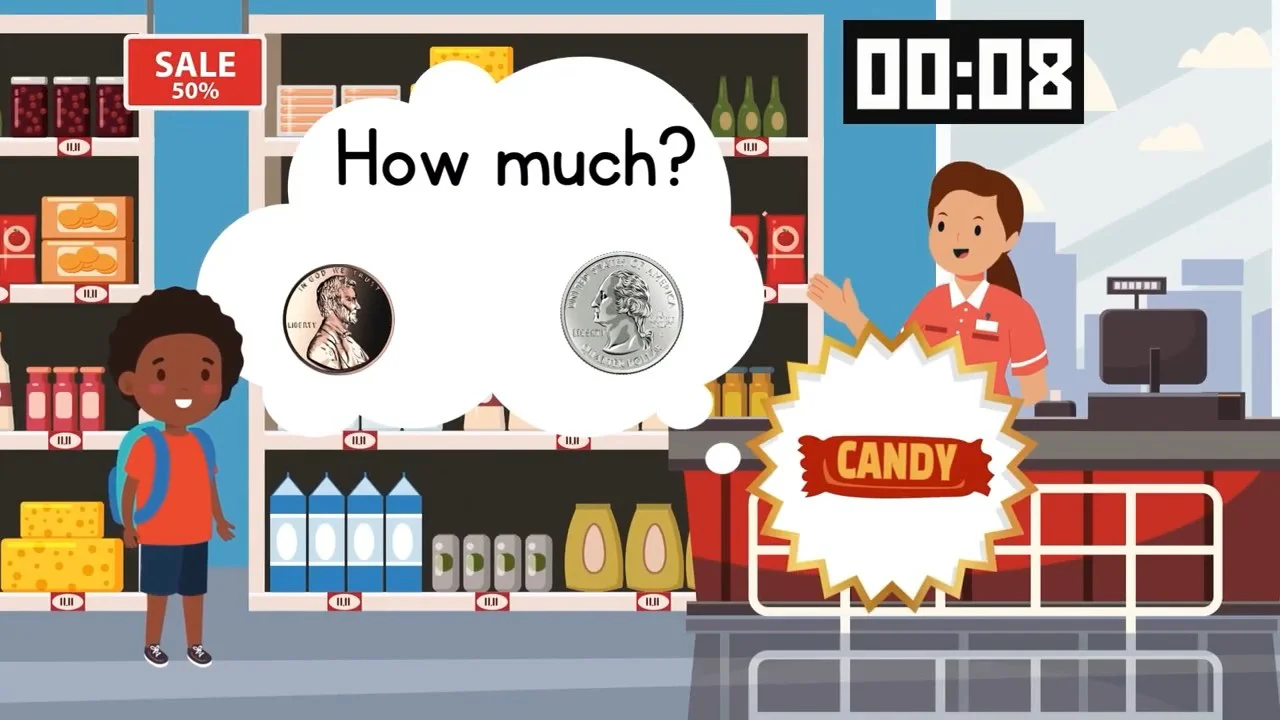
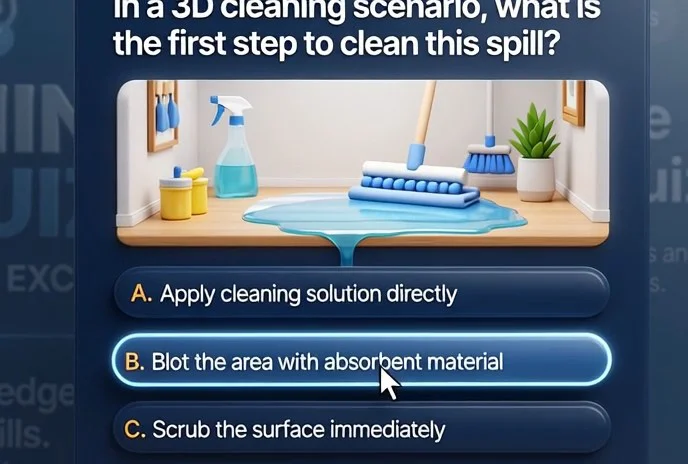
That's where training quizzes come in. They turn tedious memorization into an interactive scenario with live dialogues and objection-handling practice. Employees train in a safe environment and learn to speak the language of customer benefit—which leads to higher conversion.
Quizzes increase employee engagement so much that employees themselves ask for more. And we handle the development of a 3D dialogue quiz simulator on Unity—a technology-driven solution that makes learning as compelling as a good series.
As a result, managers leave the conversation with several confirmed next steps instead of a "we'll think about it." That's the bridge that closes the gap between acquisition costs and actual revenue.
What Changes in Business After Implementing a Quiz: 5 Results
Implementing a training quiz changes not just the learning process but the entire commercial machinery of the company. Five measurable results will help you see the effect even before the official launch—from increased engagement to the number of booked meetings.
Employee engagement. People remember what they participate in. A quiz turns learning into a game: employees find answers themselves, compete on the leaderboard, and return to scenarios multiple times.
This directly affects loyalty: the team atmosphere becomes livelier, and people don't want to leave such a company.
Product knowledge retention. A short test after each module reinforces knowledge of your SaaS solution.
Instead of reading documents, the employee experiences real customer situations—so in a conversation with a buyer, they confidently use use-case scenarios rather than memorized terms.
Sales growth through objection handling. The dialogue simulator reproduces typical conversations: the client hesitates, compares against competitors, asks for a discount.
The employee rehearses responses in a safe environment, and in a real meeting their answers sound natural and well-reasoned—hence the increase in booked meetings.
Clear analytics for managers. You see which questions cause difficulties for most employees and adjust the training program in time. Quiz results can be easily tied to sales metrics—for example, to the number of booked meetings after completing the course.
Fast launch and support. We take on all development on the professional Unity engine, and you get a ready-made tool embedded in onboarding and ongoing training. No launch delays—just an intuitive interface for employees and management through a simple panel.
Quiz Formats for Your Task: From Test to Quest
The same material can be presented in different ways: an express test checks product knowledge, a dialogue simulator practices live communication with a client, and a quest with choices immerses the participant in a real sales situation. Each format solves its own business task—from a quick assessment to deep skills training.
We select the format for your goal in advance, at the briefing stage. Below is a cheat sheet to help you choose a quiz for SaaS sales training.
Main Quiz Formats
| Format | For whom | What it gives the client |
|---|---|---|
| Express test | New employees, initial assessment | Quick knowledge check in 5–7 minutes, gaps immediately visible |
| Dialogue simulator | Sales managers, working with objections | Real dialogue practice without risking the deal, building muscle memory |
| 3D quiz quest | The whole team, corporate training | Engagement through a scenario with branching choices—employees find solutions themselves |
| Hybrid (test + simulator) | Department with mixed skill levels | Each person gets their own difficulty level and specific recommendations |
A test is convenient for regular monitoring, a simulator for practicing complex stages of a deal, and a 3D quest is remembered as a vivid event.
If you're not sure which format will deliver the best ROI for your team, send us a description of the task—we'll advise you within one day.
How the Project Works: 6 Steps from Brief to Launch
We've structured the process so you can see results at every stage. You make the decisions, and we handle the technical part. No magic—just six clear steps from brief to launch.
- Brief and goals. A conversation with you: which knowledge and skills need to be reinforced, and who the audience is. We record the success criteria—for example, the completion rate or growth in correct answers.
- Scenario approval. We prepare a scenario: questions, answer choices, explanations. You make edits before development starts—that's a guarantee that the training fits your reality.
- Prototype and design. We show how the quiz will look on screen. You approve the style and logic, and then we build the final version.
- Development and build. We implement the quiz on a professional platform. You receive test builds without needing to get into the technology.
- Testing and launch. We test on different devices, and you conduct acceptance testing. Then we publish the quiz to your portal or send a link to employees.
- Support and analysis. We stay in touch, make adjustments, and help analyze results. We add new questions if needed.
As a result, you get a working turnkey quiz rather than a technical specification. The entire process takes from two weeks—the exact timeline depends on the scope of the scenario and the number of questions.
What's Included in the Delivery: A Complete Kit for Your Team
Implementing a quiz in SaaS sales isn't just a fun test. We hand over a complete training system that fits into your ongoing team operations and delivers immediate results.
The package includes everything you need to launch and monitor, without involving developers or additional content budgets.
- Ready-made quiz scenarios for SaaS sellers: from product introduction to handling objections about annual agreements. Employees train on real situations, not abstract questions.
- Training content in short modules: benefits, pricing plans, typical customer scenarios. Material is absorbed faster than multi-page instructions and is remembered as a game.
- Customization for your product and deal cycle: the quiz uses your real cases, so after completion managers immediately apply their knowledge in negotiations.
- Integration into corporate training: we connect the quiz to your processes—from onboarding new hires to scheduled sales team assessments.
- Instructions for administrators and HR: how to launch the quiz, change questions, and view results. Your team starts working on the day of delivery.
- Reports for each employee and the whole team: see progress, common mistakes, and readiness for client communication. You manage results rather than guessing who understood what.
You receive a package that doesn't gather dust on the shelf. Scenarios, content, integration, and support are already prepared—all that's left is to launch the quiz and see how your team sells your SaaS services more confidently.
Case Study: How a Dialogue Quiz Boosted Deal Conversion
One of our clients—a SaaS document management platform—ran into a problem typical of subscription services: managers knew the product well but lost deals at the objection stage. Questions about data security, integrations, and price left them stumped. Negotiations dragged on, and some leads simply went cold before ever reaching a presentation.
Instead of another lecture, we proposed a dialogue quiz that sells the learning process itself. The manager conducts a dialogue with a virtual client: the client hesitates, interrupts, returns to pain points, and reacts to every word.
After the session—error analysis, ready-made phrasing, and a new round until a confident result is achieved.
What Changed After a Month
Deal conversion grew from 31% to 54%—and this wasn't a one-off stroke of luck but a sustainable result after three weeks of practice.
Objection handling time dropped from fifteen minutes to five: managers stopped fumbling for answers and calmly resolved even the clients' most sensitive issues.
But the main effect was systemic. New employees began reaching normal performance levels twice as fast, and the department head saw a transparent picture for the first time: who on the team is ready for tough negotiations and who needs additional training.
The quiz became a living tool rather than a one-off initiative: the client regularly updates scenarios for new pricing plans and product features, and has already returned with a third request to expand the simulator.
How to Choose the Right Quiz Format for Sales
Choosing a quiz format for SaaS sales means deciding how quickly the client will understand the value of a complex product.
If the service is hard to explain in words, a classic knowledge test won't help: the buyer won't see how the solution works in their situation and will turn to competitors.
For a complex product, the main guide isn't a "popular format" but a scenario that models the client's real task.
A dialogue quiz lets the client walk the path from problem to purchase hands-on: they choose options, see the consequences of their decisions, and come to the conclusion themselves that your SaaS meets their need.
This format works well when the product has multiple use cases or when different roles take part in the purchasing decision.
For simple products with a single decision-maker, a short survey with a result breakdown is enough. When a group makes the decision, it's better to choose a format that shows the benefits for each participant.
That's why we first look at your funnel: where clients get stuck, and which objections you hear most often. This determines which format will produce the maximum effect.
We help you choose the option that fits your audience and quickly embed it into your existing sales process—without lengthy approval chains or needless back-and-forth. In one day, we prepare the scenario, prototype, and launch plan.
With this approach, the quiz becomes not entertainment but a sales tool: the client comes to the manager already understanding the product and with a clear request. All that remains is to discuss implementation rather than explain why your service is needed by the company.
Answers to Frequently Asked Questions About Quiz Development
Clients who sell SaaS services most often ask the same things: how long it will take to launch a quiz, how it will fit into current sales, and what will happen if something goes wrong.
These are the right questions—the answers determine whether you get a working tool or just a nice-looking page.
We've structured the process so the quiz generates leads within the first month. Below are answers to the main objections.
How long does it take to implement the quiz?
A typical project takes two to four weeks: from the brief to the moment when the link can be sent to your first clients. The timeline depends on the number of questions and whether integration with your CRM or email marketing service is needed. At the start, we lock in the scope and launch date—from there on, we work without surprises.
Will the quiz fit into our current sales processes?
Yes. A quiz is a standalone page or an embeddable block that connects to your funnel. We adapt the logic to your scenario: contact capture, lead qualification, and automatic recommendations. Setup is done together with your manager—there's no need to rebuild the department from scratch.
What happens if the quiz doesn't work or breaks?
After launch, we provide a performance guarantee and remain on support: we fix bugs promptly, help update questions, and monitor stability under increasing load. If anything goes wrong during the warranty period, we fix it at our own expense and as quickly as possible.
Will we be able to change questions without a developer?
Yes, there's a user-friendly admin panel for that. A marketer or sales manager can independently update texts, answer options, and display settings. A developer is only needed during the creation stage—after that, your team controls the quiz.
Take the First Step: Get a Quiz Implementation Plan
Training quizzes are rarely implemented successfully on the first try without a prepared scenario. Employees need to understand the mechanics, managers need to see coverage and progress, and the system itself needs to integrate into current processes.
That's why after a development request, we prepare a personalized implementation plan for you: specific steps, timelines, and areas of responsibility.
Fill out the form on the website—within one business day, you'll receive a document you can immediately discuss with your team and add to the training plan. It's free and comes with no obligation.
What the quiz plan includes:
- Goals and metrics: which sales and knowledge-level indicators you'll track.
- Scenarios and formats: how the quiz is structured and why employees will take it with interest.
- Development stages: from selecting questions to a test run with your team.
- Integration with training: how the quiz fits into new-hire onboarding, courses, and regular knowledge checks.
- Team resources: who we need from your side at each stage and how much of the work we take on.
- Timeline estimate: how long development and launch will take given your internal processes.
If you still have questions, book a consultation—we'll discuss the details, show examples, and advise which format will speed up results. Submit your request today—and in a day, you'll know how to turn training into a sales growth tool for your SaaS team.