

Accidents and fines: the weak spot of industrial safety
Every day without incidents is not only about employee health, but also about the company's bottom line. An accident at a production facility stops the workshop, disrupts supplies, and triggers inspections and fines.
Most incidents happen not because of complex equipment, but because of the human factor: an employee knows the instructions formally, but in a stressful situation acts incorrectly.
Traditional safety briefing is reading the regulations and signing the logbook. It does not test how a person will behave in a real environment, and it does not reinforce the skill.
Within a week, the information is forgotten, the risks remain, and the next inspection may reveal the same violations. As a result, training becomes a formality that protects neither people nor the business.
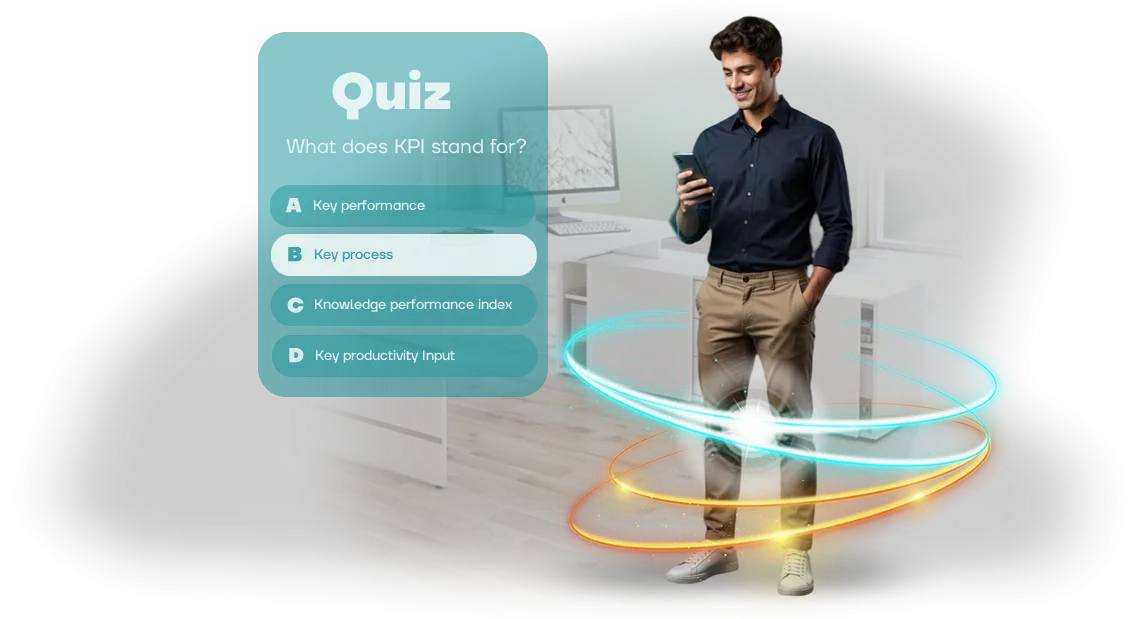
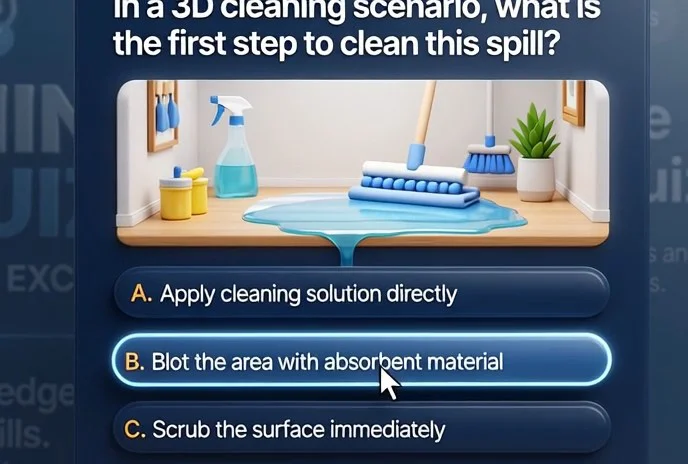
We solve this problem with training quizzes built on scenarios from real production situations. An employee does not just read the rules—they make decisions, see the consequences of their actions in a safe environment, and internalize the procedure to the point of automaticity.
This approach reduces the number of violations and accidents because it changes behavior, not just knowledge.
Quizzes can be embedded into regular training: before a shift, during onboarding, or after an incident. A manager sees who has absorbed the material and who is at risk of making a mistake—and can provide additional coaching in time. This turns occupational safety from paper reporting into a managed process of personnel protection.
The result is fewer injuries, less downtime, and fewer fines from supervisory authorities. You get a clear training system that genuinely reduces risks and pays for itself even after a single prevented incident.
Five benefits of implementing training quizzes
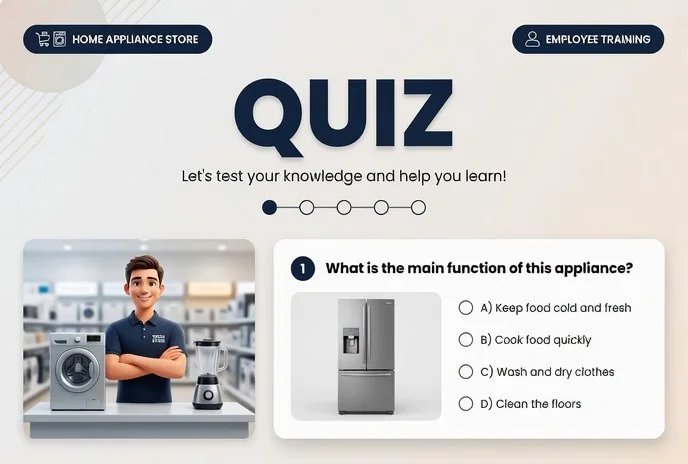
Training quizzes turn a standard safety instruction into a lively format. Instead of passive reading, employees compete, test themselves, and reinforce the rules through game mechanics—which directly affects discipline and risk reduction. Below are five key benefits for your production facility.
The approach is based on a combination of gamification and clear scenarios that have already proven effective in real projects. For example, we at our team use this tool for companies where fast staff adaptation and knowledge control without interrupting work are important.
Increased engagement in training
Employees perceive the quiz as a game, not as another mandatory lecture. This increases interest in the material and reduces resistance. People willingly answer questions, discuss results, and engage their colleagues—training stops being a formality.
Better retention of safety rules
The competitive element and instant feedback help absorb information several times faster than with a standard briefing. Mistakes are analyzed immediately, and correct answers are reinforced—knowledge stays in memory for a long time and is applied in practice.
Fewer violations and incidents
When rules are practiced in an interactive format, employees begin to notice dangerous situations in advance and act according to the procedure. Regular quizzes build a habit of following safety rules, which directly reduces the number of violations and accidents.
Saving time and resources
Automated knowledge checks take minutes, not hours. Managers get ready-made results without manually checking tests, and employees do not have to step away from work for long lectures. Retraining becomes fast and targeted.
Measurable effectiveness for the manager
You see in numbers which employees truly absorbed the material and who needs additional work. This allows you to adjust the training program in time and reduce risks associated with the human factor. The result—peace of mind regarding production safety.
Quiz formats for industrial safety
Training formats differ not in visuals, but in the depth of assessment. A simple test records that the employee has read the instructions. A dialogue quiz shows how they reason in an emergency situation. And a 3D simulator lets them work hands-on—without risk to health or equipment.
Below is a comparison of the formats we use. Focus on your goals: scale, operational complexity, or the strictness of supervisory requirements.
| Format | For whom | What it gives the client |
|---|---|---|
| Text-based test | For the entire shift after the briefing | Quick knowledge snapshot, automatic statistics by department, time savings on checking |
| Dialogue quiz | For operators and maintenance personnel | Practicing procedures in emergency situations, developing quick decision-making, visible error logic |
| 3D simulator on Unity | For work at hazardous facilities | Practice without real risk, high engagement, lasting skill to the point of automaticity |
| Combined format | For a full training cycle | First a test, then a quiz, then a simulator—and you see the real level of each employee |
We select the format based on your specifics and budget. If needed, we combine: a test for everyone, a quiz for key roles, and a 3D simulator for the riskiest operations. All results are compiled into unified reporting—you will not have to merge data manually.
How does the quiz development process work?
The quiz development process for industrial safety is structured so that you control the result at every step and understand what is happening with the project. We take care of everything: from the initial brief to launch and support. Below is a typical workflow that accelerates implementation and eliminates surprises at the finish.
- Brief and task immersion. We start with a short meeting or questionnaire: what skills need to be checked, who the target audience is, what formats are convenient for your employees. The output is an understanding of the scope, timeline, and expected result.
- Quiz scenario design. Together with you, we define the question structure, difficulty levels, and feedback moments. Here we build in the pedagogical effect: a mistake is not just recorded—it turns into a hint for memorization.
- Content and rules approval. You receive a draft scenario and question bank for review. We make edits until the text is accurate for your industry and does not cause ambiguous interpretations among employees.
- Quiz development and assembly. We use a professional development environment that ensures stable operation on work computers and tablets. Graphics, sound, and gamification elements are added at this stage—everything that holds attention.
- Pilot group testing. We test the quiz on real users within your team or on a small group of employees. We collect metrics: completion time, percentage of correct answers, and points where participants get stuck. Based on the results, we adjust the scenario.
- Launch and integration. We deploy the quiz on your internal portal or training platform. We configure access, result delivery, and reports by department—you see who has completed it and where knowledge gaps exist.
- Support and content updates. After launch, we stay in touch: we fix technical issues, update questions when regulations change, and help with re-runs for new employees or scheduled knowledge checks.
The entire process takes on average 2–4 weeks, depending on content volume and quiz format. You get a ready-to-use tool that works immediately, plus post-launch support to keep the quiz relevant.
What is included in the delivery package
You receive not just a working quiz, but a complete package that your team can use independently. All materials are transferred to company ownership—without hidden fees or contractor lock-in.
- A ready-made quiz configured for your industry and corporate standards. The program has been tested on real employees, so there will be no issues at launch.
- Source materials: question structure, scoring logic, and settings. If needed, you can make changes with your own specialists or order enhancements from us.
- Administrator documentation. It describes step by step how to launch, update, and support the system—basic knowledge is sufficient.
- Methodological guidelines for managers and HR professionals. They explain how to integrate the quiz into the training plan and use the results to reduce violations.
- A training webinar for your team. We will show hands-on how to work with reports and update content so you do not waste time figuring it out.
- Certificate and diploma templates. After successful completion, employees automatically receive confirmation—this boosts engagement.
- A first-launch report. You will see completion numbers, the most challenging questions, and recommendations for improving the material.
This package saves your time and money: you will not need to find new contractors for every change. All updates and scaling to new departments can be done without additional investment—or quickly ordered from us since we already know your setup.
Case study: reducing injuries with a quiz
our team developed a 3D quiz on Unity for industrial safety at an enterprise where most injuries occurred due to the human factor.
Safety briefings were held regularly, but employees let the rules go in one ear and out the other—formal surveys did not create the needed engagement.
We proposed a different approach: instead of a flashcard test, the employee enters a virtual workshop where they must notice colleagues' violations, choose a safe scenario, and respond to an emergency situation.
Each mistake is accompanied by a visual consequence, so correct behavior is remembered through emotion and personal experience, not rote memorization.
Result after three months
The number of recorded violations dropped by almost 40%, and micro-injuries by 2.5 times. Employees themselves asked for additional rounds, and workshop managers used participants' scores to assess team readiness without extra checks.
Engagement also proved high: completing the quiz was voluntary, yet more than 80% of employees finished it during the first week. One scenario takes 10–15 minutes, so training did not pull people away from work and did not require gathering groups in a classroom.
An effect that keeps working
Six months later, the enterprise ordered quizzes for two other workshops and included the scenarios in the new-hire onboarding program.
The repeat order was our main confirmation: game-based training delivers measurable business results—fewer violations, lower injury rates, and a stronger safety culture across the team.
How to choose a quiz format for your task?
Choosing a quiz format is not a technical question—it is about what task you are solving. If you need to quickly check knowledge of industrial safety instructions, a classic test with questions and answer options is enough.
If you need to practice behavior in an emergency situation so the employee acts on autopilot, you need a scenario as close to reality as possible.
A dialogue 3D simulator on Unity is exactly what allows you to immerse an employee in a workshop or industrial site environment and have them make decisions in near-real conditions.
This format suits hazardous industries where the cost of a mistake is an injury, an accident, or equipment downtime. Game mechanics hold attention and improve material retention: the employee does not just read text—they experience the situation.
Different formats work for different audiences. Newcomers need visual clarity and hints; experienced employees need speed and more complex scenarios. If the team has many older specialists, we choose a simple interface, large text, and clear instructions. Younger employees engage more easily with competitive elements, rankings, and answer time limits.
We select the format based on your goals, audience, and timeline and budget requirements.
At the start, we conduct a short brief, clarify the scenario, difficulty level, and technical constraints—and propose a solution that will actually change employee behavior, not just formally satisfy an audit.
In the end, you get a tool that works for safety and risk reduction, not just another checkbox in a report.
Frequently asked questions about quiz development
Before ordering a quiz, clients most often want to understand: how much does it cost, when will it be ready, how will it connect to current training, and who is responsible for the result. We answer honestly—without technical details or hidden conditions.
How much does quiz development cost?
The cost depends on the number of questions, task formats, and whether integration with your distance learning system is needed. We prepare an estimate for your task and lock it in before the start—there will be no cost surprises.
What are the quiz development timelines?
We build a basic quiz with 30–50 questions in 2–3 weeks. If you need a more complex system with difficulty levels and error analysis, we plan from a month. We fix the exact schedule in the brief and stick to it.
How does the quiz integrate into current training?
It is a separate module that connects to your distance learning platform or works as a standalone trainer. Employees access it through the corporate portal without separate registrations or unnecessary navigation.
What questions should be included in the quiz?
We gather material together with your specialists: current regulations, frequent mistakes, and real situations from production.
Questions are presented in an interactive dialogue format—the employee enters a work situation and makes a decision, rather than simply choosing an answer option.
What guarantees exist that the quiz will work?
We are responsible for all agreed functions: we test them on real scenarios and provide technical support after launch. If something does not work as expected, we refine it at our own expense within the agreed specification.
Order a quiz for your company
Leave a request—and we will calculate the quiz cost for your task. We will explain how to integrate it into your industrial safety training program and offer a solution that employees will complete with interest.
You will get a ready-to-use tool that addresses specific business goals: reducing injuries, checking knowledge without interrupting production, and clear statistics for the manager.
The quiz works as part of the training system, not as one-time entertainment—employees remember the rules through real situations.
What is included in the order:
- audit of your current training program and risk areas at your production facility;
- a quiz scenario tailored to your regulations and typical violations;
- customization to match your corporate style and internal standards;
- administrator training and a launch guide;
- technical support and question updates after regulatory changes;
- a results report for the HR department and line managers.
To get started, simply fill out the request form on the website. We will contact you within one business day, clarify the details, and prepare a quote for your volumes and timeline.
The consultation is non-binding—you will get a clear understanding of how the quiz will fit into your training and what is needed to start. The decision will then be yours.