

Developing Leadership Skills: What Business Loses Without Training
When employees with strong professional knowledge lack leadership qualities, business pays for it every day. Decisions are made slowly: there is no clear vision, priorities blur, and responsibility is shifted.
Teams work without engagement, initiative peters out, and the best ideas remain unrealized. All of this directly hits efficiency and profitability.
Personnel risks only add fuel to the fire. Promising specialists who see no room for growth leave for competitors. Management positions have to be filled with external candidates—again spending time and money on onboarding. If there is no internal talent pool, the company becomes a hostage of the labor market.
Leadership training could close these risks, but classic lectures and generic workshops do not deliver lasting results: knowledge stays theoretical, and in practice a manager follows the old pattern.
This is especially painful at the middle-management level—those who should translate strategy into action often lack the skills to manage people and processes. They miss deadlines, waste resources on rework, and clients feel the instability. This is exactly where the profit growth potential that most companies fail to exploit is hidden.
We see the solution in a practical approach: leadership skills should be developed not in a classroom, but in scenarios as close to real work as possible.
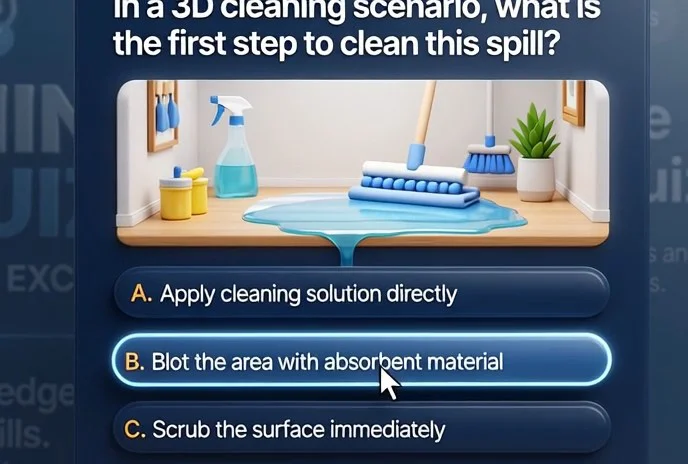
That is why we create dialogue-based training quizzes and simulators—an employee makes decisions, sees the consequences, and reinforces the right behavior patterns.
In this way, leadership training stops being a one-off event and becomes part of the company's operations, delivering measurable business results.
5 Benefits of Game-Based Quizzes for Team Growth
Game-based quizzes turn training from a mandatory formality into an exciting competition. Employees aren't just serving time—they truly engage in the process, and that changes the outcome.
We've identified five key advantages a team gains after switching to a game-based format.
-
Greater engagement. Employees take the quiz voluntarily and come back to it in their free time. The competitive spirit boosts activity even among those who usually stay silent in training sessions.
-
Faster knowledge absorption. The game-like format accelerates learning: in a short session, the team absorbs more than during a multi-hour lecture. New skills are immediately applied to work tasks.
-
Measurable progress. After each quiz, you can see who has absorbed the material and who is only going through the motions. A manager gets a clear picture of the department's skill level without lengthy tests.
-
Leadership development. Practical scenarios put an employee in front of real choices: how to lead a team, delegate tasks, or resolve a conflict. Mistakes are made without business risk—and become experience.
-
Extra motivation. Points, rankings, and prizes create healthy excitement. The team itself strives to improve results, and learning becomes a habit rather than an imposed duty.
Each of these benefits serves the main goal—sustainable team growth. Game-based quizzes deliver quick improvements that last.
Training Quiz Formats for Any Task
The same quiz formats do not work equally well for all tasks. The wider workforce needs quick knowledge checks, while managers need a tool that develops managerial flexibility.
Therefore, choosing a format starts not with design but with the goal: what should an employee do differently after completing the training.
Below is a table of popular formats with recommendations on when and for which task they are best suited. It is a benchmark we use to choose the right solution for your team.
| Quiz format | When to use | What it gives the client |
|---|---|---|
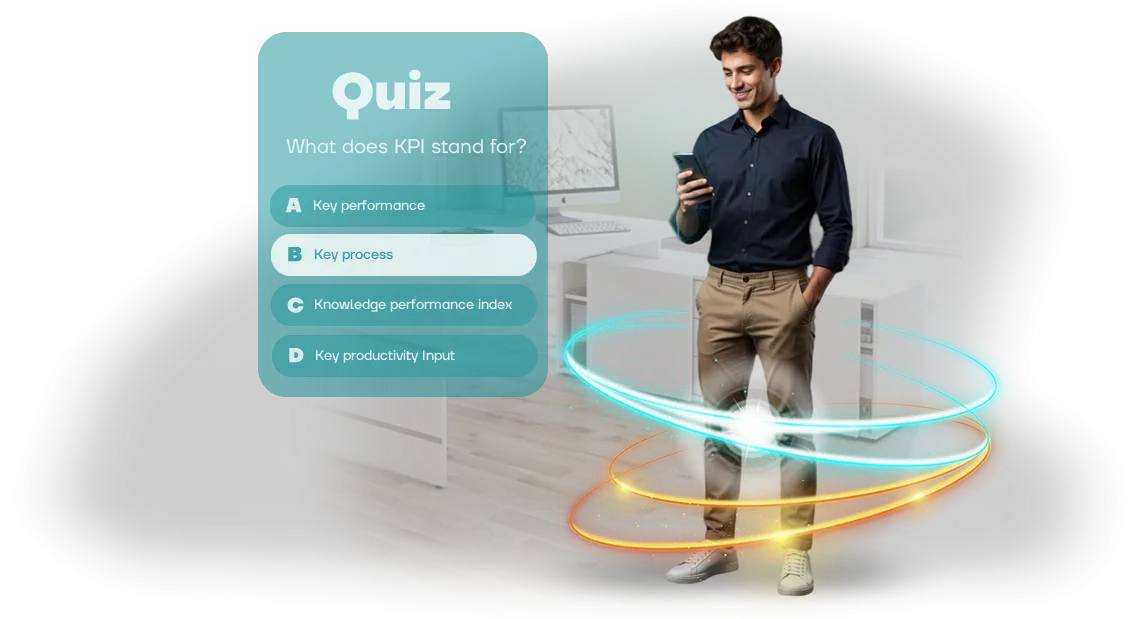
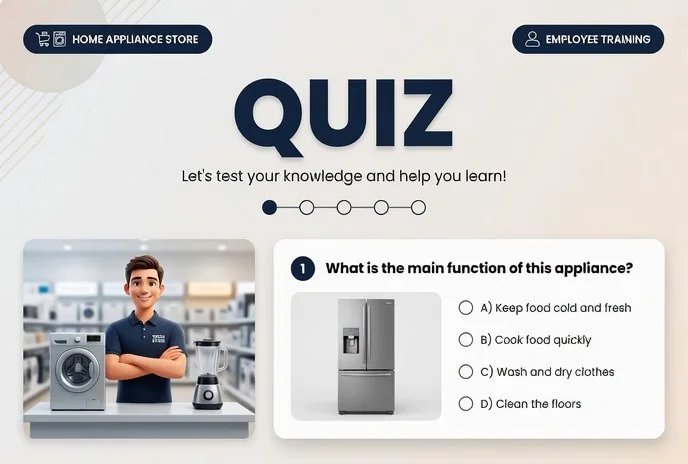
| Slide quiz with answer choices | Quick check of knowledge of regulations, safety, and product | Saves time on assessment: results are visible across the team immediately |
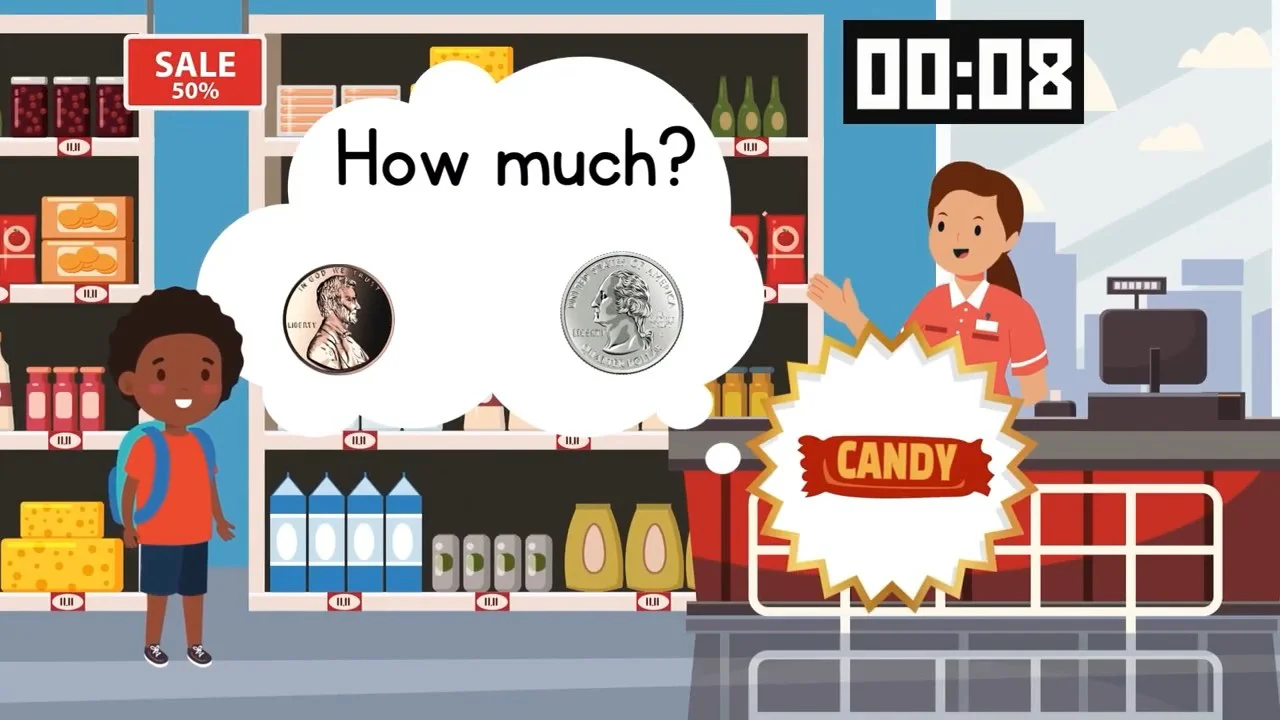
| Customer dialogue simulation | For practicing objection handling and service standards | Employees train on real-life scenarios without risking reputation |
| Interactive trainer for managers | Developing leadership and negotiation skills | Managers learn to make decisions in non-standard situations |
| Story-driven quest quiz | Large corporate events, onboarding new hires | Engages the team and reduces training stress through play |
This logic works not only for the format but for the entire training course. You get not just tests, but a complete 'write—test—launch' scenario.
In addition, text questions, dialogue trainers, and game mechanics are available on regular computers and mobile devices—training is not tied to a location or an employee's equipment.
We tie quiz results to the development of specific skills. Completion statistics show not a single right or wrong action, but a trend: where a manager faces systemic difficulties, which topic has not been absorbed by the majority, and where additional training is needed.
This fulfills a manager's request—to see team progress through clear indicators, not just a 'test passed' notice. Contact us, and we will offer a format that matches your task and your employees' baseline skill level.
Stages of Creating a Quiz: From Request to Launch
We have structured the process so that it is easy for the client: you describe the task, and we handle everything else—from the scenario to launching the finished quiz. Below are the stages each project goes through.
- Briefing and task immersion. We find out which leadership skills employees lack, what format they prefer for learning, and what results you want to achieve. The outcome is a clear technical specification that you approve.
- Scenario approval. Together with you, we outline the quiz plot, questions, and answer options. We adapt the scenario to your corporate culture and job specifics so the training feels natural.
- Development and content creation. We build interactive mechanics that hold attention and provide instant feedback. You see intermediate versions and make edits without waiting for the final version.
- Testing and debugging. We test the quiz on different devices and usage scenarios to eliminate glitches at the most inconvenient moment. You receive a link for a trial run and can assess usability and correctness.
- Launch and employee access. We place the quiz on your platform or provide a link for distribution. We automatically grant access to all participants and set up result tracking.
- Support and results analysis. We collect completion statistics: who passed, which questions caused difficulties, and how much the knowledge level improved. Based on this data, we help adjust the development program.
- Scaling and reuse. We update questions for new tasks or adapt the quiz for another group of employees—without building from scratch.
What's Included in the Delivery: A Complete Launch Kit
After the project is completed, you receive not just a quiz, but a launch-ready package—everything is already configured, tested, and packaged for your tasks.
This is a turnkey solution: all that remains is to set a date, send out invitations, and watch employees engage with the game and build leadership skills.
Here is what is included in the delivery:
- Working 3D quiz simulator — a complete scenario with dialogues and bonus rounds. Employees complete it from a computer or tablet, and no additional setup is required for launch.
- Scenario library for leadership skill development — several ready-made topics: decision-making, team management, feedback, motivation. The questions are based on real work situations, so employees easily apply them in practice.
- Instructions for HR specialists — a step-by-step checklist for organizing a session: from sending invitations to reviewing results in a group. Suitable even for those running game-based training for the first time.
- Employee materials — short cheat sheets and a presentation with the rules of the game. They explain why to participate and answer questions before the start—so you don't have to respond to each person manually.
- Administration guide — how to change questions, add new rounds, set timing, or invite an additional group. All settings are clear and in Russian, with no need to involve a developer.
- Analytics dashboard for HR — you see who completed the quiz, how much time they spent, which questions caused difficulties, and how employees performed overall. This data can be easily exported into a report for management.
- Warranty support and assistance — for an agreed period we stay in touch: we help launch the first session, answer team questions, and promptly fix any issues.
This kit covers the client's main need—you get a working training program without lengthy setup or dependence on external specialists. Everything is already packaged, documented, and adapted for your HR team, so the launch doesn't turn into a separate project.
Case Study: How We Boosted Leadership Skills at a Retail Chain
We implemented a dialogue quiz program for a retail chain with two thousand employees. The task was simple: instead of boring lectures, give frontline staff the opportunity to train leadership skills on realistic scenarios.
Three months after launch, we recorded an almost threefold increase in training engagement—whereas before, courses were completed just to check a box, employees took the quiz voluntarily and in their free time.
The head of the chain's learning department noted the key result: 'For the first time, we saw managers begin applying the practiced scenarios in real conflict situations.
This isn't just a test—it's a decision-making trainer.' Regional managers confirmed that the number of correct actions when dealing with difficult clients increased by 40%, and the onboarding time for new hires was reduced by two weeks.
Numbers That Speak for Themselves
- Training engagement grew 2.8 times—before that, staff ignored mandatory courses.
- The number of conflict escalations at the checkout decreased by 40%. Phrases practiced in the quiz carried over into daily practice.
- A repeat order for the following year—the chain scaled the program to three new regions without further development.
The secret to the result lies in the format: an employee works through short dialogue scenarios where every answer leads to consequences. A mistake is not punished, but analyzed.
This way, a middle manager works through situations in a week that would have taken months in real life.
The system collects analytics on each participant and indicates which leadership competencies are lacking—this enables targeted training rather than training everyone indiscriminately.
How to Choose the Right Quiz Format?
There is no universal quiz format: what is perfect for checking safety knowledge will not work for developing leadership skills.
The choice should start not with the tool, but with the learning goal—what the employee should be able to do after completing it, and how that will change their work in the team.
If the goal is to reinforce facts and rules, classic multiple-choice tests are suitable. But when you need to develop complex skills—conflict management, delegation, employee motivation—theory alone is not enough.
Leadership manifests itself in dialogue and non-standard situations, so you need a format in which you can try different behavior models and see the consequences without real risk.
This is exactly how the dialogue-based 3D quiz simulator works: an employee enters a realistic scenario, talks with a virtual interlocutor, and receives feedback on each decision.
When choosing a format, it is important to consider the audience: experienced managers engage more quickly if the scenarios are close to their daily tasks, while for young specialists, clarity and the ability to experiment are key.
Also pay attention to scale—a light format works for a small team, while a distributed network needs a unified system that can be used regardless of the city or employees' schedules.
We help you choose a format tailored to your goals: we analyze the training objectives, role specifics, and desired outcomes, and then propose a solution.
For leadership skill development, this is usually a dialogue simulator with gamification elements—it gives employees safe practice, and managers get data on typical mistakes and team growth areas.
Answers to Common Questions About Implementation
When implementing quizzes for leadership development, clients most often ask about timelines, compatibility with internal policies, and support after launch. These are understandable concerns: any new tool must work without disrupting familiar processes.
Over 10 years, we have completed dozens of projects and know how to quickly integrate a quiz into your training system without adding unnecessary burden. Below are answers to the questions we hear most often.
How long does implementation take?
Usually two to four weeks from the moment the scenario is approved. The first week goes to preparing materials, the second to configuring the quiz itself, and the third to a test launch and adjustments. If the scenario is already ready, the timeline is reduced to two weeks.
Is it difficult to adapt the quiz to our internal processes?
We customize the quiz to your specifics: department names, corporate values, and concrete situations from your managers' practice. Integration does not require restructuring the existing training system—just providing access to a web page or internal portal is enough.
What technical support will be provided after launch?
We support the project around the clock: we answer employees' questions, fix any issues, and annually update content to keep the quiz relevant. You don't need to hire a separate specialist—all technical matters stay with us.
Ready to Strengthen Your Team? Get a Consultation
If you're reading this section, leadership skill development is already on your agenda. We help companies turn training into a systematic growth tool—without taking people away from work, with clear results and an engaged team.
The first consultation is free and non-binding. During it, we will break down your task, show you what a working training quiz looks like, and advise on where to start implementation.
You don't need to prepare a technical specification—we will ask the right questions and propose a plan tailored to your specifics.
What you will get from the consultation:
- Free demo access to a real quiz so your team can evaluate the format before purchasing.
- Scenario selection based on your request—from short warm-ups to a series of rounds for developing leadership qualities.
- Timeline and launch stage estimates based on your calendar and employee availability.
- Examples from our practice—how other companies strengthened their management teams through dialogue quizzes.
- Metric recommendations—how to track participant progress and see real skill growth.
- Priority place in the queue—after the consultation, your project gets an early start without waiting.
Leave a training request—within one business day we will contact you, clarify the details, and suggest a convenient time for a consultation. Strengthen your team with a tool that employees will use with interest, not just to check a box.