

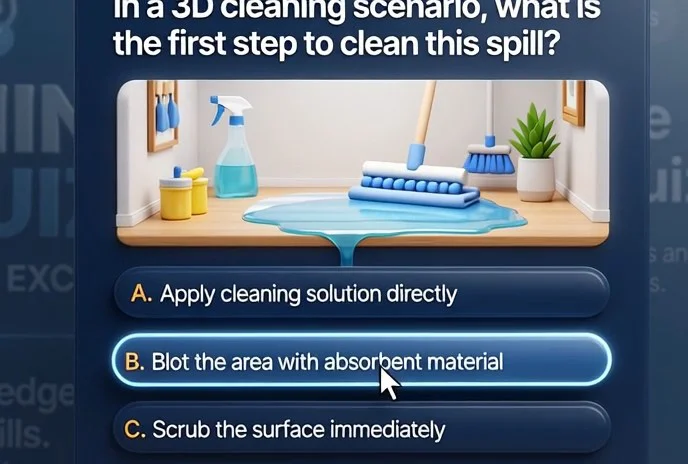
Employees fail complex negotiations — are you losing clients?
Complex negotiations are the point where the fate of a deal is decided. A manager can know the product perfectly, but if they get flustered responding to client objections, you lose both the contract and the long-term relationship.
The stakes are high: every lost meeting in B2B or services is not just missed profit, but also a gift to a competitor. An insecure employee broadcasts brand weakness, reputation melts before your eyes, and the next meeting has to start with rebuilding trust. Employees get confused, stray from the script, and the client feels it instantly.
Why don't conventional formats work? Traditional trainings deliver theory and role-playing in a safe audience, but in real dialogue with pressure, time constraints, and a tough opponent, the knowledge evaporates.
Business communication requires automation: you don't need to recall the right words, you need to act quickly and confidently.
This is exactly where employee training most often fails — managers revert to old patterns and lose key meetings, losing not only the order but also the company's face.
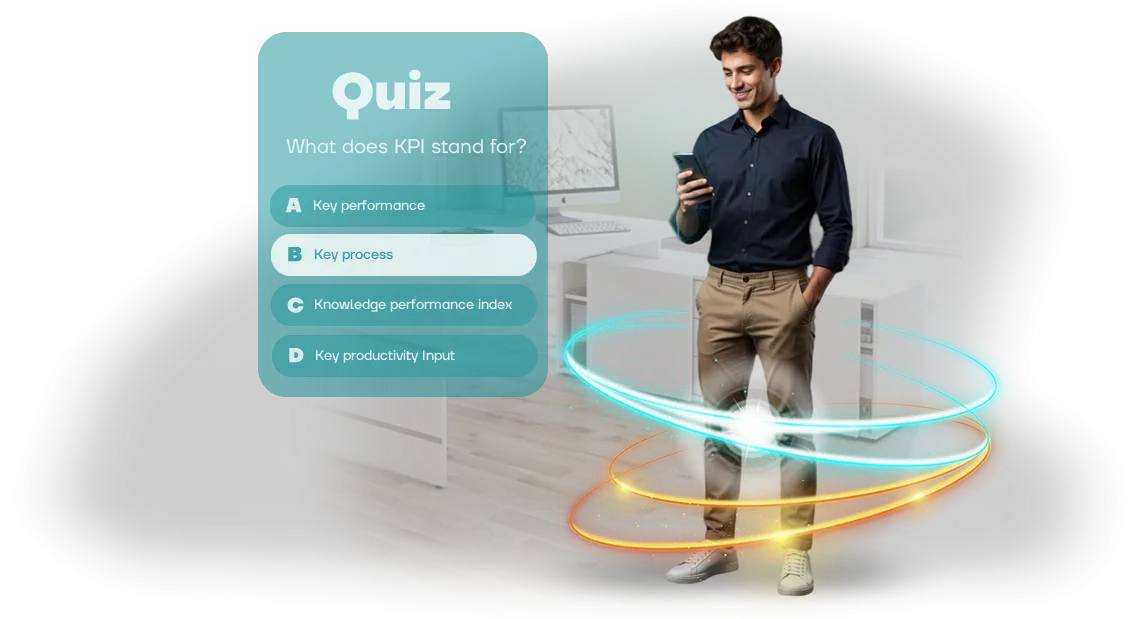
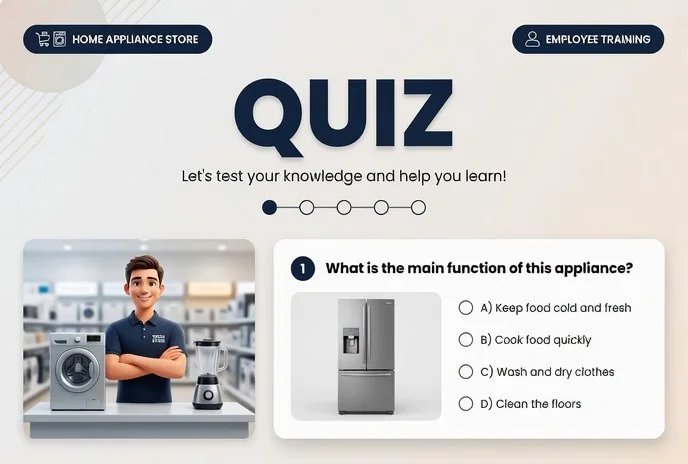
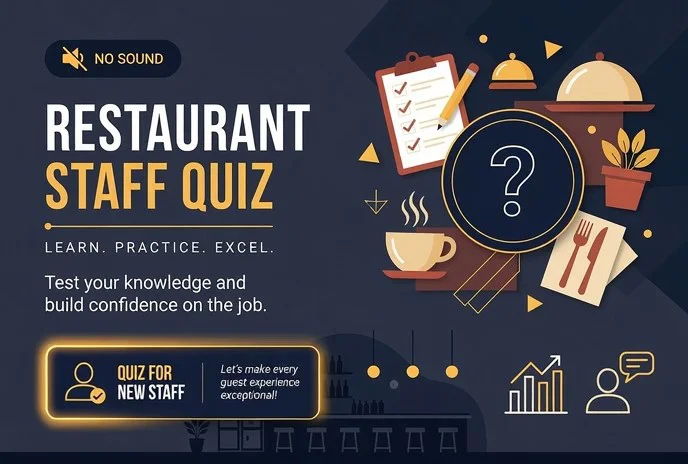
We close this pain point with a staff quiz built as a realistic dialogue-based 3D simulator.
In a safe environment, the employee experiences complex negotiations again and again, trains reactions to objections, learns to steer the meeting toward a mutually beneficial solution, and receives instant feedback.
Such negotiation training turns theory into skill, and the quiz engages even those who don't like learning. Gamification boosts engagement and makes it safe to make mistakes — every failed dialogue becomes a lesson.
As a result, your managers start winning where they used to retreat, and you get predictable growth in closed deals without changing your team.
What a negotiation skills simulator gives business
Negotiation skills directly affect profit: they determine how many deals close, how meetings with key clients go, and how confidently an employee acts in a stressful situation.
The simulator turns theory into an automatic reaction — after several scenarios, a person stops getting lost in the face of objections, pauses, and tough bargaining.
For business, this means team resilience and a predictable result. An employee who has rehearsed difficult dialogues is less likely to give discounts unnecessarily, can better justify the price, and drives negotiations toward a mutually beneficial outcome. As a result, deal conversion and average check size grow without additional spending on motivation.
The simulator also gives managers control over training. Instead of abstract "course completed" assessments, you see at which dialogue stages the team loses initiative, which employees aren't ready for tough conditions, and who only needs light adjustment. Training stops being a formality and becomes a performance management tool.
The key value is the systematic approach. You don't just raise the qualifications of individual managers — you level up the entire team: negotiation skills are reinforced with unified standards rather than depending on each person's personal experience. This speeds up new hire onboarding and strengthens the effectiveness of experienced employees.
In the end, business gets measurable growth: fewer ruined negotiations, more closed deals, and a team that acts confidently even in unusual situations. Skills sharpened on the simulator immediately transfer to real work — from the first day after training.
Formats of 3D quiz simulators for preparing for complex negotiations
Complex negotiations are an area where the cost of a mistake is especially high: one poorly chosen word can cost a contract or a relationship with a key partner. Conventional lectures and tests don't let an employee experience this safely.
The Unity-based 3D quiz simulator allows playing out a dialogue with a virtual interlocutor who reacts to every line — so the employee trains the skill without business risk.
We develop such simulators at our team. The Unity platform provides flexibility: you can build both a simple multiple-choice test and a full-fledged scene with changing negotiation conditions. The client receives a tool that integrates into an LMS and tracks each employee's progress.
| Format | Who it's for | What it gives the client |
|---|---|---|
| Linear quiz with feedback | New employees, interns | Quick immersion into basic negotiation rules, instant error assessment |
| Branching scenario simulator | Sales managers, negotiators | Training different strategies in one dialogue — see how the opponent's response changes |
| Team quiz tournament | Departments involved in deals | Practicing coordinated actions, role distribution, competitive excitement |
| Full-immersion VR format | Top management, complex contracts | The most realistic practice with non-verbal cues and pressure — without consequences |
The choice of format depends on the task: if you need to quickly train the entire team, a linear quiz works; for practicing resistance to manipulation, a scenario simulator.
Our specialists will help you select the option and adapt it to your real negotiation scenarios, so training delivers measurable results in working with clients and partners from the start.
How simulator development works: from brief to launch
A transparent process is what distinguishes a reliable contractor. You know in advance what you'll get at each stage, when interim results will appear, and how to influence the development.
That's why we've structured the work so you always know the project status and don't get distracted by technical details. Below are the typical stages your simulator goes through.
- Brief and immersion. We interview your team, study the specifics of your negotiations, and collect examples of real dialogues and difficult situations. The output is a document with learning objectives and the quiz format.
- Quiz script. Together with your experts, we write dialogue scenarios, reaction options, and correct moves in negotiations. The result is an engaging storyline that reflects your actual practice and turns training into a memorable experience.
- Prototype and approval. We show a draft version of the key scene — you see how the simulator will look and work, and you can make edits before full development begins.
- Development and iterations. We build the complete simulator: design, logic, visuals. We hand over interim versions — you test them on real situations and refine the details.
- Testing with employees. We run the quiz with a focus group of your people to make sure the material is clear, engaging, and the question difficulty matches the team's level. Then comes final tuning.
- Launch and support. We integrate the simulator into your training system, provide instructions, and stay in touch. After the launch, we update scenarios, add new questions, and monitor stable operation.
What you get with the training quiz
Each training quiz is delivered as a ready-to-use tool that can be launched within days. You get not just a game, but a complete solution for developing complex negotiation skills in employees — from scenarios to analytics and technical support.
Here's what's included in the package:
- Ready-made dialogue scenarios — well-developed negotiation branches with "live" opponent responses. Employees train on real situations: objections, tough conditions, emotional pressure.
- Customization for your cases — we adapt scenarios to your industry, product, and typical challenges. The training speaks the language of your business, not abstract examples.
- Training analytics — clear reports: who completed the quiz, where employees make mistakes most often, which skills need improvement. You see team progress in numbers.
- Integration with your training system — the quiz easily integrates into an existing LMS or corporate portal. Employees don't switch between tools, and results go into a shared database.
- Launch instructions — short guides for administrators and users. Your HR specialist can handle implementation without involving programmers.
- Guarantee and support — we help with launch, answer questions, and promptly make adjustments after initial test runs.
All of this comes as a single turnkey package. You get a tool that works immediately, not a set of documents with promises.
Case study: a bank reduced negotiation losses with a 3D simulator
In the financial sector, the cost of a mistake in negotiations is too high — a lost client, missed deals, reduced trust. Classic role-playing training delivers results, but requires time and an experienced mentor.
We close this need with a 3D simulator in which employees practice complex negotiations in a safe environment.
Case study: Credit-Praktik Bank
We worked with a bank with a branch network and over 200 sales managers. The challenge was tough: prepare the team to work with dissatisfied and demanding clients without disrupting operational processes.
We built a dialogue quiz scenario: a virtual client objects, bargains, turns the conversation emotional, and the employee learns to steer it back to constructive territory. Each session takes 15–20 minutes, so training happened right between meetings.
The simulator records typical mistakes and suggests how to fix them — the manager sees their progress, and the supervisor sees the team's readiness.
In two months of simulator operation, the number of successful deals grew by 18%, and the average preparation time for complex negotiations dropped by 40%.
Employees became more confident in handling objections, and the training department stopped gathering groups for the sake of training.
The bank saw a measurable effect and ordered the simulator scaled to new directions — the best sign that the mechanics work. For us, this confirms that a proper 3D simulator gives business not an abstract "training" but concrete sales metrics.
How to choose a simulator format for your company's tasks?
The choice of format depends not on trends, but on what skills you want to reinforce in employees and under what conditions they'll use those skills.
Short dialogues and deep scenario-based simulations solve different problems, and there's no universal "best" option — there's only what fits your company.
If employees need to quickly practice specific phrases, confidently respond to objections, or memorize an action algorithm, a compact simulator with short dialogues is enough.
It takes 5–7 minutes, easily fits into regular training, and works for large groups when you need to give everyone practice without disrupting their work.
When it comes to complex negotiations where emotions, unexpected twists, and extended argumentation decide the outcome, short scenarios don't provide the needed depth.
Here, scenario-based simulation is effective: the employee immerses in a multi-step conversation, learns to manage the dialogue, sees the consequences of their decisions, and gets a breakdown of their actions. This format suits key employees, managers, and those who handle important client negotiations.
We help you decide before development starts: at the consultation, we break down your tasks, training scenario, audience preparation level, and desired result.
Based on this, we propose a format — from a light trainer to a full-scale simulation — and if needed, combine both approaches in one program.
Leave a request — we'll find a solution that precisely matches your goals without making you overpay for unnecessary functionality.
Frequently asked questions and concerns about implementing a quiz simulator
Implementing corporate training often runs into the same concerns: will we launch on time, will data leak, will the format fit internal standards. Below are the questions usually asked before starting, with honest answers.
How long does preparing a quiz simulator take?
A standard project takes from two to four weeks — the timeline depends on the number of scenarios and the depth of dialogue development. You'll see the first working version within a few days after the brief, then we refine it together.
If you need a quick launch, we can start with one module for a pilot group and add the rest iteratively. The schedule is always fixed in the contract and met without delays.
Is it safe to share internal materials with you?
Yes, security is a key condition of our work. We sign a non-disclosure agreement, use a secure channel for file transfer, and don't involve third-party contractors without your consent. Corporate scenarios and employee personal data stay within your company.
After project completion, all materials remain with you; we don't store them on our servers. If needed, we can add additional storage and access terms.
Can you adapt the quiz to corporate standards?
We fully adapt: we use your brand identity, accepted terminology, and regulations — from greetings to the final breakdown of results. We build scenarios on real cases from your industry so employees immediately recognize familiar situations.
If you have an internal training system, we'll integrate the quiz into it or provide access via a link. You won't have to change your existing processes — the tool becomes a natural part of them.
Will employees without technical background handle the simulator?
That's what it was made for. Completing it takes a few minutes and requires no special skills: choosing answer options, dialogue lines — everything is intuitive. Hints and error breakdowns appear immediately, so participants learn as they go.
We'll also help prepare a short instruction and launch email — to explain the value and address initial questions. Employees usually see this format as a game, not as a test.
If your concern remains or you want to discuss your own scenario — ask directly: we'll answer and show how it will work on your example.Order a demo version of the quiz and an implementation plan in 2 days
To decide on implementing a training quiz, you need to see it in action and understand how it fits your processes.
In 2 days, we'll prepare a demo version of the quiz for your scenario — for example, for practicing complex negotiations — along with an implementation plan and a commercial proposal.
No abstractions: you get a complete package that lets you evaluate the business value and launch timelines.
What you get after submitting a request
- A demo version of the quiz on your topic: you'll go through several scenarios, see the mechanics, the interface, and how an employee responds to choices in negotiations.
- An implementation plan: stages, timelines, responsible parties — from brief to launch in your training.
- A commercial proposal with transparent pricing and format options: for a small group, a department, or the entire company.
- Guarantees: fixed timelines, support at launch, and scenario refinement for your real cases.
- Content recommendations: how to turn your existing materials into questions and decision points so the quiz teaches your specific negotiation rules.
- Effect assessment: how the quiz will impact engagement, learning speed, and material retention.
In 10 years of working We've gotten used to quickly engaging with client tasks and handling them in a concrete way. The request carries no obligation: we'll prepare the demo and plan, you review them, ask questions — and only then decide whether to move forward.
Leave a request on this page — within two days you'll receive a package with the demo version, implementation plan, and commercial proposal. This saves you time on approvals and gives you immediate material for your decision.