


Problems of dental education: knowledge fades right after the lecture
Every dental clinic manager faces the same pain: after a traditional lecture, employees nod, but a week later they forget half the material. This is not a question of motivation — that is how memory works: passive listening does not create lasting skills.
As a result, staff training problems come to the forefront: nurses confuse the sequence of instrument processing, assistants doubt protocols, doctors return to old habits.
Mistakes in a clinic cost dearly — this is not only a risk for patients, but also a blow to reputation, additional expenses for correcting the consequences.
Low employee engagement makes the situation even harder. Adults don't learn when they are lectured to: they get distracted, scroll through their phones, think about current tasks.
The effectiveness of classic seminars is falling every year — studies show that after 72 hours only a small part of what was heard remains. Staff do not see the connection between theory and real actions in the chair, so knowledge does not translate into confident skills.
Forgetting material becomes a systemic problem if training happens from time to time. Without regular practice and comprehension checks, gaps accumulate imperceptibly.
Employees begin to act on intuition, and this is a direct path to non-standard situations and conflicts with patients.
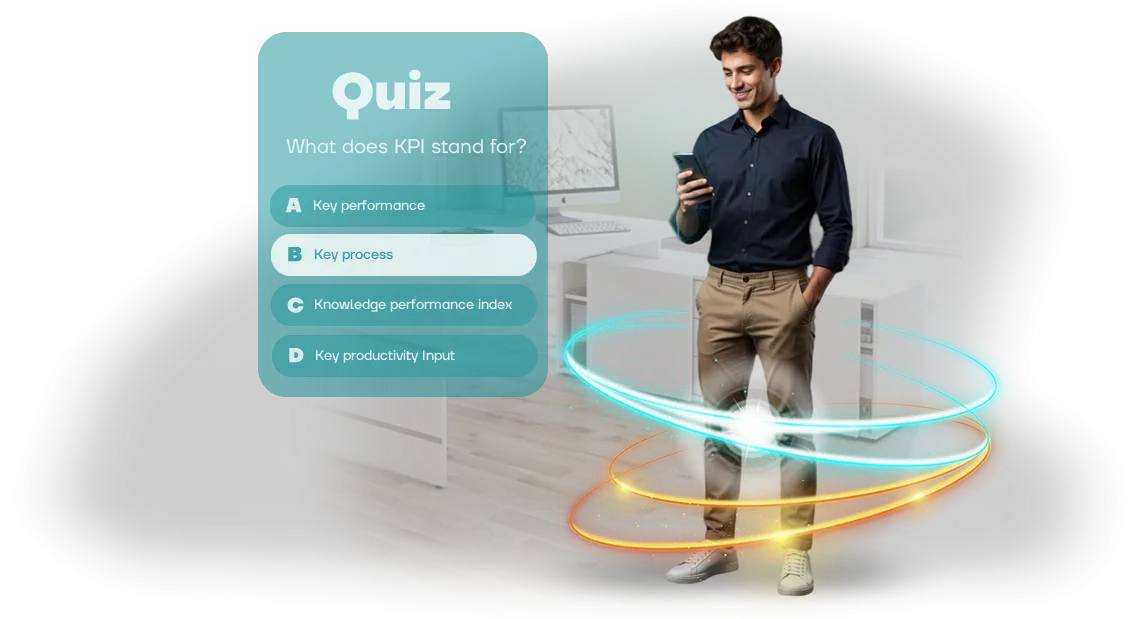
We close this gap. Instead of passive lectures — training quizzes that involve staff in active work with materials and reinforce correct algorithms until they become automatic.
This approach makes dental training predictable and measurable: you see who has absorbed the material and where there are still weak spots.
What an interactive quiz gives you: engagement and measurable results
Ordinary lectures and tests do not hold attention: employees listen, but a week later they forget half. An interactive quiz turns learning into a game where everyone answers questions and immediately sees their result. This is not entertainment for entertainment's sake — it is a tool that delivers measurable results.
What you will get after implementation:
- Staff engagement. The competitive element and instant feedback keep attention to the end. Employees complete training with interest, not "under duress."
- Better retention. Active actions are absorbed better than passive reading. Scenarios with real clinical cases reinforce correct algorithms.
- Objective knowledge assessment. The system records answers and time — you see who has mastered the material and who needs additional support.
- Skills practice in a safe environment. A dentist trains on complex cases without risk to patients. Mistakes on a simulator cause no harm, but teach you to act correctly.
- Staff motivation. Points and ratings turn professional development into an achievement. Employees themselves strive to complete the material.
This approach justifies the investment: employees actually absorb knowledge, and you get clear data for decisions. Wedevelop quizzes for dental training to suit your tasks — from checking assistants' knowledge to complex clinical cases for doctors. Leave a request, and we'll show you how it works in practice.
Formats of training quizzes for dental education
There are quizzes and quizzes. A clinic needs not just a test of terminology knowledge, but a tool that actually changes the behavior of doctors and assistants. The format determines whether training achieves its goal or remains a formal checkbox.
| Format | For whom | What it gives the clinic |
|---|---|---|
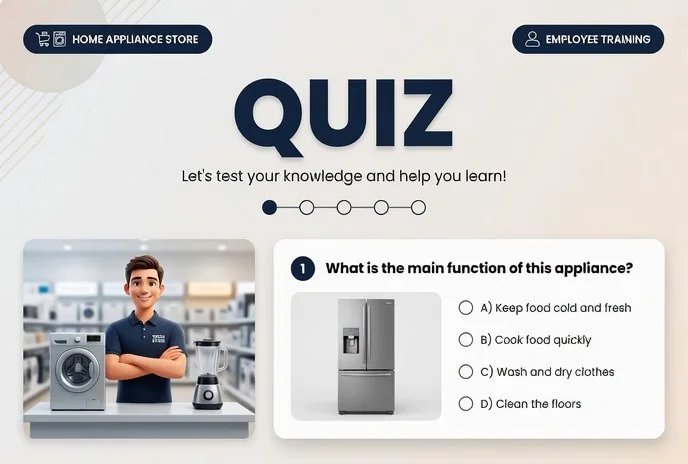
| Text quiz | For testing theory, regulations, and standards | Quick certification, gaps in knowledge visible, questions easy to update |
| Dialogue simulator | For practicing patient communication and handling objections | The doctor calmly explains the treatment plan, more treatment plans are accepted |
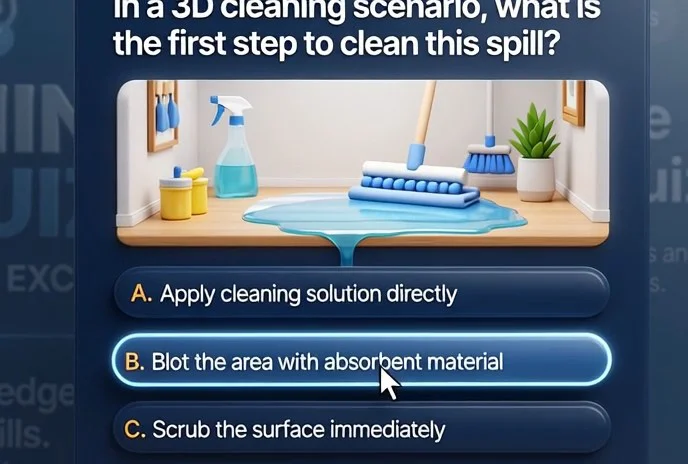
| 3D scenario | For training clinical skills and working with equipment | Safe practice without risk to the patient, fewer errors in appointments |
How to choose a format
If the task is to check whether staff remember protocols, a short text quiz is enough. If you need to teach a doctor to communicate with an anxious patient or explain the cost of treatment, you cannot do without a dialogue simulator.
And when it comes to practicing a complex procedure, a 3D scenario provides the very experience that previously took months to build up.
The best result usually comes from combining formats. We structure the program so that employees first take short checks, then practice dialogues and clinical situations. This turns learning into a clear system rather than scattered tests.
How the project goes: from brief to launch of a training program
The client needs a clear process, not a "black box." We structure the work so that you always know what is happening with the project and are not distracted from managing your clinic or training center — we handle all organizational matters.
- Training brief. We record which employees need to be trained, which skills to improve, and in which format it is more convenient to test knowledge. You fill out a short questionnaire — we propose a quiz structure for your tasks.
- Project approval. We prepare the question scenario, dialogue logic, and design concept. You see what the quiz will look like before development starts and make edits without unnecessary iterations.
- Development of the training program. We build the quiz on a professional engine — with interactive scenarios, roles, and answer options. Everything is adapted to your brand and the way your employees speak.
- Testing on real scenarios. We test the quiz on a small group of employees, collect feedback, and adjust the difficulty balance so that training is both useful and engaging.
- Launch of the training program. We place the quiz on your devices or in your work network and train the administrator if needed. Employees can complete it at a convenient time — without disrupting their schedule.
- Quiz support. We stay in touch after launch: update questions, add new blocks, and make sure everything runs stably. Training lives and grows together with your clinic.
Thanks to this approach, you get a ready-made tool that improves your team's qualifications without your constant involvement. All we need from you is the initial input — we do everything else ourselves and support the project after launch.
What is included in the delivery: a complete set for independent work
You get not just scattered files, but a working set with which your team will start training on the day of delivery. Everything is already configured, tested, and packed so that you do not depend on a developer in your day-to-day work.
Here is what is included in the delivery:
-
A ready-made quiz on your topic. The scenario is approved by your experts, and questions and answers are adapted to real cases of dental practice — from anesthesia to handling patient objections.
-
An admin panel for management. You can change questions, deadlines, add new blocks, or edit wording yourself — without knowing code or contacting a programmer.
-
Instructions for staff. A clear guide for employees: how to log in, how to take the quiz, and where to see their result. Minimum questions directed at you.
-
Training materials for the manager. An implementation guide: how to announce the launch, how to motivate the team, how to interpret results and turn them into a development plan.
-
Methodological recommendations for the scenario. A breakdown of which topics are better to present at the beginning and which after practice, so that training proceeds consistently and does not overload staff.
-
Documentation for independent work. Short checklists and action plans for non-standard situations — for example, if an employee forgot a password or you need to urgently complete testing.
Each item in the set solves a specific problem: launch training without an IT specialist, save the manager's time, and get a transparent picture of the team's knowledge. All you have to do is distribute access and set a start date.
Case study: how a quiz improved diagnostic accuracy in dentistry
The dental clinic Dental approached us with a typical training problem: after courses, doctors knew theory well, but made diagnostic errors in appointments. This was especially true of complex cases — deep caries, root canal lesions, hidden inflammation.
The manager wanted to turn "knowledge" into a lasting skill, not just a "passed test."
How the quiz works
We developed an interactive 3D quiz based on real clinical cases. Instead of flat cards with questions, the doctor saw a three-dimensional model of the dentofacial system: changed the angle, marked problem areas, and made a preliminary diagnosis. The system immediately showed the error and explained why the correct answer was exactly that one.
The format turned out to be more convenient than ordinary lectures: the doctor trains in a safe environment and is not afraid to make mistakes. The same clinical scenario is repeated until the skill is consolidated — without risk to a real patient.
The result for the clinic
The first changes were noticeable within a month. Diagnostic accuracy in the therapeutic department grew by a third, and the number of repeat X-rays and follow-up consultations decreased by half.
For the clinic, this is not only the quality of treatment, but also increased patient trust: patients less often return with complaints and more often recommend the clinic to acquaintances.
After the first launch, the clinic ordered an extended version for orthopedics and surgery. We support the project: update cases, add scenarios, and make sure training helps the business result — not just checks the box for course plan.
Common concerns: what if employees do not accept the format?
Employees resist new things — that's normal. Especially when the format is associated with "school tests." But a training quiz for dentists and assistants is not an exam, but a living tool: short rounds, clear scenarios, and instant feedback. It won't be boring, and confidence in actions — will appear.
We configure implementation for your team: you can run a pilot on one group, collect feedback, and calibrate difficulty.
No schedule disruptions — the quiz fits into a shift in 10–15 minutes, and results go into a common table so the manager can see progress without manual checks.
What if employees sabotage the quiz?
We avoid this at the configuration stage. We make the format short and competitive: the quiz takes 10–15 minutes, not an hour of lecture. Plus you get feedback — we see where people get stuck and adjust the difficulty. If there is resistance in the pilot group, we adjust the scenario before the full launch.
Is it difficult to integrate the quiz into the current workflow?
No need to allocate a separate day. Employees take rounds at a convenient time — from a computer or tablet. The system remembers progress and allows you to return to an incomplete module. We support the implementation: set up access, train the administrator, give a short guide. Your specialists continue to work at their usual pace — they just get a quick knowledge-check tool.
Do you need special equipment for the quiz?
Ordinary computers or tablets are sufficient — almost any device with the internet works. No complicated software installation on workstations. We launch the quiz through secure server infrastructure, and the client receives a link and access credentials. All setup is done on our side, so you don't need a separate IT specialist.
How to choose the right quiz format for your clinic's tasks?
The right quiz format depends not on fashionable trends, but on what result your clinic needs. If the goal is to quickly check how employees understood the regulations after a lecture, a compact test with answer options is enough.
If the task is to practice a difficult conversation with a patient or actions in an unusual situation, a simple choice of the "correct" option will not give the desired effect — here you need a quiz simulator with immersion in a scenario.
For dental training, it is critical not just to memorize theory, but to bring algorithms to the point of automaticity. That is why we often offer dialogue formats where the doctor or administrator talks to a virtual patient and sees the consequences of their words.
This makes it possible to transfer a skill from the learning environment to real practice without risking the clinic's reputation.
When choosing a format, pay attention to the level of staff training and the frequency of knowledge updates. For regular short checks on hygiene standards or working with objections, light quizzes that take 5–10 minutes during a break are convenient.
For annual certification or training new employees, a multi-scenario simulator that evaluates actions rather than just memory is better suited.
If it's about motivation and engagement, add a competitive element: a rating of results and an analysis of errors after each question make learning clear.
This approach helps to more accurately identify weak points in a particular specialist's knowledge and adjust the program without reference to overall averages.
We will help you choose the right type of quiz for your clinic's tasks after a short brief.
You describe which employees need to be trained and which skills are more important, and we propose a format that will solve the problem with the required depth — from a quick check to a complex simulator.
Ready to make training effective? Let's discuss your request
After your request, you get not just a commercial proposal, but a step-by-step plan for improving staff qualifications. We value your time and immediately get involved in solving the problem, without long approvals and technical details.
We understand the specifics of dental practice: what matters is not only knowledge of theory, but also practicing patient communication scenarios, following protocols, and confidence in non-standard situations.
Therefore, the quiz we develop is not a test for the sake of a checkbox, but a tool that changes employee behavior and delivers measurable results.
What you will get after your request:
- Training consultation — we analyze your task and propose an approach that will fit organically into your team.
- Quiz proposal — a transparent estimate and timeline, without hidden conditions or "fine print."
- Quiz demo — a live example using your material, so that you can see how it works in your setting even before the start.
- Implementation plan — detailed steps: from setup and adaptation to launch and result evaluation.
- Support after launch — assistance and adjustments to your updated requirements.
- Ready for scaling — the ability to expand the quiz to new clinic departments or branches.
Leave a request — we will contact you within a business day, answer your questions, and prepare a personal proposal. At the first stage, we evaluate your task for free and offer an optimal format, so you do not need a technical specialist: we speak the language of your business.
Order a quiz today — and get training that employees complete with interest, with results visible in daily work with patients. Fill out the form or write to us in a messenger — let's discuss your request and choose a solution for your goals.