

Welding Without Control: Risks to Production and People
Welding is a production process where the cost of an error is measured not only in a spoiled part. An untrained welder creates a direct threat to production safety: the risk of accidents, injuries, equipment damage, and even loss of life.
One poor-quality weld can stop an entire line, disrupt delivery schedules, and lead to financial losses that significantly exceed the cost of training.
Even if an employee completed courses at some point, skills fade without practice and oversight, while technologies and requirements change.
Formal welder certification, conducted infrequently, does not provide the full picture: a person may successfully pass an exam on a simulator, yet violate the technology under real conditions.
Without regular knowledge checks, it is impossible to spot gaps in time and prevent defects or tragedy. The goal is not to punish the worker, but to give them the opportunity to systematically maintain their qualifications.
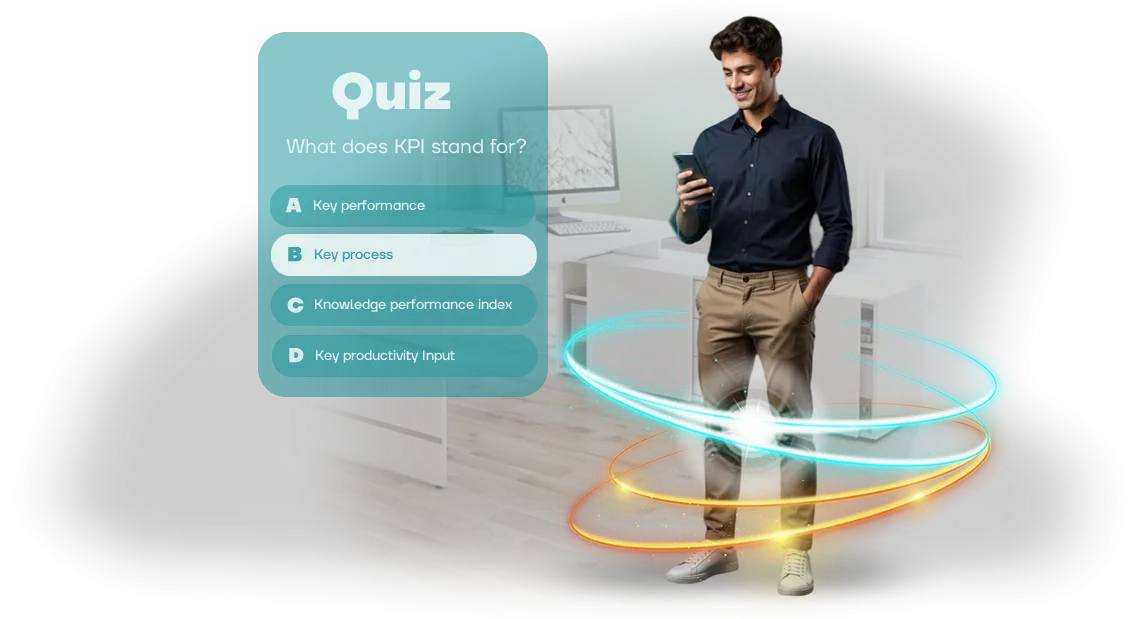
This is why we develop training quizzes for employees — they help make welding training continuous and practical. Such checks reveal weak points before they become the cause of an accident or a customer claim.
You get safe production, confidence in every welder, and protection of your business from risks associated with the human factor.
What a Training Quiz Will Give Your Enterprise
Reduced Production Defects
A training quiz from our team translates knowledge of welding technology into lasting skills. An employee works through typical mistakes in practice and reinforces the correct techniques, so the defect rate decreases after the first few training cycles.
Fewer defective welds means less spending on rework, materials, and equipment downtime. Every percentage point of defect reduction directly affects product cost and order delivery times.
Increased Safety and Discipline
The quiz rehearses scenarios of hazardous welding situations, from working with gas to personal protective equipment requirements. In a game-like format, rules are memorized better than by reading instructions.
Employees act deliberately and violate safety rules less often, while the enterprise reduces the risk of injuries, downtime, and claims from regulatory authorities.
Quick Onboarding of New Employees
With the quiz, a newcomer masters internal regulations and quality standards several times faster. They do not need to wait for a mentor to explain every detail — the base is absorbed independently.
The result is a shorter ramp-up period, fewer mistakes in the first months, and less load on experienced specialists.
Increased Motivation and Engagement
The game format, points, and competition between participants turn training from an obligation into an interesting challenge. Employees see their progress, strive to improve results, and apply the knowledge in practice.
Personnel engagement grows, staff turnover decreases, and a culture of safety and quality becomes part of everyday work.
Welding Training Formats: Quizzes for Specific Tasks
Welding training is not one “all-purpose” quiz. Employees go through different stages: they enter a position, learn new technologies, and analyze mistakes.
To make training effective, we match the quiz format to the specific business task — from a quick knowledge check to practicing complex production situations.
Which Welding Quiz Formats We Use
| Format | For whom | What it gives the customer |
|---|---|---|
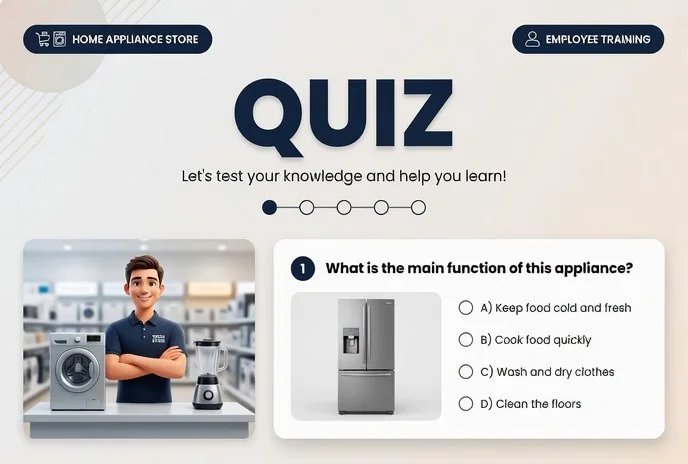
| Theory quiz | New employees, trainees | Knowledge assessment in 10–15 minutes: safe work access without a long time away from the mentor |
| Interactive 3D welding simulator | Active welders | Practice in rare and dangerous scenarios without material consumption or production stoppage |
| Video cases with questions | Employees of all levels | Analysis of real defect and accident cases to prevent their recurrence in the workshop |
The first format is suitable when you need to quickly “filter out” those who are not ready to work. The second is for advanced training: the welder makes decisions in situations that are difficult to simulate on a real site. The third is for reinforcing correct behavior models and analyzing the consequences of mistakes.
We combine formats and adapt the quiz to your specifics: the number of employees, shift schedules, and skill levels. Training happens without stopping operations — quizzes are taken at a convenient time, and results immediately appear in the report.
How Quiz Development Works: 7 Steps
Developing a quiz for employees is not just collecting questions; it is a structured project with clear stages and checkpoints. We go from brief to launch so that you see the result at every step and can influence the process. Below are the seven steps we use to create a training quiz, including for welding.
-
Brief and objectives. We define the training goals: which welding skills need to be tested and which employee mistakes need to be eliminated.
We determine the audience, the number of questions, and a clear success criterion — for example, the share of correct answers after completion.
-
Plan and approval. We draw up a work plan and timeline and approve the quiz scenario. You receive a transparent document with stages so you know what will be ready and when, and you can make changes without delay.
-
Content and scenario. Together with your experts, we formulate welding questions: process technology, safety, equipment handling, and typical mistakes. Each question is unambiguous and checks exactly what is critical for your production.
-
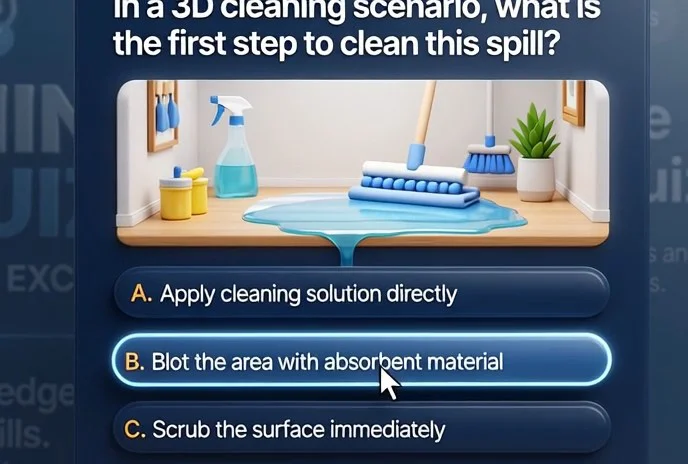
Dialog-based 3D simulator development. We create a virtual welding environment: workplace, equipment, and situations close to reality. The employee does not just choose an answer but sees the process and its consequences — this makes training more memorable.
-
Programming and logic. We set up the scoring system, hints, and explanations after each answer. The quiz itself guides the employee: if the answer is incorrect, it shows where the gap is and what the correct approach is.
-
Testing. We test the quiz on a control group of employees: the accuracy of questions, the operation of all elements, and interface usability. We test on a real device to eliminate technical failures before launch.
-
Launch and support. We arrange access, distribute links, and support the training during the first month. If necessary, we adjust questions, change difficulty, and refine the logic based on the first attempts.
This sequence makes the project predictable: you always know what stage the development is at, and you receive a quiz that genuinely improves welders’ qualifications and reduces the number of errors at work.
What’s Included in the Delivery: A Kit for Launching Training
After project completion, you get not a “game for the sake of a game” but a working kit for launching training. Each delivery item addresses a specific task: run the quiz, assess knowledge, track progress, and continue using the material without involving developers.
- A ready-to-use welding quiz aligned with your regulations and typical operations. Employees go through realistic scenarios, and you receive data on who has absorbed the material and who needs additional training.
- Quiz admin panel: you see results for each employee, group, or workshop yourself. No manual summary tables — all statistics are updated automatically and presented in a convenient form.
- Training instructions: a step-by-step plan for integrating the quiz into your existing training program, scheduling completion time, and reviewing mistakes with the team.
- Administrator and instructor training: a short session after which your employees can independently launch quizzes, change questions, and manage access.
- Technical support after launch: we help with setup, updating the question bank, and any technical issues. You are not left alone with the product.
- Project results summary: comparative completion data before and after implementation, so you can demonstrate the effectiveness and return on investment of the training to management.
- Source descriptions and documentation: scenario logic, evaluation rules, and question structure. If necessary, you can develop the quiz further with your own team or with our help in the future.
Case Study: Reducing Defects by 30% in 3 Months
At a production site where dozens of welders work, even a small technological error leads to the rejection of an entire batch. Every percentage of defects is a direct loss, so manufacturers look for ways to improve qualifications without disrupting work.
Classic briefings and lectures provide theoretical knowledge but do not reinforce it in practice: employees quickly forget the details, and quality control detects the problem only after the product is manufactured.
We received a request from a machine-building enterprise with exactly this pain point.
Instead of another presentation, we proposed an interactive quiz built as a dialog-based 3D simulator: the welder goes through realistic scenarios, makes decisions in emergency situations, and immediately sees the consequences of their actions.
Implementation Results
Within three months, the defect rate fell by 30%. Employees trained in the new format passed certification on the first attempt twice as often as colleagues who attended traditional lectures.
Moreover, training happened without stopping production — 15 minutes a day was enough to reinforce the material.
Workshop managers noticed that newcomers adapted faster and experienced welders made fewer mistakes on critical orders. After the pilot, the enterprise ordered similar quizzes for adjacent specialties — the effect of this simple and understandable format proved that strong.
How to Choose the Right Quiz Format?
There is no universal “correct” option — the appropriate quiz format is determined by the task you are solving. If the goal is to check whether an employee has remembered safety rules before being allowed to work, a short multiple-choice test is sufficient.
But if you need to practice actions in an emergency at a welding site or assess how a worker would behave in a fire, gas leak, or equipment failure, a dialog-based 3D simulator works better: it places the person in conditions as close to reality as possible and shows their reaction.
For welding as a high-risk profession, the right choice is not about a “pretty picture” but about safety and speed of learning.
A test answers the question “what does the employee know”; a simulator answers “what will they do in a real situation.” Therefore, selecting a training format should begin not with a discussion of platform features, but with an analysis of your learning objectives: new personnel need to be taught basic standards, experienced welders need advanced training, and site managers need to verify their ability to supervise subordinates.
The good news is that you do not have to make this choice alone. We offer a free consultation with a specialist: we study the specifics of your production, the number of employees, their current skill level, and the time windows available for training.
Then we propose a concrete scenario — from a 15-minute testing module to a multi-stage 3D simulator with error analysis and automatic reports for each participant.
The main criterion when choosing a quiz is a measurable result. If the number of work errors decreases after training, the number of safety violations diminishes, and the time needed to bring a newcomer up to speed is reduced — the format is right.
This is exactly the outcome we build into every quiz, and we make further adjustments based on the data you receive after the first launches.
FAQ on Quiz Development and Implementation
We have compiled questions and answers about the timeline, cost, and guarantees of developing quizzes for employees. Our team works transparently: you know in advance what you are paying for and when you will receive the result.
How long does quiz development take?
The timeline depends on the format and the number of questions. We launch a simple quiz in a few days, while a project with custom design and analytics takes 3–4 weeks.
The exact deadline is fixed in the technical specification and agreed on before the start — no “approximately” and no surprise delays.
What does the cost of a quiz consist of?
The price depends on the format: a text-based quiz is cheaper than one with design adaptation and a scoring system. We prepare a detailed cost estimate before signing the contract, stating the amount for each stage.
The final cost does not change during the process, and if you need to stay within a budget, we will offer a simplified option focused on the key task.
Can the quiz be updated after launch?
Yes, we include the ability to make changes. You can add new questions, change correct answers, or update text and graphics. You can do this independently through a simple interface or through us under a support agreement. New materials do not require redeveloping the entire quiz.
Will employees find it difficult to figure out?
Our goal is for the employee to complete the quiz without instructions or training. That is why we make the interface intuitive: large buttons, clear hints, and instant feedback. If needed, we add an instructional screen at the beginning or allow trying again.
What quality guarantees do you provide?
The main guarantee is acceptance based on the technical specification. You first test the quiz, check the scenario, and only then accept the work. If something does not work as expected, we fix the issues free of charge. All completed work is covered by a one-year warranty, which is stated in the contract.
Order a Quiz for Employee Training
Training new employees takes time and resources, and classic briefings are quickly forgotten. A quiz developed specifically for your situation turns training into a clear process: employees absorb the material faster, and you always see the real level of knowledge.
We handle the entire cycle — from task definition to launch — so you don’t have to dive into technical details.
Order a turnkey quiz for employee training and get a ready-made tool that integrates into your training system.
For complex operations, such as welding, we use visual 3D scenarios based on Unity: the employee does not just read theory but sees the correct actions in conditions close to reality.
What you get when ordering:
- A custom scenario that takes your regulations and internal standards into account.
- A clear knowledge assessment system — you immediately see who has mastered the material and who needs additional training.
- Short development timelines: we provide the first version within a few days after a brief discussion of the task.
- Adaptation to your corporate style and logo so the training looks organic.
- A flexible format: it can be completed on a computer, tablet, or smartphone.
- Technical support after launch and assistance with implementation.
Leave a request on our website and we will prepare a proposal with clear terms and options. We will advise you, recommend the optimal format, and handle the entire implementation. Start with one project and evaluate the result.