


Employees Don't Know Environmental Safety Rules
Formal environmental safety instruction has long become a mere formality: employees nod, sign the log, and a week later cannot say where to dispose of spent lamps or what to do in the event of a chemical leak.
Employee training boils down to reading the regulations—the information does not stick in memory and does not become a skill. Yet this is exactly when fines, accidents, and reputational losses for the company are set in motion.
Environmental safety is directly linked to occupational safety: violating rules often means not only environmental damage but also a risk to people's lives. Government inspections end with orders, and serious incidents lead to administrative and criminal cases against managers.
Business pays twice: first for eliminating the consequences, then for restoring the trust of clients and partners. Moreover, most problems arise not from ill intent but from ignorance of simple action algorithms.
The problem is that classic instruction does not account for how adults process information. Lectures and slides are the weakest way to consolidate knowledge.
For environmental safety rules to actually work, you need to train decisions in conditions close to real work: choosing actions, reviewing consequences, repeating through game mechanics. That is how a lasting skill is formed, not a temporary answer on a test.
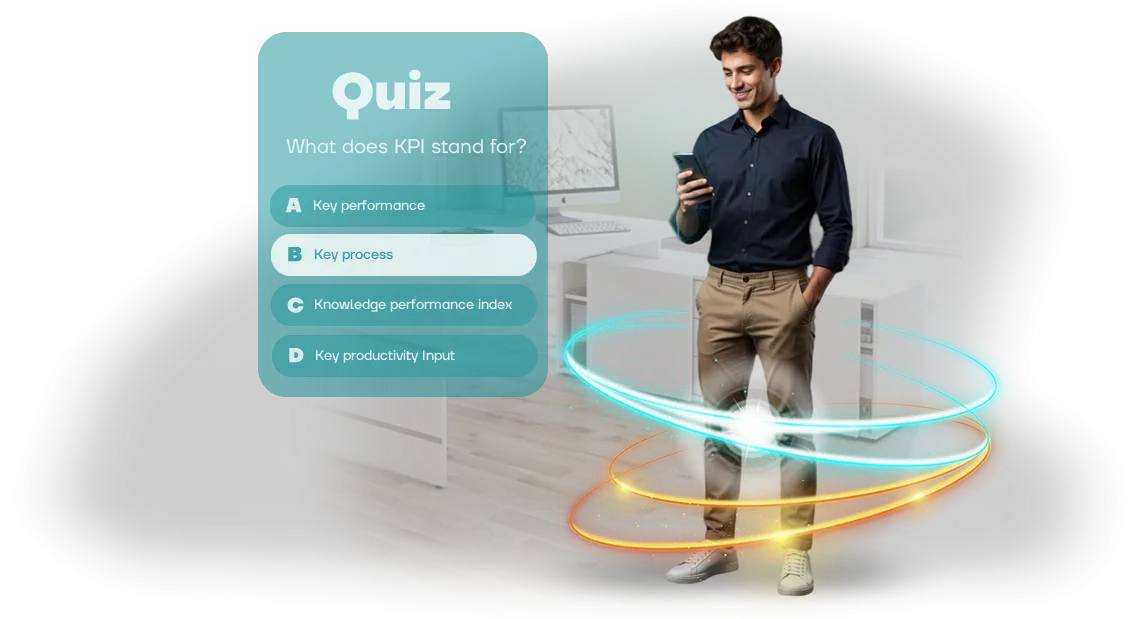
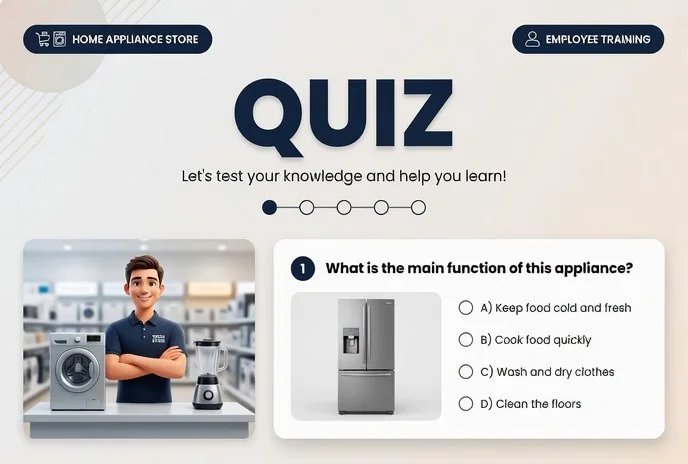
We solved this problem by developing training quizzes and quest quizzes on a professional gaming platform. Instead of reading instructions, employees go through an interactive scenario where wrong actions clearly show what a violation leads to.
This kind of employee training is completed with engagement and the rules are remembered for a long time—which means your business is protected from fines and accidents.
What Benefits Does a Training Quiz Bring?
Employees often sit through traditional lectures and presentations on environmental safety just to check a box: the information is quickly forgotten, and violations repeat. This leads to fines, accidents, and reputational risks for the business.
A training quiz solves this problem by turning a mandatory program into a lively process in which everyone participates.
Employee Engagement
A game format with questions, points, and competition triggers intrinsic motivation: employees themselves want to show results rather than just sit out the hours.
The quiz easily fits into corporate training—from onboarding new hires to scheduled environmental safety briefings—and works equally well in the office and remotely. Team rounds and a leaderboard turn training into useful team building.
Importantly, employee engagement becomes sustainable: people want to return to the quiz, and knowledge is reinforced in the process.
Training Effectiveness
Unlike passively watching slides, a quiz forces employees to recall, apply, and reinforce the rules. Professional development on Unity and well-structured question logic ensure natural repetition of the material—retention is higher, and preparation time is reduced.
Employees immediately see their mistakes and get an explanation of exactly what they missed, while managers see real training results.
Risk Reduction
When personnel genuinely know environmental safety requirements, the number of violations and accidents decreases, and therefore so do direct losses and fines. The manager receives transparent analytics: who has fully absorbed the material and who needs additional review. This makes training manageable and safety accountability personal.
Wehave been designing training quest quizzes for business for over 10 years. We work turnkey: script, questions, design, technical implementation, and reports for HR and management.
We'll tell you how a quiz can fit into your training program and show examples of projects for your industry.
Quiz Formats for Environmental Safety
Various quiz formats suit environmental safety—from a simple test to a full-fledged quest. The choice depends on the goal: quickly check employee knowledge, reinforce rules, or hold a vivid team event.
We work with several quiz variations and match game mechanics to your task. For example, short drill tests are convenient for regular control, while story-driven quests are easier to remember and engage even those who do not like formal training.
Suitable Formats
| Format | For whom | What it gives the client |
|---|---|---|
| Drill test | All employees, mass training | Quick knowledge check and automatic statistics by department |
| Quest quiz | New hires, practical training | Immersion in work situations with error analysis, high engagement |
| Team game | Departments, corporate events | Team cohesion and competitive spirit |
| Hybrid scenario | Mixed groups | Combination of test, quest, and discussion in one session |
If you need an environmental safety quiz scenario on a specific topic—for example, waste management or emergency response—we will select a format and mechanics for your team. We'll advise on how to integrate the quiz into existing training or run it as a standalone event.
Quiz Development Stages: From Brief to Launch
We begin every employee quiz development project by immersing ourselves in the task. So that you always understand at what stage the work is and what comes next, the process is divided into six steps—from brief to training launch. You participate in key decisions and approve each stage, so the result never comes as a surprise.
Workflow
- Brief and goals. We record the environmental safety topic, team size, and desired outcome. You receive a document with goals, audience, and quiz format—this is the basis for all development.
- Concept and scenario. We propose a structure: question types, duration, difficulty levels, game mechanics. We approve the scenario before production begins—at this stage, edits do not require rework.
- Design and prototype. We create a visual style in corporate colors and show screens on a real device. You see in advance how the quiz will look to employees and adjust details.
- Development and content. We build the quiz on a professional engine: upload questions, configure rules, results, and reports. We add explanations to answers so the quiz not only tests knowledge but also teaches.
- Testing and approval. We test the scenario on different devices, fix issues, and hand the project over for your testing. The final version is locked in after your confirmation.
- Training launch and support. We deploy the quiz on your infrastructure or in the cloud, connect employees, and provide instructions. We stay available after launch: we help with questions and refine material for new needs.
What Is Included in the Quiz Delivery
You receive a quiz ready to launch and a complete package of supporting materials—nothing needs to be figured out or ordered separately.
All elements are packed into a clear structure so the employee responsible for training immediately understands how to use the product and how to check results.
The delivery package includes:
- A ready-made environmental safety quiz: customizable questions, answer options, and automatic checking—employees complete training at a comfortable pace.
- Scenario and methodological recommendations: description of task logic, tips for the facilitator, and options for delivery—from self-paced completion to team format.
- An administrative panel for management: you can change questions yourself, add new topics, and track progress without involving developers.
- Results reporting: summary data for each employee and for groups—who completed, who made mistakes, and which topics should be reviewed.
- Implementation documentation: instructions for installation, configuration, and technical support, as well as a content update procedure.
- Source materials and rights for further development: you are not dependent on us in the future—you can expand the quiz with your own team.
This package covers all tasks: training, knowledge control, and transparent reporting for management. After the handover, you receive access to all materials and a short briefing—so you can launch the quiz as early as next week.
Case Study: How a Quiz Increased Training Engagement
A large manufacturing holding company approached us with a task: teach employees environmental safety rules without boring lectures. In previous years, training was formal—people mechanically completed tests and forgot key rules within a month. They needed a format that would hold attention and actually change behavior.
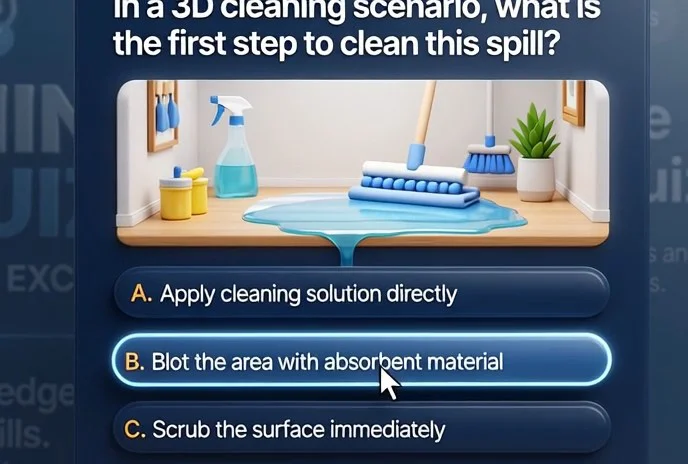
We developed a quest quiz based on Unity in which an employee enters a virtual situation: a chemical spill, waste sorting, emergency actions. They must make decisions within a limited time—a wrong answer shows the consequences and immediately explains what should have been done.
The game mechanics create healthy excitement: employees want to complete it without mistakes and earn maximum points.
What the Training Achieved
The pilot results exceeded expectations. 97% of employees completed the training course—instead of the usual 70%—and the average score on the final test rose from 64 to 92.
Three months later, a follow-up assessment showed that employees remembered key rules 2.3 times better than the group that studied with old materials. Additionally, we saw repeat completions: 45% of employees returned to improve their results.
Management noticed the effect as well: the number of violations related to waste handling dropped by a third within six months. The quiz also sparked lively discussion among employees—they shared screenshots of results in messengers, which widened the training reach.
After this success, the company scaled the project to five branches, and together with their team we prepared new scenarios for annual refresher training. The quiz is now used as a mandatory part of onboarding for new employees.
How to Choose the Right Quiz Format?
Selecting a quiz begins with the question of what problem you are solving. If the main goal is to objectively assess how well employees have absorbed environmental safety knowledge, a classic quiz with questions and answer options works well.
It is simple to launch, understandable to everyone, and lets you quickly collect statistics for the whole team—who is ready and who needs to review the material.
When the goal is not just to test but to engage the team in the topic, a quest format is worth considering. Instead of standard questions, employees enter a simulated situation—for example, a chemical leak or office waste sorting.
They must make decisions, analyze consequences, and find the right solutions—this is how knowledge is consolidated naturally and remembered for a long time.
The third criterion is reach and training location. For distributed teams and a large number of employees, an online format is convenient: everyone takes the quiz at a comfortable time from any device.
For in-person events, safety days, or meetings, team games that create lively discussion and a competitive spirit are suitable.
Also consider timelines and budget. A simple quiz can be prepared in a few days; a quest takes a little more time for scenario development but gives a deeper effect.
We will help you choose the right option for your timeline and budget, and if needed, combine formats: first an online check, then a live quest for reinforcement.
In the end, choosing the right format determines how quickly employees will start applying environmental safety rules in their everyday work. Focus on goals, number of participants, and available time—and we will select a quiz that solves exactly your task.
Frequently Asked Questions and Client Concerns
Before launching a training quiz, most clients have similar questions. We have collected the most common ones—and answer honestly, drawing on experience from dozens of projects for companies across various industries.
Employees won't take the game seriously—how do we make the training work?
We design the quiz not as entertainment but as an element of a knowledge assessment system. Questions are tied to your regulations and real situations, and results are visible to the manager.
Therefore, the game serves a practical purpose: the employee does not just earn points but remembers the correct action algorithm.
Will implementation take months and require stopping workflows?
No. A typical project takes two to four weeks—depending on the number of topics and participants. You do not need to assign a dedicated employee or change the schedule: it is enough to approve the brief and provide reference materials.
We handle preparation, launch, and technical support, so training runs in parallel with current work.
What if employees don't like the quiz or technical issues arise?
Before launch, we conduct a test run with your pilot participants. After launch, we remain available: throughout the entire period the quiz is active, you receive prompt support, and if needed, we adjust questions and settings. We record guarantees in the contract—this reduces risks for both you and us.
Order a consultation before the project starts—we will address your concerns on a concrete task. It is free and non-binding.Order a Quiz—Start with a Free Brief
To order a quiz, you don't need to prepare a technical specification or wait for approvals. Simply leave a request—we will provide a free consultation and help formulate training objectives.
This takes 20–30 minutes, and you will leave with a clear brief that shows how the project will be built.
The free brief is not a checkbox questionnaire but a working document. We will examine which employees will take the training, which environmental safety rules need reinforcement, and which format is more convenient—on a phone, in a browser, or in a training area.
In the end, you receive a scenario plan, timelines, and a transparent cost estimate without hidden items.
Here is how we will start the project:
- Request and consultation—we discuss your task, answer questions, and clarify details.
- Free brief—you fill it out on your own or together with us: goals, audience, topics, preferences.
- Scenario and plan—we propose the quiz structure: questions, mechanics, difficulty levels.
- Cost estimate and timeline—we fix the budget and milestones before work begins.
- Development and launch—we build the quiz, test it with real users, and deliver it to you.
- Support—we help after implementation and adjust questions and settings if needed.
You can start the project immediately after the plan is approved. We take on development, testing, and integration, and you receive a ready-made employee training tool—with clear results and feedback.
Leave a request for a free consultation—on the very first call you will learn how the quiz can fit into your training program and what is needed for that.