

Machinery Safety Training Does Not Motivate Employees
Formal occupational safety training does not change people's behavior. Employees sit through lectures, mechanically answer questions, but within a few days they no longer remember how to act in an emergency.
For industrial safety, this is not just a shortcoming — it is a direct risk to people's lives and to the business: injuries halt production, bring fines, and undermine team trust.
The problem is especially acute in machinery safety, where every movement at a machine requires strict adherence to regulations. Here, a formal approach to personnel training results in costly incidents.
Managers see that old methods don't work, but they don't always understand what to replace the boring briefings with.
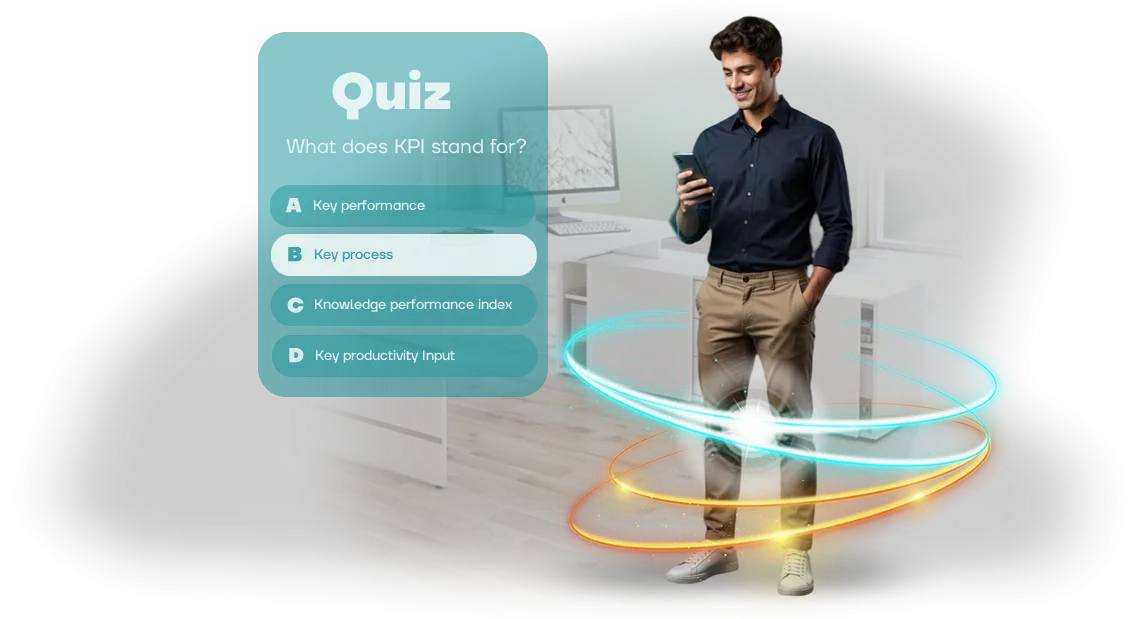
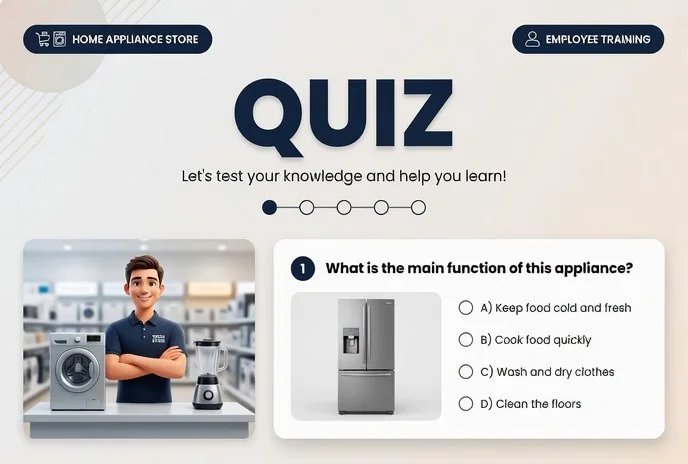
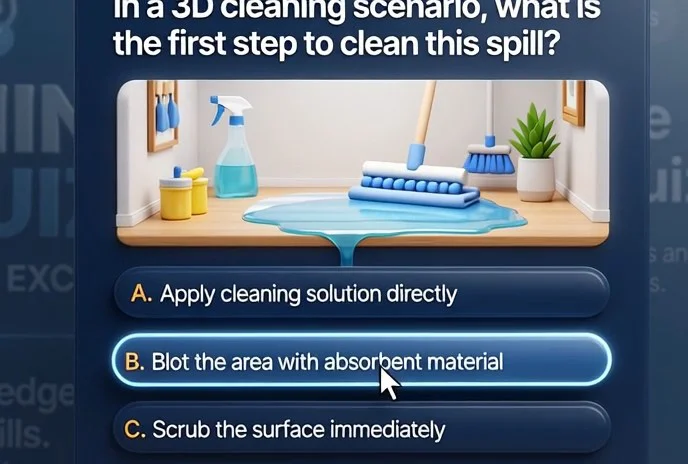
We close this gap with an occupational safety quiz — an interactive format that turns rules into clear scenarios. An employee doesn't memorize abstract items; instead, they experience situations, choose the right actions, and receive instant feedback. This is how knowledge becomes a habit rather than short-term memory.
For you, this means fewer incidents, stable shop floor operations, and peace of mind for every employee. Training stops being a formality and becomes a tool that genuinely protects people and the business.
Interactive Learning: Employees Get Engaged Instead of Going Through the Motions
When it comes to machinery safety, the cost of a formal approach is too high. Employees sit through lectures and briefings, but after a couple of weeks they remember neither the rules nor the action procedures. On the production floor, this translates into injuries, equipment breakdowns, and downtime.
Interactive training flips this scenario. The quiz immerses the participant in a virtual situation where decisions have to be made: choose the safe sequence for starting a machine, spot a violation on a shop floor diagram, react to an abnormal situation. This way, the material is remembered through action, not through note-taking.
Gamified training adds a competitive element: points, ratings, levels, time limits. Employees try to complete the module better than their colleagues and return to the simulator again and again.
That's how genuine employee engagement is achieved — they dive into the process instead of going through the motions.
We handle the technical side for you. The quizzes are built on the professional Unity engine — this guarantees stable performance both on an office computer and on a tablet on the shop floor, without glitches or freezes. You don't need to allocate powerful hardware or configure complex programs.
The result — an employee practices skills on a virtual simulator until they become automatic. In a real dangerous situation, they act correctly without thinking. The more such training, the more durable the skills and the safer production becomes.
Which Test Formats Fit Different Teams: A Visual Comparison Table
Each team learns machinery safety standards at its own pace. Shop floor operators can't step away for two hours, office employees respond faster to live scenarios, and remote branches need a clear completion system. If the format doesn't match the real working day, even quality material remains a formality.
To help you choose the right option without lengthy approvals, we've summarized the main test formats in a clear table. It shows which teams and tasks each format suits and what it delivers as an outcome.
| Format | Best for | What the client gets |
|---|---|---|
| Team quiz on a tablet | Work shifts, operators, line staff | Quick knowledge check right at the workplace, without stopping production |
| Remote training with tests | Remote employees, regional branches | A unified completion process and automatic reports for each team |
| Interactive quest scenario | Trainees, new employees | Engagement with safety rules through real workplace situations |
| Timed exam | Certification, authorization for critical tasks | Objective readiness assessment and reduced risk of errors |
The table isn't a rigid scheme. You can combine formats within a single project: start with a short quiz before training and finish with a control test. This gives you both live engagement and a measurable result across the entire company.
The Project in 5 Steps: From Brief to Quiz Launch
Developing a machinery safety quiz doesn't drag on for months or turn into a "black box." We've built a five-step process — at each stage you understand what's happening and can make changes.
-
Brief and deep dive into the task. We study your regulations, instructions, and typical violations. We define the goal — reduce the number of errors, prepare for certification, or boost engagement — and shape the format around it.
-
Scenario and question design. We turn dry rules into situations that employees encounter on the shop floor. We approve the structure: number of questions, difficulty levels, task types. You see the draft before development begins.
-
Layout and design approval. We show what the quiz will look like on screen: styling, texts, navigation logic. We make edits at this stage — it's faster and cheaper than reworking a finished course.
-
Assembly and testing. We build the quiz into a single program and test it on different devices and user behavior scenarios. You receive a test version and go through it as a participant — before your employees see it.
-
Launch and support. We install the quiz on the required devices or publish it via a link. We hand over instructions to the administrator and stay in touch: fix comments, add new questions, update blocks as regulations change.
What's Included in Delivery: A Complete Launch Kit
We don't just hand over a link to a game — you get a complete package of materials that can be used for training right away. You won't have to assemble manuals or search for answers — everything is ready and packaged for your specific task.
- Quiz scenario — ready-made questions and answers on machinery safety, organized by topic and difficulty level. Use them as is or supplement them with examples from your company's practice.
- The quiz application itself — a compiled program to run on employees' work computers or tablets. Installation takes minutes and requires no special knowledge.
- Facilitator's guide — instructions for running the game, recommendations for setting difficulty, timing, and reviewing mistakes. Suitable for both HR and department managers.
- Admin panel — you manage questions yourself, change answer options, and add new topics without involving developers. Content updates take minutes.
- Result analytics — the system collects each employee's responses, shows overall statistics, and identifies topics where the team makes the most mistakes. You see the real knowledge level, not just a formal completion checkbox.
- Launch and setup instructions — a step-by-step guide for the administrator to run the first game independently, without our presence.
- Training session for your team — a short session where we show how to use the kit and answer your employees' questions.
This package lets you launch training within a week of project delivery. If you need to add new questions or change game settings, your own specialist can do it without new budgets or lengthy approvals.
Case Study: How a Quiz Helped a Factory Cut Safety Violations by 60%
A machine-building plant, PromTekhMash, had a typical problem: safety briefings were conducted formally, and employees kept violating safety rules. Management understood that the issue wasn't punishment but a lack of engagement in the learning process.
They needed a solution that would make workers think about safety every day, not just during inspections.
We developed an educational quest quiz for the plant covering key rules for operating equipment, moving around the shop floor, and responding to emergencies. Instead of boring lectures, employees went through question-and-answer scenarios with instant feedback and error analysis.
The quiz adapted to each worker's level, so both newcomers and veterans absorbed the material without losing interest.
The results were measured two months after launch: the number of violations recorded by the occupational safety department dropped by 60%. The passing score on the final test rose from 62% to 94%, and the number of corrective action notices fell by 2.5 times. Most importantly, not a single accident occurred at the sites where the quiz was implemented.
According to the plant's safety engineer, for the first time employees themselves asked to continue training and even competed with each other for the best rating. This confirms: training effectiveness depends not on the strictness of control but on how much it engages people. The quiz didn't just punish violations — it helped build a culture of safe behavior.
How to Measure the Impact of Machinery Safety Training?
Training impact can't be measured by the number of completed courses or issued certificates. The real result is a change in employee behavior and a reduction in micro-injuries, equipment-handling violations, and accidents. That's why you need to measure the shift in knowledge and its application in the workplace.
The assessment is based on learning metrics: test results before and after the quiz, the share of correct answers per topic, time spent on difficult questions, and error repetition.
The difference between "before" and "after" shows how well the material was absorbed, and retaking the quiz shows whether the knowledge stuck. This is objective knowledge assessment, not emotions.
Learning analytics links results to safety performance. If violations have decreased and scores on control questions have risen after training, the program works.
We make sure such data is collected automatically and presented to managers as a clear overview: dynamics by department, topics that cause difficulty, and each employee's progress.
This approach turns machinery safety training from a formal obligation into a manageable process. Managers and HR see not just "who passed the test" but who has truly internalized the rules and is ready to apply them when working with equipment. This helps identify risk areas in advance and adjust the program before a mistake leads to injury.
In the end, training impact becomes measurable: fewer incidents, higher staff engagement, and a transparent picture across the entire team. This is exactly the kind of data that justifies the training budget and demonstrates a real return on safety investments to management.
Frequently Asked Questions and Client Concerns: We Address Them Before You Start
When it comes to a machinery safety training quiz, clients often have the same doubts: how long will development take, is it difficult to adapt to their regulations, will the quiz fit into their existing learning management system, and what happens after launch.
We address these questions before you start, so you can make a decision based on understanding the outcome, not on blind faith.
How long does quiz development take?
A standard project takes two to four weeks, depending on the number of questions and design requirements. We have ready-made mechanics templates, so most of the time is spent on content creation and approval with your safety experts. If you need an urgent launch by a specific date — we discuss it separately, we find a solution.
How does the quiz adapt to our instructions and regulations?
All content — questions, scenarios, error analysis — is created based on your materials. You send your current instructions, and we turn them into scenarios close to real production situations.
No abstract theory: employees see the same rules that apply in your company and learn to apply them in practice.
Can the quiz be integrated into our LMS?
Yes, the quiz works as a standalone learning module and easily integrates into an existing learning management system. We provide instructions and help with technical setup if needed.
Employee results are transmitted to your LMS — you can see progress and performance for each participant.
What happens after launch — do you just hand over the project?
After the launch, we don't disappear. You get support: we technically maintain the project, help update questions when regulations change, and refine the mechanics for new tasks. The quiz won't become dead weight — it will live and grow together with your training system.
Won't the quiz be too difficult for employees to grasp?
We deliberately keep the interface simple and intuitive, with a game-like presentation and clear wording. Employees experience training as a game, not another boring lecture. This improves engagement and material retention — exactly what the project is for.
Let's Get Started Right Now: Request Your Quiz Development
We know how quickly training gets "ticked off": employees click through slides and forget safety rules a week later. A pilot quiz solves this differently — it's embedded in the workflow, easy to understand, takes 10–15 minutes, and you can see who has learned what.
We suggest starting small: we'll develop a pilot version of a machinery safety quiz based on your real scenarios. This lets you evaluate the impact without large investments and adjust the program before scaling it across all shifts.
What you get after submitting your request:
- Consultation — we analyze your tasks, audience, and formats, and help you settle on the right mechanics.
- Pilot project — one topic or one site, delivered quickly with a clear result.
- Transparent timeline — we calculate a schedule tailored to your production calendar.
- Result demonstration — we show the pilot to the group and gather feedback.
- Scaling plan — the next topics and stages, building on what already works.
- Technical support — integration with your learning management system or separate access, whichever is more convenient.
After the pilot, you get measurable data: completion rates, errors, time. Based on that data, we launch full machinery safety training programs — without downtime or formal "check-the-box" training.
Submit your request for quiz development — we'll discuss the details and send you a timeline estimate. It takes no more than a couple of minutes.