


Why Employees Forget Training and How to Fix It with Steam VR
Employees complete training, and two weeks later they can’t recall key procedures. The reason isn’t laziness or poor memory—classic formats like presentations and on-screen tests only activate surface-level perception.
Information doesn’t stick because it never becomes a practical skill, which means training budgets and staff time are wasted.
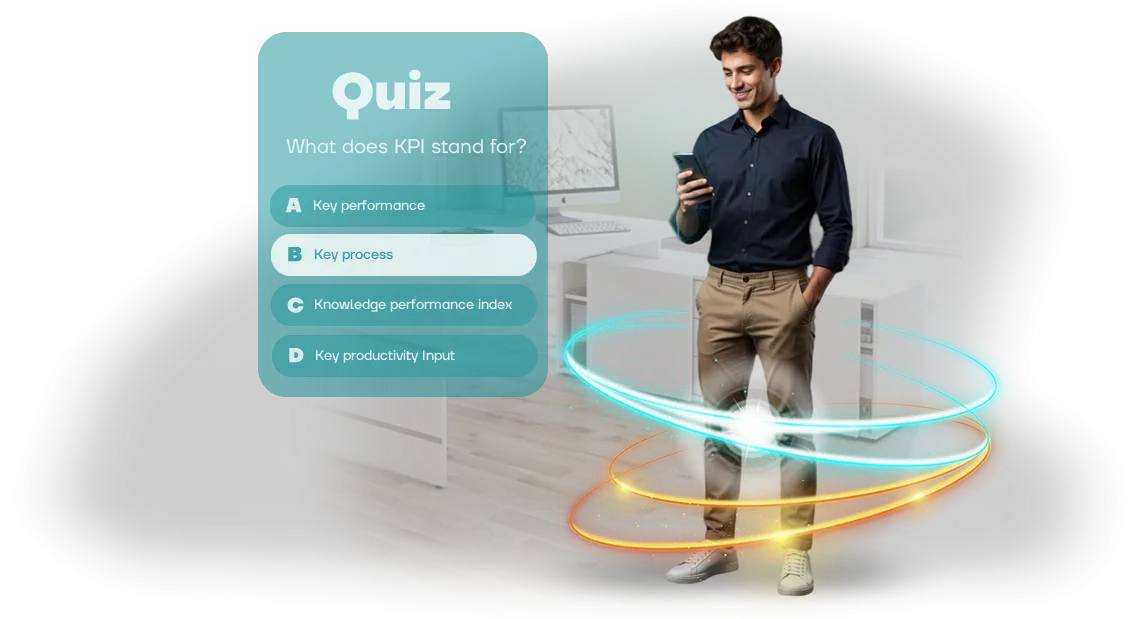
Steam VR quizzes solve this differently. Instead of passively reading slides, the employee is placed inside a training scenario: they make decisions, see consequences, correct mistakes, and get immediate feedback.
The brain remembers such experience as real action, so knowledge stays with the person and carries over into daily work without extra reminders.
For business, this means measurable results: faster onboarding, fewer careless mistakes, and consistent compliance with standards across all departments. Quizzes can be adapted to any corporate rules—from safety regulations to customer communication scripts. Managers get objective statistics: who has mastered the material and who needs additional training.
For over ten years, we have been creating interactive formats on professional equipment and proven tools, so clients get not an experiment but a working solution.
Steam VR provides a stable environment for corporate quizzes—employees can complete training from any compatible headset, and the company gets a unified quality standard without being tied to a specific office or branch.
The result is fast deployment, clear analytics, and training that employees actually use on the job.
What Business Tasks Does a Staff Training Quiz Solve
Ordinary lectures and presentations quickly lose employees’ attention: after just a few minutes they get distracted, and only a small part of the material remains after training.
Training quizzes turn the process into a game where every employee becomes a participant rather than a listener. This solution directly affects business metrics: higher engagement, faster adaptation, more accurate knowledge assessment.
The first and main task is increasing engagement. The competitive format, points, immediate reactions to answers, and visible progress make employees complete training with interest, not just to tick a box.
As a result, completing the course stops being a formality—people actually engage with the material.
The second task is material retention. When knowledge is tested in a question-and-answer format, the information is reinforced naturally.
Game mechanics use emotional memory: vivid scenarios and rewards help employees hold on to company rules, standards, and procedures for a long time.
The third task is saving time and providing objective knowledge assessment. Instead of manually checking tests, you get automatic analytics: which topics are well understood and where the gaps are.
This makes it possible to adjust training quickly and make HR decisions based on facts, not assumptions.
New employee onboarding deserves special mention. A quiz helps immerse a newcomer in corporate processes faster, introducing them to the product and quality standards without lengthy mentor support.
And if you add a virtual reality format based on Steam VR, training becomes even more realistic and memorable—employees practice scenarios in conditions as close to real work as possible, but without risk to the business. This is exactly the approach we implement for companies that want measurable results from training.
Steam VR Quiz Formats for Different Business Needs
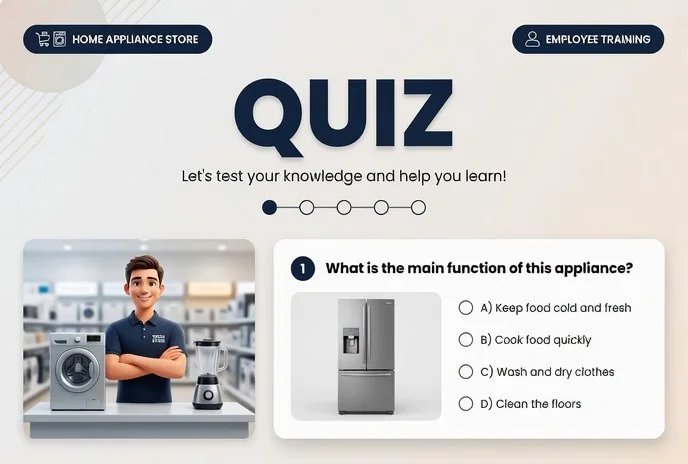
Steam VR quizzes are not just interactive variety. The same tool can be configured for a specific business task: faster onboarding of newcomers, checking safety knowledge, or conducting fair employee certification.
Quiz formats differ in scenario and depth of assessment, but they have one thing in common—employees learn in a safe virtual environment, and the company gets a measurable result. Below are three typical scenarios we implement most often.
| Format | For Whom | What It Gives the Business |
|---|---|---|
| Onboarding quiz | New employees | Fast immersion into procedures and corporate culture, fewer mistakes in the first week |
| Safety quiz | Workers, production staff | Practicing emergency actions without risk, knowledge checks without stopping the shift |
| Employee certification | Line staff, managers | Objective competence assessment, clear results for HR |
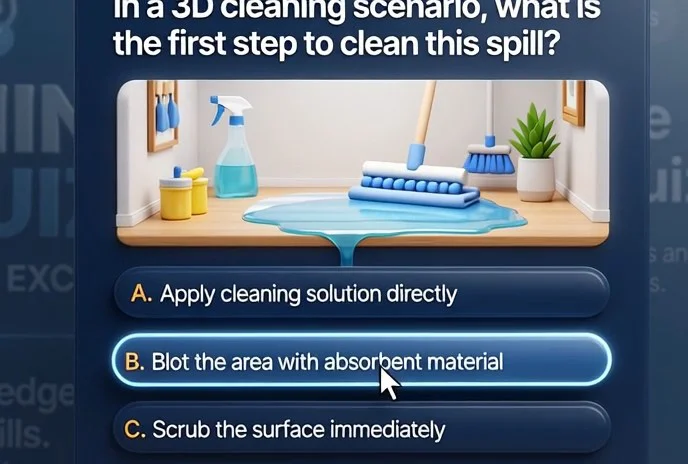
Each scenario runs in Steam VR on professional equipment. Employees don’t read abstract questions—they act in a virtual situation: they choose the right sequence of actions during a fire, spot an error in a workflow, or make a decision in a dialogue with a virtual customer.
This format increases engagement and retention, and HR gets clear statistics for each participant—who has mastered the material and who needs additional training.
If you don’t know which format suits you, start with an audit of your task. We’ll help you choose the best quiz and adapt it to your procedures.
Stages of Developing a Corporate Quiz for Employees
Corporate training often stalls because of boring lectures and tests—employees complete them just to tick boxes. A virtual reality quiz solves this problem, but to make it truly work, you need a structured process: from understanding business goals to launch and analytics.
Below are the stages we follow to create a turnkey quiz, including a Steam VR version, without surprises in timeline or budget.
How the Work Unfolds
-
Brief and goals. We define what the team should learn and which skills and knowledge are important to check. We determine the format: individual completion, team tournament, or part of an onboarding program.
-
Quiz script. Based on your company materials and interviews with experts, we write questions, answer options, and error explanations. The script is adapted for VR training—taking into account short sessions so employees don’t get tired and absorb material effectively.
-
Approval. You receive a document with the script, question structure, and scoring logic. We make edits before moving to assembly—this saves time and money.
-
Assembly and setup. We build the quiz in virtual space and connect the results tracking system. At this stage, the quiz already works on Steam VR equipment and is easy for an administrator to launch without technical training.
-
Pilot launch. We test with real employees, gather feedback, and refine the script and interface. We eliminate any rough edges before full rollout.
-
Launch and support. We deploy the quiz to the necessary locations or VR headsets, train administrators, and provide instructions. After launch, we provide support, update questions, and add new blocks if standards or products change.
After each stage, you understand what is happening and what result you will get at the finish. This approach allows you to implement training in 3–5 weeks without team downtime and with transparent reporting on employee progress.
What Is Included in the Delivery of a Corporate Training Quiz
We have put together a package with everything you need to launch a training quiz in your company—from script to regular updates. You get a ready-made solution, not a set of scattered files, and you can launch training within days after project handover. We work on professional equipment and proven tools, so the result is stable at every stage.
- Quiz script — developed according to your business goals and company specifics. We take into account who is being trained, what knowledge needs to be reinforced, and how to keep employees’ attention.
- Question and answer database — from 30 questions with explanations for each option. Questions are adapted to your industry: from regulations to product lines, with varying difficulty levels.
- Instructions for administrators and participants — short guides on how to launch the quiz, grant access, and collect results. No technical expertise needed: everything is outlined step by step.
- Admin panel — a convenient interface for managing questions, viewing statistics, and configuring the quiz for different employee groups. Change content without involving developers.
- Content updates — after launch, we regularly expand the question database based on your new materials and feedback. The quiz stays relevant, and employees stay engaged.
- Technical support — available during business hours to help with any launch or operation questions. If something goes wrong, we fix it quickly.
All of this is included in the cost and is covered by a contract with guarantees. All you have to do is set a launch date and gather your employees—we take care of the rest.
This approach has already been proven in dozens of projects for companies across different industries, including virtual reality training based on Steam VR—you get a modern format that increases engagement and material retention.
Case Study: How a Quiz Increased Employee Engagement
Let’s share a real case: a distribution company faced a typical pain point—employees completed mandatory training just to tick boxes. They opened the materials but didn’t engage, struggled through the tests, and forgot key rules a month later. After traditional lectures, engagement dropped and certification results were disappointing.
We proposed turning the dull regulation into a competitive VR quiz based on Steam VR. Instead of dreary slides—game rounds with questions, a timer, and instant feedback. Employees split into teams and followed the action on a shared screen.
The excitement and desire to win did what orders couldn’t: colleagues reviewed materials on their own and helped each other understand difficult topics.
The result exceeded expectations. Course completion rose from 40% to 96%—training became an event, not an obligation. The average certification score increased from 61% to 92%, and preparation time was cut in half: knowledge was absorbed right during the game.
For the client, this meant faster onboarding of new employees and fewer errors in customer interactions.
We also noticed a change in staff behavior: employees discussed the quiz in messengers, shared result screenshots, and asked for “more rounds.” The HR director noted that there hadn’t been this kind of interest in training for years.
A quarter later, the company ordered a second quiz for another department—and again saw growth in engagement.
This case is a clear example of how gamification transforms attitudes toward training. Employees don’t just sit through the time—they truly engage with the material, remember it better, and return to it gladly.
For business, this means increased staff efficiency without force—only through the right delivery format.
How to Choose the Right Quiz Format for Your Task?
Choosing a quiz format isn’t about technology; it’s about the task. If you need to quickly check how well employees have absorbed a regulation, a simple test is enough.
If the goal is to make new rules actually stick and be applied at work, a Steam VR quiz is the better choice: immersion in a scenario forces participants to think, not to recall answers from a textbook.
Look at three things: who will take the training, how often it repeats, and what result you want to measure. For mass onboarding, a short 10–15 minute session works well. For practicing complex situations, use a VR quest with a branching storyline.
We’ll advise you on which training format will deliver the effect you need without extra production or equipment costs.
You should also put extra thought into the quiz questions. Even the best platform won’t help if the questions are disconnected from real work. We formulate tasks based on your actual cases, so employees solve not abstract exercises but situations they face every day. This approach improves retention and reduces post-training errors.
Not sure where to start? Come for a consultation—tell us about your tasks, and we’ll suggest a format, scope, and launch plan. In 30 minutes, we’ll analyze what your team needs and show examples of similar projects.
It’s free and with no obligation: you’ll get concrete recommendations even if you decide to build your quiz with someone else.
Answers to Common Questions About Implementing a Quiz
Implementing a quiz is usually more frightening because of the unknown than because of actual complexity. Clients ask: how much time will launch take, do we have to buy VR equipment, and who is responsible for failures. We address the main concerns so your decision is easy.
Is it difficult to integrate a quiz into the work process?
No, it’s not a long IT project. We handle platform setup, question preparation, instructions for employees, and administrator training. From brief to launch usually takes 2–3 weeks.
Employees get a link, the administrator gets a results panel, and you get a ready-made training mechanism—without involving your own developers.
Do we need to buy extra equipment for VR?
For a standard quiz, a computer or smartphone that employees already have is enough. We use the VR format as an engagement booster: one headset and controllers are sufficient, and we can help you rent or choose them for the task.
We work on the proven Steam VR platform—this ensures stability and doesn’t require a technical team from the client side.
What guarantees that everything will work on launch day?
Before the event, we run a test, check the quiz on your equipment, and give you a checklist. On launch day, an engineer is on call: most issues are solved remotely, and if needed, they can come to your site if you’re in Minsk. These terms are set out in the contract.
If your question remains unanswered, write it in the comments. We’ll tell you which quiz format suits your team and how to integrate it into the training process faster.Discuss Your Task and Get a Cost Estimate for Your Quiz
To get a cost estimate for your quiz, you don’t need to fill out long technical questionnaires. Just leave a request—we’ll call you back within one business day, clarify your goals, and offer an option that fits your budget.
From there, everything follows a clear path:
- Request on the website or by phone—we record your preferences and a convenient time to talk.
- Consultation call: we discuss training topics, question formats, and the number of employees.
- Cost estimate: we send an estimate with options—basic and extended—so you can choose the best fit.
- Brief: a short questionnaire to refine content, style, and deadlines.
- Approval and launch: we prepare the quiz, test it, and hand it over to you on the platform.
- Feedback: after delivery, we support the result and make quick edits if needed.
The initial consultation and estimate are free and come with no obligation. You’ll receive a transparent commercial proposal within one or two business days and can calmly compare it with other solutions.
Ordering a quiz is simple: call or write to us. We’ll answer your questions, show you how to integrate training into your workflow, and prepare a tailored proposal for your team.