

The Problem with Gas Stations and Filling Stations: Training Doesn't Retain Staff
Staff turnover at gas stations is one of the most expensive problems a network faces. An operator completes training, starts their shift, and a couple of months later leaves for a competitor — and it all starts over.
Every new hire means more time, money, and the risk that the person never reaches the required level of service.
Low employee skill levels hit revenue directly. Errors at the cash register, confusion with promotions, slow service — the customer drives off to the neighboring station.
And when this happens repeatedly, the station earns a reputation for "poor service" — restoring trust is harder than conducting a dozen training sessions.
The problem is that conventional training for gas station staff doesn't work. Lectures and brochures get skimmed, briefings are done "just to tick the box," and knowledge is never reinforced in real situations.
A new employee ends up alone with the cash register, the fuel, and an unhappy customer — making decisions at random.
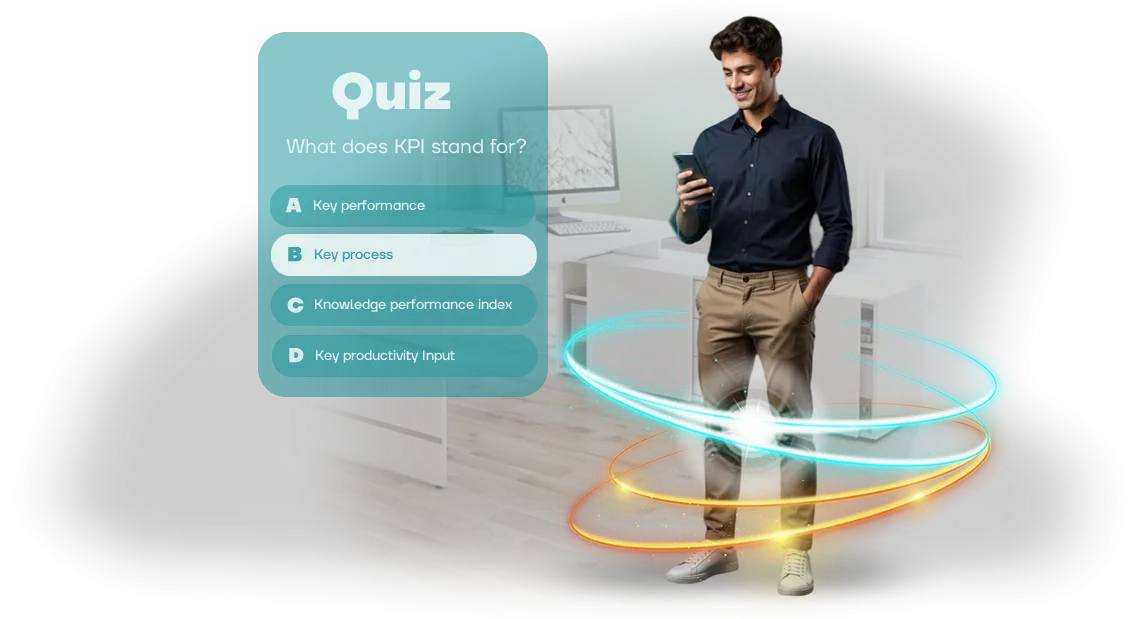
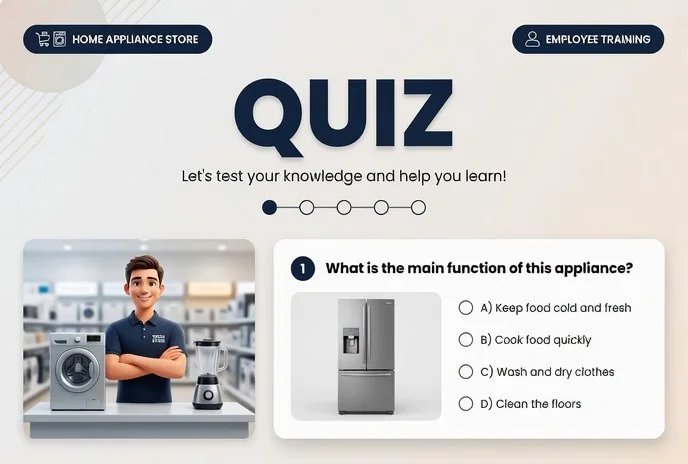
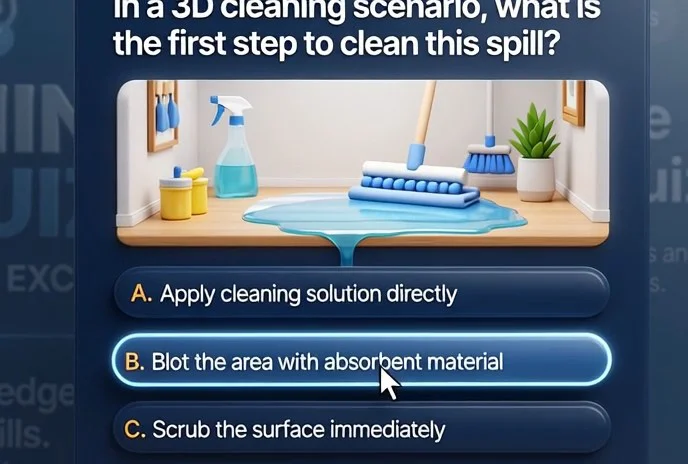
We close this gap with training quizzes: the employee works through game-based scenarios, sees the consequences of their decisions, and learns the rules through practice.
Training stops being a formality and starts delivering results — consistent service, fewer errors, and more confident staff.
Benefits of an Interactive Quiz for Employees
Training gas station employees isn't just about briefings and tests. An interactive quiz turns routine into a game, and staff actually want to complete their training.
For a gas station network with high turnover and strict standards, gamification becomes a solution that saves time and money.
Staff Engagement
Boring presentations and handouts don't hold anyone's attention. An interactive quiz with competitive elements motivates employees to finish their training and come back to it. As a result, staff don't just sit through the motions — they actually take part.
Knowledge Growth
The game format helps people retain information better: employees test themselves on the spot, see their mistakes, and reinforce the correct answers. Regular quizzes raise knowledge of the product, service standards, and safety procedures — without feeling forced.
Fewer Errors
When knowledge sticks, on-the-job errors drop: fewer incorrectly completed documents, more accurate compliance with procedures, and more careful customer handling. For gas stations, that's a direct impact on revenue and customer loyalty.
Wedevelop training quizzes on Unity tailored to gas station networks. We'll help you implement training gamification with minimal launch cost.
The quiz integrates into the workflow and requires no dedicated time — employees complete it in 10–15 minutes per shift, and the results are automatically sent to the manager.
Quiz Formats for Gas Stations: From Test to Simulator
Gas station employees work in a constant flow of customers — only minutes between shifts are left for training. Long courses and paper manuals lose out: the material is forgotten, and mistakes with customers and the cash register keep recurring.
Short quizzes and tests solve this: they fit into the shift schedule and test knowledge precisely, according to your procedures.
For training to deliver results, the format must match the task. We develop programs at three levels — from quick tests for daily control to scenario-based simulators with real situations at the station.
| Format | For whom | What it gives the client |
|---|---|---|
| Quick test, 5–10 questions | Cashiers and operators at the start of a shift | Knowledge control without taking time away from work; each employee's "weak spots" are immediately visible |
| Training quiz, 15–20 questions | New hires and staff after procedure updates | Engagement with the material, better retention through game mechanics |
| Gas station simulator, scenario-based quiz | Frontline staff and shift supervisors | Practice for difficult situations: customer, fuel, safety, cash register — without risk to the business |
When choosing a format, evaluate three parameters. First, the goal: knowledge control, new hire adaptation, or preparation for emergencies. Second, the shift rhythm: a test is convenient to take daily, a quiz once a week, and a simulator needs just two or three hours a month.
Third, flexibility: questions must be updated along with procedures so the training doesn't become outdated.
Most clients combine formats: the test keeps the basics sharp, the quiz engages employees, and the simulator prepares them for difficult situations. We'll build a program around your schedule and integrate it into the work process without compromising customer service.
How Quiz Development and Launch Work
We've structured the process so you always know what stage the quiz is at and can influence the result. No "black box": you get transparent stages, clear approvals, and fixed deadlines.
You don't need to understand the technology — we handle the entire implementation, while you control the content and the meaning.
-
Brief and immersion in the task. We discuss the goals: increasing brand awareness, staff training, customer engagement. We clarify the audience, the usage scenario (at the cash register, in a mobile app, on a corporate portal), and the desired results.
-
Concept and plan. We prepare the quiz structure: topics, number of questions, task types, reward options, and difficulty levels. You receive a document with the scenario description and work schedule — once you approve it, we move on to implementation.
-
Writing the questions and scenario. Our editors and instructional designers prepare questions with your specifics in mind. You make edits at this very stage — so the final quiz speaks the language of your employees and customers.
-
Build and testing. We assemble the game on a professional game engine and verify that it works correctly on different devices. We run internal testing, then you receive a link to a demo version and check how the quiz looks and works.
-
Approval and final tuning. You make the final edits to the texts and design. We lock the version, connect the required integrations (if statistics collection, result export, or synchronization with your training system is needed).
-
Quiz launch. We place the quiz where it's needed: on the website, in the app, or on the corporate portal. We provide instructions for administrators and train your team to work with the results.
-
Support and growth. After launch, we stay in touch: we promptly fix errors, help with updates, and add new questions when the quiz starts to get old. If you need to expand the functionality, we'll propose a solution.
In the end, you get not just a game but a ready-made training tool with a clear launch system and ongoing support. Every stage is transparent, deadlines are fixed in the plan, and you can see the result before the final launch.
What's Included in the Ready-Made Quiz Package
The ready-made package isn't just a game — it's a complete training solution for gas station staff. You get everything you need to launch without involving developers: the quiz itself, an intuitive interface, instructions, training reports, and a methodology guide. All that's left is to set a date and invite the staff — everything else is already configured.
Here's what's included in the delivery set:
- Ready-made quiz game — adapted to typical gas station work scenarios: safety procedures, customer service standards, and emergency action plans.
- Employee interface — a simple login page that works in a browser on any computer or tablet, no installation or lengthy training required.
- Admin panel — you manage the completion schedule yourself, turn the quiz on or off, and change questions and settings without programmers.
- Training reports — an automatic table: who completed it, who missed it, what percentage of correct answers, and which topics the team struggles with.
- Launch instructions — short guides for shift supervisors and administrators to organize the quiz in 15–20 minutes.
- L&D manager's methodology guide — a delivery script, recommendations for reviewing errors, and integrating the quiz into regular training.
Let me elaborate on reporting. You see results across the entire network or for an individual station: the number of people who completed the training, the average score, and problem topics.
This settles the control question — the manager gets concrete numbers, not "everyone seems to have passed." Based on the report, it's easy to decide who needs additional review and which shift has already mastered the material.
The methodology guide turns the quiz from entertainment into a full-fledged training tool. It lays out a plan: how to announce the initiative, how to motivate employees, which questions to review at the next meeting, and how to measure the effect.
In the end, the package works as a system: launch it once, and training runs smoothly from then on, without constant developer involvement.
Case Study: A Gas Station Raised Training Completion to 90%
At gas stations, employees change often, and a newcomer needs to be brought up to speed as quickly as possible.
Regular briefings and tests based on paper reference sheets don't work: completion drops, knowledge quickly evaporates, and the cost of a mistake is losses at the register and unhappy customers.
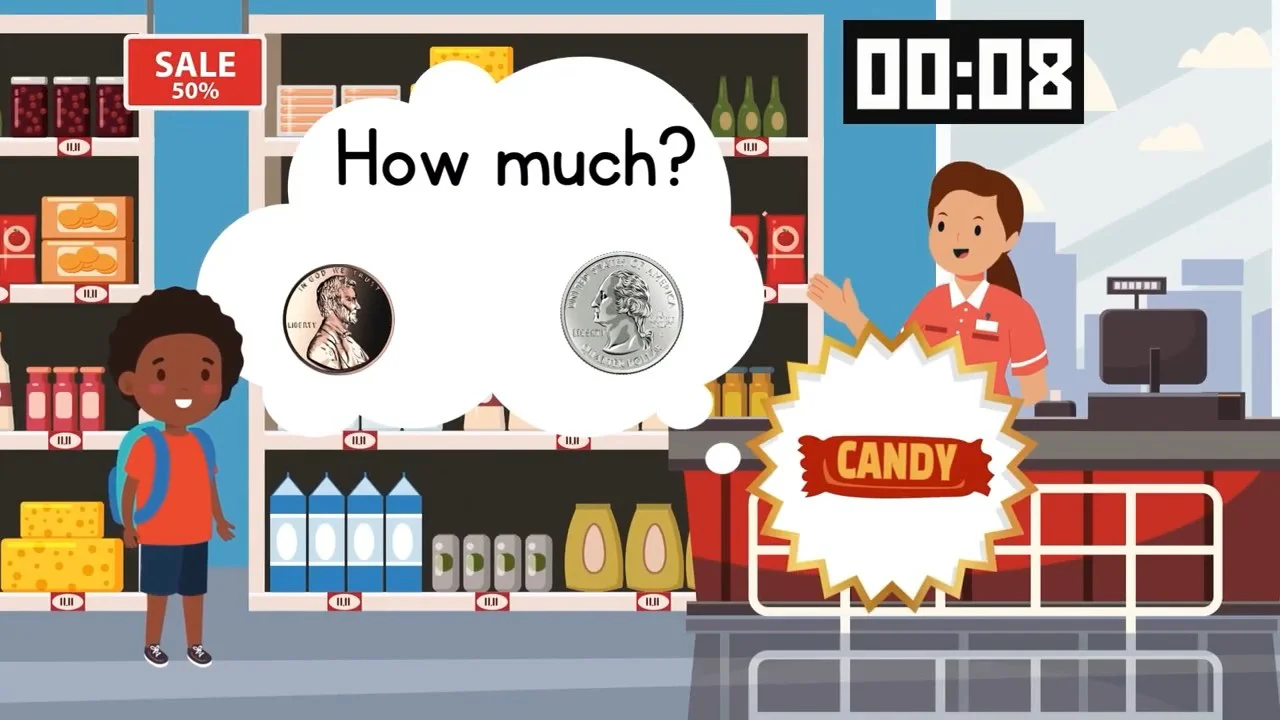
We solve this problem with a training quiz. Instead of reading boring slides, the employee goes through short game scenarios: meets a customer, refuels a car, resolves a conflict situation.
In the process, they make choices themselves and immediately see the consequences — that's how knowledge is reinforced in practice.
What Changed at the Station
The Magistral gas station network launched this quiz for all staff — from operators to shift supervisors. Training completion grew to 90%: employees reach the end instead of dropping the course halfway through. The quiz takes 10–15 minutes, so it can be taken right before a shift or during a lull.
The main thing for the business is the result. The number of errors when handling fuel and the cash register decreased, newcomers get into the work faster, and mentors stopped spending days repeating the same instructions.
The training manager sees statistics for each employee: who has absorbed everything and who needs another explanation.
Client Testimonial
Magistral's head of training says: "We've finally stopped asking whether an employee has read the manual. The quiz clearly shows who understood the topic and who just clicked buttons.
And it's not a one-time event — we add new questions ourselves for seasonal promotions, and an update takes a couple of days." Since then, the network has been ordering quizzes from us for new areas — both for training and for internal communications.
How to Choose a Quiz Format for Your Task?
Choosing a format starts not with a picture or a technical specification, but with the task. For a gas station network, this is onboarding new operators, checking knowledge of standards, or engaging employees in a competition between stations.
The answer determines which quiz to order: a short training game, a scenario with error analysis, or a tournament with a rating.
If the task is to train a newcomer in one shift, a compact format fits: 10–15 questions with hints, taken on a tablet or work computer. The employee sees the error immediately, gets an explanation, and remembers the correct sequence of actions. This format doesn't require dedicated time — it can be completed between customers.
When you need to maintain knowledge of standards — cash handling discipline, safety rules, customer communication scripts — regular short checks work better. They show which topics have slipped and let you review the material precisely where it's needed. Here, statistics for each employee and each station matter, not the mere fact of completion.
If the goal is motivation and healthy competition, choose a tournament: an overall rating, awards for the best, and team scores between stations.
People get involved in the game, return to the questions on their own, and the manager gets a clear picture of engagement without extra meetings.
The more precisely the format matches the task, the higher the return on training. For a simple check, a light quiz is enough; for large-scale network training, a scenario game with reports.
We help you decide, show examples from gas station practice, and fix the scope of work before the start: you pay for trained employees, not for extra options.
Common Doubts About Employee Quizzes
Having doubts before launching a training quiz is normal. Every client wonders whether the system will break, how much time implementation will take, and who will update the questions. Let's look at the three most common fears — and show how we address them in our work.
What if the quiz breaks down right in the middle of training?
The risk of failure is reduced to zero before launch. We test the quiz on real gas station scenarios — taking into account the number of employees, shifts, and workload.
After launch, we stay in touch: technical support accompanies the project, and in case of an unexpected situation, we take care of the fix ourselves. You're not left alone with the problem.
Will it take long to implement the quiz, and won't it stop the station's work?
Implementation takes from a few days to a couple of weeks — depending on the number of employees and the format of the tasks. Training runs in parallel with the work process: staff take the quiz between shifts, on a tablet or computer at the station. It doesn't stop or slow down the station's work.
Is it difficult to update questions when standards or promotions change?
Updating is made as simple as possible. You get a convenient interface through which you change questions, answers, and hints without contacting developers. New rules, fuels, or loyalty programs appear in the quiz in a couple of minutes.
Staff turnover is taken into account: candidates can be given the same course, and experienced employees — new tasks to test their knowledge.
Such concerns arise when a client encounters interactive training for the first time. But it's precisely the absence of technical difficulties and clear support that allow the quiz to work like an ordinary work tool — predictably and without surprises.Submit a Request — Start with a Pilot Quiz
Our team offers a format that removes risks: start with a pilot project and get a measurable result before the full launch. Submit a request for a quiz — and we'll conduct a consultation to understand the specifics of your gas stations.
Here's what the work timeline will look like:
- Quiz request. You leave your contacts — we get in touch within one business day, clarify the number of employees and training goals.
- Quiz consultation. We discuss the topics: safety procedures, service standards, knowledge of fuels and products. We propose a pilot scenario.
- Pilot version preparation. Our instructional designers compile questions from your procedures and style the quiz to match your corporate style. This usually takes 5–7 days.
- Launch at one station. The station's employees take the quiz at a convenient time — without taking time away from work and without extra stress.
- Analysis and report. You see which topics are well mastered and where additional practice is needed. You get clear numbers for the group.
- Scaling decision. If the pilot is effective, we roll the quiz out to the entire network. If needed, we refine the content and launch again.
Each stage brings a concrete result: from quick feedback to ready statistics for the station. You make the decision about next steps based on data, not assumptions.
Submit your quiz request now — it will take a couple of minutes. After that, we'll suggest a convenient time for the consultation and prepare a pilot project for your tasks.