

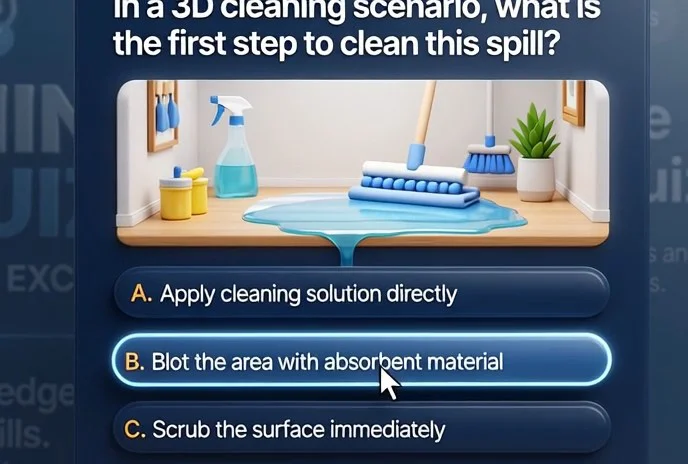
Educational quizzes for MFIs and credit institutions
In MFIs and credit institutions, employees undergo training regularly: new products, changes in legislation, service regulations. But classic formats — lectures, briefings, PDF memos — are perceived as a formality.
The material is forgotten by the end of the week, and this directly affects errors in customer work.
Staff training in the financial sector is not about “ticking a box” but about reducing risks and quality of service. When an employee knows the product terms confidently, they respond to customers faster, make fewer mistakes, and are less likely to create conflict situations. The question is how to ensure knowledge sticks without coercion.
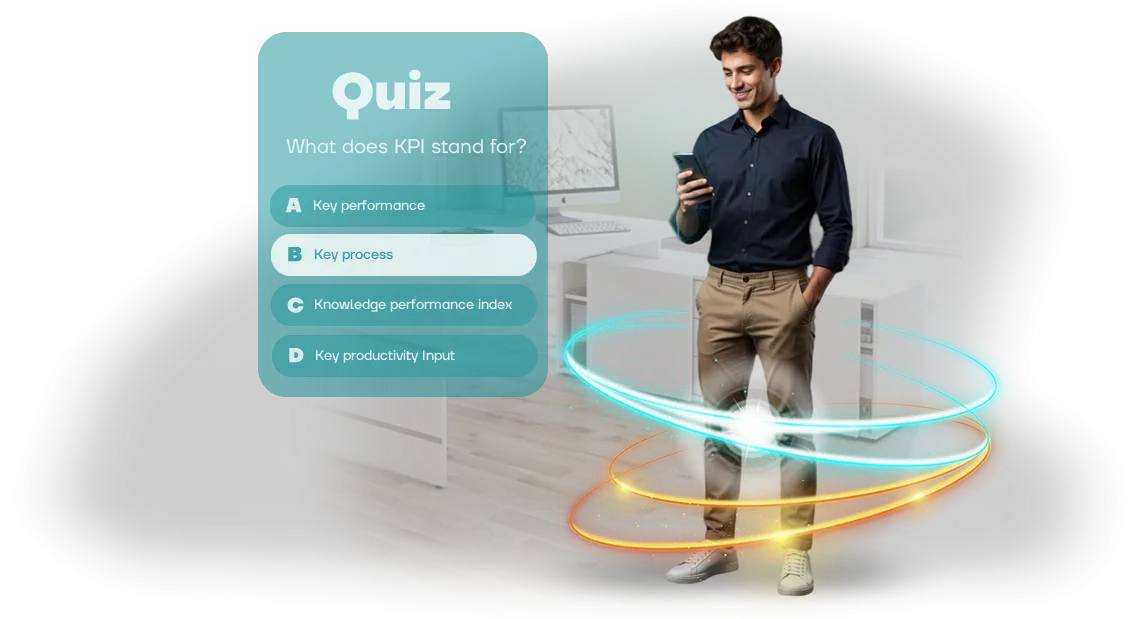
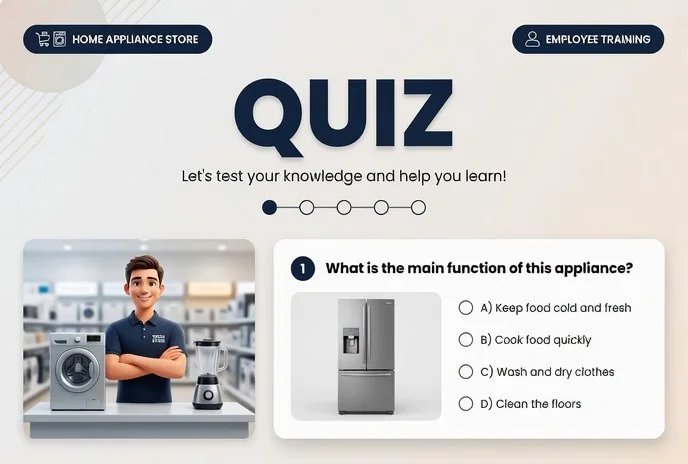
Educational quizzes solve exactly this problem. The game format triggers healthy competitiveness: a person answers questions, sees progress, compares results with colleagues.
Information is absorbed through action rather than passive reading — that way it stays in memory for a long time. For MFIs and credit institutions, this is also a control tool: you see which topics cause difficulties and adjust the program in time.
We develop educational quizzes for your internal regulations and products, integrate them into your distance learning system, or launch them as a standalone training. Employees complete the game on a computer or tablet, and you receive clear statistics for each participant.
The format is easy to update — when rules change or a new product appears, you simply add questions. This turns mandatory training into a useful game that delivers results for the business.
Why game-based learning increases employee engagement
Standard training in credit institutions and MFIs often turns into a formality: employees listen to the material, but a week later they forget key regulations.
Game-based learning solves this problem through quiz mechanics — it turns knowledge testing into an engaging process that people want to join.
The first benefit is employee engagement. Instead of passively watching a presentation, a person answers questions, sees their result, and compares it with colleagues.
The excitement and competitive spirit bring back even those who usually postpone courses — so the material actually gets worked through, not just marked as complete.
The second is material retention. When knowledge is tested in a format with instant feedback, the brain consolidates information more actively.
A quiz allows a short session to cover all key norms and internal instructions, which directly reduces the number of errors at work and helps new employees adapt faster.
The third is clear analytics for the manager. Game-based learning records which topics cause difficulties for the majority and which have already been mastered.
Based on this data, you can refine the program with precision and see the real level of preparation of each employee — without collecting paper reports or manual checks.
The fourth is format flexibility. The quiz runs on a computer or smartphone at a convenient time and does not require gathering a group in a meeting room.
Training fits into the current schedule, so it does not stop branch operations and does not create emergencies — everyone takes the test whenever it suits them and the team.
Finally, gamification of learning creates a habit of continuous development. MFI and credit institution employees are more willing to take regular knowledge tests in a game format, so the overall level of competence grows without coercion.
The quiz becomes part of the corporate culture — it strengthens team loyalty and reduces staff turnover.
Corporate quiz formats for different purposes
A corporate quiz is not just entertainment but a learning tool that can be easily tailored to the task. For MFIs and credit institutions, it is important to quickly communicate knowledge about products, regulations, and service to employees — and here the format is everything. We develop quizzes for a specific scenario: from a short warm-up to a full training course.
| Format | Target audience | What the client gets |
|---|---|---|
| Short quiz (5–7 minutes) | Front-line staff, operators, branch managers | Quick knowledge check after instruction, engagement without taking time away from work |
| In-depth quiz (20–30 minutes) | Department heads, product specialists | Deep reinforcement of material, analysis of gaps for each employee |
| Scenario-based quiz (story with decision choices) | New employees, trainees | Simulation of work situations — training on real cases in a safe environment |
The format determines the result. Short quizzes are easy to launch — once a week after a planning meeting to keep knowledge fresh. In-depth quizzes are suitable for preparing for certification and for monitoring after introductory training.
Scenario quizzes immerse employees in practical situations: customer communication, handling objections, product processing — and teach them to act correctly without risk.
For MFIs and credit institutions, it is important not only to train but also to confirm that the knowledge has been absorbed. A quiz provides objective statistics for each employee and department: who is managing, who needs additional work. Training becomes measurable.
How quiz development goes from brief to support
For many companies, developing a quiz seems like a complex task: you need to create a scenario, package it into interactive content, take into account the requirements of internal departments, and meet deadlines.
We turn this path into a transparent process with several stages, where you see the result at each step and control the budget.
- Brief and immersion. We collect initial data: learning goals, audience, desired length and complexity. We help you articulate which employee knowledge you want to test and reinforce.
- Planning and structure. We create a quiz map: topics, number of questions, logic for transitions between blocks. We agree on suitable formats — from multiple choice to matching tasks.
- Scenario approval. We write the texts of questions and answer options, select correct explanations. You receive a document that can be shown to methodologists and the security department — edits are made before development begins.
- Development and design. We build the interactive on a professional engine and adapt it for different devices: employees can take the quiz from a work computer, tablet, or smartphone.
- Testing and launch. We check logic, display, and result calculation. We train your team on administration: how to grant access, get a link, and view statistics.
- Support and analytics. After launch, we support the project, collect completion data, and help adjust materials for subsequent training cohorts.
This approach eliminates risks: you do not get a “black box” at the end, but control each stage of quiz creation. The main thing is that the scenario is approved in advance, so revisions are inexpensive, and the result precisely matches your objectives.
What is included in the delivery: a quick-start kit
The delivery includes everything needed to launch training within the next week. No lengthy development or technical specification approval — you receive a ready-made quiz with defined mechanics, questions, and settings. All that remains is to distribute links among employees and view the first results.
For MFIs and credit institutions, it is especially important that training tests real knowledge: of products, regulations, and transaction security. Therefore, the kit is built around your internal materials. Specifically, the delivery includes:
- A quiz scenario adapted to the needs of a credit institution: from a welcome screen to the final result.
- A question bank with answer options and explanations for the employee — what they answered correctly and why.
- Design in corporate style: logo, colors, fonts — so training looks like part of the corporate culture.
- A training reporting system for each employee: who completed, how many points they scored, which topics caused difficulties.
- Launch instructions: short checklists for the administrator and a participant guide.
- Technical support at the start stage and throughout the entire usage period.
- Question updates: as products or regulations change, you can replace questions yourself.
This kit saves time for methodologists and developers, and the manager gets a transparent picture of competencies. Everything is ready to go — all you need to do is set a date and invite employees.
Case study: how an MFI reduced onboarding time with a quiz
In one regional MFI, onboarding newcomers took almost a month: lectures, lengthy regulations, and control tests in spreadsheets. A third of those hired left during the first week, and the rest confused products and made mistakes.
Management was looking for a way to shorten this path — and we proposed implementing a training quiz.
How it worked
For MFI "FinPlus", we designed a game quiz that replaced boring instructions. Newcomers went through short rounds based on real scenarios: customer communication, contract processing. Every answer immediately received an explanation — mistakes stopped accumulating.
The quiz was integrated into the training plan from day one: the system guided step by step, and the mentor saw the result of each round. This accelerated onboarding without overloading mentors.
Business results
Within two weeks after launch, the average onboarding time decreased by 40% — from 15 working days to nine. First-try certification pass rates increased by a third, and the number of errors in application processing dropped noticeably.
Management noted that the team starts work faster, and there were far fewer questions for mentors. Based on the pilot results, the quiz was implemented in all company offices and included in regular training. Learning outcomes depend on format, not on the volume of material.
How to choose a quiz format for your task?
Choosing a quiz format always begins with a question: what problem are you solving? If you need to quickly check how employees have absorbed a regulation or a new product, a compact test with answer options and instant feedback is enough.
When the goal is to strengthen sales skills or practice complex customer dialogues, scenario-based cases work better, where the participant makes decisions as they go through the quiz.
Selecting a quiz to match the task is also about presentation format. For mandatory training at the workplace, a module that an employee completes in 10–15 minutes at a convenient time is ideal.
For team training or onboarding newcomers, a competitive format is more effective: groups compete, discuss answers, and error analysis turns into a live discussion. This makes training more memorable, and knowledge is absorbed more deeply.
Selection criteria also include team size and technical capabilities. If a branch has five employees, a simple online test with results in a personal account is enough.
If we are talking about a network with dozens of offices, it is better to choose a server version with centralized statistics and different user groups.
We always clarify these parameters at the start to offer an optimal option — without overpaying for unnecessary features and without losing convenience.
It is also important to remember motivation. People complete quizzes faster when they see progress, a rating, and clear results. Therefore, we offer options with points, answer time limits, and a clear final result.
These elements help turn a routine knowledge check into a game that employees complete with interest, and you get accurate data on who has learned what.
In practice, the choice of format should be made together with the developer: during a brief, we analyze your tasks, audience, and desired result, and then propose a suitable format — from a simple test to a multi-stage scenario with error analysis. This way you get a quiz that solves your specific problem, not just a beautiful but useless tool.
Frequently asked questions and concerns before ordering
Before ordering an educational quiz, managers at MFIs and credit institutions have the same questions: “What if employees complete it formally?”, “How long will the launch take?”, “How do we integrate the tool into existing HR processes?” Below are honest answers to these concerns, based on implementation experience in dozens of financial-sector companies.
What if employees treat the quiz formally, just “for show”?
We design the quiz so that people want to complete it: short rounds, clear scenarios, elements of competition between departments, and final statistics for the manager.
You see not only the fact of completion but also the percentage of correct answers, time per question, and problematic topics — so formality is eliminated at the engagement level.
How long does it take to implement a quiz?
A typical cycle is two to three weeks from the moment we receive materials. We collect the questions ourselves, adapt them to internal regulations and policies, run a test launch with a group of employees, and only then open access to everyone. You don't need to assign a dedicated person for coordination — our manager handles the process.
How does the quiz integrate into HR processes?
The finished quiz easily connects to an existing training system: it can cover initial onboarding for newcomers, knowledge checks after updated instructions, or annual certification.
All results are exported to a report that can be attached to internal documentation — this addresses competency and discipline tracking without additional manual checks.
Most concerns are resolved at the brief stage. We show how the quiz will look on an employee's screen and agree on the completion logic before development begins. So you can see in advance what you will get and confidently plan the launch within your own time frame.Order a quiz development — let's discuss your tasks
Getting started is easy: leave a request on the website and get a free consultation. We have worked with MFIs and credit institutions for a long time, so we will immediately ask the right questions — about goals, audience, and quiz format, not technical details.
After your request you receive:
- A response within one business day and a personal consultation on your task
- A free brief: we help you define quiz goals and choose the right format for your team
- An estimate of timelines and work stages up to full launch
- Recommendations on mechanics: from quick knowledge checks to team tournaments between branches
- Examples of quizzes for MFIs and credit institutions with results
- A preliminary project plan with the scope of work — what will be done and when
This is enough to make a decision without risk: you understand the timelines, stages, and result in advance.
From there, we follow a transparent scheme: after the brief, we send a concept within a couple of days, then build a working quiz prototype, and after your “excellent” — the final version with instructions for employees.
Ordering a quiz development is simple — leave a request, and it obligates you to nothing. We'll discuss how the quiz will fit into your training: it will help quickly onboard newcomers, test knowledge of products and regulations.
We'll explain what we do turnkey: mechanics, questions, design, and integration into your internal learning system.