

Why Do Employees of Retail Chains and Retail Centers Forget Training?
Training in a retail chain is an expensive affair: you need to pull a shift off the sales floor, prepare materials, and explain standards to new hires. But the main problem is not the budget — it's the result.
Lectures, videos, and instructions are passive: the employee sits, nods, and a week later remembers barely half. High turnover makes it worse: every new shift requires another cycle, and shifts are packed — there's simply no time to absorb the material.
And what do forgotten knowledge and skills mean for a business? Cashier errors, an unheard complaint, an incorrect product display. Every incident costs money and hurts both the chain's revenue and its reputation.
It's a double cost: you pay for the training and for the hours staff spend off the floor, and the outcome still isn't right.
The second reason is the format itself. Retail has a lot of information: new products, promotions, regulations, safety rules. This entire flow is delivered as a solid block of text, so attention retention inevitably drops.
Within two or three weeks without practice, knowledge fades, and ineffective training has to be repeated.
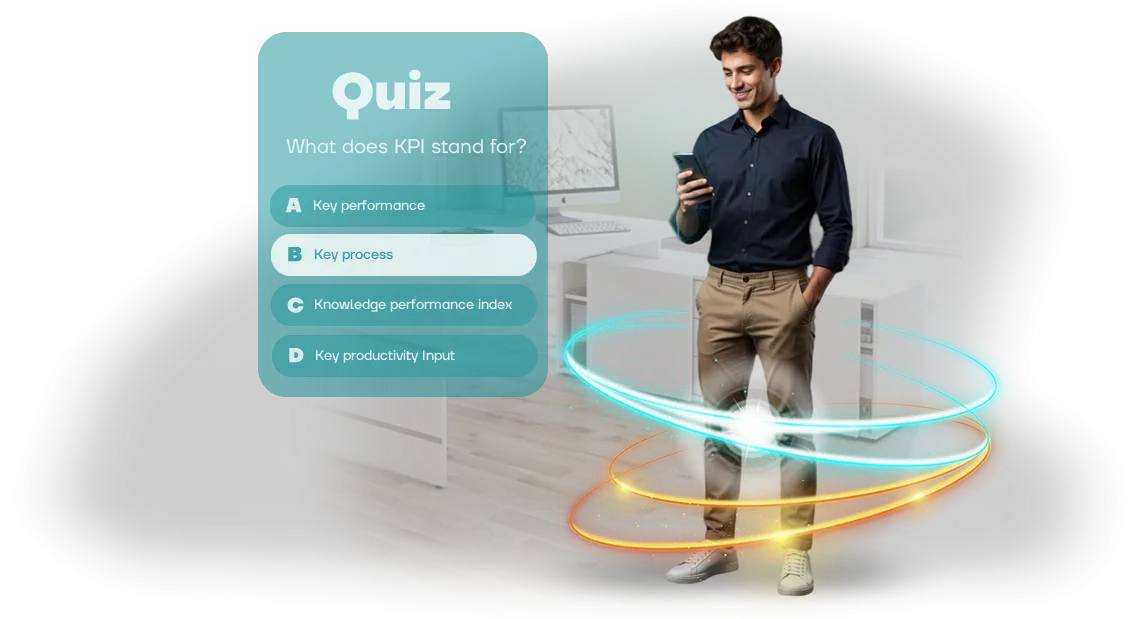
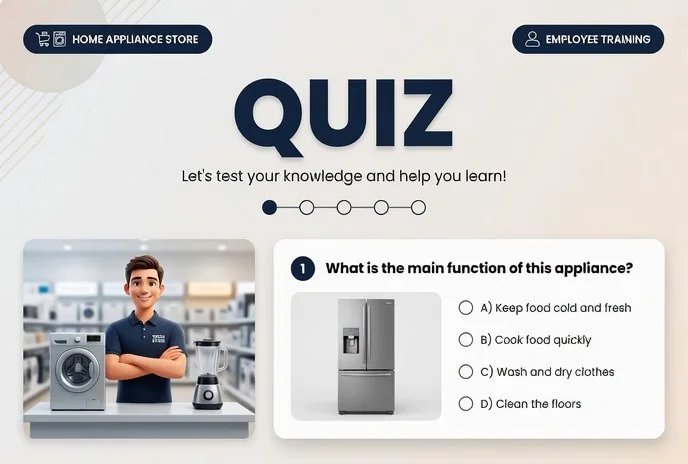
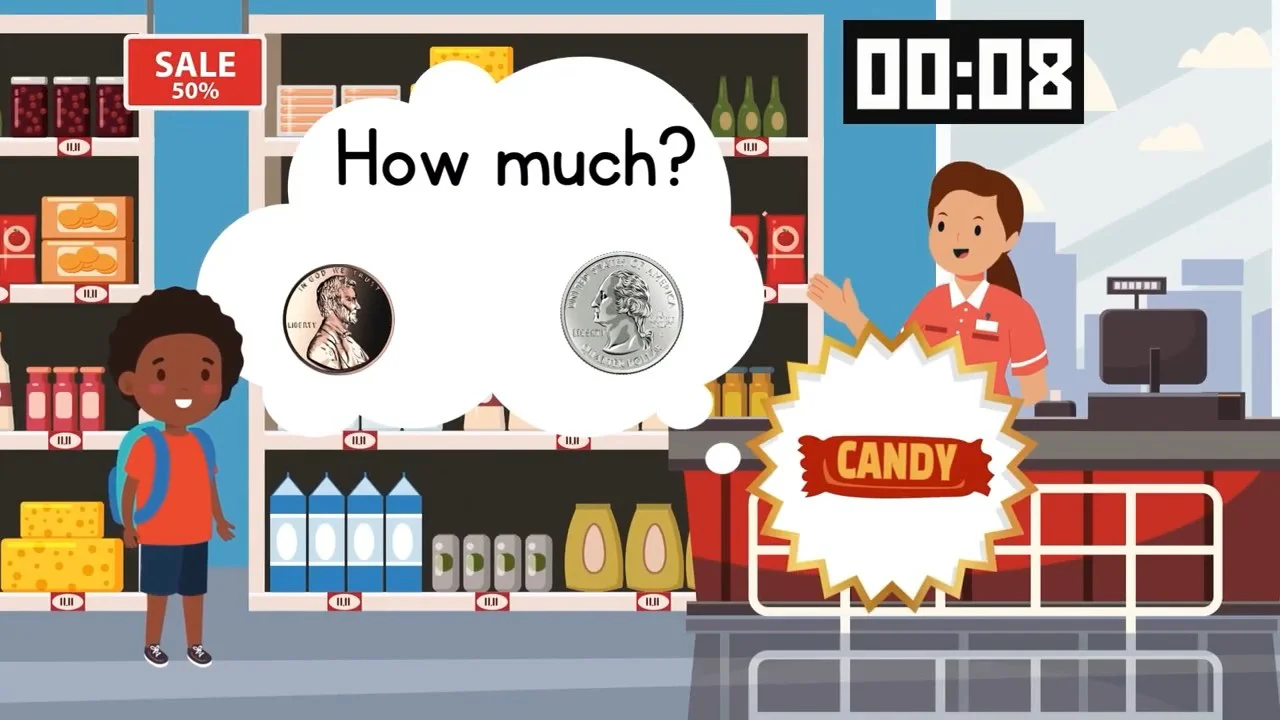
This is where a quiz for employees helps. It turns staff training into an active game: the employee answers, chooses the right option, sees their mistake immediately, and earns points.
This mechanics keeps attention and reinforces the skill at the moment of answering — not "sometime later." For retail chains and retail centers, this means a well-prepared employee who sells more and makes fewer mistakes.
We build such quizzes at our team. Below, we'll show how exactly they fit into your training program.
What Results Does a Training Quiz Deliver?
A training quiz works as a management tool: it doesn't just entertain; it solves specific business tasks for a retail chain. Let's look at five measurable results you'll get after launching it.
The first benefit is increased engagement. Employees get involved more willingly: the game format removes the fear of making mistakes and turns mandatory training into a competition.
Instead of "checking a box," staff actually take an interest in the material, and knowledge sticks naturally.
The second result is speed of learning. Short questions and instant feedback help employees memorize key working standards in a single shift rather than over a week of lectures.
For retail this is critical: you don't need to pull people off the floor for long trainings, and new employees reach the required level faster.
The third point is measurable knowledge control. A manager can see, for each employee, who has absorbed the regulations and who needs extra support. Reports show the before-and-after dynamics, so personnel decisions are made based on data, not assumptions.
The fourth benefit is time savings. The quiz runs alongside the work process: an employee answers questions in 5–10 minutes, and the results go straight into the system.
Scaling to thousands of people doesn't require hiring more trainers — this is especially important for chains with high staff turnover.
The fifth outcome is a unified training standard. All employees at all locations go through the same scenarios, so service quality levels out regardless of region or seniority.
In total, the quiz delivers engaged staff, fast adoption of standards, transparent knowledge assessment, and resource savings — you get not just a game but a management tool that pays for itself in the first month.
Quiz Formats for Different Business Tasks
In a retail chain, employees face different learning tasks: newcomers need to master standards quickly, experienced staff need to refresh their knowledge, and managers need to check the team's readiness for the season.
Each task requires its own game-based learning format: what motivates at the start isn't suitable for regular check-ins. That's why we use three basic quiz types and flexibly combine them to fit business goals.
| Format | Who it's for | What it gives the client |
|---|---|---|
| Olympiad | Teams with different skill levels, product launches, or motivation through competition | Explosive interest, identifying leaders, higher engagement without coercion |
| Marathon | Regular training for large teams, a long period — a month or more | Continuous knowledge reinforcement without taking time off work, high regularity of participation |
| Verification | Certification, post-training control, assessment of new employees | A transparent view of each person's knowledge, fewer client-facing mistakes |
We don't just build a quiz — we design a game scenario for a specific business task: a competition for a launch, a series of short rounds for systematic training, or a strict survey for certification.
This saves the manager's time and provides clear numbers: which topics have been learned, who is falling behind, and who needs additional training.
Each format is easy to adapt to a company's corporate style, and results are immediately visible in a personal dashboard. This way you control the learning process without distracting employees from their main work.
How Turnkey Quiz Development Works
A transparent process without surprises is what sets a reliable quiz vendor apart from a random team. We've structured the work so that at every stage you understand what's happening, what's already done, and when the quiz will start training your employees. No black boxes: only agreed steps, clear reports, and fixed deadlines.
- Brief and immersion in the task. In 1–2 meetings, we find out what knowledge needs to be tested, who your employees are, and how often they undergo training. We select a format that fits their work rhythm — from short 5-minute tests to full-length hour-long quizzes.
- Scenario and questions. Together with you and your methodologists or experts, we write questions, answer options, and explanations. We take the specifics of a retail chain into account: service standards, product knowledge, regulations, and safety protocols.
- Concept and design approval. We show an approximate look of the quiz: style, structure, and navigation logic. You make edits before active development starts — this saves time and budget.
- Quiz creation and technical implementation. We build the quiz using proven tools: we set up per-employee statistics, result delivery, the option to retake, and adaptation for employees' phones and tablets.
- Testing and debugging. We run the quiz through real scenarios and check how the system behaves under a large number of simultaneous attempts. You get access to a test version and confirm it's ready.
- Launch and team training. We onboard your employees: send out the link, help set up access, and explain how to read reports. From day one you can see who has completed the training and who needs a reminder.
- Support and further development. After launch, we stay in touch: we fix inaccuracies, add new questions, and adjust the difficulty. Usually after 2–3 months of use, we update the quiz — and it keeps working toward your goals.
This approach has already been tested in retail chains: employees train without leaving their work, and managers get a clear picture of who has absorbed the material and where additional practice is needed.
When choosing a quiz contractor, you get not just development but a complete turnkey quiz creation process — with clear stages, no missed deadlines, and no need to dig into technical details.
What's Included in the Training Quiz Delivery
You receive a complete delivery package that immediately integrates into the training processes of a retail chain or retail center. You don't need to hire additional contractors or get into technical details — we hand over everything in one package, from scenario to support.
What's included in the package:
-
Ready-made game scenario — a well-thought-out structure: an easy start, increasing complexity, and competitive elements. Employees experience the quiz as an engaging game rather than a boring test, so attention stays to the end and the material is absorbed better.
-
Question library on your topic — quiz content tailored to your regulations, standards, and product knowledge. Questions can be replaced or supplemented with your own — this is done without a programmer, through a simple admin interface.
-
Brand customization — design in your corporate style: logo, colors, fonts. Employees see familiar company design and, at the same time, remember the company's visual standards — this strengthens brand recognition.
-
Launch guide — a simple two-to-three-page manual explaining how to switch on the quiz, what settings to use, and what to do in standard situations. Any administrator can handle it without special training.
-
Administrator training — a short online meeting where we show how to manage the quiz: change questions, time limits, and rules. Usually 30 minutes is enough for your team to start working independently.
-
Ongoing support and maintenance — we're available during working hours, quickly answer questions, and help solve any problem. Support is included in the cost and remains active for the entire period of use, so you can always count on us.
In the end, you get not just a program but a complete training tool that can be launched the day after delivery. It saves employees' time, reduces the burden on mentors, and makes training in a retail chain predictable and regular.
Case Study: How a Quiz Improved Staff Knowledge
For a large retail chain we'll call Alpha-Retail, staff starting knowledge of the product range and service standards was at 56%. Regular lectures and paper tests didn't change the picture: employees memorized the material for the check and returned to old habits a week later.
We suggested replacing knowledge checks with a training quiz. Instead of a boring survey — short game sessions of 10–15 minutes: questions broken down by topic, the correct answer with an explanation shown immediately, and a competitive element.
This creates an active response and true retention rather than rote memorization. The game mechanics reduce stress: the quiz feels like practice, not an exam, so even those who previously avoided tests take part.
Implementation Results
Just two months after launch, the average test result rose from 56% to 88%. The training happened directly at workstations — without time off shifts and without the cost of external trainers.
Store managers got a simple results dashboard: you can immediately see which topics are weak for a specific employee.
The project's success was confirmed by a repeat order: the chain launched a second wave of quizzes for new product categories. The quiz became part of the staff onboarding and certification system, and we now support this process on an ongoing basis. This approach is easy to scale to new departments and stores — just add fresh questions.
How to Choose the Right Quiz Format?
Choosing a quiz format depends directly on three parameters: how many employees need to be trained, how widely they are distributed, and how often you plan to use the game.
These characteristics determine which quiz to choose — a short one for a quick launch or a deep system for regular training.
For a small team in one location, live sessions with a host are a good fit — they create excitement and involvement.
But if we're talking about a retail chain with hundreds of locations and thousands of employees, a format that can be launched from any device at any time is more effective. This removes logistical constraints and lets everyone complete training without leaving work.
Frequency of use will point to the right format. For a one-time introductory training, a compact 10–15 question quiz is enough to hold a newcomer's attention.
For regular knowledge checks — when product ranges or service standards change — you need a modular structure where questions can be easily replaced without stopping the game.
The more often you plan to run the quiz, the more value you get from automation and a ready-made mechanism.
When selecting a quiz, we always start from your conditions: the number of employees, reach, and regularity. We propose an optimal structure and integrate your materials into it so that training solves the business task from the very first launch. Describe these three parameters to us, and we'll prepare a solution for your chain.
Frequently Asked Questions About Quiz Development
Before launching a training quiz, learning specialists and managers often have questions: timelines, data security, and brand adaptation. We've collected answers to the most common ones so you understand how the work will be organized and what result you'll get.
How long does quiz development take?
A standard quiz for a retail chain takes 3–4 weeks. If you need a simple version with standard questions, we can do it in two. We give the exact timeframe after the brief and scenario approval.
How is employee data protected?
All completion statistics stay inside your company: we host the quiz on an internal server or in a secure environment. Only authorized employees get access to the results; third parties can't see the data.
Can you adapt the quiz to our brand?
Yes, we fully follow your corporate style: colors, logo, and tone of voice. The scenario is written for a specific department's goals — from onboarding newcomers to practicing service standards.
What if employees don't like the quiz?
First, we launch a pilot with a group of 10–15 people, collect feedback, and adjust the scenario. If any issues remain, we refine it until you're satisfied with the result.
Do you have feedback from retail clients?
Yes, we have positive feedback from retail chains and retail centers. Quizzes help bring new staff up to speed faster and increase engagement in training, which is why many clients come back for new quizzes.
Order a Training Quiz Development
To order a training quiz for employees, you don't need to understand quiz mechanics. Just leave a request, and we'll prepare a scenario, a schedule, and a cost estimate for free.
A consultation on the format and questions is also included in the first step, with no obligation on your part.
We work with retail chains and retail centers, so we know how to turn regulations, standards, and product knowledge into a game. Employees remember material faster when it's delivered through competition and emotion, and you get an objective picture of who has learned what.
When you leave a request, you receive:
- A quiz scenario tailored to your tasks — from a simple knowledge check to a full training course.
- A schedule with stages and deadlines — from brief to launch in your training system.
- A transparent cost estimate for quiz development: the price is fixed before the start and doesn't change during the process.
- Consultation on question types, difficulty, and rules, so the quiz is fair and useful.
- Examples of our quizzes for retail chains and retail centers that you can review.
- Implementation recommendations: in-person training, a remote course, or a hybrid format.
This package gives you the full picture in terms of timelines, budget, and content. You can calmly compare us with other vendors and make your decision. And if the project doesn't go ahead, you're left with a ready-made plan you can use as a basis for training.