


Developing quizzes for colleges and universities: boosting engagement
Colleges and universities spend a lot of resources on staff training: orientations, courses, seminars, mandatory lectures on occupational safety, information security, and internal regulations.
But often these formats work only formally: attendees sit through the hours, nod at the right moments, and within a week forget most of the material.
The reason is not staff laziness — it is that passive information intake does not spark interest, provide feedback, or show practical value.
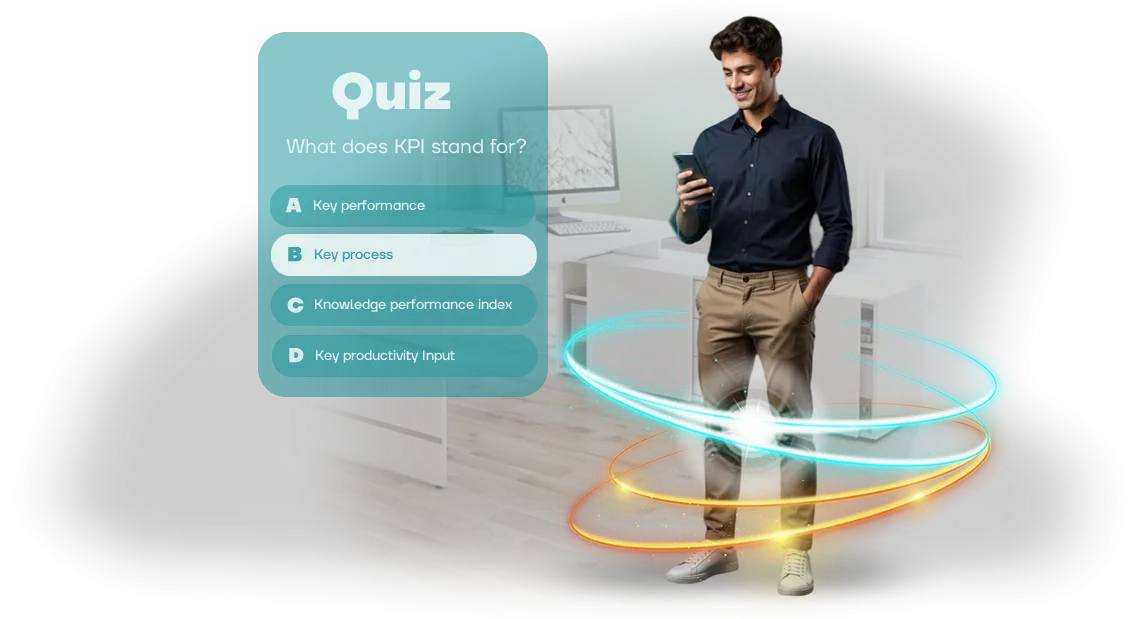
Training quizzes solve this problem differently. They turn knowledge assessment into an engaging game: employees answer questions, get instant feedback, see their results, and compare them with colleagues.
The competitive element and emotions help consolidate the material more reliably than simply reading instructions or listening to lectures. What is more, a quiz can be completed at a comfortable pace, returning to difficult topics several times.
For colleges and universities this is especially valuable. A quiz can be adapted to internal regulations, quality standards, safety procedures, or professional standards.
It is equally effective for the initial onboarding of new employees, scheduled certifications, and regular professional development — everything happens in an easy format, but with a measurable result. Management sees who actually absorbed the material and who merely checked the box.
We develop training quizzes that fit into the corporate learning process and require no special preparation from employees. Engagement grows, knowledge sticks, and the university administration gets clear completion statistics.
This way, learning stops being an obligation and becomes part of the corporate culture, and a quiz for the university works toward a common goal — increasing the team’s competence.
What a training quiz gives you: 5 benefits for your organization
Quizzes have long ceased to be just entertainment. In staff training, they work as a gamification tool: they turn routine knowledge checks into a game that people want to play.
This is especially relevant for colleges and universities — interactive learning helps hold the attention of both faculty and administrative staff. Here are the five main benefits your organization gets.
1. Engagement instead of boredom
Employees complete training with interest, not just “for show.” The competitive element, timer, and instant feedback keep attention focused, so the material is absorbed naturally — without feeling forced.
2. Simple knowledge control
Managers see transparent statistics: who passed, how many correct answers, where the most common mistakes are. There is no need to collect reports manually — the system itself shows the result of each employee and the whole group.
3. Time savings on preparation
A question builder and ready-made templates let you assemble a quiz on a specific topic in a couple of hours. Updating the material takes minutes: the regulation changed — you make the edits right away, and employees immediately take the up-to-date version.
4. A unified training standard
All employees study the material under one program, and the quiz reveals knowledge gaps. This is especially important for universities, where you need to check knowledge of internal instructions, requirements for working with students, and other mandatory norms.
5. Motivation to develop
Ratings, points, and rewards for successful completion encourage employees to return to learning voluntarily. Knowledge is reinforced, and the corporate culture becomes more modern — instead of formal lectures, people engage in the process on their own.
The development of such quizzes for colleges and universities is handled by our team. We create game formats that fit into the educational process and deliver measurable results — from increased engagement to reduced time spent on knowledge control.
Training quiz formats: how to choose the right one for your task
A training quiz is not just entertainment but a working tool that helps check knowledge, reinforce material, and increase engagement in learning. In colleges and universities, the same content is often used for both students and staff — but each task requires its own format.
There is no universal solution: what works great in a large lecture hall will fail in a training session for faculty or administrative staff. That is why we first determine the goal and audience, and then propose the appropriate type of quiz.
| Format | Who it’s for | What it gives the client |
|---|---|---|
| Interactive quiz game | Students, employees | High engagement, material retention |
| Quiz with prizes and ratings | Large groups, competitive teams | Motivation, healthy excitement, repeat participation |
| Test with error analysis | Certification, knowledge control | Objective assessment, clear analytics, reporting |
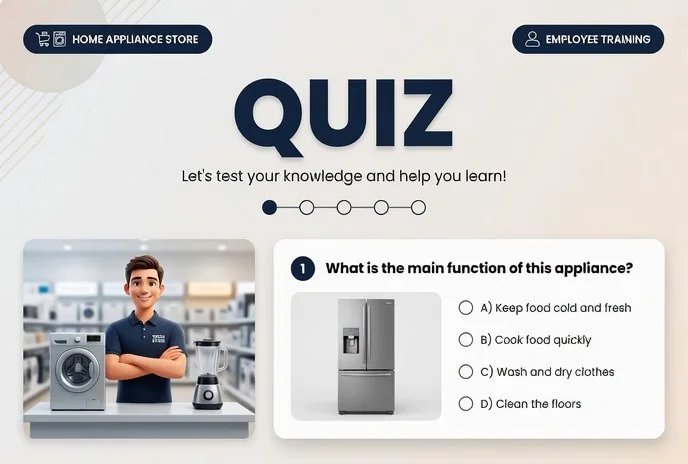
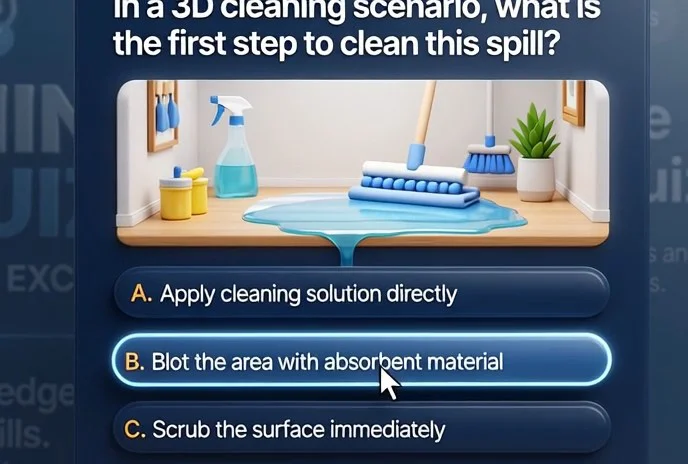
| Scenario quiz (quest) | New employees, interns | Practice with real situations, lasting skills |
How to choose a format for your task
Use three criteria: the learning goal, the number of participants, and the available time.
For a quick check at a seminar, a test with automatic grading works well; for regular training, a game with points accumulation and a rating; for final certification, a version with feedback on each answer.
We help you choose the format that will work specifically for your case and develop a quiz with game mechanics and clear statistics for the teacher or HR manager.
At the same time, you fully control the content: questions and scenarios can be changed without involving a developer.
How quiz development works: from brief to launch
University teams often wonder: how do we control the process if you work remotely? That is why the quiz development process is built as a clear system with approval checkpoints. You always know what stage the project is at, what is ready, and what comes next. No “black box” — only transparent steps with your participation.
Stages of work
-
Quiz brief — you fill out a convenient questionnaire or answer the manager’s questions: what task the quiz is for, how many students or employees will play, which topics need to be covered. We collect your wishes and constraints and set deadlines.
-
Plan and estimate — based on the brief, we prepare a concept: question formats, visual style, the number of game sessions, and the approximate duration. You receive a document with the scope of work, timelines, and cost — before development starts, with no hidden extras.
-
Project approval — we approve the scenario, the question pipeline, and the layout of the future game. You see the structure of the quiz before we start building it. Edits at this stage are made quickly and without delays.
-
Development and assembly — we build the quiz: questions, answer options, screens, animation, and result calculation. We set it up to work on any device — laptops, tablets, phones — so you don’t need to buy extra equipment.
-
Testing and launch — we run the quiz on a control group, check for errors, and train the host. After launch, you receive instructions on how to quickly run the game for 20, 100, or 500 people.
-
Post-launch support — we stay in touch, help with technical issues, and quickly make edits to questions if the curriculum or event regulations change.
This process has been proven on dozens of projects for colleges and universities: project approval takes minimal time, and there are no surprises at launch. You focus on the content and the result, while the technical side is our job.
What’s included in the delivery: a complete quiz package for colleges and universities
When ordering a quiz for a university, it is important to understand in advance exactly what you will receive. We put together the delivery so that the university gets a complete package for launching and independent use — from ready-made files to trained staff. Below is what you receive after the project is completed.
- A ready-to-run quiz program — adapted to the university’s brand style, works on your computer or laptop. Suitable for open days, orientation programs, internal Olympiads, and holidays.
- Source materials and settings — all questions, scenarios, and game parameters are handed over to you in an editable format. You can change questions and rules without involving developers.
- Quiz documentation — clear instructions for installation, launch, and administration. Scenarios for different audiences are described separately: students, applicants, faculty.
- Staff training — a practical session where your employees learn to launch the quiz on their own, manage the game flow, and respond to unexpected situations.
- Administrator access — you can add new questions, change timings, rename teams, or completely update the scenario for the next event.
- Technical support at launch — during the first two or three events, we are on call and help resolve any issues quickly so you feel confident.
- Warranty support — within the agreed period, we fix errors and update the quiz free of charge if adjustments are needed.
This package covers the university’s main need: you are not dependent on the contractor after the project is handed over.
Staff go through training, receive instructions, and get all source data — and can run the quiz at any time, adding new questions and adapting the game to their goals. This turns a one-time development into a long-term tool for working with students and applicants.
Case study: how a quiz improved employee training results by 40%
At one partner university — Vector University — the task was to quickly train faculty and administrators to work with a new electronic system.
Regular lectures and text instructions barely worked: employees kept postponing the courses, and completing the first module took several weeks. Training was seen as a formality, not as something useful.
We proposed replacing boring materials with an interactive quiz. Employees completed training in a game format, answered questions based on real work scenarios, received instant feedback, and saw their progress.
Thanks to the rating and game mechanics, a healthy competition started between departments, which kept interest high throughout the course.
Result after one month: the share of employees who completed training increased by 40%. The average test score rose from 68 to 84, and completion time dropped almost by half.
Importantly, a repeat order was not long in coming — the university asked us to develop a similar quiz for first-year students.
The head of the learning center shared her impression: “For the first time, we saw employees reminding each other to complete the course. The quiz helped engage even those who usually ignore internal newsletters.”
This example shows that properly organized learning through games delivers measurable results. For each client, we adapt the scenario to their goals and motivation system, which is why similar results recur in 8 out of 10 clients.
How to choose the right quiz format for your order?
Choosing a quiz format starts not with technical details but with questions about your audience and goal.
For colleges and universities, the same game solves different tasks: checking student knowledge, introducing applicants to fields of study, bringing faculty together, or training staff on new regulations. A test simulator and a team quiz are different tools, and each is justified in its own scenario.
How do you choose the quiz that is right for you? Evaluate three parameters: the number of participants, the way it is completed — in a classroom, remotely, or on personal devices — and how you will use the results.
If you need to quickly process answers from hundreds of students, choose a format with automatic grading and summary statistics. If live discussion and team spirit matter more, a quiz with rounds and a tournament table will work.
Also consider your organization’s specific requirements: brand style, integration with the learning management system, adaptation for people with special needs, or offline operation in a classroom.
We start selecting a format with a brief, where we record all these nuances. After that, we offer two or three suitable options — from a light revision test to a multi-round game with a leaderboard and prizes.
You see how each format looks from the participant’s perspective and make a decision without diving into technical details.
For example, for a large flow of students, we recommend short sessions of 10–15 questions with instant feedback, and for open days — a narrative quiz with animation and questions about the university.
Each format has its own duration and complexity, so we adapt to your task, not the other way around. Send us a description of your goal — we’ll get back to you within one business day with a concrete proposal for a format that covers your task without unnecessary costs.
Frequently asked questions about quiz development for organizations
Before launching a training quiz, you want to be sure that you won’t waste time and budget, and that employees will approach the game with interest. We have completed dozens of such projects and know that predictability matters most. That is why we have clear answers to the questions usually asked before signing a contract.
Below are the main ones. All conditions for protecting your interests are written into the contract, so risks are minimized.
What if employees don’t like the quiz?
Before launch, we show a pilot version and collect feedback from a small group. If something doesn’t land, we adjust the scenario and mechanics. After launch, you see completion statistics and can fine-tune the content on the fly, while we advise on how to engage the team.
What quality and stability guarantees do you provide?
We work under a contract with specified deadlines and warranty obligations. The quiz is tested on different devices and in different browsers, so every employee can complete it from any computer or tablet. If any errors appear after launch, our support team takes them on.
What if something goes wrong during the project?
We have a support protocol: you send a request, the team logs the issue and starts resolving it within the agreed timeframe. Critical failures that block participation are fixed first. So even if an error appears, it won’t derail the training.
Order a quiz for your team today
Starting a project is simple: you describe the task, and we propose a solution for your timeline and goals. No need to dive into technical details — just a few words about your audience and goals, and we’ll handle the rest.
By contacting us today, you immediately get:
- consultation and a preliminary concept within one business day;
- a transparent estimate with no hidden fees or forced options;
- a format choice for your team — from a short quiz to a series of tournaments;
- fixed deadlines in the contract and weekly reporting;
- a ready-made scenario with questions that truly reinforce knowledge;
- post-launch support — we’ll quickly make edits and add new topics.
From there, the work follows a clear plan: discussion, scenario, development, testing, launch. You see progress at every stage and always know what happens next.
We specialize in learning games for business and education. our team has accumulated 10 years of experience that helps make quizzes interesting and useful. We work remotely, so collaboration is convenient for clients from any city.
Don’t put off training. Write to us — and in just a few days your team will be taking their first quiz, and you’ll see engagement grow.