

Why training for exhibition complex employees stalls
Exhibition complex employees work with dozens of exhibits, tenants, and different visitor flows every day.
They need to quickly memorize rules, service scenarios, and safety standards, but classic training — lectures, PDF cheat sheets, and check-the-box tests — doesn't deliver the needed effect.
Within a week the material is forgotten, mistakes repeat, and when employees interact with guests, the venue's reputation and repeat visits suffer.
Why does training stall like this? People absorb information better through participation, competition, and fast feedback, not through passively reading slides.
In an exhibition complex, an employee must act in a live environment: help guests, answer unexpected questions, and follow venue regulations. Regular tests don't train for that — they only check memory of dates and terms.
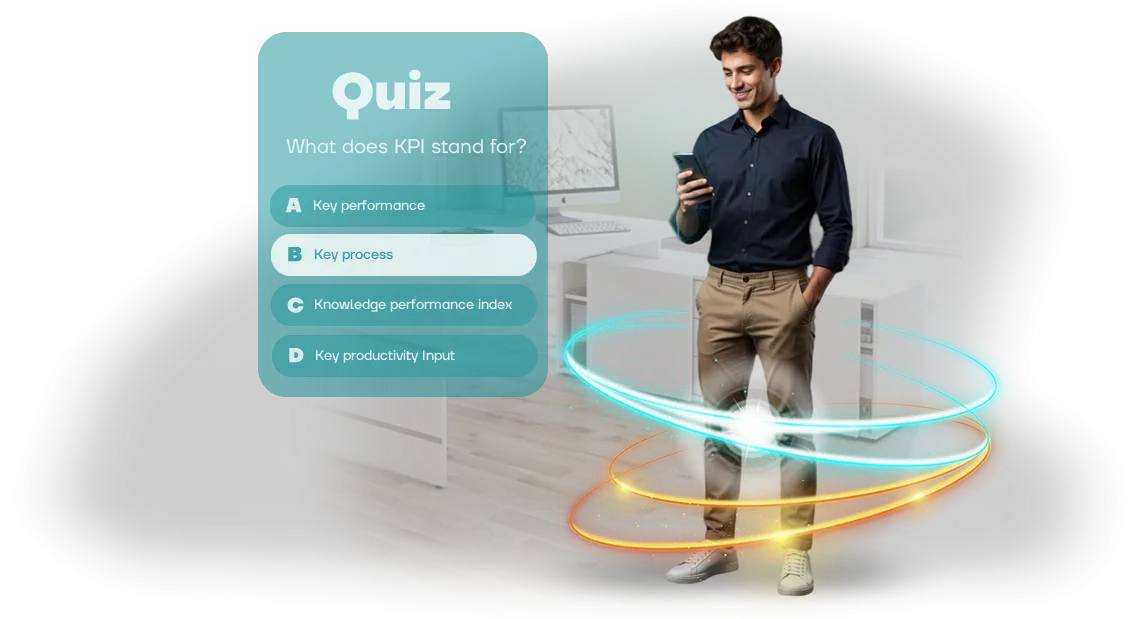
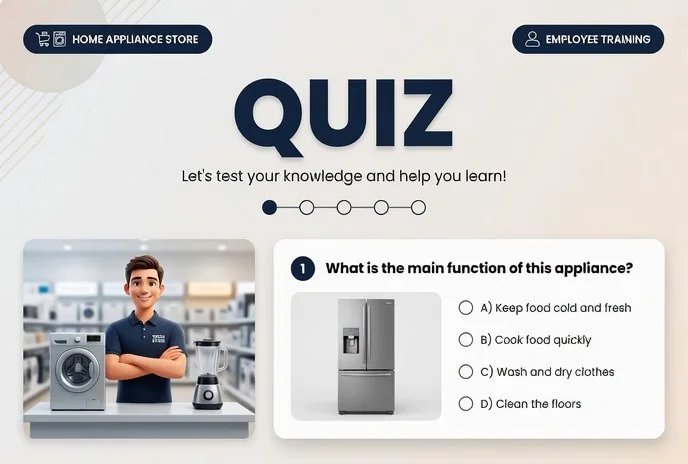
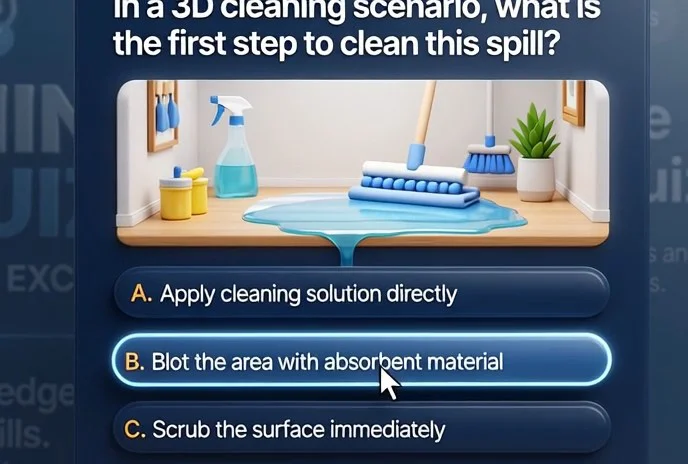
An interactive quiz solves this problem differently. It's not entertainment instead of work but a tool that turns rules into clear scenarios: the employee answers questions, encounters real situations, sees their mistakes, and immediately gets an explanation. As a result, training takes less time, and knowledge is actually applied on the job.
We see this problem on every second project for exhibition venues.
That's why our team develops training quizzes that fit into employee schedules and deliver clear business results: higher engagement, faster onboarding for newcomers, and fewer mistakes when working with guests.
What results the quiz delivers for the team and management
A quiz is a way to turn training from compulsory routine into part of corporate culture. For an exhibition complex, where every employee interacts with guests, both exhibit knowledge and service standards matter.
Management gets a clear tool: the team engages with training, and you can see which knowledge has stuck and what needs further work.
Here's a checklist of results so you can verify the goal is achieved:
- Higher engagement. Game mechanics turn training into competition: employees don't just serve time but strive to show the best result. This boosts activity and reduces staff turnover.
- Material retention. A quiz forces employees to recall and apply knowledge in different wording. Through repetition, information sticks faster than by simply reading instructions.
- Objective knowledge assessment. Managers see each participant's scores and team dynamics. No need to interview employees personally — the system provides the full picture.
- Targeted gap fixing. If the majority gets a topic wrong, you know: additional briefing or error review is needed. Training becomes flexible and targeted.
- Time and effort savings. Short quizzes are built into the workday and don't require renting a venue or bringing in external trainers. Coverage is still one hundred percent.
- Uniform standards for all staff. All shifts and all employees receive the same knowledge and requirements. This is especially important for exhibition complexes where regulations must be followed by everyone without exception.
By ordering quiz development from our team, you get not a "game for the sake of a game" but a manageable training and control process. We handle the scenario, questions, and mechanics; you get the result: a prepared team and transparent analytics for management.
Quiz formats for exhibition complex tasks
An exhibition complex has two tasks — attract guests and quickly train staff. The quiz covers both: visitors engage with the exposition and remember it, while employees absorb standards in a game mode — without boring lectures.
Formats for typical scenarios
We don't stick to a template — we match the format to the client's specific goal. The table shows basic scenarios that already work at exhibition venues.
| Format | For whom | What it gives the client |
|---|---|---|
| Quiz on touchscreen kiosks | Exhibition visitors, including families with children | Increases time spent at exhibits, boosts photo sharing on social media, collects contacts |
| Training quiz for staff | Guides, administrators, promoters | Checks knowledge of exhibits and standards, reduces mistakes in guest communication |
| Quest-style quiz across the venue | Guests of special events | Increases engagement, motivates visitors to complete the route and come back again |
| Corporate quiz for tenants | Partners and residents of the complex | Strengthens business relationships, creates a reason for repeat visits |
The common foundation of all formats is a clear interface, quick start, and instant results. Staff get training in a game rhythm, and guests get a vivid experience they tell others about.
We work on Unity — one project easily adapts to touchscreen kiosks, tablets, and lobby screens. You don't need two separate systems for training and entertainment: one tool covers both tasks.
How turnkey quiz development works
To keep quiz development from turning into a long and unpredictable project, we've built a clear process. You always know what stage the work is at and can see intermediate results.
For exhibition complexes, it's especially important that the game easily adapts to the event format and number of participants — we account for this from the very start.
- Brief and task immersion. We discuss training goals, the participant profile, and the specifics of your venue. We gather preferences on question topics and visual style so the quiz scenario works specifically for your audience.
- Scenario and question development. Based on the brief, we create the quiz structure: rounds, difficulty, pacing. We write questions tailored to the exhibition complex's specifics — from general topics to branded highlights. You receive a ready scenario for approval before development starts.
- Design and visual style. We craft a look that fits your space's interior and atmosphere. We show you the screens so you can see how the game will look through a guest's eyes before launch.
- Build and mechanics testing. We implement the game on professional equipment and check loading, synchronization, and fault tolerance. We run the scenario in test mode to prevent glitches and pauses during the event.
- Pilot run with your team. We hold a rehearsal with your employees: they see the full participant journey, ask questions, and give feedback. We make final adjustments to copy, timing, and interface.
- Training launch at the venue. We deploy the quiz in the exhibition complex, configure equipment, and train your staff to run the game independently. You get instructions and a short training session — no dependence on us for daily tasks.
- Support and evolution. After launch, we stay in touch: we help update questions, change rounds for a new exposition, or expand the quiz for more frequent sessions. For repeat events, this saves your time and budget.
Each stage ends with a concrete deliverable that you approve. That way you control timelines, quality, and understand what you'll get as a result. That's exactly why most exhibition complexes continue working with us after the first training launch.
What's included in the employee quiz delivery
The employee quiz isn't a scattered app but a ready-made kit that can be launched on the day of delivery. We hand over all materials so you can run training in a convenient format: with a host, in groups, or individually.
The delivery includes:
- Quiz scenario — ready-made script with timing, host lines, and round descriptions. You save development time and get a structure that holds attention and engages participants.
- Questions and answers — a question bank on your topics: product knowledge, standards, regulations. Questions are selected for your tasks, with correct answers and explanations for error reviews.
- Scoring logic — automatic real-time result calculation. Winners are determined automatically, eliminating disputes and manual counting.
- Host materials — a facilitation guide, team forms, answer keys, and moderation tips. The host confidently runs the process even without preparation.
- Screen graphics and interface — design in your brand style: splash screens, question screen, results table. Participants see familiar company branding, which boosts engagement.
- Results report — a final summary for each participant and team: percentage of correct answers, error distribution by topic. You see what knowledge has been absorbed and where improvement is needed.
All materials are delivered in electronic form and easily adapt to different venues: from a training room to a large hall. If needed, we add questions and support the launch at your site.
Case study: quiz raised exhibition staff engagement
Exhibition complexes have rapid staff turnover — new administrators, coordinators, and booth staff are hired for every exhibition.
Onboarding usually relies on lectures and memos, and the result is still weak: newcomers mix up regulations, get lost on client questions, and move slowly when visitor traffic is at its peak. Employees aren't engaged in the process, so knowledge doesn't stick.
We offered a different format — a training quiz built into the preparation process. The project was developed on Unity as a full-fledged game where employees go through scenarios, answer questions about booths, navigation, and service standards.
Staff don't read a boring manual — they compete with each other, see progress, and memorize what matters through game mechanics.
What changed after the quiz launch
The client got a measurable result. Onboarding time was cut by nearly a third — instead of two full days, team preparation now takes a day and a half. Employee engagement also grew: staff themselves asked for additional rounds to boost their standing in the overall ranking.
Post-training test results showed the average score rose by 40% compared to groups that went through standard lectures.
They also noted that employees became more confident working with visitors. They navigate the pavilion layout faster, know where to direct guests, and how to answer off-script questions.
The shift supervisor noted that newcomers can be placed at the information desk after just two days instead of a week-long internship.
The director of the exhibition pavilion summed it up: "We expected it to be fun, but we got a working tool. People remember the rules of the game instead of cramming a manual.
For us, that means fewer errors on the job and smooth shift handovers." After the first exhibitions, the client ordered an additional module for training senior shift leads — the quiz stopped being a one-off activity and became part of regular preparation.
This approach works not only for new employees but also for upskilling the existing team. If you want to see how a training quiz works at your venue — request a demo for one department and see the difference in training dynamics.
How to choose a quiz format for your team?
There's no universal quiz format — the right option depends on your team's tasks and work specifics. For an exhibition complex, it's important that employees quickly master new expositions, remember visitor service standards, and can act in unusual situations.
So choosing a quiz format starts not with mechanics but with answering the question: what knowledge and skills need to be reinforced, and what gap needs closing?
When selecting a quiz for your team, look at the schedule and headcount. If employees work shifts and rarely gather together, an asynchronous mode works better: everyone takes the quiz in their spare time, and results are collected into a shared ranking.
If you need to unite the team or spark discussion, a synchronous team session works well, where groups answer at the same time and see each other's progress.
The amount of material also matters. A short regular quiz of five to seven questions reinforces regulations and common mistakes better, while a larger story-driven game suits certification or the launch of a new exhibition.
We help you choose a format that doesn't turn into a boring test but gives employees clear feedback and the motivation to beat their result.
A good quiz is a tool that adapts to your specifics. We analyze the target audience, scale, and goals, propose the right option, and verify how well it lands during a pilot run. If employees complete it faster and show growth, the format was chosen correctly.
Frequently asked questions about quiz development
We've gathered answers to the questions most often asked before starting quiz development. If you don't see yours — write to us and we'll discuss your task personally.
What kinds of questions will be in the quiz?
Content is assembled together with you: your regulations, guest service standards, safety rules, product lineup. We turn the materials into engaging multiple-choice questions so employees quickly absorb information and enjoy the training.
How long does quiz development take?
A standard project takes three to four weeks from brief approval. That timeframe includes all stages: question development, design creation, programming, and final testing. If deadlines are tight, we speed up the launch using ready-made mechanics.
Can questions be updated after launch?
Yes, you can change questions and add new topics without involving a programmer. A simple admin panel is included: add a question, save it, and it immediately appears in the quiz. Learning to use it takes less than an hour.
How do you guarantee quality?
Before launch, we test the quiz in real conditions — on the same computers and screens used in the exhibition complex. After project delivery, a warranty period applies: if something doesn't work as expected, we fix it promptly at no additional charge.
Order a quiz — get a ready scenario and results
Ordering a quiz from us means getting a ready scenario and a clear launch plan right after your inquiry — not a "let's talk and think about it." Clients need to see a result before paying: the game structure, questions, rules, and format. That's why we start with a working product, not empty promises.
As part of developing a quiz for employee training, we prepare a complete kit that stays with you:
- A ready quiz scenario for your topic and format — from 30 to 60 minutes of gameplay.
- A structure of 5-7 rounds: from warm-up to challenging questions, with answer options and explanations.
- Rules for the host, a scoring system, score sheets — no improvisation needed.
- Instructions for a quick launch on your existing equipment: projector, screen, laptop — whatever you already have.
- A feedback plan: how to review results, announce winners, and hand out awards.
- Slides and print materials — round titles, team name cards, participant certificates.
This works both for offline training and for an interactive zone in an exhibition complex. In both cases, you get a proven format that easily scales to any number of participants — from 10 to 500 people.
To get started, just leave a request. Within one business day, we'll send you a scenario, sample questions, and a cost estimate. Then you decide whether to launch the quiz as is or adapt it to your tasks.