

AR maintenance software: repairs take hours and halt the workshop
Every hour of workshop downtime is lost revenue, missed shipments, and burning deadlines. When a machine or line stops, maintenance crews have to search for schematics, flip through paper instructions, or wait for the one engineer who knows that unit to answer.
According to McKinsey, up to 30% of a maintenance specialist's working time goes to finding information rather than to actually repairing equipment.
The other half of the problem is rare experts. Unique knowledge about a specific model often lives in the heads of one or two people: while they are on vacation or at another site, the workshop stands still.
Remote diagnosis via photos in a messenger doesn't help—you need a step-by-step breakdown that even a beginner can understand. And when it comes to complex imported equipment, waiting for the right specialist can drag on for days.
All this adds up to hours of forced downtime, urgent parts orders, and frayed nerves in the production department. The company pays twice: for the repair itself and for lost capacity.
Depending on the industry, the cost of an hour of equipment downtime is determined by an audit—and that's before accounting for penalties for missed deliveries.
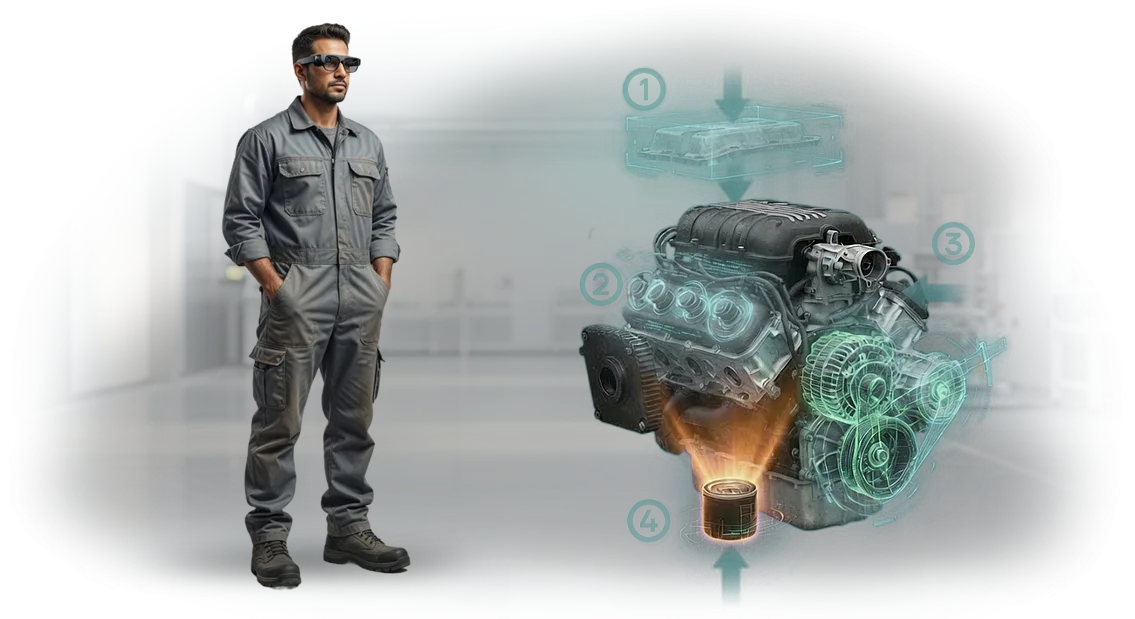
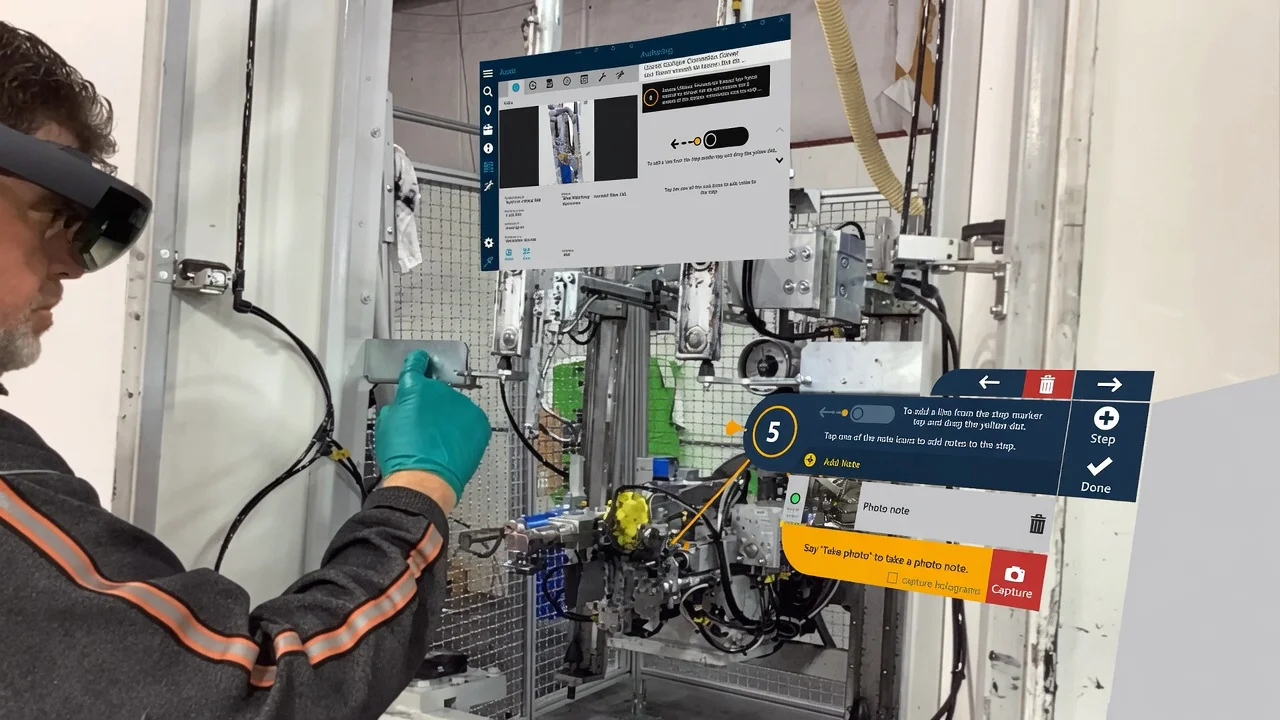
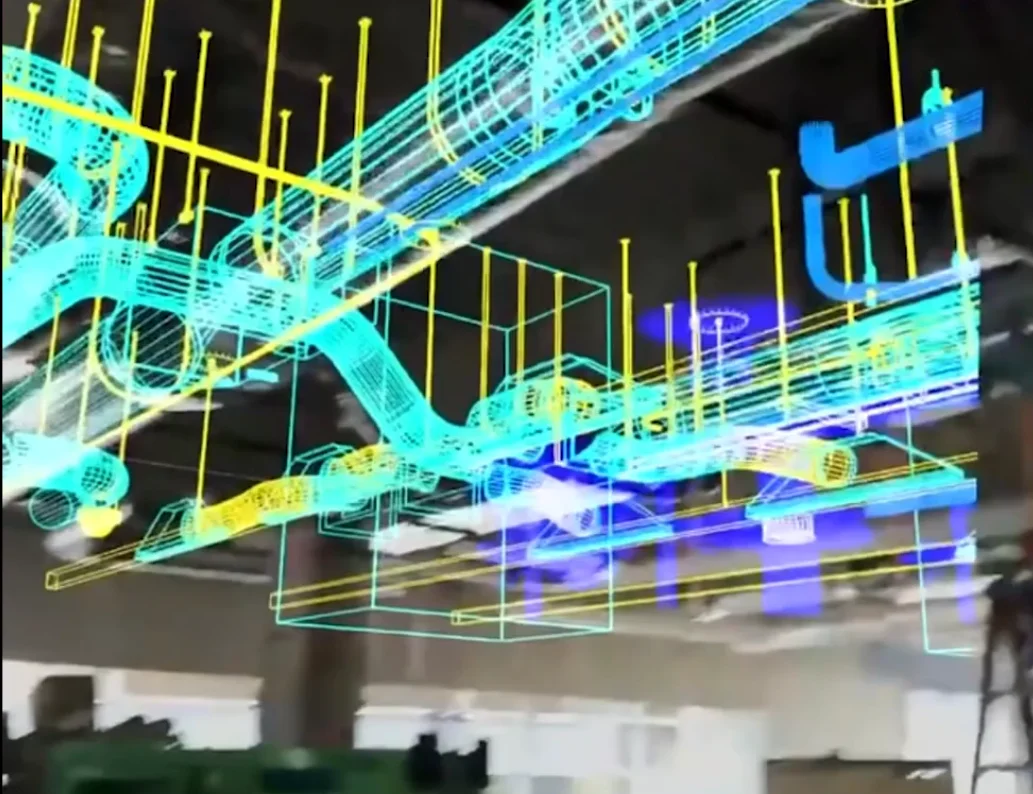
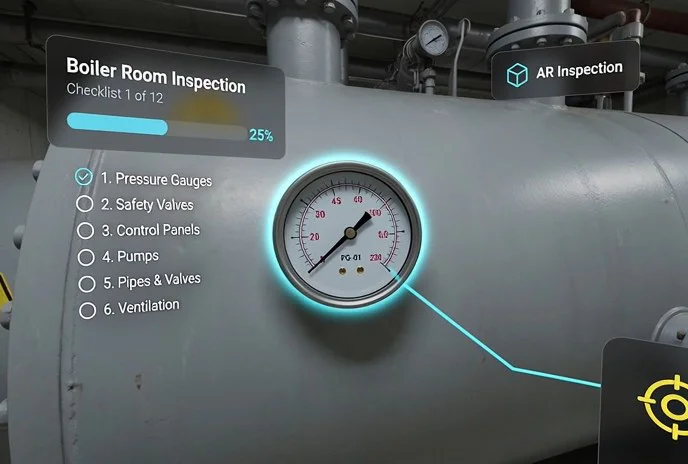
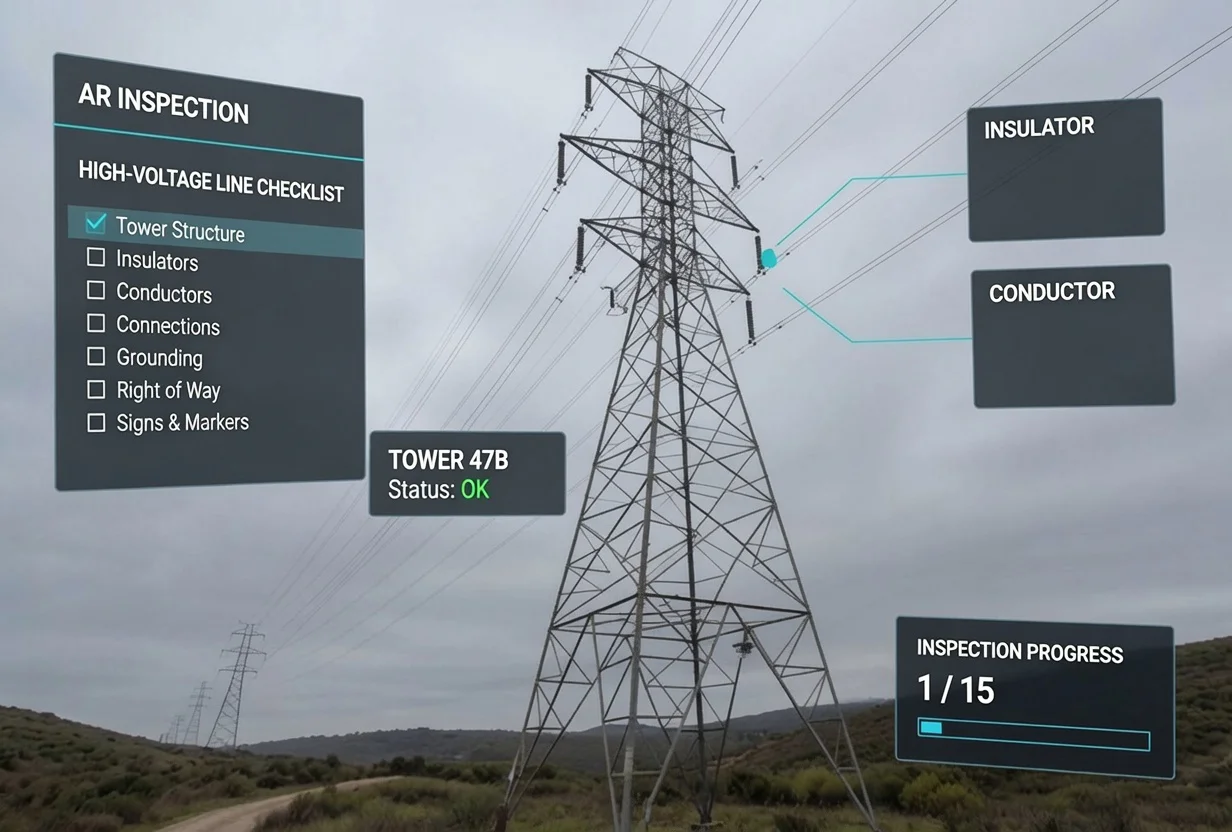
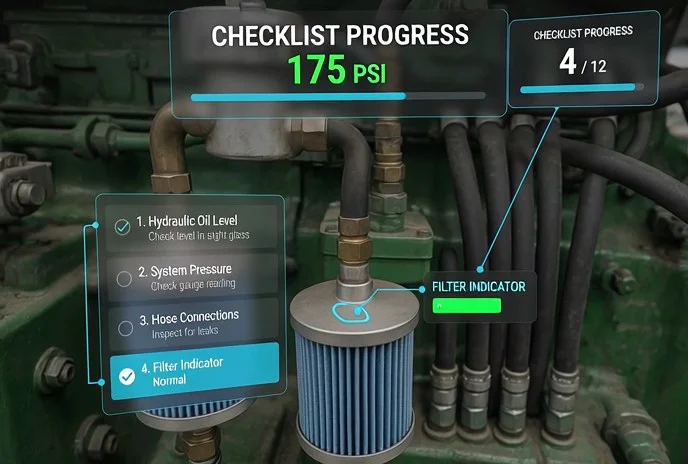
We close this gap with AR maintenance software—a system that overlays step-by-step instructions, diagrams, and diagnostic hints directly onto working equipment. The repair technician sees where to place the tool, in what order to unscrew components, and what to check first.
This turns repairs from hours into minutes, and dependence on scarce experts and phone consultations becomes a thing of the past.
What AR instructions deliver: less downtime, higher productivity
The operator sees step-by-step guidance right on the equipment: where the component is, in what order to unscrew it, and what torque to apply.
Repairs no longer depend on the memory and experience of a particular employee—any specialist acts like a setup technician with ten years of experience.
Time spent on routine maintenance drops by 30–40% because there is no need to flip through paper manuals or ask senior colleagues for answers.
Errors in assembly and diagnostics are minimized: the system highlights the correct elements and any deviations. This means fewer repeat repairs, fewer emergency stops, and consistent achievement of planned production capacity.
For a manager, this approach directly increases operator efficiency—the same people get more work done per shift, and equipment downtime stops being a production bottleneck.
Training new employees is no longer long and expensive. Instead of week-long courses with a mentor—a few hours of practice with AR hints. The company saves on instructor fees and on the losses inevitable while a newcomer is getting up to speed. Experienced specialists also switch faster between different equipment models without losing pace.
The effect is visible within the first weeks of deployment: less time on repairs, higher quality of work, and predictable planned maintenance.
We tailor the process to your task: we record maintenance routes, adapt the interface to real operations, and support the team after launch.
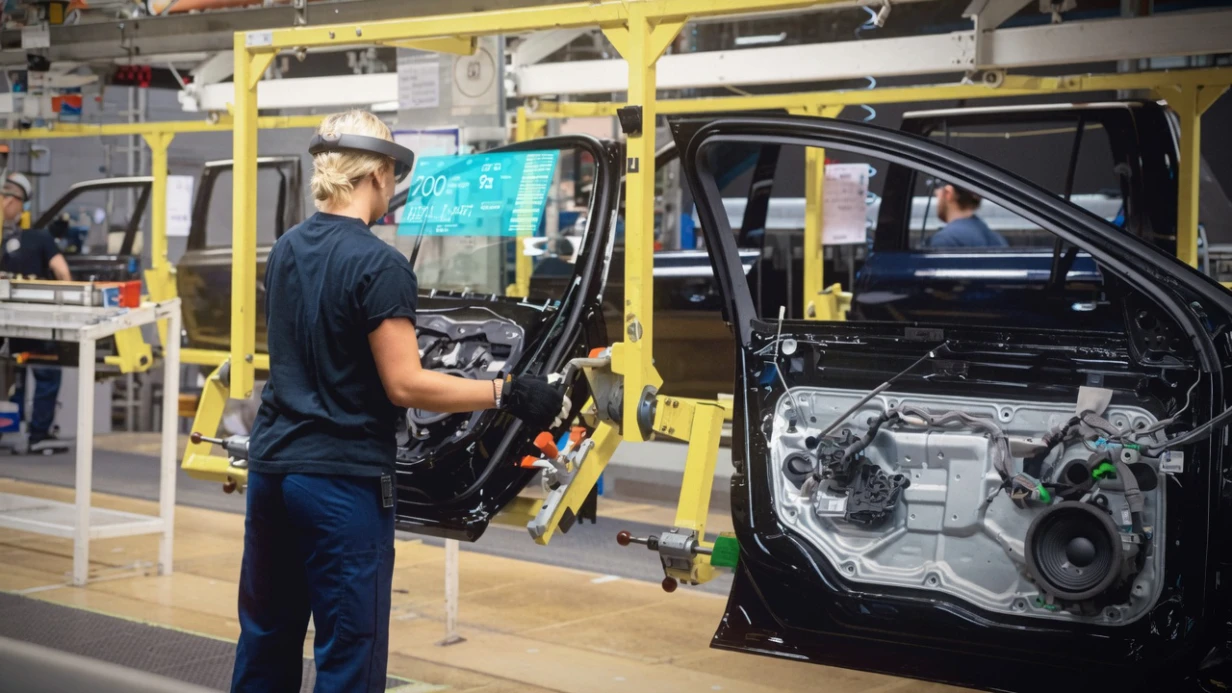
The tool runs on professional equipment and requires no additional skills from operators—you just put on the headset and follow the prompts.
Project formats: from a single line to the entire equipment fleet
You don't always need to change the entire maintenance system at once. We offer three formats for implementing AR instructions—from a pilot project on one line to full deployment across the entire equipment fleet.
Each format addresses a specific business goal: test the impact, expand coverage, or build a unified standard.
A pilot project is a way to see real results at your site without major investment. Scaling is suitable when you need to reduce downtime and speed up staff training across several areas. Full deployment provides unified working algorithms at all facilities and measurable savings.
| Format | For whom | What the client gets |
|---|---|---|
| Pilot project (one line / area) | For those who want to test AR in practice | Clear numbers on repair speed and errors, a trained team, and a basis for deciding on scaling |
| Scaling (multiple areas / workshop) | For managers who need to cut downtime and quickly onboard newcomers | Unified instructions across all areas, less dependence on experienced specialists, fast response to abnormal situations |
| Full deployment (entire fleet / all sites) | For owners and production directors who want a systemic result | Maintenance standard at all facilities, quality control, transparent statistics, training savings |
The formats are not rigidly exclusive: you can start with a pilot and, after a couple of months, expand to the whole workshop, then roll the solution out to other sites.
We tailor the scope to your budget and timeline—you get a fast start without overpaying for unnecessary options.
How AR instruction development works: from audit to launch
We work without lengthy approvals or technical surprises: at each stage you see the result and make decisions without getting into implementation details. Below is a clear route from the first meeting to the daily use of AR instructions by your employees.
-
Equipment and task audit. We study documentation, visit the site, and break down real operations—repair, setup, and maintenance. We identify where employees lose time, where they make the most mistakes, and which scenarios will deliver quick results.
-
Scenario alignment. We present the list of operations to be turned into AR: their priority, expected outcome, and timelines. You approve the scope and order of work—this is the basis of the plan.
-
Prototype development. We take one operation and fully implement it in AR—from overlaying hints to testing the instruction on real equipment. Already at this stage, it's clear how an employee will see and use the system.
-
Revisions and approval. You receive a finished sample, get feedback from technologists and workers, and we make adjustments. Once the prototype is approved, we move to full production without rework.
-
Production of remaining instructions. Using the approved template, we quickly create AR instructions for all selected components and operations. Each one is checked against the procedure, numbering, and action logic.
-
Testing at workstations. The instructions are tried by mechanics, operators, and engineers themselves—on equipment in the workshop. We collect feedback, improve usability, and make sure the system helps get work done faster rather than distracting.
-
Launch and support. We integrate AR instructions into your process, train employees, and provide support after launch. When procedures change, we update the content—you always work with the current version of the instructions.
What you get in the delivery: a complete kit for fast repair training
We deliver not just an AR application, but a turnkey kit for fast training in equipment repair and maintenance. The delivery includes everything your specialists need to start using the instructions within the first few days, without a separate implementation project.
- Ready-made AR instruction library — step-by-step repair and maintenance scenarios for your equipment, adapted to real work operations.
- Admin panel for content management — you add new instructions and update procedures yourself, without waiting for developers.
- Training materials for staff — short cheat sheets and videos on working with the interface: a couple of hours is enough to train the trainers.
- Instruction archive — the entire version and procedure history is stored in one place, so it's easy to find the current document or restore an old one.
- Support and warranty — our engineers are available during business hours, help with configuration, answer user questions, and quickly resolve issues.
- Regular AR platform updates — new features and compatibility with modern equipment models arrive automatically.
In the end, you get not a one-off development but a working training tool: new employees reach independent work faster, the number of errors drops, and downtime shrinks.
We support the project from first launch to full confidence of your team—and stay close after the work is completed.
Case study: how maintenance software cut press repair time by 35%
At a metallurgical plant, each hour of press downtime cost an amount calculated after audit, and a repair took up to 8 hours.
A qualified engineer had to be called in from another plant: local specialists were not confident about the disassembly sequence of a complex hydraulic unit. A mistake was expensive—one wrong operation could knock the equipment out for several more days.
We developed an AR instruction for this press. A technician points the tablet's camera at the unit and sees highlighted components, the disassembly order, checkpoints, and required tools on screen. No paper manuals and no guesswork—all hints appear right on the working machine.
For the stamping line manufacturer FormPress, we deployed the system across 12 production sites. Over six months, the average repair duration fell from 7.5 to 4.9 hours—a 35% reduction—and the number of repeated disassemblies dropped by half. The plant met its downtime-reduction plan three months ahead of schedule.
Annual savings on lost output alone exceeded the cost calculated after audit. In addition, the plant stopped depending on outside experts: 80% of breakdowns are now repaired by in-house staff.
Newcomers reach normal working speed in two weeks instead of two months—the AR instruction became the training standard.
After the pilot, the client expanded the system to three more types of equipment and plans to implement it at other plants in the group. We continued developing the instructions together with their engineers, adding new scenarios as feedback came in.
How to choose the right AR instruction format for your budget and scale?
There is no one-size-fits-all answer: what works for a workshop with three lines can be ruinous for a plant with a thousand employees. So choosing an AR instruction format starts not with technology but with answering how many people will use it and how often.
If you have a few teams and complex equipment, simple step-by-step hints on tablets are enough: they speed up repairs and reduce the number of errors.
If you're looking at mass production where dozens of new operators need training every shift, a full-featured system with component recognition and automatic action verification is more cost-effective.
The key metric is not development cost but return on investment: how many hours of downtime and defects you eliminate per year.
With a limited budget, it makes sense to start with one pilot area where losses from errors are highest. This delivers a measurable effect in a couple of months—and then you scale the solution to other lines based on clear numbers rather than faith in technology.
At large scale, it's cheaper to build in a comprehensive platform from the start: it costs more upfront, but the cost per employee is many times lower, and updating instructions takes hours instead of weeks.
The key is that the format fits your operating model, not the other way around. We help you choose an option for your budget and scale, calculate ROI before launch, and never suggest anything unnecessary.
Leave a request—in a short meeting, we'll show which AR instruction format will deliver maximum impact without overpaying.
Frequently asked questions about implementing AR instructions in manufacturing
We answer the main fears that prevent companies from launching AR maintenance software on the production floor. Companies often postpone implementation, thinking it's complex, expensive, and requires restructuring all processes. Practice shows the opposite: modern AR solutions launch progressively and deliver results quickly.
Is implementation complex and does it stop production for a long time?
No. We launch a pilot in one area in 2–3 weeks without stopping the lines. Employees continue working in their usual mode while learning the new instructions.
At the PromMet plant, the pilot took 10 days, after which we scaled the solution to two workshops without any loss of output.
How safe is it to use AR in manufacturing?
AR instructions reduce the number of errors and injuries: the worker sees hints right in their field of view without looking away to paper or a phone. Access is protected by corporate authentication, and data never leaves your network. We strictly follow industrial safety requirements and are ready to account for your standards.
Is it difficult to integrate AR with our systems?
We don't replace your software; we build AR instructions around it. Integration with maintenance systems takes from a few days to a couple of weeks. Our engineers configure the data exchange themselves, so your team doesn't need to dig into technical details.
How will employees adapt if they have never worked with AR?
We design the interface to be as simple as possible: large hints, minimal text, and intuitive gestures. A 15-minute introductory course is enough for adaptation.
After a few shifts, operators start working more confidently and even suggest improvements—that's how it goes on most of our projects.
Leave a request: we'll move repairs into AR mode in 4 weeks
Every hour of equipment downtime means lost revenue and missed order deadlines. At the same time, training new employees takes months, and experienced mechanics can't keep up with all requests.
AR instructions remove this dependency: the repair technician sees step-by-step hints directly on the equipment and acts without errors. We move repairs into AR mode in 4 weeks—from request to working process.
Leave a request, and we'll hold a free consultation the same day: we'll review your task and propose a pilot plan for one of the components. Then you get:
- a pilot project at the chosen site—test the effect on real repairs;
- an AR instruction prototype within 5 business days;
- an implementation plan for all equipment lines;
- training for your team on working with AR tools;
- support at all stages—from testing to launch;
- post-launch technical support so the system runs smoothly.
In 4 weeks, you'll have a working solution: employees carry out repairs faster, make fewer mistakes, and no longer depend on knowledge holders. And you're not buying a pig in a poke: the pilot will show the result before scaling. Start with a request—we'll take care of the rest.