

AR for Assembly: How to Stop Losing Money on Defects and Downtime
Every new hire on the assembly floor is a risk to deadlines and budget. While they study drawings, memorize the sequence of operations, and keep asking the mentor questions, the line sits idle, and the first products often end up in rework.
Assembly errors are discovered late—when the unit is already assembled and there is no time or material left for another attempt. With a shortage of skilled workers, this risk only grows: people change, and knowledge leaves with experienced workers.
As a result, production suffers double losses: training takes weeks, and defects eat into margins.
A manager sees idle time figures in the report but cannot always tell exactly where the money is lost—on new-hire onboarding, on outdated paper instructions, or on human error during a complex operation.
Every assembly error means rework, extra components, and shipping delays—and that directly affects reputation and contract fulfillment.
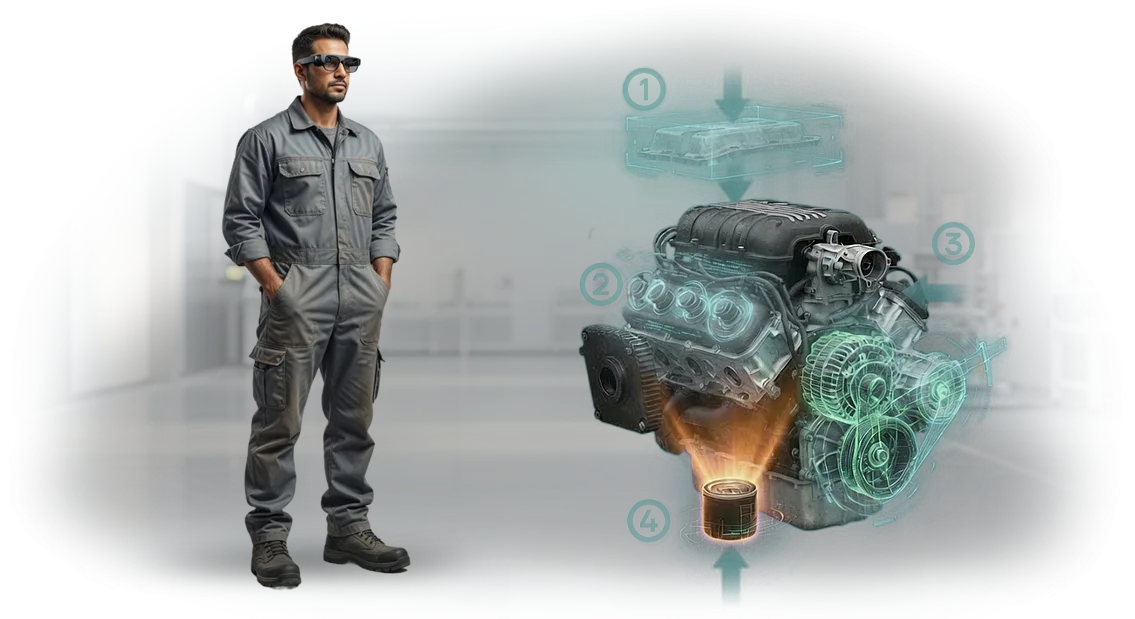
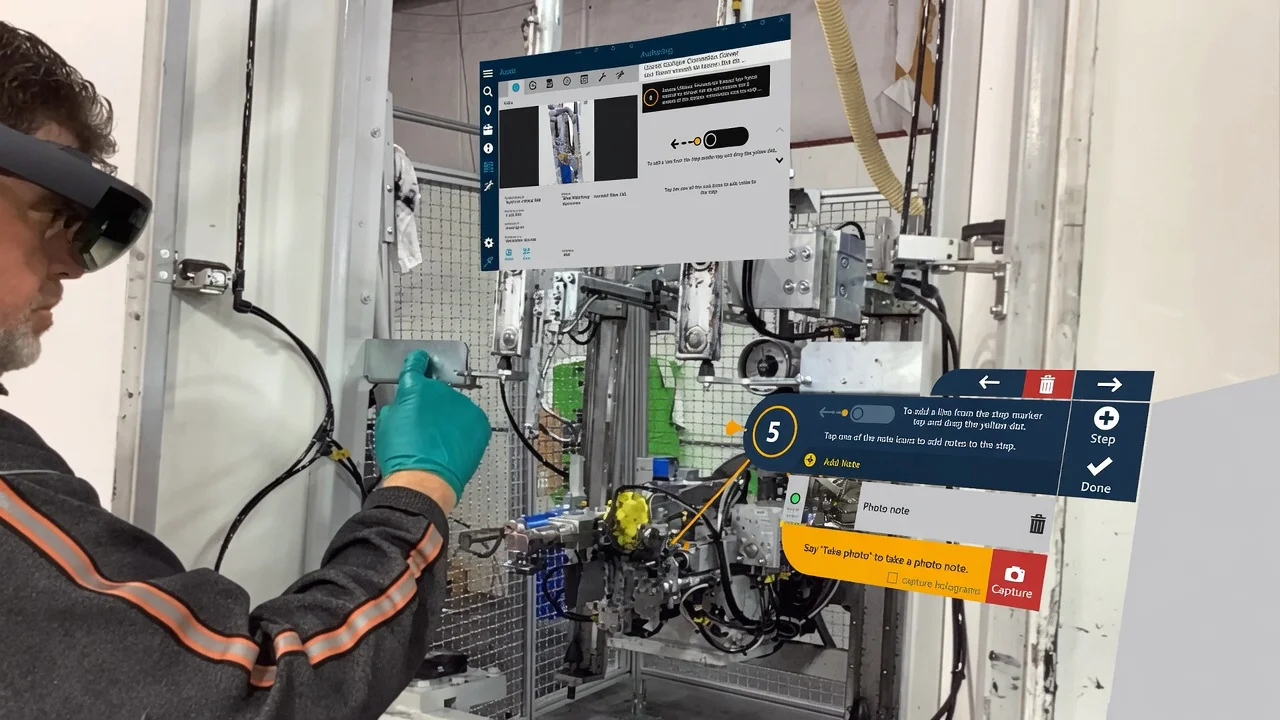
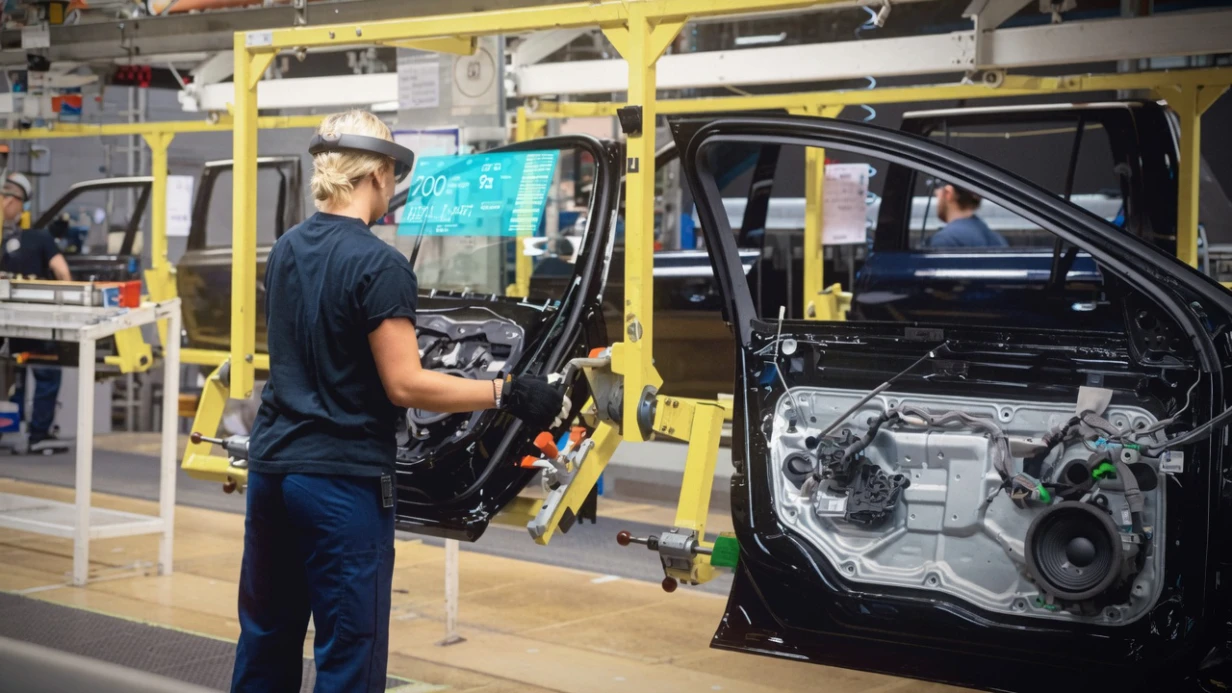
AR for assembly closes this gap. Instead of thick manuals and videos, augmented reality overlays step-by-step prompts directly onto the real unit: the worker sees where to place a part, in what order to tighten fasteners, and where the checkpoint is.
AR instructions do not need to be re-read and mentally translated into actions—they appear at the right moment and in the right place. This reduces error rates dramatically and cuts the time for a new hire to reach normal pace from weeks to a few days.
Our team has already helped companies eliminate such losses: after implementing AR for assembly, rework drops, downtime disappears, and mentors return to developing the floor instead of constantly repeating the same thing.
Right now, we are ready to show what this looks like on your equipment and estimate the effect in numbers.
What Interactive Instructions on the Factory Floor Deliver
Assembling complex equipment today means constant battle against two costs: training time and defect rate. When an operator works from paper instructions or from memory, every non-standard operation turns into downtime, and the slightest mistake turns into rework.
Interactive instructions based on augmented reality remove this uncertainty: the worker sees directly on the equipment what to do and in what order—without looking at diagrams or relying on “the wisdom of senior colleagues.”
Assembly Speed
A new employee no longer trains for weeks—they reach working pace within the first few days. The AR instruction highlights the relevant units and the sequence of actions, so the operator does not need to flip through documents and search for the right section.
As a result, assembly takes 20–30% less time, and transitions between operations happen without pauses.
Speed directly translates into output volume. Equipment does not sit idle, and the production plan is met with a buffer. For a manager, this means predictable shipping dates and more orders in the same period.
Fewer Defects
The main cause of defects in manual assembly is human error: skipping a step, mixing up parts, incorrect tightening. The AR instruction visually checks every action and does not let the operator move on until the operation is done correctly. An error is either eliminated or caught immediately—before the unit moves further down the line.
Even a 2–3 percentage point reduction in defects saves money on materials and rework. And most importantly—fewer customer complaints, which protects reputation and the budget for warranty obligations.
Operation Control
The floor supervisor gets full visibility: the system records who performed which operation, when, how long the assembly took, and whether there were deviations. This replaces subjective “walk around and take a look” supervision with objective data.
With this data, it is easy to spot bottlenecks and adjust workloads. Suspected defects no longer require investigating verbal explanations—there is an accurate record of every step.
Employee Motivation
Working with AR instructions reduces fatigue and stress: operators no longer need to keep dozens of operations in their heads or fear making mistakes. They master new models faster, feel more confident, and grow their skills without leaving the production floor.
Less routine and downtime—higher engagement. People see that work is becoming more technologically advanced and that the company invests in tools, not just requirements. This retains valuable staff and attracts new specialists.
AR for Assembly Formats: From Prompts to Full Control
Augmented reality for assembly is not one “magic” tool but a set of formats for different workshop tasks. Sometimes unobtrusive prompts are enough, sometimes step-by-step control of every action is needed, and sometimes a remote expert who sees the worker's hands is the answer. We select the format for your operation and show what it does for the business before launch.
AR Instruction Formats by Task
| Format | Who It Is For | What It Delivers to the Client |
|---|---|---|
| Short prompts above the unit | Serial assembly of standard products | Faster switching between operations, fewer errors when changing models |
| Step-by-step control with step verification | Complex units and non-standard orders | Assembler never skips operations, defect rate drops from the first attempt |
| Interactive new-hire training | Areas with high turnover or new employees | New employees reach standard output in days, not weeks, without tying up the mentor |
| Remote expert support | Multiple workshops, frequent setups and failures | Engineer sees the same as the worker and resolves the issue in one session |
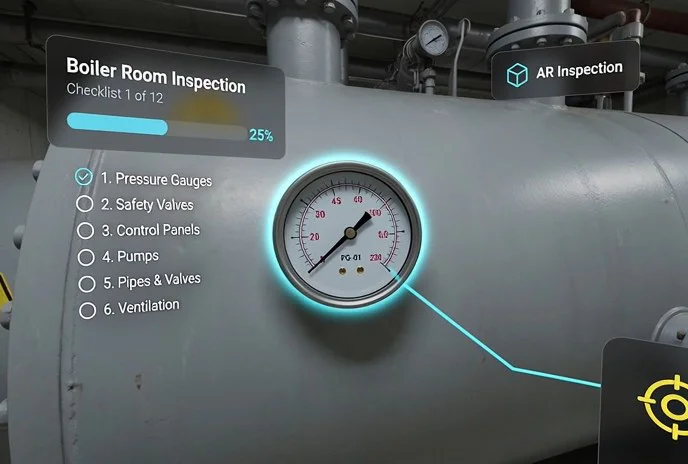
| Assembly result recording | Quality control and final inspection | Every unit passes a checklist, data flows into the accounting system |
The choice of format depends on where time and money are currently being lost. During a consultation, we review your operations, calculate the savings potential, and propose a pilot scenario: first, the effect on one area, then we scale across the entire workshop.
How Development Works: Stages and Your Control
To ensure AR instruction implementation does not turn into a “black box,” we have built a transparent process with clear checkpoints. You see the intermediate result at every stage and can influence it—from the first drafts to launch on the factory floor.
-
Development Brief — we discuss which operations should become faster and where errors happen most often. Together we identify the area that will deliver maximum effect with minimal process change.
-
Scenario Design — we break down the process step by step together with your process engineers. We develop the prompt logic: what, when, and how the operator should see. We agree on the scenario on paper to eliminate misunderstandings.
-
Instruction Approval — we show a demo version on your equipment or its digital copy. You see how an employee will receive prompts and make edits before the instruction goes into production.
-
Pilot Project — we launch the AR instruction on one line or area. We collect metrics: operation time, error count, operator feedback. You get numbers confirming the effect and only then decide on scaling.
-
Launch and Training — we configure everything for your infrastructure, connect the necessary equipment, and train employees. They work with the instruction from day one instead of studying complex manuals.
-
Launch and Support — we support you after the start: update instructions when regulations change, add new units, and help with questions. Support is included in the contract, so you are never left alone with the technology.
What Is Included in the Delivery: Launch Kit
We will prepare a complete launch kit for AR instructions so that within 2–3 weeks your employees are working with the new scenarios. There is nothing for you to configure or buy extra—everything needed is included in the delivery.
- Ready-made AR scenarios for assembly, maintenance, and repair: step-by-step prompts, error control, on-screen hints.
- Digital instructions and technical maps—always at hand on the employee's tablet or smartphone.
- Staff training: hands-on sessions with operators and setup technicians so the team uses the system confidently from day one.
- Role-based access rights—administrator, instructor, operator: each user sees only the scenarios and reports they need.
- Adaptation of your existing regulations: we upload your processes and turn them into step-by-step AR scenarios.
- Ongoing support and technical assistance: content updates, modifications for equipment changes, and answers to questions.
- Documentation and reporting: execution logs, error statistics, and data for improving the assembly process.
After launch, you get a single knowledge base that reduces training time for new employees and lowers the risk of assembly errors. And we stay in touch—we will refine the scenarios whenever your equipment or regulations change.
Case Study: How Interactive Instructions Cut Downtime by 37%
Situation and Solution
A large agricultural machinery manufacturer, AgroTech, approached us. On the assembly line, stops happened every day: operators spent 30–40 minutes searching for paper instructions, double-checking units, and fixing errors.
As a result, equipment downtime reached 4 hours per shift, and the defect rate during assembly of complex hydraulic blocks stayed at 6%.
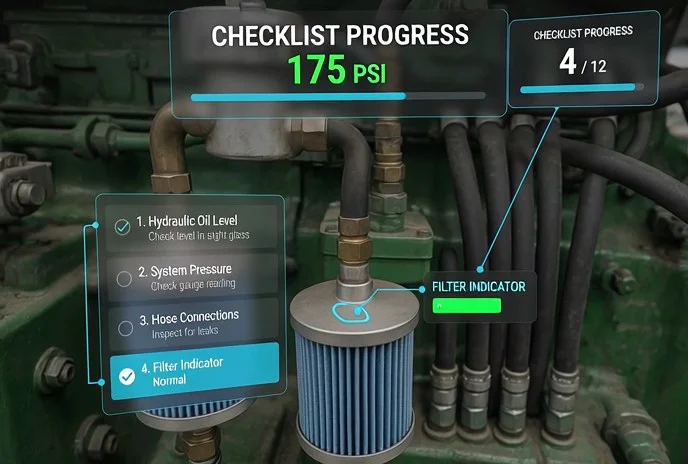
We proposed replacing paper manuals with interactive AR instructions. The operator points the tablet camera at the unit—and immediately sees the step-by-step assembly diagram, highlighted elements, and checkpoints on the actual part.
No more searching through folders: all information appears in the field of view within a second. Our engineers adapted the solution to workshop conditions: the tablets work with gloves, and are resistant to dust and temperature fluctuations.
What the Implementation Delivered
One month after launch, we measured the results. Line downtime dropped by 37%—that is almost 1.5 hours of additional work per shift. Defects fell by 22%, and repeated rework was cut in half.
New employees reached full pace in three days instead of two weeks—because they no longer had to memorize instructions.
Production stopped depending on the experience of a single operator. Any worker, even after vacation or a transfer from another area, assembles a unit with the precision of an experienced master.
The client was so convinced by the results that they expanded the project to five other plant lines. Total savings from reduced downtime and defects exceeded the cost calculated after audit in the first year.
How to Choose the Right Augmented Reality Format for Your Workshop?
Augmented reality for a factory floor is not a ready-made off-the-shelf product but a tool that delivers value only when properly matched to the task.
One manufacturer only needs simple step-by-step prompts on a tablet; another needs a projection directly onto the workbench with automatic control of every step. Choosing the wrong format leads to overpaying for unnecessary features or disappointment in the technology.
The choice of format depends on typical tasks: assembling a new unit, training new hires, or reducing errors in repetitive operations. For personnel training, mobile instructions are more convenient—employees open them themselves and move at their own pace.
For a complex assembly line, stationary systems with execution control are more effective—they reduce the risk of skipped stages.
Equipment requirements are equally important. We help assess what is already available in the workshop: whether standard tablets or smartphones will suffice, or whether the task requires rugged devices and stationary cameras. This helps avoid unnecessary costs and make use of existing resources.
Before scaling, we recommend running a pilot project on one area: select a specific operation, implement the instruction, and measure the result—assembly time, error count, and new-hire ramp-up speed.
Based on the pilot, you see the effect in numbers and make a decision about expansion without risking the entire production.
Our team helps you choose a format that fits your tasks and budget, runs the pilot, and supports implementation. You get a solution that pays off—not an expensive toy.
FAQ: What If the Instruction Does Not Work?
Most often, clients are not worried about technology but about the instruction failing in the workshop: old equipment, employees used to paper, updates stalling.
These concerns are understandable—any production downtime costs money, and nobody wants to be a “guinea pig” at their own site.
We design AR instructions so deployment runs smoothly: first we check compatibility with your equipment fleet, then we adapt scenarios to real workstations.
If an operation does not display correctly or an employee gets confused, a support engineer connects remotely and resolves the issue on the spot without stopping the shift.
What if the AR instruction will not run on our equipment?
We guarantee launch on the agreed list of devices. Before the start, we conduct a technical audit: we check which models and software versions you have and select the format—from tablets to augmented reality glasses.
If problems appear in any area, our engineers refine the project until it is fully functional—this is included in the scope, not charged separately.
It is also important that the instruction can work even on older equipment: we create simplified versions of the scenarios that do not require heavy computing power. After launch, you receive a support channel through which you can quickly report any error. Response time is up to one business day, and critical failures are resolved within an hour.
Discuss Your Task: Get an Implementation Plan and an Accurate Estimate
You already understand that AR for assembly reduces training time, lowers the risk of errors, and speeds up new employees reaching full output. But one thing is a general idea, and another is understanding how it applies specifically to your equipment, processes, and budget.
That is why we suggest starting with a short free consultation. You do not need to study technical details—just describe the task, and our engineers will propose a solution and show how it works in practice. You get specifics, not promises.
What you receive after contacting us:
- A free consultation: we discuss your scenario and point out where AR instructions will deliver the greatest effect.
- An accurate cost estimate based on the scale and type of your equipment—with no hidden extras or fine print.
- A demo of an AR instruction on your unit or part: see with your own eyes how an operator works with the prompts.
- An implementation plan with stages, timelines, and areas of responsibility—clear for a manager, not overloaded with technical jargon.
- Examples of industrial projects and customer feedback, so you can verify our experience before making a decision.
We work remotely and adapt to your schedule. Usually, within 2–3 days after your request, you will have a plan and estimate in hand, and you can view the demo even before the project starts.
This does not obligate you to place an order—but it gives clarity on what you are paying for and what result you will get.
Leave a request for development—and after a short conversation, you will understand how AR fits into your production and starts delivering value.