

Why Paper Instructions Lose to Smart AR Glasses in the Workshop
A new shift begins, and an employee is at the line for the first time. Paper instructions are hunted for through drawers, and even when found, the worker spends minutes poring over diagrams that don't match the actual layout. An assembly error isn't just rework — it's equipment downtime and a safety risk.
According to PwC, manufacturing companies lose up to 10% of working time on training and corrections that could be eliminated. An experienced mentor can't be at every machine at once, so new employees learn by trial and error — at the cost of defects and injuries.
Paper forces workers to break away from the task, and every second of pause reduces speed and attention.
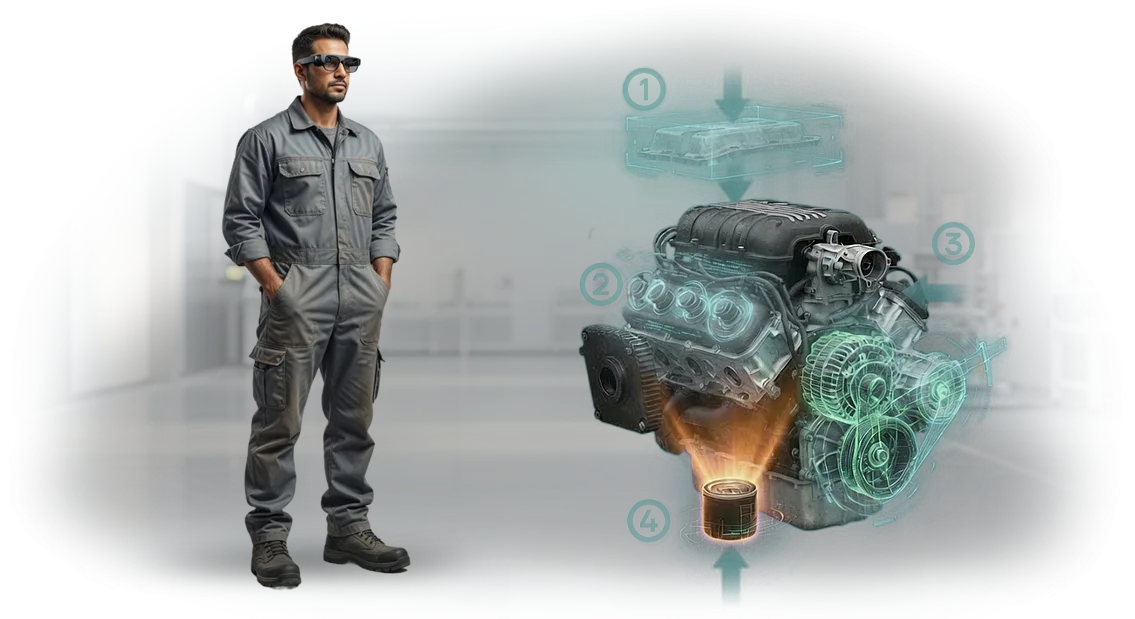
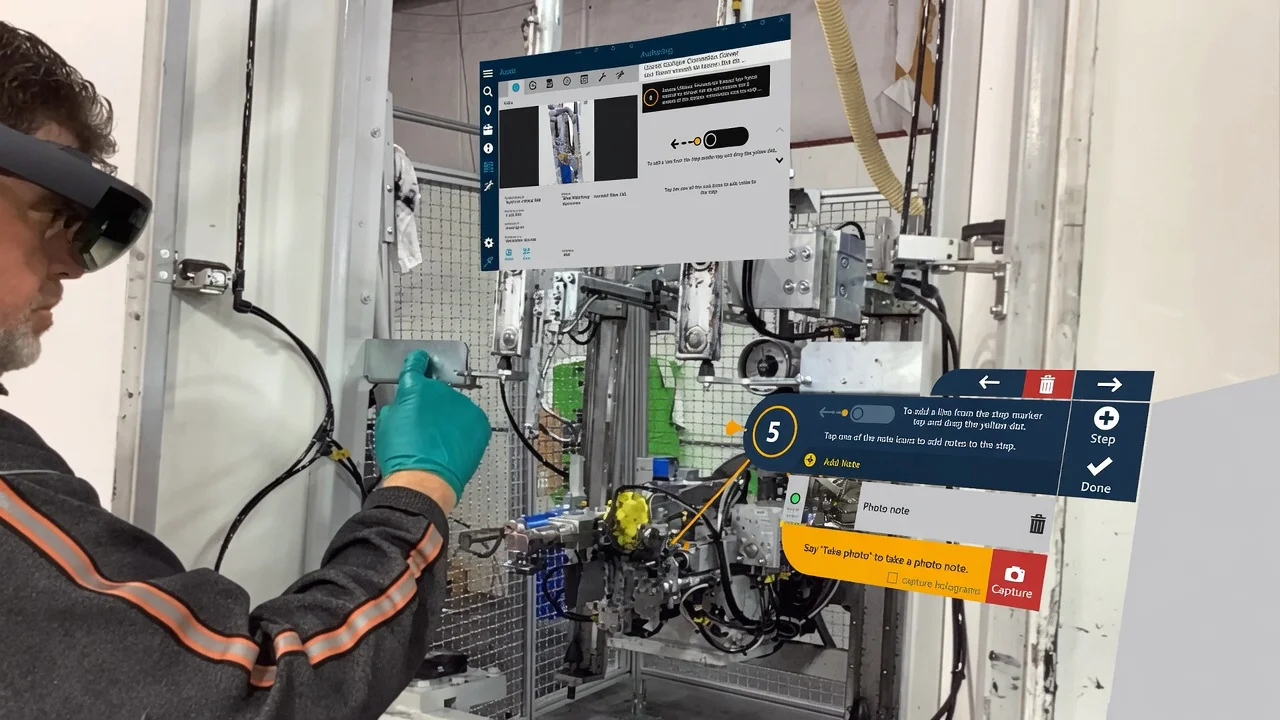
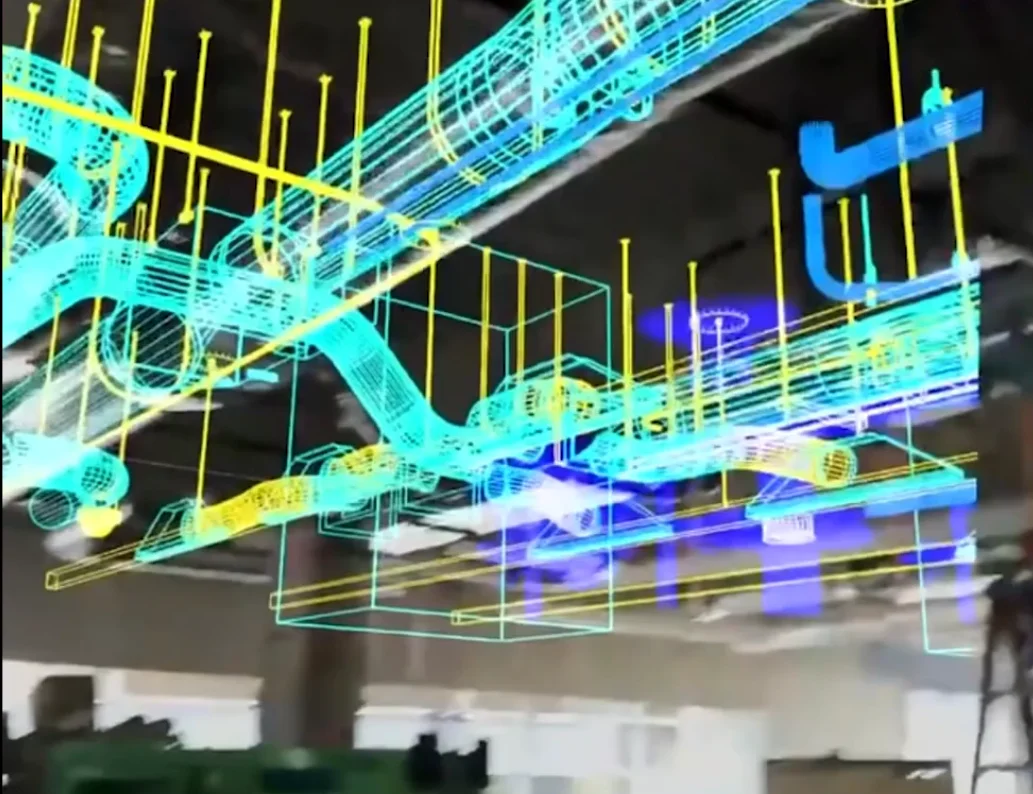
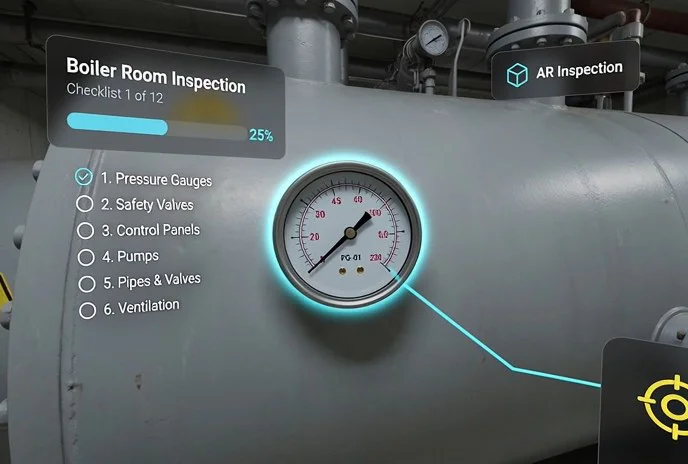
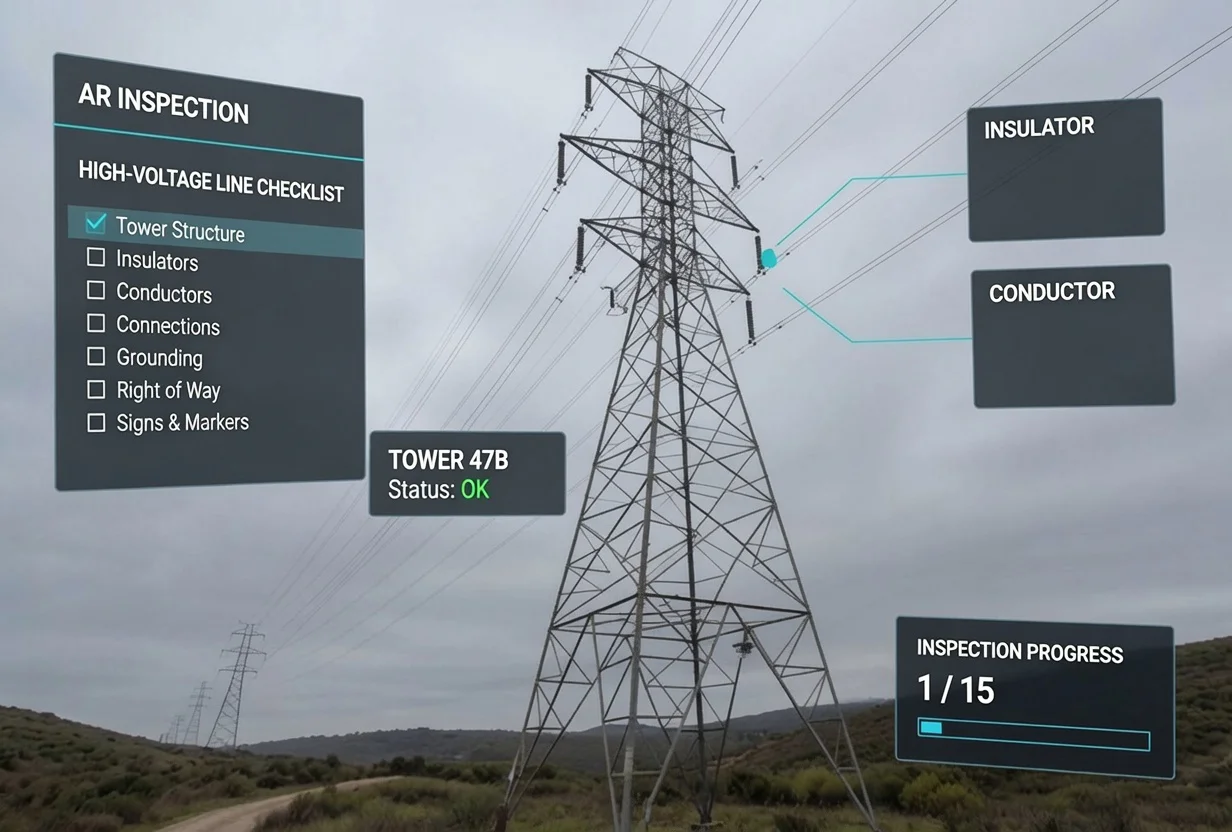
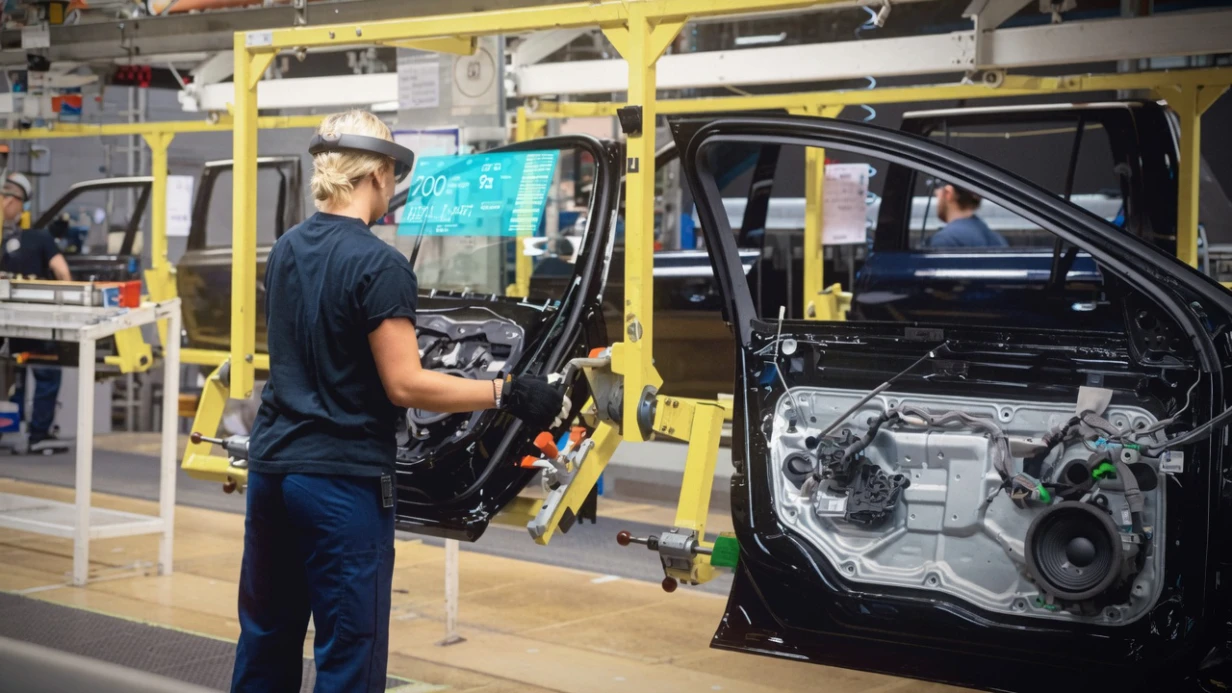
Smart AR glasses change the process: prompts, diagrams, and checkpoints appear right in the field of view without pulling attention away from the work. The employee sees the next step without ever taking their hands off the part.
Errors drop, ramp-up to planned productivity accelerates many times over, and workplace safety reaches a new level: instructions are always right in front of the worker.
We convert paper instructions and standards into AR format for industrial enterprises. Our engineers break down operations, design scenarios for your equipment, and deploy the system so that training becomes fast, safe, and under the supervisor's control.
Employees get up to speed faster, and mentors focus on complex tasks instead of repeating basic steps.
What Benefits You Get from AR Glasses for Employee Training
Deploying smart AR glasses isn't just buying a device — it's a systematic acceleration of workforce training. With projects for the machine-building holding StalProm as an example, we see AR benefits appearing as early as the first month of operation.
Benefit: 2x Faster Training Without Stopping Production
A newcomer sees step-by-step prompts right on the equipment and performs operations immediately — no notes required. Onboarding time shrinks from weeks to just a few days, and one mentor can simultaneously guide several people.
Benefit: Reduced Defects and Errors
The instruction won't let a step be skipped: the glasses highlight the right component and guide the correct sequence. On assembly lines, the error rate drops by 20–30%, and repeat warranty repairs fall by almost half.
Benefit: Enhanced Safety
The employee is less distracted by papers and folders — hands are free, and eyes stay on the equipment. Enterprises report fewer injuries and fewer regulation violations when working with electricity, chemicals, and moving machinery.
Benefit: Control and Fast Payback
The system automatically records who completed the course, where an error occurred, and how long each operation took.
Managers get objective statistics with no manual reports; deployment typically pays back in less than a year thanks to savings on defects, rework, and mentor time.
AR Instruction Development Formats to Fit Your Budget
We understand that different enterprises have different budgets and deployment timelines. Some need to quickly test how smart AR glasses will affect maintenance and staff training; others need to cover all production areas at once. That's why we offer development formats ranging from a pilot project to full deployment.
In every case, you get a working result, not a presentation. After the pilot, you'll be able to measure the real time savings and error reduction, and then decide whether to scale.
The development cost depends on the format you choose and the number of instructions — we lock in the final estimate before we start.
| Format | For Whom | What the Client Gets |
|---|---|---|
| Pilot project | For first steps and hypothesis testing | 2-3 working instructions, operator training, effect assessment within 2-4 weeks |
| Turnkey development | For enterprises that want to cover all standard operations | Full catalog of AR glasses instructions, a unified work standard for all shifts, guaranteed results |
| Scaling across sites | For companies with several workshops or branches | Fast deployment across all locations, lower costs for field specialists |
| Support and updates | For those who change equipment and regulations | Instructions always up to date without digging into technical documentation, support and refinement for new tasks |
Any format starts with a short brief — within 2-3 days we'll show how a specific process at your production facility will look in smart glasses and calculate the budget. Then you choose: a pilot or a full project right away.
Deploying Smart Glasses in Production in 6 Steps
To make smart glasses truly simplify work on the production floor, buying the hardware isn't enough. You need a process that accounts for the specifics of each area, employee tasks, and safety requirements.
That's why we've structured deployment as six transparent stages — from the first interview to post-launch support.
-
Brief and goals. We document which operations need to be accelerated, which errors need to be eliminated, and how results will be measured. We define the scope of responsibility and the project's success criteria.
-
Production audit. We study real work processes: we visit the site, talk with supervisors and operators, and identify bottlenecks. The output is a map of the areas where smart glasses will deliver measurable value.
-
Plan and prototype. We select an area for the pilot project, agree on instruction scenarios and the format for presenting information. We prepare a realistic timeline and budget plan with no unnecessary costs.
-
Pilot project. We launch smart glasses in a limited area, collect employee feedback, and refine the solution. Even at this stage, you can see how much operation time shrinks and how fewer errors occur.
-
Scaling. We roll out the proven solution to other shifts and lines. We integrate it into the training system for newcomers and into quality control, so the effect spreads across the entire production facility.
-
Support and development. We stay in touch after launch: we update instructions when regulations change and expand smart glasses functionality for new tasks. You get not a one-time delivery but a working tool that evolves together with your production.
What's Included in the Delivery: A Complete Kit for Launching AR Instructions
We provide not just an application but a complete working kit — from files and instructions to training materials for your team. You get a solution that can be integrated into the production process immediately after handover, with no additional investment or lengthy setup.
Here's what's included in the delivery:
- Ready-to-use AR instructions: a complete set of scenarios for your equipment, tailored to your employees' specific tasks.
- Software licenses: all necessary usage rights for your enterprise, so you avoid legal risks.
- Staff training: we train your engineers and operators — they learn to work with instructions through smart AR glasses and to configure them for new tasks.
- Administrator's guide: a clear manual for your IT department on updating content and managing the system.
- Technical documentation: a description of the solution architecture and operating procedures that helps your team maintain the project independently.
- Startup technical support: a dedicated engineer during the pilot launch and a hotline for quickly resolving issues in the first months of operation.
This protects you from a situation where the project stays "on paper" after delivery. The kit is designed so your employees start using AR instructions in their work as quickly as possible, and you see the effect in reduced downtime and faster onboarding of newcomers.
Case Study: How We Reduced Assembly Errors with AR Glasses
We help equipment manufacturers move away from paper instructions and human errors.
One of our clients — the pump plant PromTech — faced a typical pain point: assembling complex units took more than twenty minutes, and errors in connecting hydraulics led to defects and missed deadlines.
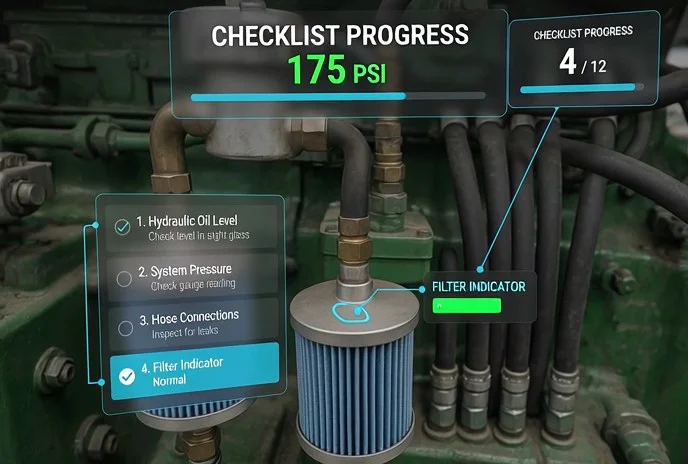
To remove the main source of errors — the need to keep dozens of diagrams in mind — we deployed step-by-step AR instructions in smart glasses.
The operator sees directly on the part the exact spot for the pipe fitting, which fastener to choose, and how much force to apply when tightening. Hands are free, eyes are focused on the work, and paper instructions are gone.
Within two months, the assembly error rate dropped by 87%, and average operation time was reduced by 43%. Downtime from defects fell threefold, and a new employee reaches planned speed in three days instead of a week.
"Previously, a supervisor had to control every complex series," says the assembly shop manager.
"Now the smart glasses guide the sequence of operations, and we can confidently trust assembly to a newcomer." After the first area, the client expanded the project to two more workshops.
We handle scenario development, glasses configuration, and staff training — the plant gets a measurable result, not a demo stand. Experience shows: AR instructions pay for themselves within the first months and work in every area with manual assembly.
How to Choose the Right Development Format for Your Task?
The choice of format depends not on trendy technology but on the task you need to solve. If an employee needs to quickly learn how to service a new component, a short interactive scenario is enough.
If you're dealing with complex equipment with dozens of operations, you'll need a full application with step-by-step control. Once you define the goal — training, maintenance, or quality control — you'll understand the required depth of detail.
Budget and timelines are directly tied to scale. A standard project with prompt screens and instructions overlaid on the real object costs several times less than a system with automatic part recognition and online reporting for managers.
We always offer a modular architecture: you can start with a basic plan and expand functionality once you see the effect on the production floor.
Consider the specifics of the facility and the equipment itself. For work in a dimly lit workshop, the interface must be adapted to the conditions; for outdoor use, it must resist glare.
During the initial analysis, our engineers visit the site to factor these nuances into the estimate and prevent surprises at the deployment stage.
In any case, the ultimate criterion is the speed and quality of your specialists' work. That's why we recommend not simply ordering "application development" but conducting a joint process analysis — it's free.
This way, you'll get a clear understanding of which format will pay off faster in your specific case and can make a well-informed decision.
Frequently Asked Questions About AR Instruction Deployment
Deploying AR instructions raises questions: budget, compatibility, safety, timelines. We answer them directly — so you can decide with confidence.
How much do AR instructions cost?
We calculate the cost individually: it depends on the number of components and the complexity of operations. After the brief, we give you an exact estimate — with no hidden fees. The investment pays off through reduced errors and shorter training time.
Will it work with our equipment?
Yes, in most cases. We work with equipment from various manufacturers — you don't need to replace anything. We build instructions from your drawings or videos. If necessary, we visit your site.
Is it safe?
AR doesn't remove safety procedures — it reinforces them: the employee sees the real object and the prompts without getting distracted. This reduces the risk of errors and injuries. Data is stored on secure servers with access control.
What are the deployment timelines?
From brief to working prototype — 3-6 weeks. We build the first instruction in an accelerated format so you can see the result. Then we roll it out to the remaining components on your schedule.
How do we train employees and update instructions?
No lengthy training is needed: put on the glasses — see the prompt. For supervisors, we provide a short briefing. Updates are made through a simple panel, and we support you throughout.
Still have questions? Write to us — we'll help.Leave a Request — We'll Calculate Your Project Cost in 1 Day
We know how important it is to quickly understand your budget and timelines: every day of waiting is lost time and money. That's why, after your request, we'll prepare a preliminary project cost estimate within one business day — without complex forms or technical specifications.
Submit a request, and our team will call you back, clarify the details, and prepare a personalized proposal. You don't need to understand the technology — we'll ask the right questions and offer the optimal option for your equipment.
Here's what you get after contacting us:
- Free analysis of your task — we'll assess which processes can be accelerated or made safer with AR instructions.
- Turnkey cost estimate — a transparent estimate for development, integration, and ongoing support.
- Implementation timeline assessment — clarity on when the project will be ready and when you'll start seeing results.
- Format recommendation — a fixed workstation, tablet instructions, or smart AR glasses: we'll find what truly suits your employees.
- Expert consultation — discuss your task with an engineer from our team who has already delivered dozens of similar projects for industry.
- Commercial proposal with clear stages — you'll know exactly what you're paying for and what results you'll get at each step.
No obligations — just a consultation and an estimate. Submit a request through the form on our website or write to us in your preferred messenger: as early as tomorrow, you'll know the project cost and can make your decision.