

No AR Work Instructions — No Standardization: Downtime and Defects Multiply
Each day of assembly line downtime is lost revenue, and every operator error caused by an unclear instruction is a defect that has to be reworked at the company's expense.
Paper regulations and PDF reference sheets become outdated the moment edits are made, and employees work not according to the current standard but from memory — this creates deviations that auditors record as systemic.
The problem gets worse when new hires or temporary staff work on the line. Without a clear visual prompt, they spend time searching for the right component, skip critical steps, and add pressure on mentors, who have to divert attention from their own tasks.
In the end, not only quality suffers but also safety: an incorrect sequence of operations is one of the most common causes of workplace injuries.
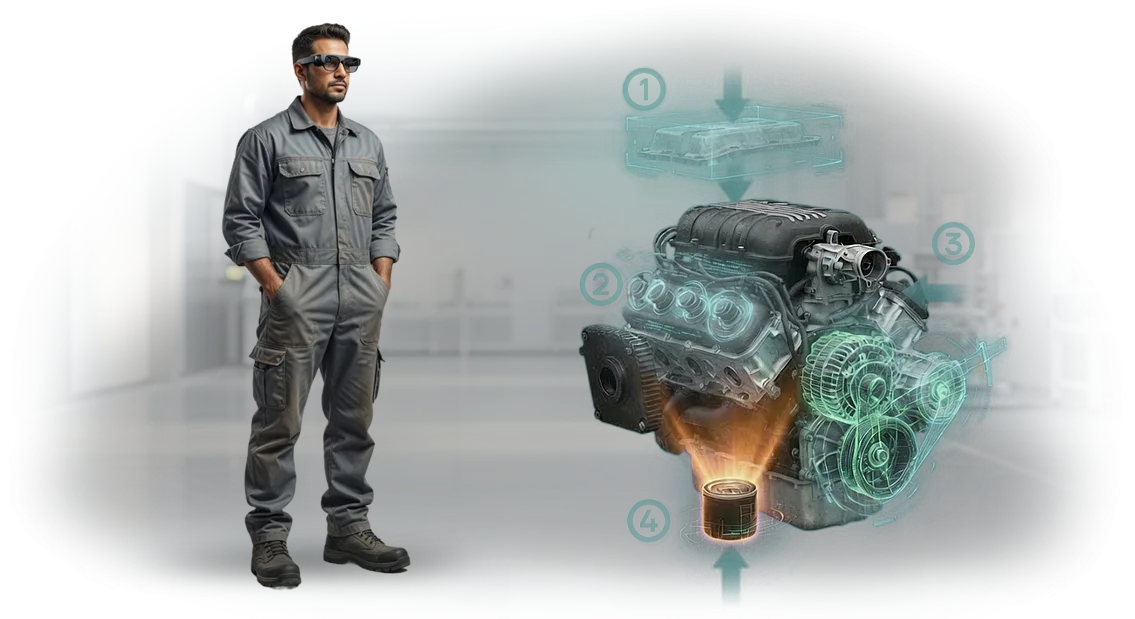
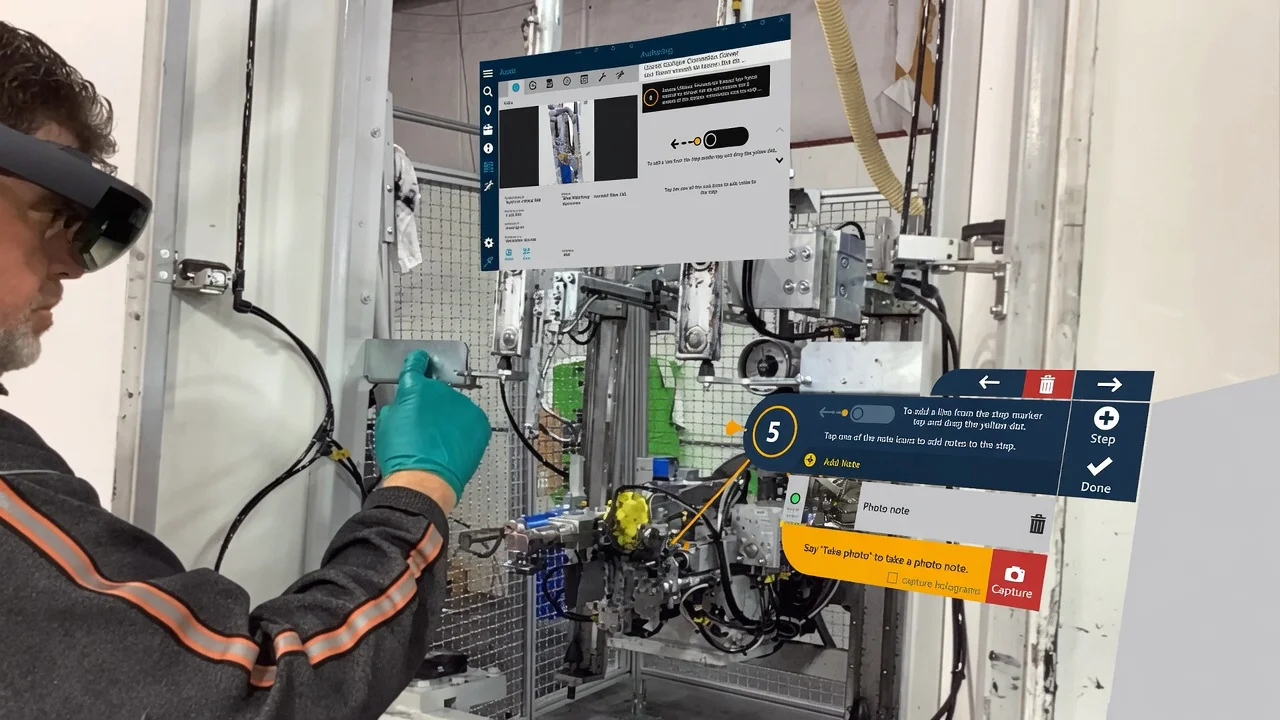
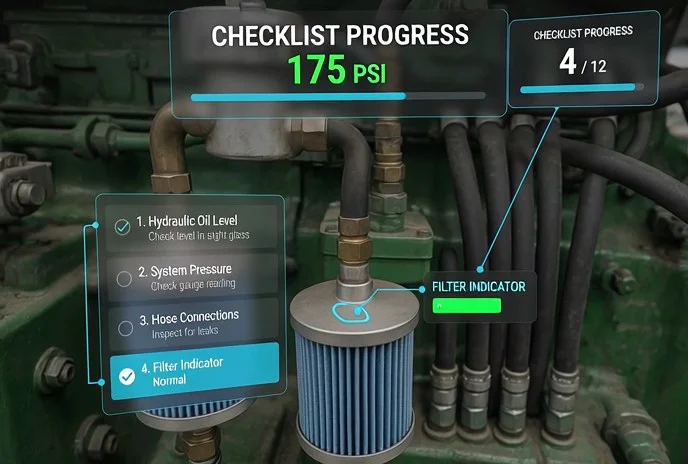
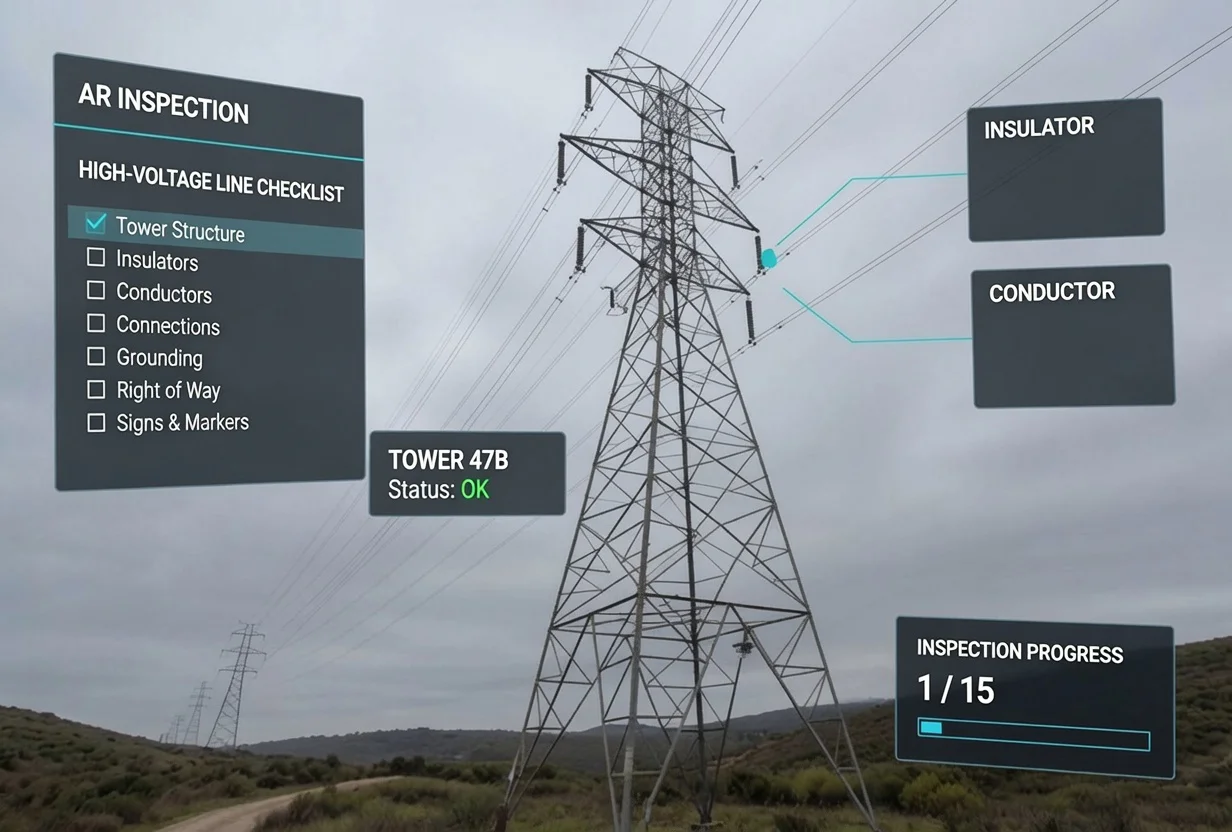
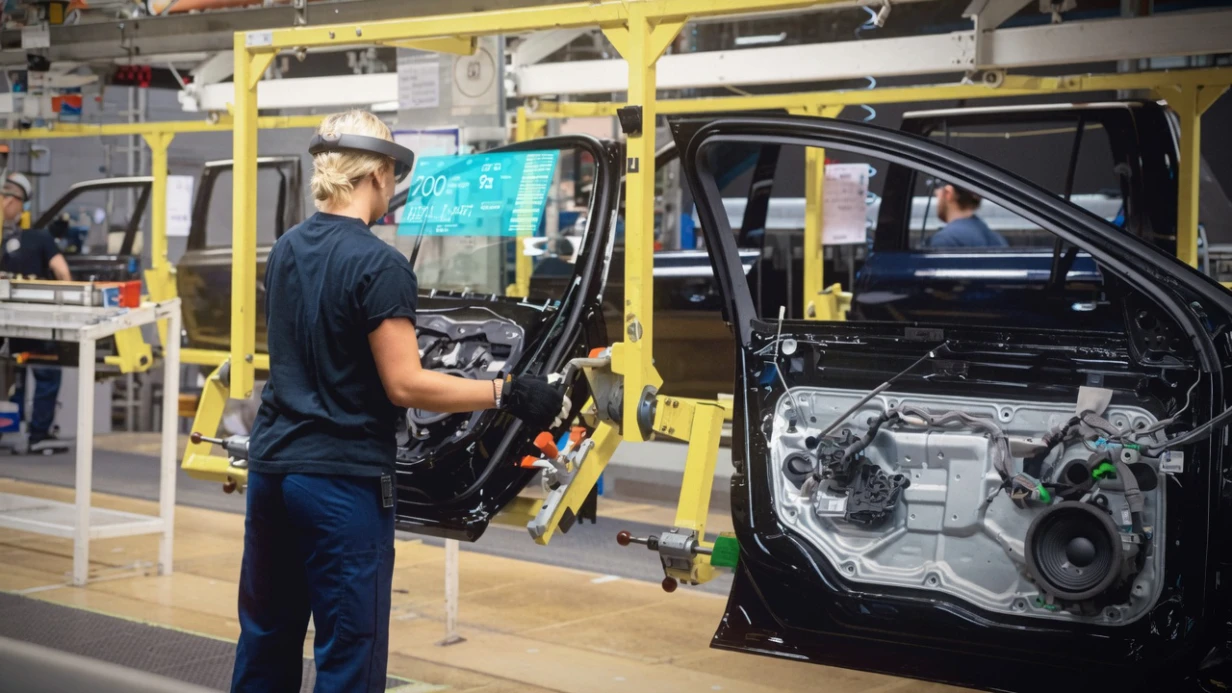
We address this need by implementing AR instructions: step-by-step digital prompts are projected directly onto the equipment, and the operator sees what to do and in what order without flipping through paper.
Every action is recorded, the standard is the same for everyone, and updates take minutes rather than weeks of approvals.
The result — fewer defects, stable assembly cycles, and peace of mind for the manager about meeting the plan. Production stops depending on the experience of a specific employee and starts consistently delivering a product of the required quality.
AR Work Instructions: 5 Benefits for Manufacturing
Production without quality instructions loses money every day: new employees train for weeks, errors turn into defects, and equipment downtime reduces output.
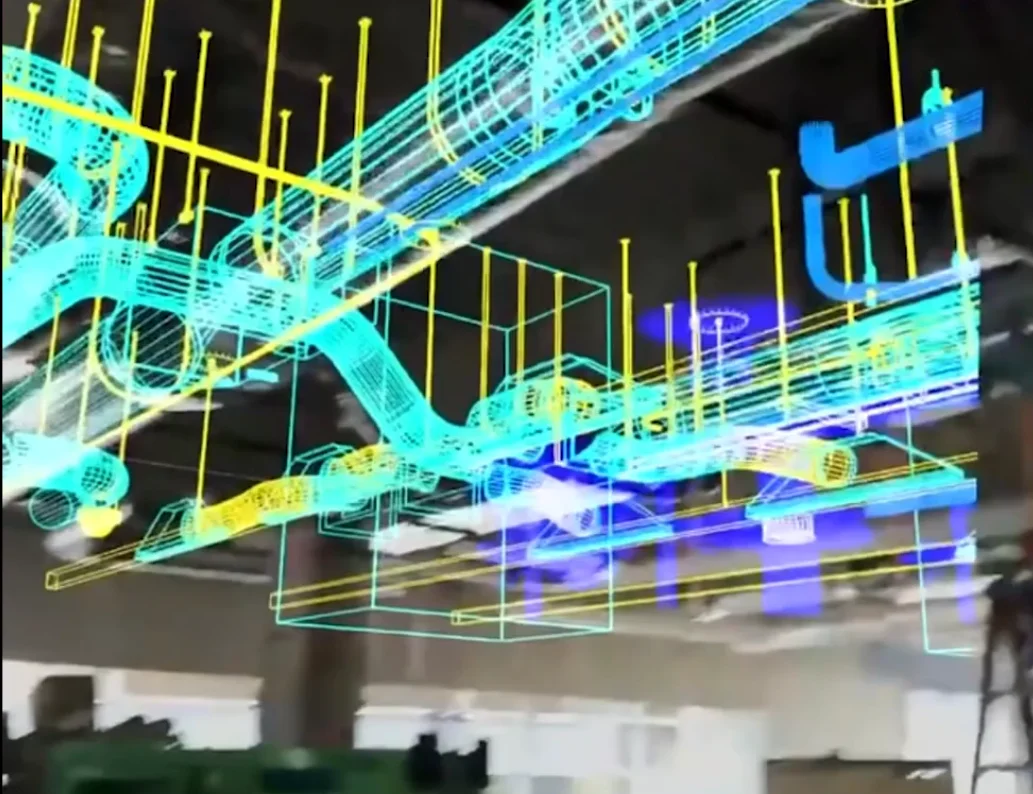
AR instructions solve this problem in a fundamentally different way — step-by-step prompts are overlaid directly onto the real machine or line, so the worker always has the correct sequence of actions right before their eyes.
Reduced training time. A newcomer doesn't flip through paper regulations or search for the right component in a complex diagram — they see the prompt right in their field of view.
This makes it possible to onboard employees several times faster and get them to planned productivity sooner.
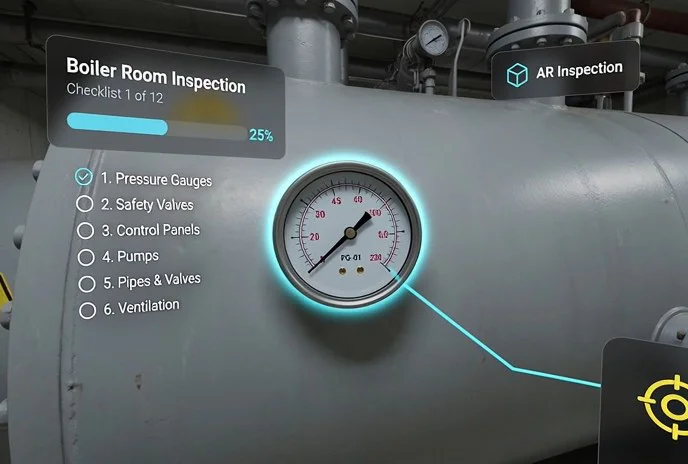
Fewer errors. The system highlights the right parts and controls every action, preventing the operator from mixing up the order of operations. Defects and rework decrease within the first month, and product quality becomes stable without tightening control.
Increased productivity. Experienced workers stop spending time recalling rare operations and coordinating questions with a mentor. Changeover and maintenance take less time, and output grows without additional staffing costs.
Improved safety. The instruction warns about hazardous areas in advance and prevents a forbidden action from being performed, so injuries decline and inspections go smoothly. This is also a direct saving on compensation and downtime.
Savings on training and documentation. Paper instructions become outdated, while AR content is updated centrally and is always current. The experience of the best craftsmen is preserved in digital form and passed on to any employee without taking the mentor away from work.
Together, these five benefits deliver a measurable business impact: lower production cost, higher quality, and a fast return on investment. If you want to assess the effect for your site in numbers, we are ready to run a pilot project on one of your processes.
AR Instruction Formats: Choose According to Your Task
Each employee gets their own scenario: an operator on the line needs a quick prompt, a repair technician needs a step-by-step breakdown, an engineer needs access to parameters and service history.
This is why AR instructions are rarely made as a "single file": it's better to choose a format to match the specific task and the person's skill level.
AR Instruction Formats
| Format | For Whom | What It Gives the Client |
|---|---|---|
| Quick prompts | Line operators | Fewer errors when switching modes, no need to flip through paper instructions |
| Step-by-step scenarios | Repair technicians and service teams | Clear sequence of actions, control at every stage, less downtime |
| 3D unit breakdown | Engineers and technologists | Understanding of the design without opening the equipment, faster diagnostics |
| With remote support | All roles | The expert sees the same as the employee and provides guidance in real time |
The formats complement each other: one model can be used for newcomer training, operational prompts, and maintenance. At the project start, we analyze exactly where time is lost and errors occur, and then propose a format that addresses those losses.
All options work on tablets and smartphones — no expensive equipment or lengthy retraining of personnel is required.
Instructions are easy to update: changes in the production process are immediately reflected for all employees rather than "settling" in outdated paper regulations.
How We Develop AR Instructions: 6 Steps from Brief to Launch
We have structured the process so that you see results at every stage and can influence them. No "black box": you understand what is happening, when, and what you are paying for.
- Brief. In one or two working calls, we determine which operations need to be covered, how many employees are involved, and on what equipment. The output is a document with goals, timelines, and budget.
- Audit and plan. We study your production, regulations, and typical errors. We create a plan where each stage has its own result and deadline. We agree it with you before starting work.
- Prototype. On one real unit or machine, we show what the instruction will look like: text, arrows, animation. You immediately see whether it is convenient for your employees.
- Development. We create a complete set of AR materials for your operations. We regularly send intermediate versions — you control the process without getting into technical details.
- Launch and training. We install it on tablets and smartphones, configure it for shop floor conditions, and train instructors. We test it in a real environment: light, dust, movement.
- Support and refinement. We stay in touch: we update instructions when regulations change, add new units, and monitor system stability.
In the end, you get not just files but a working tool that reduces the number of errors and speeds up the onboarding of newcomers. We take on all implementation risks — you stay focused on production rather than technical details.
What Is Included in the AR Instruction Delivery Package
When ordering AR instruction development, you get not just an application but a ready-to-use tool. We put together the delivery package so that launch does not require any additional investment or time from you.
The final package includes:
- AR Instruction Library — ready-made step-by-step scenarios for all selected operations. The employee sees prompts directly on the equipment, which reduces the number of errors.
- Content Management Panel — you update instructions yourself when regulations change, without contacting developers.
- Integration with Your Systems — we connect instructions to your knowledge base, document management system, or training portal so that data is always up to date.
- Access and Permission Configuration — you determine which employees can view and edit instructions, ensuring order in your operations.
- Personnel Training — we conduct training sessions for managers and workers: we show how to use the instructions and the management panel.
- Operating Documentation — we provide concise guides on setting up, updating, and launching instructions so that you do not depend on us.
- Technical Support — we support you in the first months after launch: we quickly resolve issues and help adapt the instructions.
This set covers the full cycle — from installation to everyday use. You get a measurable result: fewer errors, faster training of new employees, and time savings on process control.
Case Study: How a Factory Reduced Training Time by 40% with AR
Let's talk about a real project: we developed AR instructions for the machine-building factory TechnoProm. At the time, training new operators took two weeks, and even experienced employees made mistakes on complex units.
Paper instructions and videos did not help: a worker had to mentally transfer drawings onto real equipment, which took time and led to defects.
We started with one site. Together with the customer's process engineers, we broke down the most problematic operations and turned them into step-by-step scenarios that the operator sees directly on the machine.
At the right moment, the prompt shows which tool to take, where to point it, and what to pay attention to. Training with this system is faster because there is no need to memorize anything — all actions are confirmed on the screen.
First-month results:
- New employee training time decreased by 40% — from two weeks to eight days.
- The defect rate in assembly of complex units decreased by 25%.
- The number of support requests decreased — operators began making fewer mistakes.
- The project paid for itself in four months through savings on mentors and production losses.
Now these AR instructions are part of the factory's standard personnel training system. We embedded them into workflows, trained internal instructors, and handed over tools to the customer for independent content updates.
Already after the first phase, the client ordered a second shop, and later recommended us to colleagues from the holding company — this is the best sign of trust.
How to Choose the Right AR Instruction Format for Your Equipment?
Choosing an AR instruction format is not a question of "what is trendier" but of "what will solve your specific task." Equipment differs in complexity, operating conditions, and personnel skill levels, so there is no universal solution.
We select the format to match your specifics — and this is the key principle that saves budget and implementation time.
For complex machines or expensive lines where the cost of an error is high, an interactive step-by-step instruction with control of each stage is effective.
It does not allow an employee to skip a critical step, reduces defects, and speeds up bringing the equipment to operating mode even for a newcomer.
If operations are simple and repetitive, compact visual prompts are enough — they do not overload attention and quickly fit into the familiar work rhythm.
The next factor is operating conditions. For stationary equipment located in a workshop, the instruction can be "anchored" to a specific unit and appear right on it.
For mobile equipment or field maintenance, a format that works through a regular tablet or smartphone without complex setup is more convenient.
We take into account how many shifts you have, how experienced the personnel are, and how often process sheets change — the structure and depth of the instruction depend on this.
A separate question is what tasks you are solving: training new employees, reducing repair time, or reducing operational errors. Each task has its own optimal format, and our engineers will help determine it.
We analyze your equipment, typical faults, and process flows, and then propose a solution that naturally fits into production rather than requiring a restructuring of all processes.
In the end, a properly chosen AR instruction format works for you: it reduces downtime, decreases employee turnover, and improves work quality without additional spending on expensive simulators.
We take on the analysis and selection — all you have to do is run a pilot on one site and see the difference in the numbers.
Frequently Asked Questions About Implementing AR Instructions
We understand that managers have the same questions when implementing AR instructions: how much does it cost, how quickly will it pay off, will we have to change equipment and train personnel? Let's address the main concerns.
How much does implementation cost and when will it pay off?
The cost depends on the number of instructions and the complexity of operations.
At the first stage, we conduct an audit and give an exact price, but the effect is usually visible even in the trial project: employees master new processes faster, make fewer mistakes, and costs for paper regulations and training decrease.
How quickly can AR instructions be launched?
The first trial project takes a few weeks: most of the time is spent preparing content for your operations and aligning it with process engineers. After that, the instructions scale to other sites without production downtime.
Is it compatible with our equipment?
Yes, it is enough to have tablets or smartphones that the enterprise already has. We do not require purchasing new machines or changing software — AR instructions simply overlay onto real objects and accompany the employee on the screen.
Will personnel need retraining?
No, the interface is extremely simple: you just need to point the camera at the equipment and follow the prompts. We provide short training, but most often employees master everything during the first shift.
In addition, instructions reduce dependence on mentors and lower the risk when passing on experience.
Do you have any other questions about implementing AR instructions? Contact us — we will provide a free consultation on your production site.Order AR Instruction Development for Your Manufacturing Process
Ordering AR instructions means getting not just a visualization but a working tool for your manufacturing process. We use industry experience and knowledge of shop floor specifics, so the scenarios are immediately adapted to real operations rather than ideal schemes.
You receive a package that employees use from the first day, and it pays off through reduced training time and a lower number of errors.
Here is what is included in the development for your factory:
- Audit of current instructions and regulations: we determine which operations give the greatest effect from conversion to AR.
- Scenario design: we configure each step for a specific equipment model and the worker's skill level.
- Creation of instructions with overlay onto real units: the employee sees prompts directly on the machine without being distracted by paper.
- Integration with your document storage system: updates reach AR automatically, eliminating outdated versions.
- Personnel training and launch support: we help with implementation and answer questions until the process becomes familiar.
- Result guarantee: we fix deadlines and cost, and after launch we refine scenarios based on your team's feedback.
Ordering AR instructions is simple: leave a request — we will send a commercial proposal within a couple of days. We will start with a pilot site so that you can see the effect on one operation, and then we will scale the solution to the entire shop without losing quality.