

Mistakes on the production floor are costly — you need augmented reality work instructions
On the production floor, every operator error is not just a defective part, but a chain of losses: line shutdowns, downtime of expensive equipment, missed delivery deadlines, and rework.
Even experienced employees make mistakes due to incomplete or outdated instructions, while new operators are forced to spend weeks mastering complex processes through trial and error.
The more sophisticated the equipment, the higher the cost of each incorrect action — and the greater the impact on production efficiency.
Staff training is another hidden cost. Mentors are pulled away from their own work, newcomers take longer to get up to speed, and their first shifts are still marked by errors and downtime.
If equipment is used infrequently, skills are forgotten, and each subsequent setup becomes stressful: the operator frantically searches for the right section of the manual, studies unclear drawings, and asks colleagues for confirmation. As a result, downtime grows and the company's reliability reputation suffers from missed deadlines.
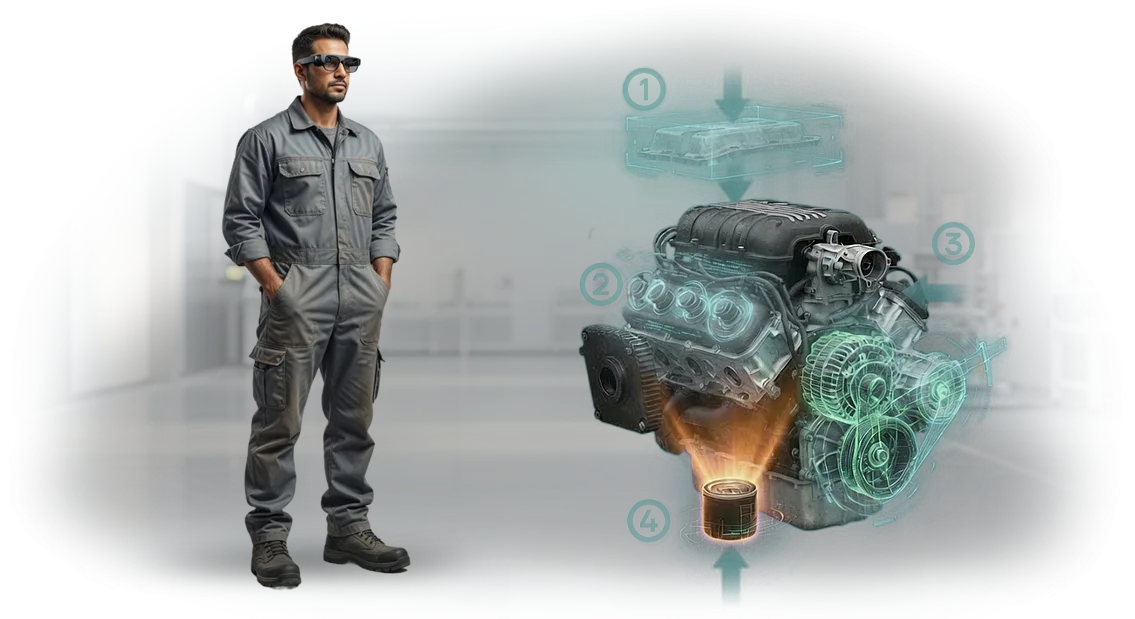
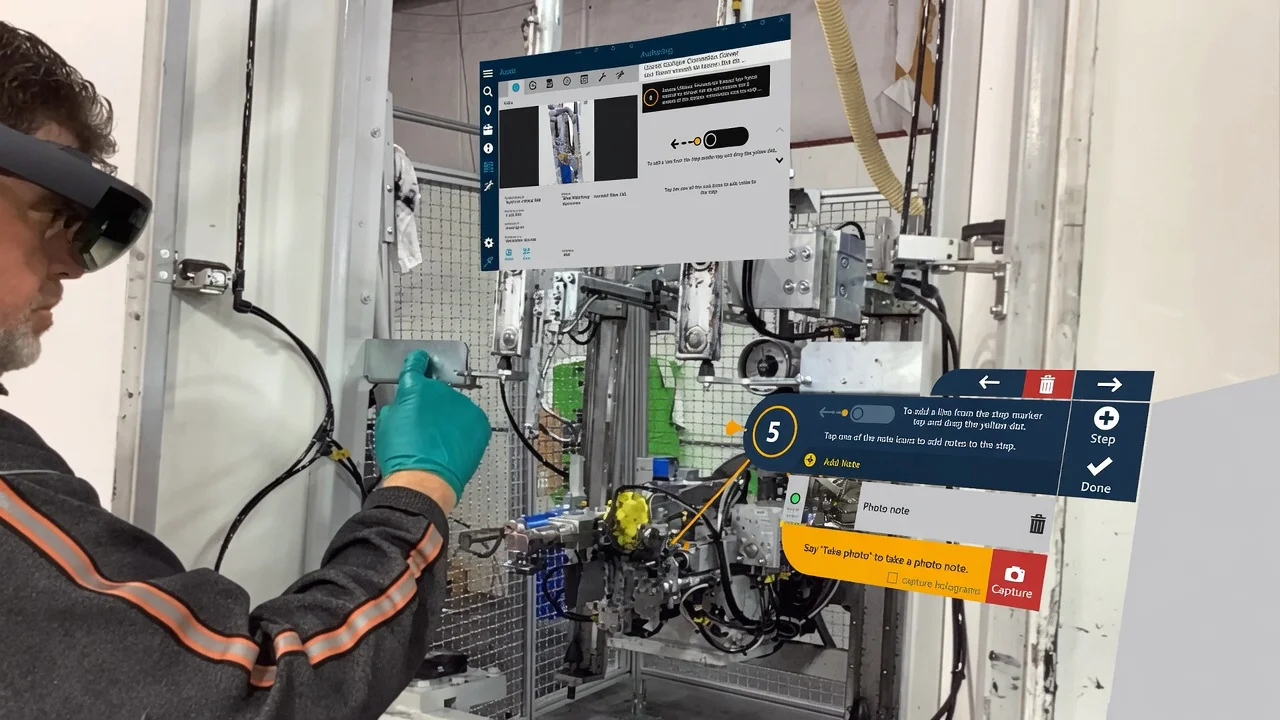
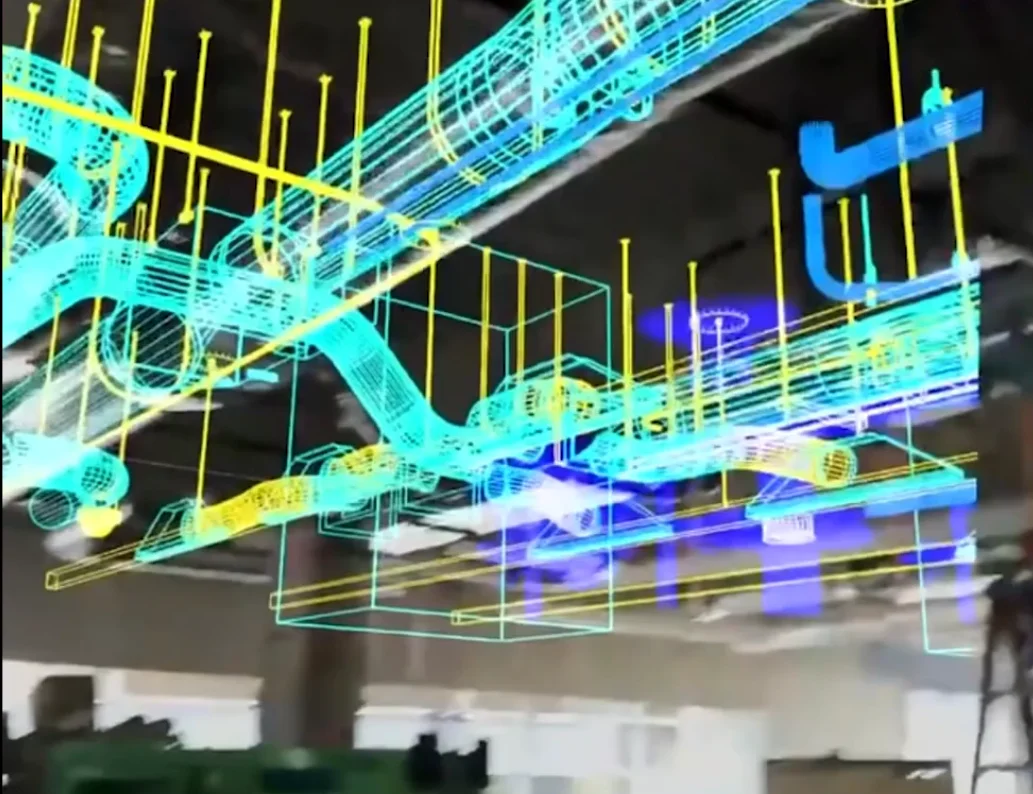
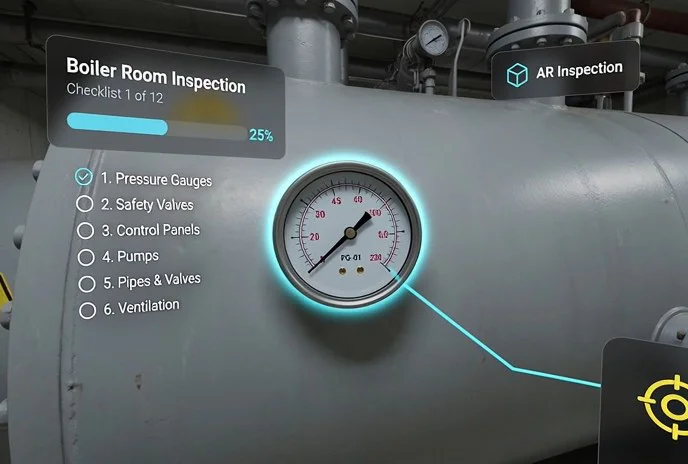
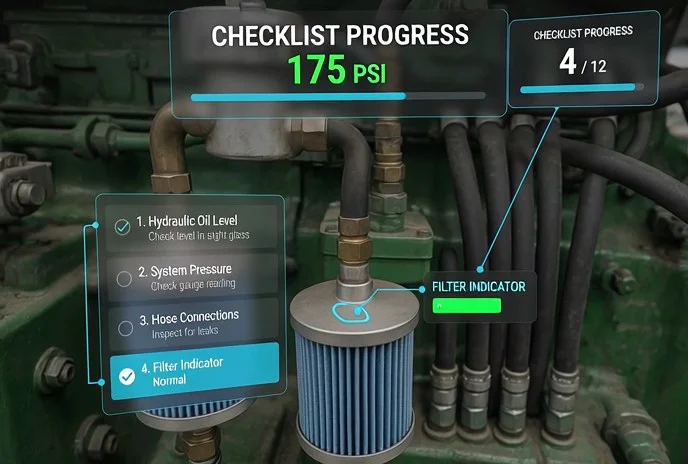
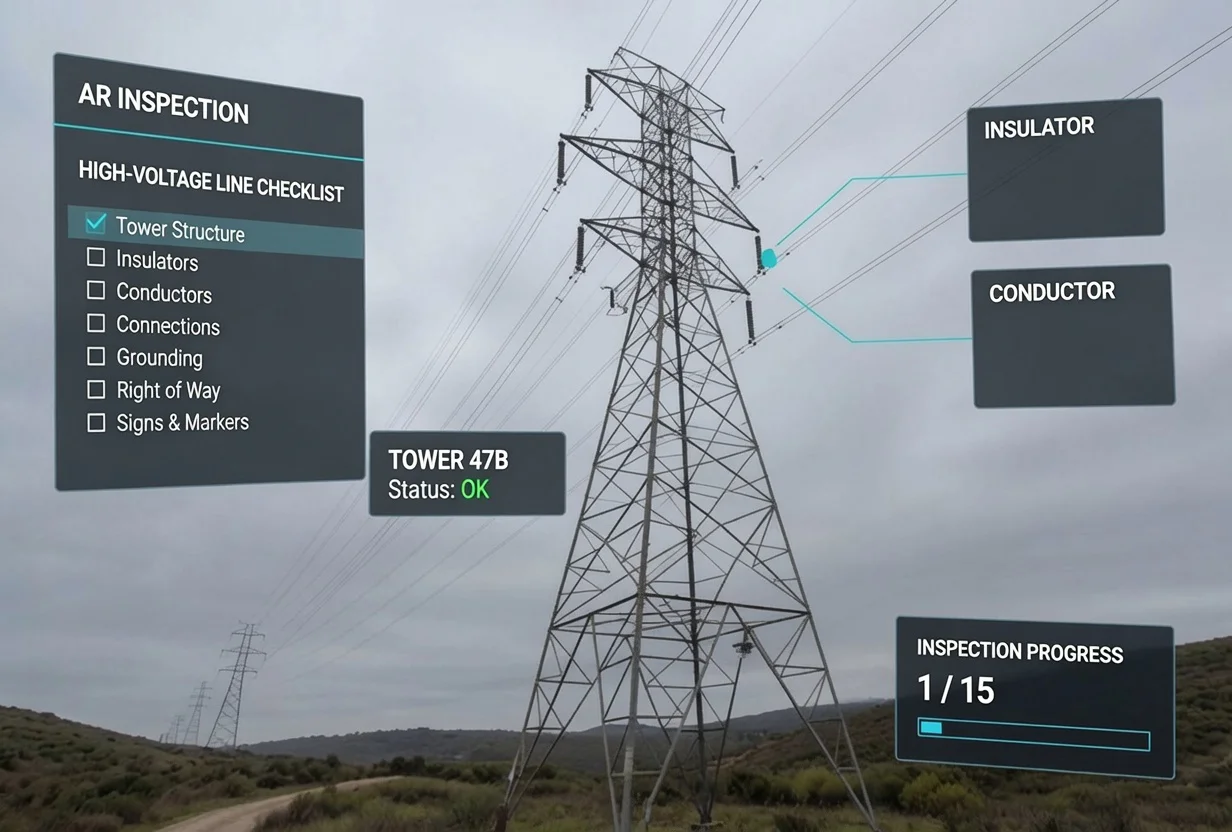
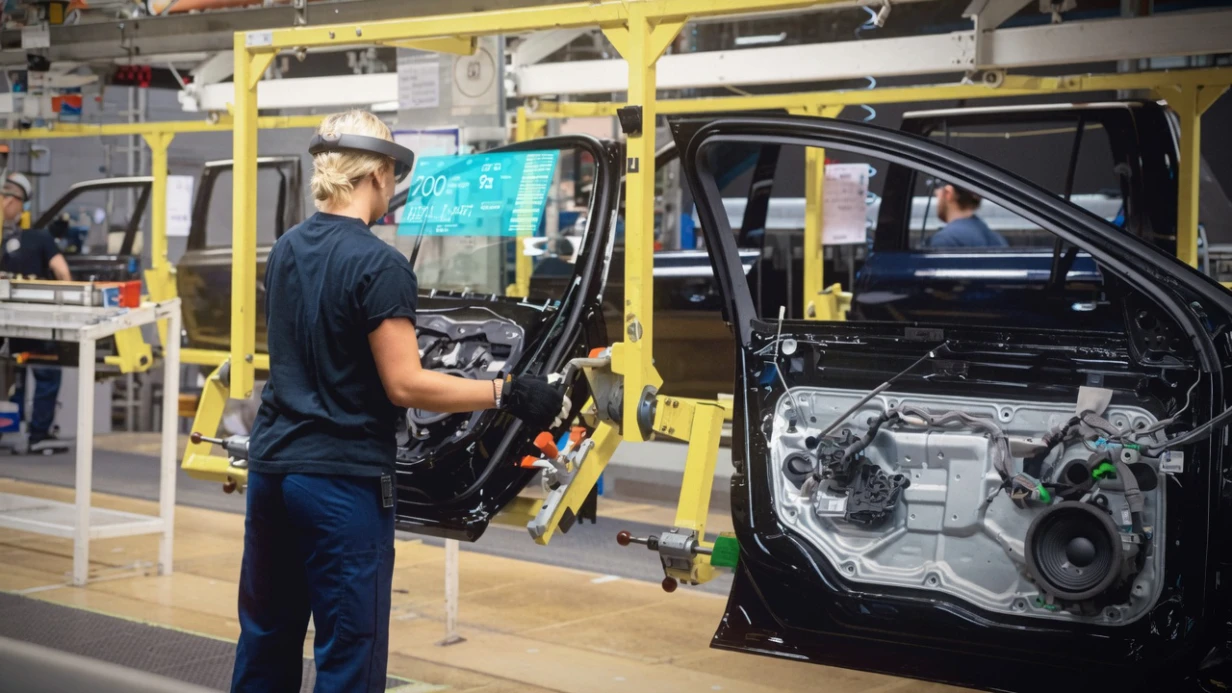
AR instructions solve precisely these problems. Augmented reality shows the sequence of actions directly on the equipment — arrows, highlighting of the relevant components, and warnings about an incorrect step.
The employee sees clear prompts and acts with confidence instead of guessing from paper diagrams. This reduces the number of errors, accelerates the training of new operators, and restores confidence when performing rare operations.
We develop such AR instructions for each customer's specific equipment — from operation analysis to shop-floor deployment — so we solve the problem end to end rather than just creating attractive 3D models.
What you get from implementing AR instructions: 5 measurable benefits
For manufacturing, the value of AR instructions is measured not by a "wow effect" but by concrete metrics: operation time, defect rate, and how quickly a newcomer reaches target pace. You will see five measurable results within the first few months.
Fewer errors
The operator sees the next step directly on the equipment: highlighting, diagrams, and allowable tolerances. The risk of mixing up the sequence or tightening a component with the wrong torque drops by 40–60%. For expensive equipment, this delivers significant annual savings per line.
Faster training
Training time for a newcomer is reduced by 2–3 times, and even more for complex operations. Instead of a week of theory with a mentor, the trainee receives voice and visual prompts in real time. According to PwC, such employees reach full productivity twice as fast.
Improved safety
The instructions block dangerous actions and remind workers about PPE, guards, and procedures. The number of minor injuries and safety violations decreases, which means fewer investigations, fewer compensation claims, and less downtime. The company protects both people's health and its reputation.
Time savings
An operator spends on average 3–5 minutes per operation looking for the right page in a manual. An AR prompt delivers it instantly in the field of view.
Over a shift, this saves up to an hour of working time per employee — with a team of 20–30 people on the line, that amounts to up to two additional shifts per month.
Higher KPIs
The effect shows up in the numbers that appear in reporting: higher output, lower rework costs, and less downtime. The overall increase in line productivity is typically 20–35%, and implementation pays for itself in as little as three months.
AR instruction formats for different production tasks
Production tasks vary widely: training a newcomer to assemble a module is one thing; helping a service engineer repair a machine on site is another. A one-size-fits-all AR instruction does not work here.
That is why we choose the format based on the specific task and on the devices your employees already have — from tablets to AR glasses.
For example, for a manufacturer of metal-cutting machines, we created separate formats for the assembly shop and for field service — each solving its own problem.
| AR instruction format | For whom | What it delivers to the client |
|---|---|---|
| Step-by-step assembly | Line operators | Fewer errors, faster ramp-up for new employees |
| Equipment repair | Service engineers | Fault correction without calling in a specialist, less downtime |
| Planned maintenance | Shop-floor staff | Scheduled work without stopping production |
| Employee training | New workers and mentors | Shorter onboarding time, reduced burden on mentors |
Each format includes not just a 3D model but prompt logic and verification of correct actions. The employee sees where they made a mistake and fixes it immediately, rather than reworking the assembly after inspection.
As a result, defects decrease, operation speed increases, and knowledge is not lost when an experienced master leaves.
Stages of creating work instructions: from brief to support
We have structured the process so that you understand what is happening and what you are paying for at every step. No "black box": from the first brief to launch, you see intermediate results, make edits, and control the timeline.
This reduces risk and ensures that the final AR instruction solves exactly your task — training employees, reducing errors, or accelerating repairs.
-
Brief and task audit. We analyze which operation the instruction covers, who will use it, and what result you expect. We set measurable goals: training time, number of errors, and execution speed.
-
Plan and estimate. We propose an augmented reality workflow scenario, a list of equipment, and timelines. You receive a clear estimate and schedule — with no hidden work.
-
Layout approval. Using sketches and diagrams, we show how the employee will see prompts on the equipment: arrows, animations, and text blocks. At this stage, it is easy to adjust the logic and design.
-
Creating 3D content and animations. Our specialists prepare 3D models of components, disassembly and assembly animations, and text instructions. You receive a draft version for testing on real equipment.
-
On-site testing. Together with your operators and engineers, we test the instruction in working conditions: equipment recognition, interface usability, and prompt speed. We fix any awkward issues.
-
Launch and user training. We hand over the finished solution, install it on your tablets or glasses, and provide brief employee training. You receive a user manual and access to updates.
-
Support and refinement. After launch, we stay in touch: we update content when equipment changes, add new components, and refine the interface based on feedback.
This approach lets you launch a useful AR instruction in 4–6 weeks and measure the effect immediately: faster training for new employees, less downtime, and fewer errors during maintenance.
A single dedicated manager runs your project from brief to support — you do not need to understand the details; you only make decisions at key points.
What is included in the delivery of AR instructions: a complete package for your production
When you order the development of AR instructions, you receive not just files or a link, but a ready-to-use solution that can be integrated into production processes from day one.
We assemble the package around your task: from the application to operator training and technical support. Here is exactly what is included in the delivery.
-
AR application — works on employees' tablets and smartphones, without being tied to specific models and without purchasing additional expensive equipment.
The operator points the camera at a component and sees step-by-step prompts directly on the parts, without being distracted by paper procedures.
-
Instruction content — step-by-step scenarios for assembly, maintenance, repair, or training. The materials are adapted to your operations and your team's language: text prompts, part highlighting, and animations are used to eliminate ambiguity.
-
Integration with your processes — we connect the instructions to your task management system or electronic documents. The employee receives the required AR instruction directly from the work task, without searching through folders and file storage.
-
Employee training — we conduct short training sessions for operators and area supervisors, and we also prepare an internal administrator who can independently add to and update the instructions. People start working with the AR solution on launch day.
-
Documentation — clear guides for using the application, administering it, and updating content. You receive an internal procedure rather than a "black box" that depends on a single contractor.
-
Technical support — we accompany the deployment and remain available after launch: we answer questions, fix issues, and help make changes. Support is included in the first year of operation; after that, you choose the format yourself.
This is a complete package, with nothing extra to build separately. It covers all stages — from installation to daily use — and gives production a tool that reduces the number of errors, accelerates the ramp-up of new employees, and makes staff work noticeably easier.
Case study: cutting operator training time by 40% with AR instructions
For the machine-building concern Mazak, we developed AR instructions for assembly line operators. The customer faced a typical problem: training new employees took three weeks, and setting up equipment with an engineer took up to two hours per operation. Due to staff turnover, assembly line downtime was costly.
We converted the key operations into a step-by-step format displayed on a tablet in the work zone. The operator sees virtual prompts overlaid on the actual machine: where to insert the part, what torque to use, and when to replace the tool.
It works on the standard tablets already available at the plant — no need to purchase special equipment.
After two months, training time dropped by 40%: from three weeks to one and a half. The number of errors during setup fell threefold, and engineer callouts dropped by 60%.
New employees reach planned productivity in the second week instead of the fourth, and mentors no longer have to distract themselves with repeated explanations.
The implementation paid for itself in four months through savings on mentors and reduced defects.
The customer is already scaling the solution to three shops and two plants: we are preparing a second batch of instructions for machine maintenance, and the project has become part of their internal training standard.
How to choose the right AR instruction format for your task?
To choose the right format, you don't need to understand the technology — you just need to clearly decide which production task you want to solve.
The same type of equipment can require completely different approaches: training a newcomer, speeding up routine assembly, or reducing downtime during a breakdown. The answer determines how the employee will interact with the instruction and what result you will get.
Step-by-step AR instructions are suitable for stable, repetitive operations — assembly, setup, and quality control. They help the employee perform each step in the correct sequence without being distracted by paper procedures. This reduces the number of errors and speeds up work on new equipment from the very first days.
Repair and service instructions are created for diagnostics, maintenance, and troubleshooting. Here, the main value is reducing downtime. The specialist sees which component needs to be checked, in what order to perform the steps, and how to avoid typical mistakes. Even a rare operation ceases to be stressful, because everything needed is right before their eyes.
Training formats are designed for quickly preparing new employees and for retraining. Instead of textbooks and long lectures, a person receives interactive prompts right at the workstation.
This shortens the time to full productivity and reduces the burden on experienced mentors — newcomers distract them less with questions.
We select the format individually: we study your operations, the frequency of instruction use, and the skill level of your personnel. We then propose a solution that addresses exactly your task — without unnecessary features or overpayment.
As a result, you get instructions that are actually used in production rather than remaining a demonstration project.
Frequently asked questions about implementing AR instructions in manufacturing
Implementing AR instructions usually raises the same questions: how much does it cost, how quickly will it pay off, will employees need retraining, and what happens if something breaks. We answer the main objections so you can make a decision based on facts rather than guesswork.
How much does development cost and when will the project pay off?
The cost depends on the complexity of the equipment and the number of instructions. In most cases, the cost for a pilot area is calculated after an audit and includes scenario design, development, testing on your line, and operator training.
The payback is simple to calculate: fewer errors, faster onboarding, and less downtime — savings on a single line easily cover the investment in 6–12 months. We provide the exact calculation during a free brief, showing which operations will save you the most.
What are the implementation timelines and what if they are missed?
A typical project takes 6–10 weeks, from operation audit to launch at workstations. We fix milestones and deadlines in the contract — you see progress at every stage.
If we miss deadlines due to our fault, we refund part of the advance payment or provide additional scenarios free of charge. Delays more often arise from slow document approval, so at the start we assign one responsible person on your side.
Will AR work with our equipment and software?
We are not tied to a single platform: we select a solution based on your tasks — from industrial tablets to augmented reality glasses. We integrate with your systems using standard protocols so you don't have to change existing processes.
Before launch, we conduct a technical audit: we check the workshops, lighting, Wi-Fi coverage, and machine types. If conditions are difficult, we offer an offline mode that works without a network. You receive a compatibility guarantee before signing the full contract.
Won't employees struggle — do they need programmers and long training?
The interface is built on visual prompts: workers see arrows, highlighted components, and short videos, not text manuals. It takes 30–40 minutes to master, not days of training.
Our engineers train your key specialists using a train-the-trainer approach: they will be able to update the instructions themselves for new parts. For production, this means you are not dependent on us for every operation change.
What guarantees and support do you provide after launch?
We provide a guarantee for the system's operation on your equipment and free support for the first 3 months. During this period, we quickly fix errors and refine scenarios at no extra cost.
After that, we work under an SLA: response to a critical issue within one business day, and scheduled updates and scenario reviews once per quarter. A dedicated engineer is assigned to you who knows the specifics of your production and the history of all modifications.
We understand that your reputation and shop-floor continuity are on the line — so we review each question with hard numbers during an initial brief. Book a 30-minute consultation: we will show cases from your industry and calculate the economic impact for your area.Order the development of AR instructions for your production
We have already helped factories and machine-building enterprises turn paper procedures into AR instructions that reduce new employee training time and cut the number of errors during assembly and maintenance.
At the consultation, we will show how this works on your type of equipment and give you exact launch timelines.
No "buy it and figure it out" approach: first, we analyze your operation, identify where people lose time, and calculate the economic effect. After that, you understand how much the shop will save in a year and when the implementation will pay for itself.
- Preliminary calculation of cost and timelines for your task — fixed in a cost estimate with no hidden payments;
- Engineer consultation: which operations are better to move to AR and which should remain on paper;
- Examples of industrial projects — see how an operator sees prompts and controls quality;
- Secure format: data remains inside your system, with no transfer to external servers;
- Guarantee of results: we spell out tasks, deadlines, and responsibilities in the contract;
- Support after launch: we update instructions when procedures change and respond within 24 hours.
Leave a request on the website or write to us in a messenger. We will send examples, calculate the cost, and propose a solution that will reduce downtime and training time from the very first month. This is free and places no obligation on you.