

Why does maintenance of auto service equipment cause downtime?
Equipment for an auto service is the heart of the business. When a lift, alignment stand, or compressor stops, the flow of cars comes to a halt. Every hour of downtime means unserved customers, broken appointments, and falling revenue.
The problem is that maintenance of auto service equipment often turns into a long wait. A specialist arrives a day or two later, diagnostics take time, and finding the right spare part or instruction is a separate story.
All this time, the equipment sits idle, and orders go to competitors — a direct loss of orders and money.
The usual emergency repair scenario looks like this: first you wait for a response from the service department, then for the technician to arrive. Then it turns out that another request or a specific part is needed.
As a result, equipment downtime stretches over days, and every lost working hour hits the owner's pocket. And when a lift is down, technicians are forced to send clients to another auto service — not all of them come back.
This is why preventive diagnostics and quick help without waiting for a specialist are so important. When an employee can independently identify a malfunction and receive step-by-step instructions for fixing it, downtime shrinks from days to minutes.
This helps preserve the flow of clients and avoid cash gaps. Instead of emergency repairs and downtime — planned maintenance and stable operation of the entire department.
What an AR instruction provides at every stage of service work
Every piece of equipment in an auto service is a complex unit where the order of actions and precision decide everything. While a technician holds a paper instruction or searches for a video on their phone, the service loses time, and the risk of mistakes grows.
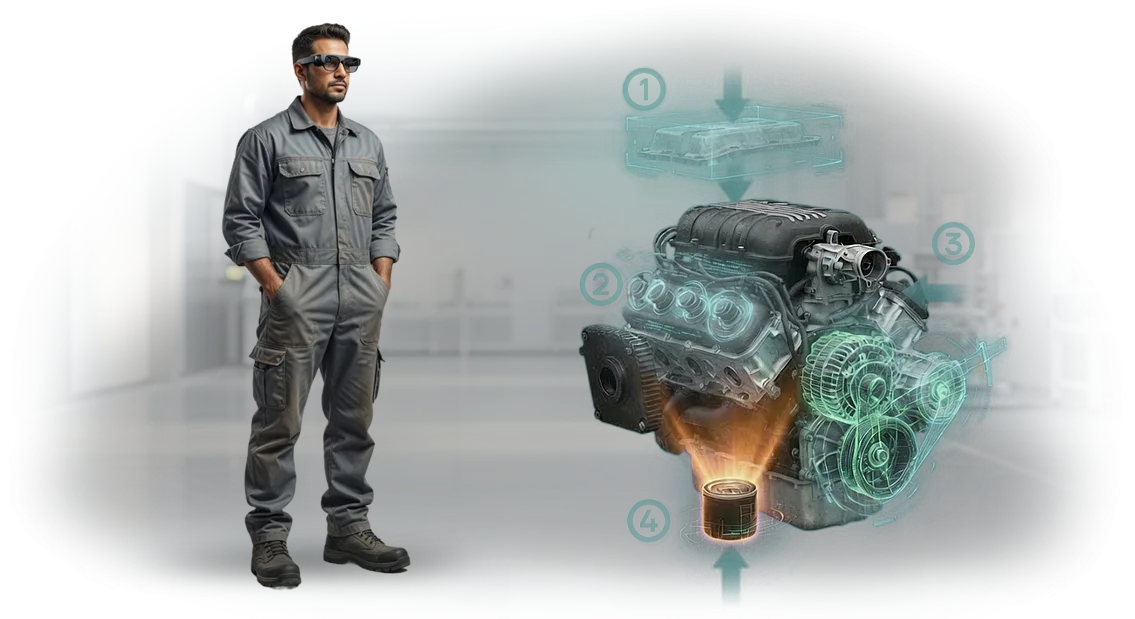
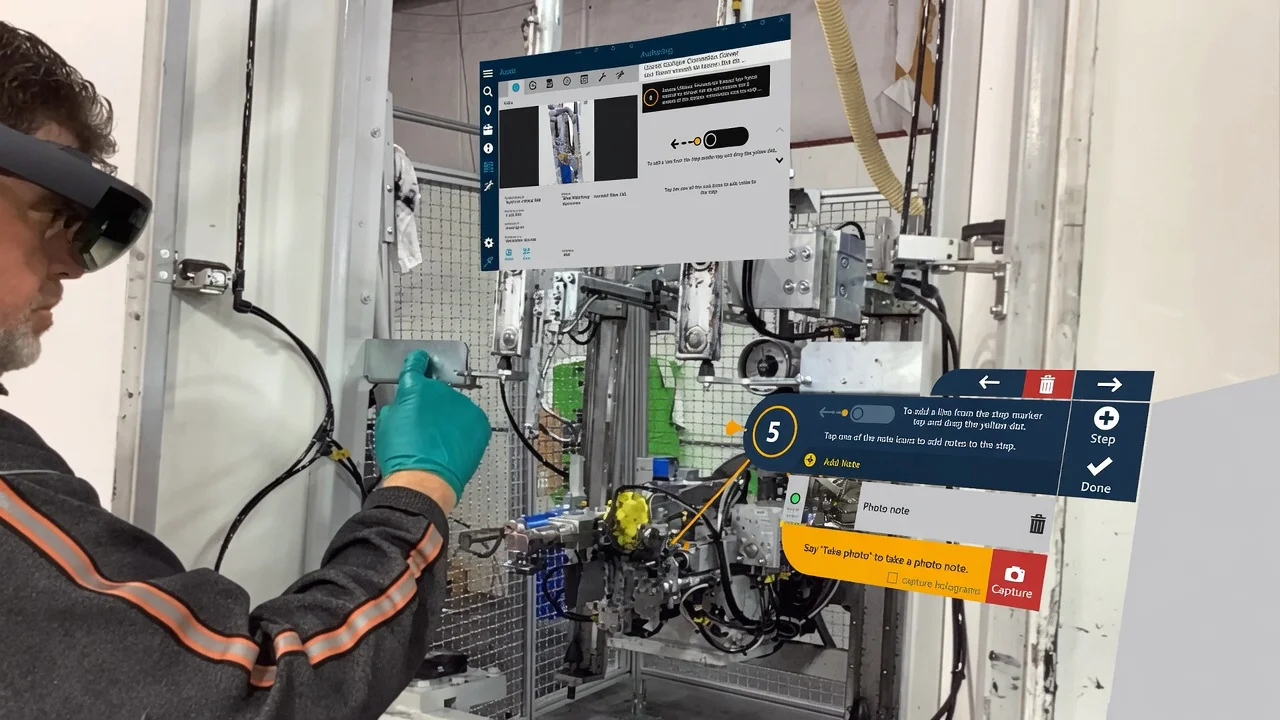
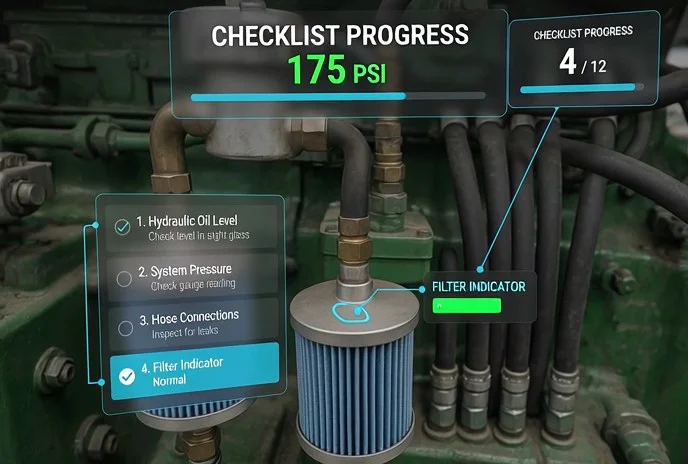
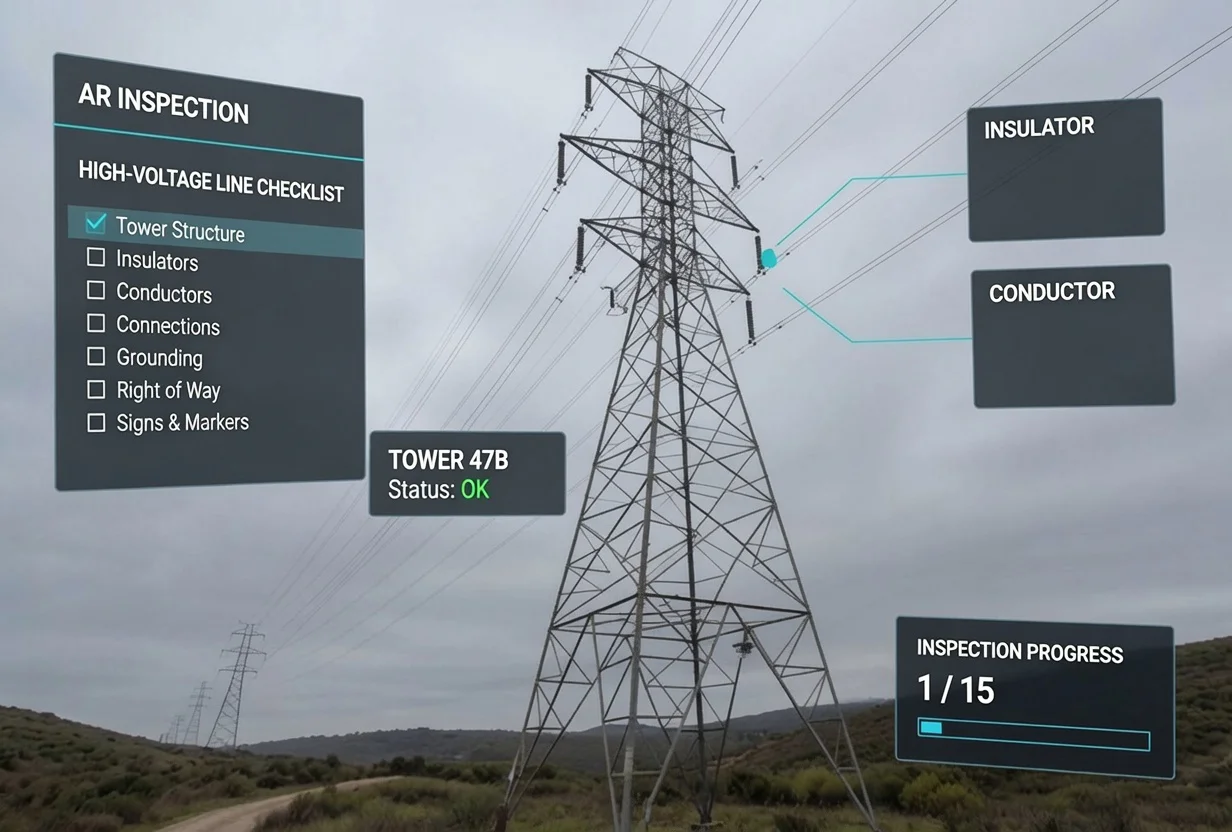
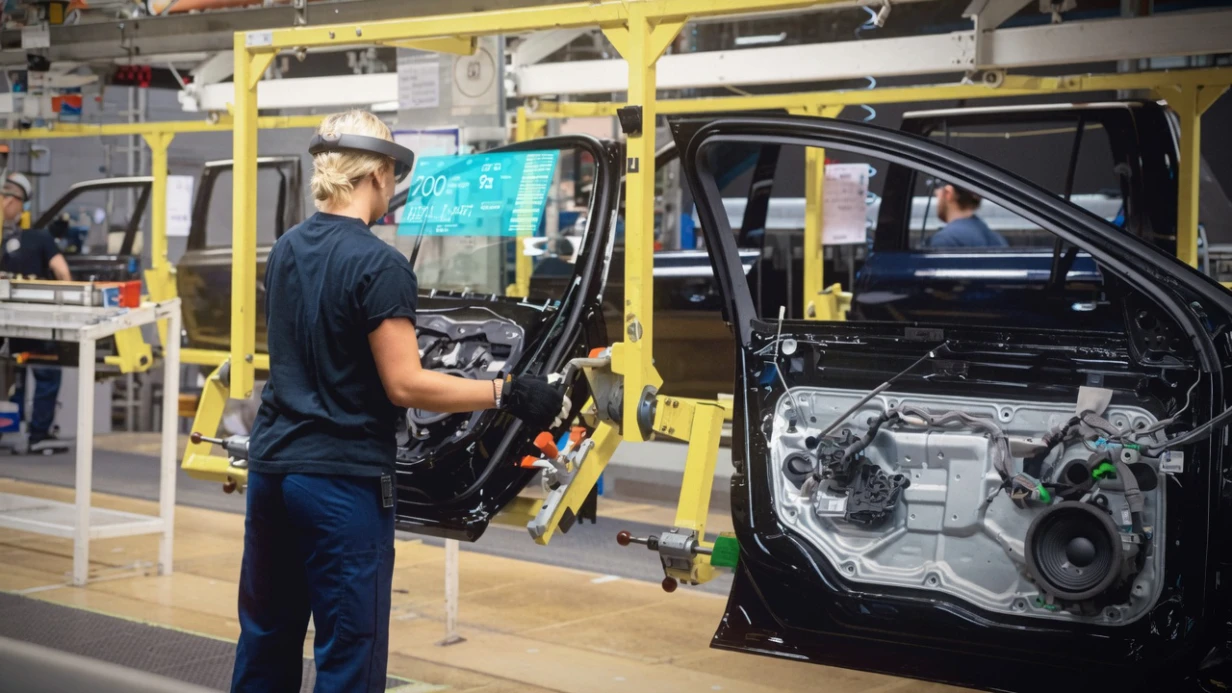
An AR instruction changes the process itself: the needed information appears right before the eyes at the moment it is needed.
The main advantages of AR instructions are learning speed, accuracy, and a unified work standard. A newcomer stops endlessly asking senior colleagues and flipping through manuals: they see a clear hint on the real equipment, follow it step by step, and complete the operation.
Onboarding a technician takes significantly less time — they start bringing value to the service faster instead of being listed as "in training."
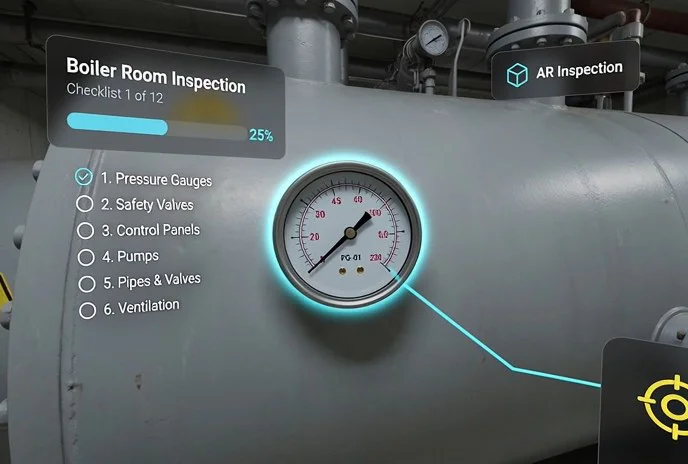
Fewer errors is the second key benefit. The AR instruction highlights the needed part, prompts when to use a tool, and warns if the technician missed something.
The human factor stops being the main source of defects: fewer stripped fasteners, incorrectly set clearances, and repeat warranty repairs. Every order is performed according to a proven scenario, not "from memory."
Repair quality becomes stable regardless of who works in the bay — an experienced specialist or a yesterday's newcomer. All technicians follow the same logic built into the AR instruction, so the result is predictable.
The service gains a reputation as a place where a client comes once and returns again — without complaints or rework.
In the end, an AR instruction pays off through the main resource of an auto service — time and client trust. Faster service, fewer reworks, higher output per bay. Implement such a system once and get a tool that works at every stage — from initial diagnostics to final inspection.
AR instruction formats for different repair tasks
When repairing equipment for auto services, mechanics need to quickly deal with non-standard breakdowns and forgotten procedures. A paper instruction or PDF is a waste of time: you flip through pages, search for the right unit, and check against the diagram.
An AR instruction overlays hints directly onto the equipment, so the mechanic immediately sees what and where to adjust — less downtime, fewer errors.
But one format does not fit all. We compare three common options and select one based on the size of your service:
| AR instruction format | For which service | What it gives the client |
|---|---|---|
| Tablet | Medium and large service centers, complex repairs | Detailed step-by-step diagrams on the screen, convenient to keep next to the equipment, fewer errors during disassembly |
| Smartphone | Small auto services, mobile teams | No need to buy additional equipment — the instruction is always in your pocket, quick access to the needed operation |
| Voice control | Services where hands are busy with tools | The mechanic is not distracted by the screen — the system prompts the next step by voice, and repairs go faster |
Each format can be used separately or in combination. For example, a tablet shows the overall diagram of a unit, while voice control guides the mechanic through the steps when their hands are already busy with tools.
This separation allows you not to overpay for unnecessary features but to take exactly the format that pays off at your scale.
For a small service center, a smartphone and voice prompts are enough; for a large network with expensive equipment, tablets with detailed views of each unit are more profitable. We will find an option that suits your tasks and the tasks of your mechanics.
How AR instruction development works: from brief to launch
AR instruction development is not a "black box" but a clear step-by-step process. You always know what stage the project is at, what is happening right now, and when the result will be ready.
This is especially important for an auto service: the sooner mechanics start working with the new instruction, the less downtime and fewer errors during equipment maintenance. Below is the typical route that every one of our projects takes.
-
Brief. You tell us about your task: what equipment, what operations need to be explained, and what difficulties your employees face. We clarify the details and form a clear technical description — without unnecessary phone calls and on-the-fly edits.
-
Plan. We prepare the AR instruction scenario: what steps it consists of, what the mechanic sees at each moment, and what actions they perform. We approve the structure before the main development begins — this saves time and budget.
-
Approval. We show a lightweight prototype of the future instruction. You bring in your technologists and experienced mechanics — they check the logic of the actions and point out if anything is missing from the procedure. We make changes immediately without redoing finished material.
-
Assembly. We create a full AR instruction: we develop the content, configure it for your specific equipment model, and link it to real control points. At this stage, you already have a working draft that you can show your employees.
-
Testing. We run the instruction in real conditions: we use the actual equipment in your workshop and observe the mechanics' actions. We verify that every step is clear, hints appear on time, and nothing confuses the technician. If something gets in the way, we fix it before launch.
-
Launch. We deliver the finished AR instruction, conduct a short training session for your team, and stay in touch during the first days of use. You get not just a file but a working tool that has already been tested on real users.
This process guarantees that you control the project at every key step. The result is an instruction that your employees actually use, not one that sits in the archive.
All deadlines and areas of responsibility are fixed in advance, so there are no unexpected "surprises" at the finish line.
What is included in the AR instruction delivery
The AR instruction delivery is a complete working package, not just files with instructions.
You get a turnkey solution that, within a few days after implementation, reduces mechanic training time and cuts the number of errors during maintenance of complex equipment for auto services.
The package includes everything needed for an immediate start and stable operation of your service department.
What is included in the package
- Ready-made AR application — works on your employees' tablets or smartphones and does not require a programmer on staff. The interface is clear, and mechanic training takes no more than an hour.
- Library of step-by-step instructions for specific models of auto service equipment: from replacing consumables to diagnostics and calibration. Each step is visualized directly on the equipment unit.
- Integration with your equipment — the application is linked to the specific models and modifications you have in your service. If the fleet is updated, we refine the instructions for new versions.
- Staff training — we conduct training sessions for technicians and engineers so they start using the AR instruction right away rather than putting it off "for later."
- Administrative dashboard — you see how often instructions are used, which operations raise questions, and you can add your own procedures to the library.
- Technical support and updates — instructions are adapted to changes in the design of auto service equipment, so you always work with the current version.
Why this is beneficial for the service owner
With such a package, you stop depending on the "golden hands" of a single senior mechanic. Experience and procedures become part of the company's digital tool: even a newcomer performs work to the standard, and equipment downtime in the service is reduced.
We cover the entire cycle — from delivery to training and support. All that remains is to set the task and get the result.
Case study: a service cut repair time in half with AR instructions
An auto service that maintains a robotic KUKA stand approached us. Every hour of equipment downtime meant shifted orders, unhappy clients, and lost future business.
Planned routine maintenance took about 40 minutes: the mechanic searched for the needed diagram in a paper instruction, checked the units, and re-verified the sequence of operations.
We proposed replacing the paper procedure with AR instructions that display hints directly on the equipment.
After implementation, repair time dropped to 15 minutes — twice as fast as before. The mechanic sees the needed unit, arrows, and control points in their field of view, does not get distracted searching for information, and does not skip mandatory steps. Equipment sits idle less, and the service accepts more orders per day.
This AR instruction case became a growth point for the client: one mechanic now handles tasks that previously required a narrow specialist, and new employees get up to speed without lengthy training. Service speed and predictability increased, and the risk of errors decreased.
The client was satisfied with the result and moved all regular routine work to AR instructions.
Equipment downtime decreased, repair quality became more stable, and the client gained a competitive advantage — orders are completed faster and more accurately, which brings repeat business and increased trust.
How to choose an AR instruction for auto service equipment?
Choosing an AR instruction for auto service equipment starts not with technology but with three parameters of your business: the number of employees who need help, the complexity of the equipment itself, and the budget you are willing to invest in training.
If the service has 5–10 technicians and standard equipment, a light format is enough — step-by-step hints on a tablet or smartphone. This option is implemented quickly and pays off by reducing the time spent searching for information.
For large services and complex machines — such as diagnostic stands or paint booths — a full AR environment with visualization of units and automatic verification of actions is needed.
Here, equipment complexity is key: the more operations and error risks, the deeper the scenario development should be.
It is also important to consider how exactly you train your employees. AR instructions replace paper manuals and a mentor standing nearby — a new technician sees directly on the equipment which part to unscrew and with what force to tighten it.
This speeds up the transition to independent work several times over and reduces the number of mistakes caused by inattention. If your service has staff turnover, the built-in training system becomes a way to quickly bring newcomers up to speed.
The budget determines the depth of development: you can start with a simple solution covering frequent operations, or immediately build a library of instructions for the entire equipment fleet.
You do not have to invest in everything at once at the start — we select a format that solves your current task and scales up later.
The main thing is not to overpay for unnecessary complexity and not to skimp on critical units, where a technician's mistake costs more than any software.
Therefore, the right choice is not buying a ready-made template but an individual assessment of your auto service: the number of technicians, equipment specifics, and training goals.
We analyze these parameters, propose the optimal AR instruction format, and make sure it is actually used in practice. Contact us — together we will determine what suits you best.
Answering frequently asked questions about AR instructions
Many auto service owners have doubts: will an AR instruction damage expensive equipment, what happens in the event of a breakdown, and who is responsible. These fears are understandable — a mistake in maintenance costs a lot.
We address them at the planning stage: we fix the scenario, deadlines, and guarantees in the contract.
Safety is our priority. The AR instruction works as a hint overlaid on the image from the tablet's camera and does not interfere with the control of machines and stands. The risk of breakdown is excluded, and the employee receives a precise sequence of steps. After launch, we do not disappear: we update instructions for new equipment and answer questions.
What happens if the equipment breaks down while working with the instruction?
The instruction does not connect to the machine's electronics and does not affect its mechanics. It only shows the order of actions. If a breakdown still occurs, you contact the manufacturer's service, and we will adapt the instruction to the new situation free of charge.
Do you guarantee the result?
Yes. The contract fixes the deadlines, the list of operations, and the expected effect — for example, a reduction in the number of errors. If the instruction does not meet these indicators, we refine it at our expense.
How do you support instructions after launch?
We do not disappear after project delivery. Support includes updating content for new models, consulting employees, and technical assistance. We process requests within one business day.
Is it safe for employees to work with an AR tablet?
Yes. We use standard tablets — they do not obstruct the view and do not restrict movement. We recommend dividing sessions into short intervals, and the instruction can be paused at any time.
Order an AR instruction and get a turnkey project
Ordering an AR instruction for auto service equipment maintenance means saving yourself from lengthy approvals and technical details. We work turnkey: from the first conversation to the launch on your technicians' tablets and smartphones. You describe the task — we take care of the rest.
After you submit a request, we go from idea to working tool. At every stage, you see the result and influence it, but you do not need to dive into technical details. Here is what happens right after the start:
- Task analysis. We study your equipment, typical operations, and the most common employee errors — this is the foundation of the future instruction.
- Brief and work plan. We fix the goals, scope, and deadlines. You get a clear plan that shows when intermediate results will be ready.
- Instruction scenarios. We break maintenance into simple step-by-step actions that are easy to perform and verify right at the machine.
- Prototype approval. We show what the interface and augmented reality interaction will look like — before the main development begins.
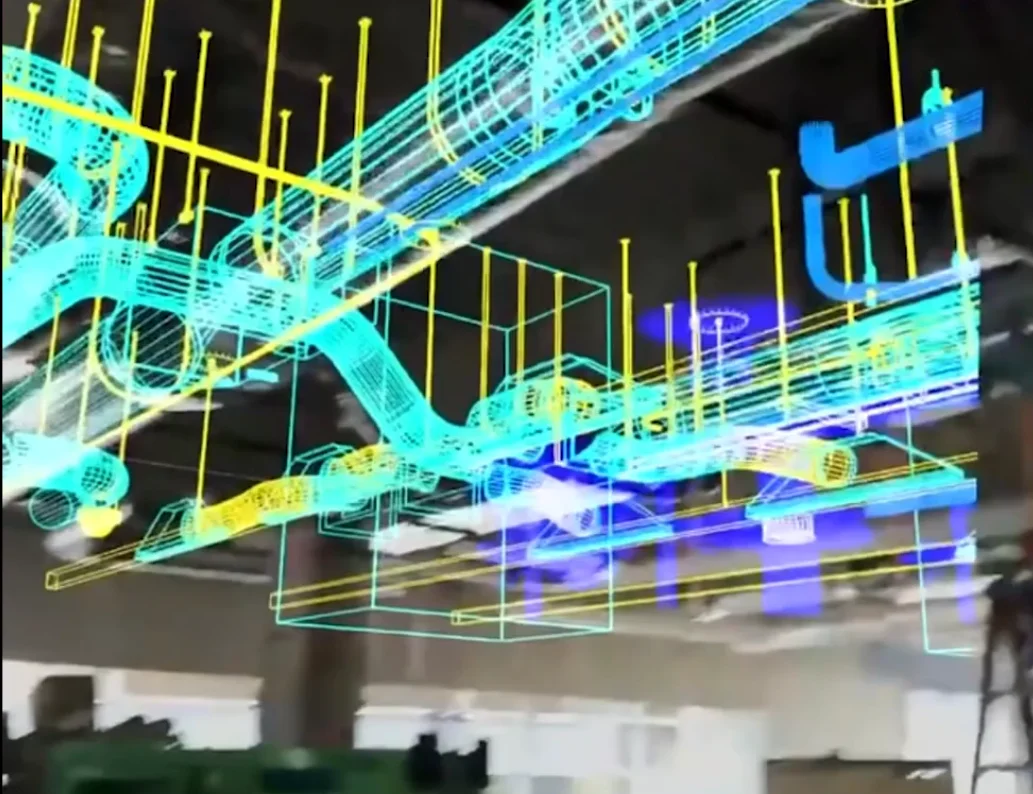
- AR content creation. Based on the approved prototype, we prepare animated 3D hints, unit highlighting, and clear visual markers.
- Testing on real equipment. We verify the accuracy of the overlay and ease of use and make corrections.
- Launch and support. We install the application, train the technicians, and stay in touch after launch.
This approach allows you to get a turnkey project rather than a "semi-finished product" that would later need to be completed.
You are ordering not just an application but a ready-made solution for reducing downtime and personnel errors — with predictable deadlines and a clear result.
Submit a request for an AR instruction — we will contact you within one business day, clarify the details, and prepare a turnkey project. Launch is possible within a few weeks after the start of work.