

Why thermal power engineers waste time on paper instructions
Every extra half hour of downtime at a complex unit means lost output, missed deadlines, and frayed nerves for the dispatch service.
When staff search for a needed section of the regulations in a thick binder or call a supervisor by phone, the equipment stands idle and the crew loses time.
At the same time, the cost of a mistake during repairs is much higher than it seems: an incorrect sequence of actions leads to repeat disassembly, damaged parts, and new downtime.
Paper instructions cannot keep up with operating reality: diagrams become outdated, amendments get lost, and in an emergency the operator has to cross-reference several documents at once.
As a result, even experienced staff act slowly and hesitantly, and the burden of decision-making falls on the person instead of working for them.
Thermal power engineers need a format that removes the gap between regulatory documentation and real equipment.
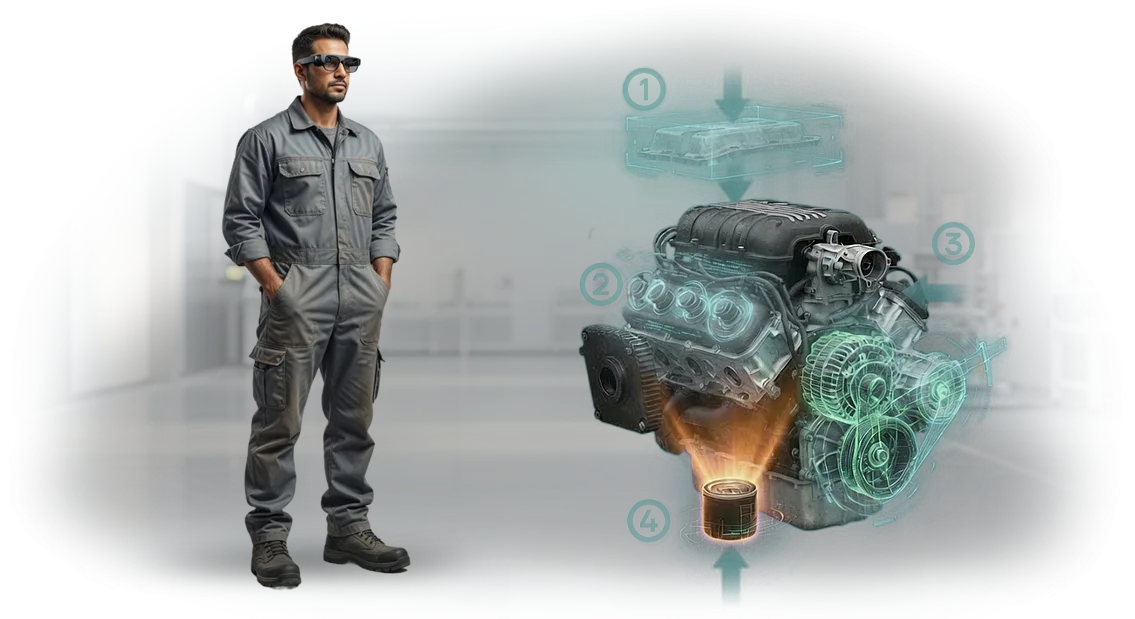
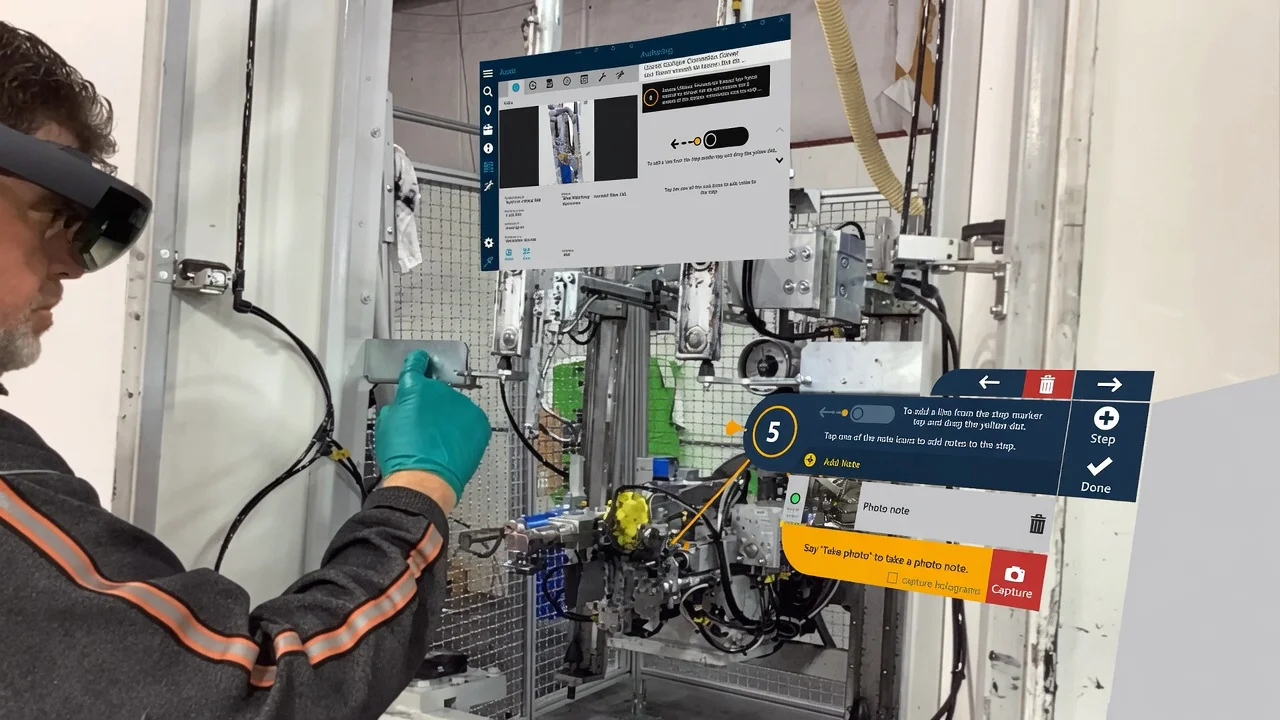
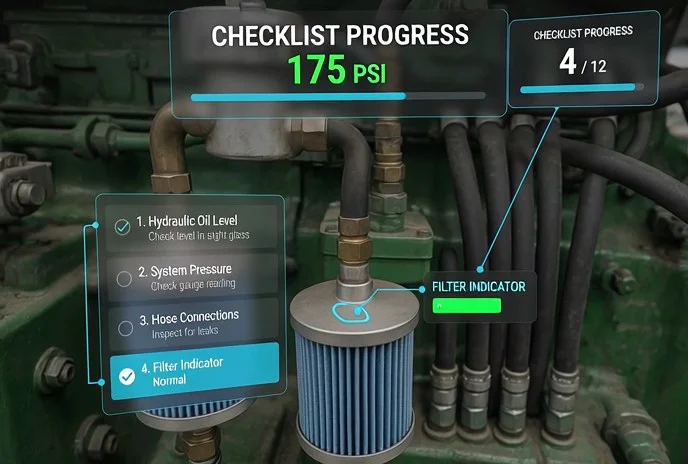
our team closes this gap with AR instructions: a specialist sees the step-by-step procedure directly on the unit's housing, while the system suggests the next step and monitors its completion.
This eliminates downtime caused by searching for information and minimizes the risk of errors during equipment repairs.
What developing AR instructions for industrial equipment delivers
Faster staff performance
Employees stop flipping through paper regulations and searching for the right section of the manual. AR hints appear right in their field of view — on the parts, assemblies, and mechanisms they are working with at that moment. The task is completed 1.5–2 times faster, and equipment downtime is reduced.
For thermal power engineering, this is especially critical in emergency situations, when every minute of downtime affects heat supply. The technician sees a step-by-step action scenario overlaid on the real object and follows it without pausing for a consultation.
Fewer errors
Errors during the installation, commissioning, or repair of industrial equipment are costly: repeated site visits, replacement of components, safety risks. The AR instruction visually highlights the relevant elements and warns of an incorrect action before it happens.
As a result, the number of errors among new employees drops by up to 70%. This not only saves money on correcting defects, but also ensures consistent work quality regardless of an individual specialist's experience.
Staff training without interrupting production
Passing on the knowledge of experienced commissioning engineers to newcomers through text instructions is slow and ineffective.
The AR format turns training from theory into practice: a newcomer puts on glasses or opens a tablet and immediately performs real tasks with system prompts.
Onboarding time is reduced by 2–3 times, and the need for a personal mentor disappears. Experienced specialists continue with their own tasks while newcomers build skills through the AR instruction.
Remote expert support
You cannot always quickly call a lead engineer to a site. An AR remote assistant lets the expert see the image from the employee's camera, make annotations, and guide actions — as if they were right there. This solves the problem of staff shortages and speeds up equipment commissioning.
Training through remote support reduces travel expenses and downtime. One expert can cover several sites in different regions at the same time — you gain control over processes without losing quality.
Full control and analytics
Managers can see which operations were performed, how long each one took, and where difficulties arose. This data helps improve regulations and identify weak points in staff training.
So you get not just an instruction, but a tool for managing production processes. Every change to the regulations is instantly synchronized for all employees — the speed of response and safety at thermal power facilities depend on this. Our team build such systems on professional hardware and tailored to your tasks.
AR instruction formats for enterprise tasks
Each AR instruction format addresses a specific business challenge: from quickly training newcomers to reducing downtime during repairs. This is especially important for thermal power engineering — the equipment is complex, and the cost of human error is high. Below are typical scenarios we implement for enterprise tasks.
| Format | For whom | What it gives the client |
|---|---|---|
| Step-by-step repair and maintenance instructions | Repair staff, duty engineers | Reduced task time and fewer errors thanks to visual prompts directly on the equipment |
| AR training for new employees | Trainees, line staff | Fast path to independent work without expensive simulators or lengthy mentoring |
| Remote support and expert assistance | Operators, mobile crews | Instant access to expert knowledge without waiting for them to arrive — especially valuable for remote sites |
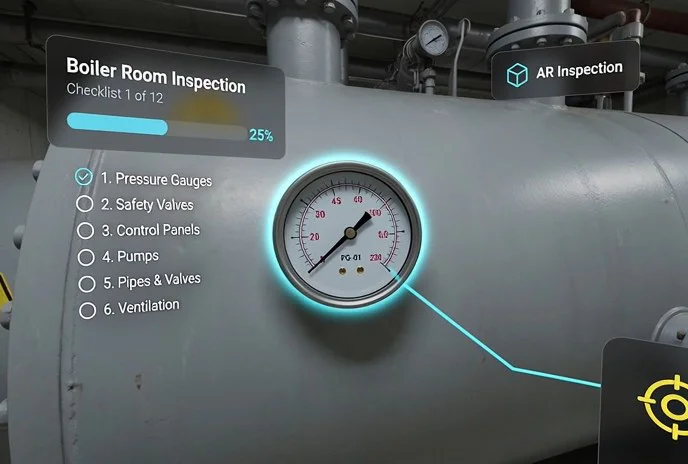
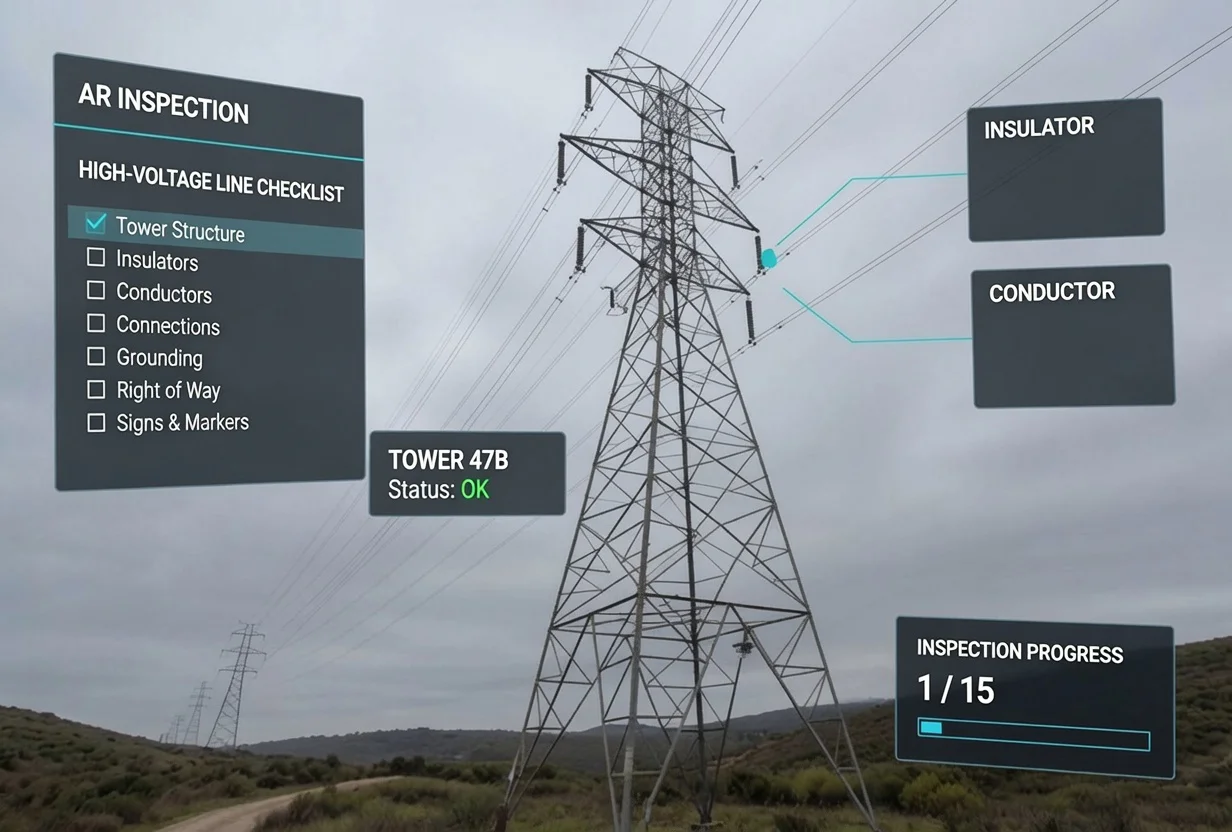
| Visual control and acceptance | Managers, quality department | Transparent inspection of completed work using on-site checklists with recorded results |
We select the format for your task: sometimes a simple visualization of steps is enough, sometimes an interactive scenario with action control is needed. All formats run on the tablets and smartphones your staff already have — no need to purchase additional equipment.
The key point is that the result is visible immediately: fewer errors, faster training, controlled quality.
How AR instructions are implemented in thermal power engineering
Implementing AR instructions in thermal power engineering is a clear process where every stage is coordinated with you.
We do not simply hand over technology — we support the project from the first meeting to everyday staff operations, so that the system fits your schedule and delivers measurable results.
-
Brief and immersion in the task. During a call, we gather information about the operations your employees perform, where errors most often occur, and which equipment requires frequent maintenance. The output is an agreed implementation plan that is clear to both you and your workers.
-
Plan and preparation. We determine what tools are already available on site and what needs to be purchased so that AR works reliably in workshop conditions. We select professional hardware that can withstand dust, vibration, and temperature fluctuations.
-
Content creation. We prepare 3D models, animations, and short prompts — everything that explains the work steps for a specific unit. Materials are reviewed with your technologists to ensure the instructions match actual regulations.
-
Testing on equipment. We run scenarios on live installations and adjust anything that does not work in real conditions. You get a solution adapted to your workshop, not a generic demonstration.
-
Staff training. We hold short sessions for repair personnel and supervisors: how to call up instructions, navigate prompts, and transmit data. Training is integrated into shifts so as not to stop work.
-
Launch and support. We hand over the regulations, set up a support channel, and collect feedback in the first weeks. If necessary, we make targeted edits to the instructions — without revising the entire project.
As a result, you get not an abstract “development from scratch,” but a tool that is used every day. Staff master new tasks faster, and the risks of errors and equipment downtime are reduced.
What is included in the delivery of AR instructions for thermal power engineering
You receive not just files with annotations, but a ready-made tool that changes how equipment is handled from day one.
We put together a package tailored to your task — from the instructions themselves to staff training and ongoing support — so the result is immediately integrated into processes and your team does not need to understand the underlying technology.
- AR instruction library — step-by-step scenarios for standard operations: start-up, shutdown, scheduled maintenance, and handling abnormal situations. Staff see prompts directly on the equipment and make fewer mistakes.
- App for tablets and smartphones — works on devices your employees already have. No additional hardware purchases are needed, and the interface is clear without special training.
- Admin panel for content updates — change text, photos, or videos in instructions without programmers. If regulations change, make edits in minutes rather than weeks.
- Training for your team — we conduct sessions for technical specialists and operators, demonstrating on real scenarios. As a result, employees confidently use the instructions from the very first day.
- Technical support — we help with setup and adaptation to your equipment and resolve issues as they arise during operation. You are never left alone with problems.
- Integration with your regulations — we overlay AR scenarios onto existing occupational safety instructions and technological maps. Employees get the same requirements, but in a convenient interactive format.
- Updates and refinement of scenarios — we expand the library as new operations appear, so the system evolves together with your equipment fleet.
This composition covers the full cycle: from the first demonstration to everyday use. You pay for results — fewer errors, faster staff training, and control over compliance with regulations.
Case study: AR instructions for pump equipment repair
For a repair crew at a thermal power enterprise, every minute of pump equipment downtime means losses in generation and the risk of disrupting the heating season.
Previously, repairing a complex unit required calling in an experienced engineer or flipping through multi-page paper regulations, and a new employee spent more time looking for the right section than on the actual part replacement.
We created AR instructions for pump repairs for TeploEnergoService: the technician sees prompts through a tablet directly on the equipment — where to loosen, what to remove, and in what order to reassemble. No memorization and no paper: the system guides step by step to the correct result.
Result
Over five months, six crews at two sites used the instructions. The time for a typical pump repair was cut in half, and the number of assembly errors dropped by more than half.
Previously, bringing a new mechanic up to speed took several days; now it takes two hours with a tablet in hand.
But the most important thing — the client valued not just speed but predictability: every repair is performed according to one proven scenario, with photo documentation of key stages. This made it possible to establish quality control and pass clear requirements to contractors.
That is why, after the pilot implementation, we received not one but three new sites for launch — a repeat order speaks to the results better than any numbers.
Frequently asked questions about implementing AR instructions
Implementation of AR instructions in thermal power engineering is often slowed by doubts: “Will this fit into our processes?”, “Is it difficult to train staff?”, “Will it affect safety?” Based on real projects, we answer the most common questions — briefly and to the point.
How do AR instructions integrate with our equipment?
AR instructions do not require replacing machinery or stopping production. A specialist uses a tablet or smartphone with a camera and sees prompts overlaid on the real object.
We adapt content to specific equipment models, and the instructions themselves are integrated into your document management system or training materials.
How much time is needed to train employees?
A short 2-3 hour session is usually enough for an operator or repair technician to confidently use the prompts. The interface is built on intuitive actions: point the camera, see the steps, complete them.
We support the launch, train instructors, and adjust materials based on the pilot results if needed.
Is it safe on the production floor?
AR does not replace occupational safety — it enhances it: the worker sees all steps in front of them and is not distracted by paper regulations. This is especially important in thermal power engineering, where a mistake during boiler or turbine maintenance can be very costly.
Every project is coordinated with the client's safety service, and the interface is adapted to regulations.
Will it work with old equipment?
Yes, we most often work precisely with installations that have been in operation for a long time. We create 3D models and photorealistic instructions based on the current state of the units, so no data from the manufacturer is needed. If you have the equipment passport and photos, that is enough to get started.
What results should we expect after implementation?
Clients note a reduction in the time spent searching for the required regulation, fewer errors during repairs, and faster onboarding of new employees.
Exact figures depend on the site, which is why we offer a measurable pilot on a single unit and record the effect before and after.
How to choose the right AR instruction format for a specific task?
The AR instruction format is not a matter of preference but a derivative of the specific task that needs to be solved. The same scenario may require step-by-step prompts, overlaying diagrams onto equipment, or live expert participation.
So the right choice starts not with discussing technology, but with answering the questions: what exactly must the employee do, under what conditions do they work, and how quickly is the result needed?
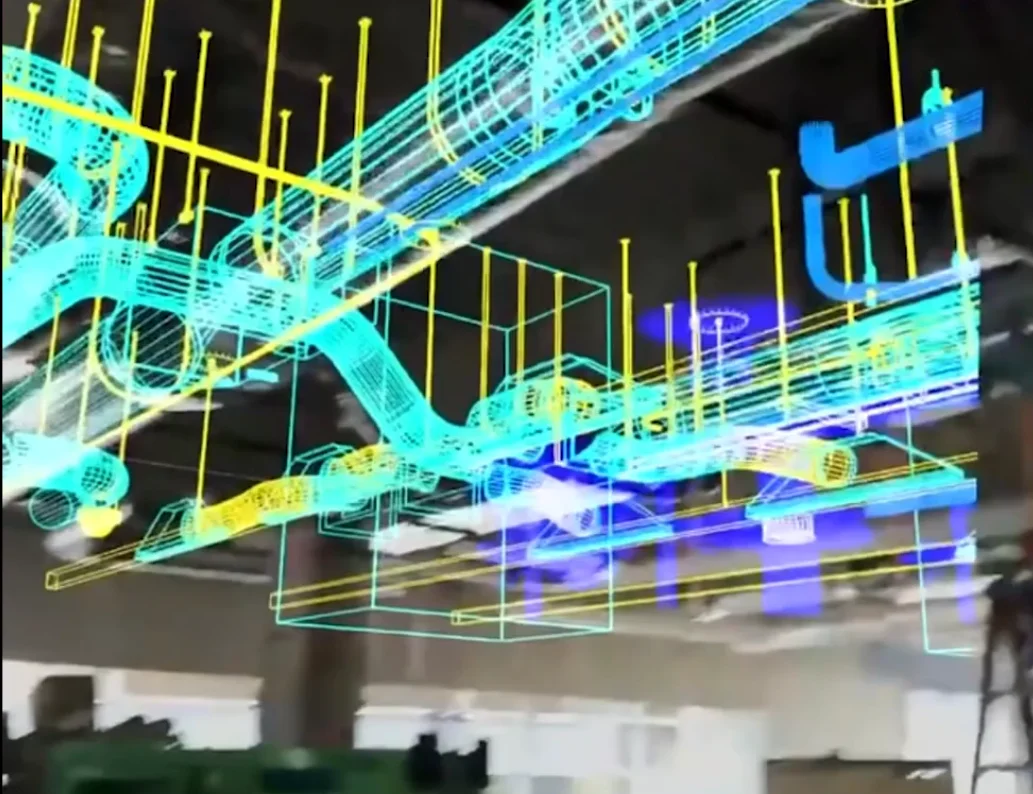
Three situations are typical for thermal power engineering. The first is scheduled maintenance: staff act according to regulations, and step-by-step instructions with markers overlaid on the units are sufficient.
The second is an emergency situation, when there is no time to flip through paper manuals: here, the more effective format is a remote assistant, where a specialist sees the camera image and guides actions in real time.
The third is training new employees: interactive scenarios allow safe practice on a virtual model without stopping equipment.
The key selection factor is the performer's skill level. An experienced engineer perceives brief visual prompts, while a beginner needs detailed explanations and control of every step.
We take this into account during development, making instructions adaptive: the initial screen shows an overall diagram, and the level of detail changes as the task is completed.
If the employee makes a mistake, the system not only reports the error but also shows the correct action.
It is also important whether the site has internet access. For offline operation, we create offline versions that are downloaded in advance and work correctly in conditions of weak connectivity.
This is especially relevant for remote boiler houses and heat points where the connection is unstable. For sites with a good channel, we enable live mode with loading of current equipment data.
We do not sell “format for format's sake.” At the start, we always analyze the task, interview staff, and visit the site. Based on this data, we propose one format or a combination, and after trial use we adjust.
If the chosen solution does not fit real conditions, we rework it — this removes the risk of choosing wrong and guarantees that the specific task will actually be resolved.
Order development of AR instructions for thermal power engineering
Submit a request for AR instruction development and get a cost and timeline estimate for your task. We will contact you within one business day, clarify the details, and propose a solution that fits your budget and schedule. The consultation is free and comes with no obligation.
We have already created AR instructions for industrial enterprises, including in the thermal power sector. Employees master complex units faster, and the number of errors during maintenance decreases. During a call, we will show examples of projects so you can assess the format.
Design and implementation are handled by one team — you get a turnkey result, from scenarios to staff training.
What you get by contacting us:
- AR instructions for your units and assemblies — from a pump to an entire installation.
- Clear training scenarios: the employee sees steps directly on the equipment.
- Remote assistance: an engineer sees the same thing as the worker on site and provides real-time guidance.
- A ready-to-use implementation package — setup, testing, training for your team.
- Post-launch support and technical assistance.
- Cost and timeline estimate within one business day after your request.
Submit your request now and we will prepare an estimate. No technical description is needed: just tell us what equipment you work with and what task you are solving. If the project is still just an idea, come to us anyway — we will advise where to start.