


Inconvenient service in the energy sector drives customers away
Customers in the energy sector arrive at the office already carrying pent-up frustration: tariffs are hard to figure out, and peak-hour queues eat up time.
People don't want to be energy experts—they want to quickly resolve their issue: submit meter readings, pay a bill, change a tariff, or submit a request. When service turns into a quest, patience runs out.
The consequences are clear: customers leave without a resolution, write negative reviews, and switch to competitors at the first opportunity. Customer loss in the energy sector is rarely loud—it is a silent churn that directly hits revenue and reputation.
While you are hiring more staff for the hotline, dissatisfied users are already forming a bad opinion of your brand.
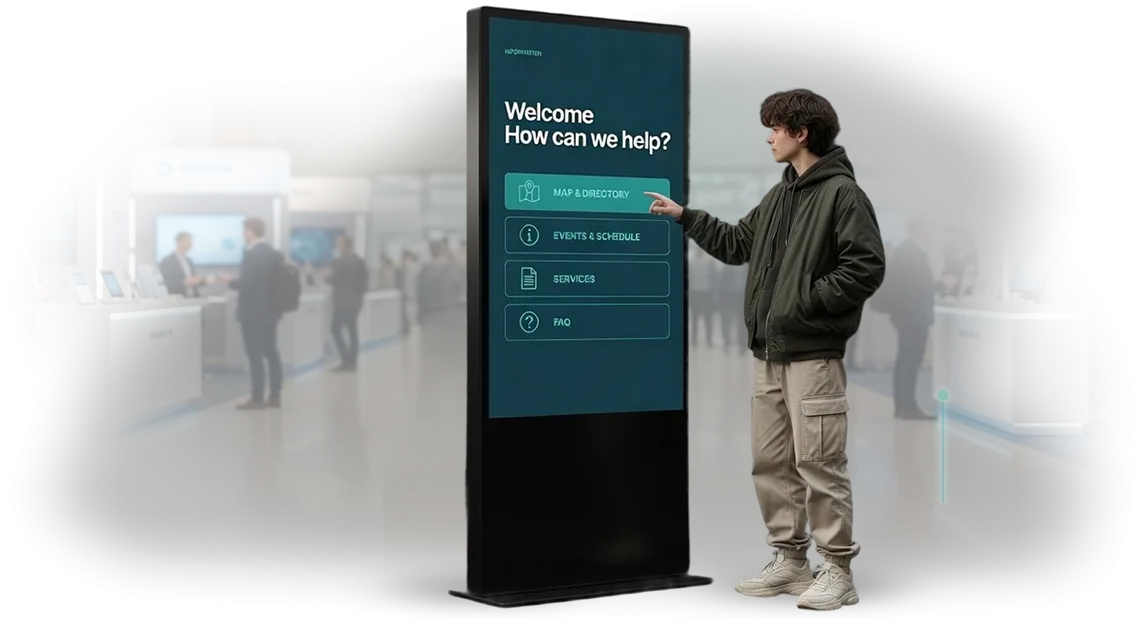
Interactive kiosks change the service model: a person resolves their issue on their own, without intermediaries, in a couple of minutes.
A familiar interface, on-screen prompts, debt checks, receipt printing, and payment with no waiting—this removes the main pain point, the dependence on office hours and queues.
The customer gets a service that works as simply as an ATM, and the company gets fewer hotline calls and higher satisfaction.
We have already helped energy companies set up such scenarios: we design logic for typical customer tasks, connect kiosks to the accounting system, and support the launch.
As a result, visitors get services faster, and operators handle only complex issues—this is what modern customer service in the energy sector looks like.
What an interactive kiosk brings to your business
Today's customers expect fast, clear service. When information about your products and services is available on a terminal screen, visitors don't waste time looking for a staff member—and you don't lose a sale because of a queue.
We develop interactive kiosks that solve exactly these problems: they increase loyalty, save resources, and boost revenue.
Higher loyalty and service quality
Visitors remember not only the assortment, but also how they were treated. The kiosk removes the main irritant—waiting.
There is no longer any need to wait for a consultant to find out the price, availability, or product specifications: everything is a couple of touches away on the screen.
This approach boosts loyalty: customers see that the company values their time and are more willing to come back.
In the energy sector, where products often require explanation, an interactive catalog helps visitors understand the parameters on their own—and they leave with a positive impression.
Saving time and increasing sales
The kiosk handles routine questions that previously fell on consultants. Staff focus on complex requests and real sales instead of repeating the same information. This reduces the workload on personnel and speeds up service for every visitor.
From a revenue standpoint, the interactive catalog also works: it suggests related items and current offers that are easy to miss in conversation. As a result, the average order value grows—and you get sales without additional investment in staff.
Interactive kiosk formats for the energy sector
Energy sales, the control room, and the administrative office are three different environments where visitors come with different needs.
A one-size-fits-all kiosk that serves both a customer with a bill and a dispatcher equally well is impossible: the scenarios and speed requirements are too different. So we separate the formats and design each one for a specific task.
| Kiosk format | Where it is installed | What it solves |
|---|---|---|
| Sales kiosk | In the halls of billing centers and customer service departments | Payments, debt checks, recalculation requests without a queue |
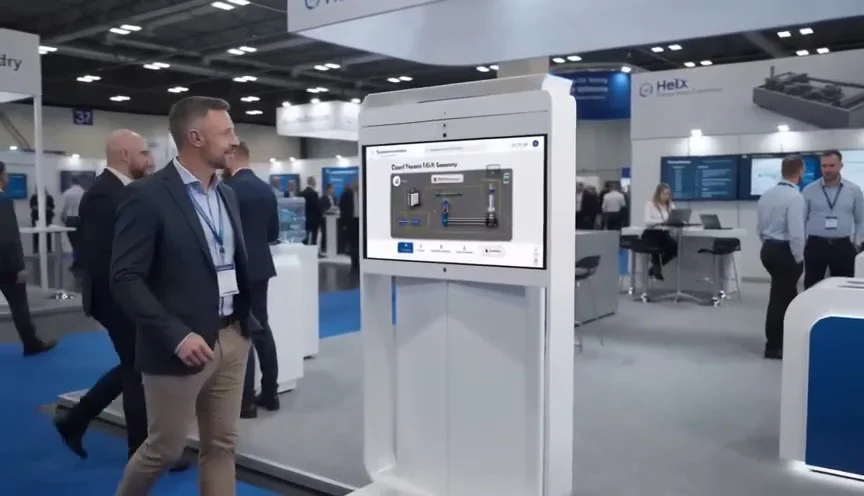
| Dispatcher kiosk | In operator and control rooms | Quick access to regulations, current schematics, and logs |
| Office kiosk | In the lobbies of administrative buildings and checkpoints | Navigation, information, request submission by employees and guests |
Sales kiosk
The main pain point of a customer service department is queues to specialists. The sales kiosk takes over the routine: customers check their balance, submit meter readings, print a receipt, or leave a recalculation request on their own.
A staff member only gets involved in complex cases—this speeds up service and reduces the load on the front office.
Dispatcher kiosk
In the control room, speed and reliability of information are critical. The kiosk provides instant access to up-to-date documentation: operational schematics, switching regulations, and request logs.
The system guides the user through the sequence of actions and records completion marks, leaving a digital trail without extra paperwork.
Office and checkpoint kiosk
The office format handles navigation and internal information tasks. A guest finds the right office in a minute; an employee checks the meeting schedule or submits an IT support request. This kiosk relieves the secretariat and makes getting around the building clear without words.
How we develop an interactive kiosk: 7 steps
Developing an interactive kiosk for the energy industry leaves no room for guesswork: from the first brief to launch, it must be clear who is responsible for what and when the result will arrive.
We have built a seven-step process where you see an intermediate result at each stage and can influence the work flow.
- Brief and task immersion. We define the terminal's goals, target audience, and usage scenarios—from building navigation to a service catalog.
- Plan and estimate. We prepare a work plan with dates and cost, agree on it, and approve it before the start.
- Interface prototype. We show a screen map and navigation logic—you see the structure of the future catalog before any code is written.
- Design mockup. We render screens in your brand style: colors, fonts, element layout.
- Implementation. We program the kiosk logic, connect the product and service catalog, and configure data updates.
- Testing on hardware. We run "as a customer" scenarios: search, details, feedback. We fix any issues before installation.
- Launch and training. We install the terminal, hand over the manual to your staff, and monitor the first days of operation.
Quality control at every stage
We don't deliver everything "on the final day"—after each step, you receive a document or mockup for approval. This rules out the situation where the finished kiosk doesn't match expectations.
And after launch, we stay in touch: we quickly make changes to the catalog, update information, and keep the terminal running stably.
What's included in the kiosk delivery package
"Turnkey" means more than just a cabinet with a screen. The delivery package includes everything needed for the terminal to work from day one: from the hardware to the content and staff training. You get a ready-made solution, not a set of parts you have to assemble and configure yourself.
- A touchscreen information kiosk in a vandal-resistant enclosure—suitable for 24/7 operation in a waiting area or lobby.
- Pre-installed software with a license: product and service catalog, navigation, news, and service mode.
- Interface adaptation to your corporate identity and catalog structure—without involving your programmers.
- Commissioning services: connection, network setup, and testing of all scenarios before launch.
- Training for your team: how to update information, upload new items, and change promotions.
- A user manual and instructions for quickly resolving typical situations.
- Warranty on hardware and software, with the option to extend it.
Service and maintenance
The kiosk works seven days a week, so we include support and scheduled maintenance. This means you're never left alone with the equipment: we respond to requests quickly, and preventive care prevents downtime.
Later, you can add an extended service package: remote monitoring, fast equipment replacement, and regular catalog updates—all this covers operational issues and extends the terminal's service life.
Case study: how a kiosk changed an energy company's operations
At a regional energy company, the customer office couldn't handle the flow of visitors. Most questions were routine: tariff changes, connection applications, request status. Each visit took an operator 5–7 minutes, and at peak times the queue stretched to an hour. Both customers and employees were tired of repetitive operations.
We proposed solving the problem with an interactive kiosk—a terminal with the energy company's service catalog. Visitors choose the right section on their own, compare tariff terms, generate an application, and immediately get a reminder with the request number.
Live staff remain available for complex questions that require expertise. No new apps—just a convenient self-service point right in the hall.
Implementation results
After the kiosk was launched at EnergoSeti, the average waiting time dropped threefold, and service satisfaction rose to 95%—the best figure in the company's history. Every month, the terminal handled about two thousand routine requests without staff involvement.
Operators switched to consulting on non-standard requests, and management gained data on popular services to improve service.
The success was so visible that the company ordered the same kiosks for all its offices. This is a typical scenario: a kiosk pays off not through staff savings, but through the speed and quality of service, which directly affect customer loyalty.
How to choose a kiosk format for your task?
Choosing a kiosk format starts not with the cabinet design, but with a question: what exactly should a visitor be able to do at the terminal?
In the energy sector, this could be a quick product search in a catalog, service ordering, checking a request status, or self-service payment.
Everything else depends on that—screen size, input method, cabinet durability, and even placement: in an office lobby, in a workshop, or in a customer waiting area.
If your task is to showcase a broad catalog and let customers explore products without staff assistance, a kiosk with a large touchscreen and simple navigation will work.
For specific operations, such as submitting a request or checking debt, a compact terminal with a quick "three touches" scenario is enough. The main rule: the simpler and shorter the user's path, the higher the completion rate and the lower the load on your staff.
It's also important to consider who will use the kiosk—your employees, who already know the specifics, or external customers, who see the terminal for the first time. The second case requires a highly intuitive interface, large buttons, and hints at every step.
And if the terminal will operate in a noisy or dusty space, it's better to choose a reinforced enclosure and a protected screen—this directly affects the service life and maintenance costs.
We help you select the format at the start of the project: we analyze your task, visitor flows, service list, and site specifics. Based on that, we propose the optimal kiosk configuration rather than a one-size-fits-all "average market" solution.
As a result, you get a terminal that pays off by reducing the load on staff and increasing the number of self-service requests.
If you're not sure which option is right for you, start with a consultation. Just describe your task, and we'll suggest the right format and explain why it will solve your problem better than others. It's free and without obligation—but you'll know exactly which kiosk your business needs.
Frequently asked questions about implementing kiosks
Before implementing kiosks in the energy sector, clients ask the same questions—about failures, payback, compatibility with internal systems, and warranties. Let's go through them in order so decisions can be made without fear and with a clear understanding of the benefits.
What if the kiosk breaks down in the middle of peak operation?
We use industrial-grade components and test every terminal before shipment. That's why even under 24/7 load in energy company lobbies, the mean time between failures remains high.
If a problem does occur, remote diagnostics will identify the fault faster than a technician can arrive. And if necessary, we'll replace the module on site under warranty—within the agreed time frame.
When will the kiosk pay for itself?
The terminal replaces an individual consultant at the request intake line: it works without lunch breaks or days off. In energy sales, the kiosk reduces peak-hour queues and relieves staff—the freed-up hours can be redirected to complex requests.
With a flow of from 150 visitors per day, the investment pays back in a few months, and from then on it starts generating savings on every transaction.
How will the kiosk fit into our system?
We have established integrations with common billing systems and CRMs used in the energy sector. The connection takes from a week, and we handle all the work of adapting data formats ourselves.
You don't need to hire a separate developer—we'll configure the data exchange and verify it with real data.
What warranties do you provide?
We provide a warranty on equipment and work, as well as on post-launch support. This means you get catalog updates, video rotations, and operational consultations without having to find a new contractor.
Everything is documented in the contract—including timelines and communication channels. Have concerns that didn't make it into the list? Write to us—we'll tell you how we solved similar tasks for energy companies and prepare an estimate based on your volume of traffic.
Submit a request for kiosk development
Guests and employees at energy facilities don't read long instructions—they need quick access to a catalog of products and services. An interactive kiosk relieves staff, reduces queues, and shows partners that the company is keeping up with the times.
To achieve exactly that result, the project should be handled by a contractor who understands the industry's challenges.
Submit your request—and by the next business day, you'll receive a concrete proposal tailored to your task. No abstract estimates: we'll calculate the cost for your scenario, show how the kiosk will fit into the space, and suggest a launch plan.
What you get after your inquiry:
- Expert consultation: we'll suggest which catalog scenarios will deliver results specifically in the energy sector.
- Cost calculation for your task, taking into account the number of terminals, design, and required functionality.
- A kiosk mockup—a visualization of how the terminal will fit into the interior and corporate style.
- Examples of completed projects for the energy industry.
- A clear project plan with stages, timelines, and responsible parties.
- Post-launch support: catalog updates, technical maintenance, and further improvements.
Submit your request via the form or by phone—it's completely non-binding. We'll simply discuss your task, answer your questions, and prepare an estimate. Within a day, you'll have a clear plan you can use to make a decision.