

Restaurant kiosks: how to reduce queues and increase the average check
Peak hour in a restaurant is when the establishment loses money. Queues pile up at the checkout, guests start getting nervous, and some visitors turn around and leave without placing an order.
Waiters are forced to take orders, deliver dishes, and calm those waiting at the same time — in such a rush, both speed and quality of service suffer. Long queues at a restaurant translate into guest dissatisfaction and lower revenue every single day.
Self-service in cafés and restaurants has long stopped being an experiment — it is a working tool that relieves the staff during the busiest hours.
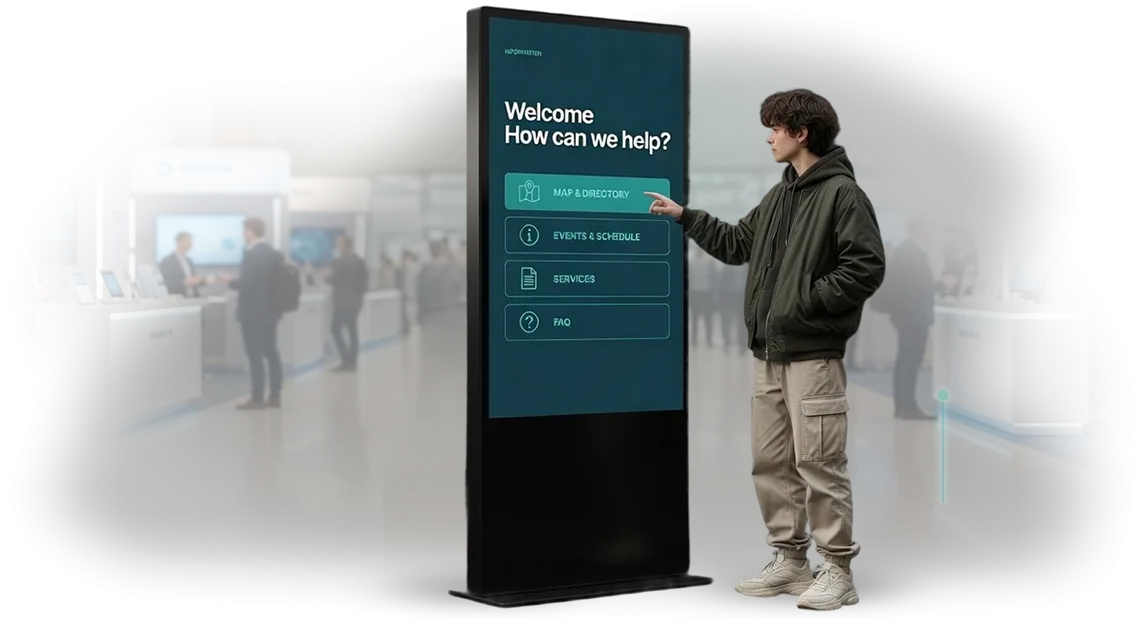
An ordering terminal lets the guest choose dishes on their own, see the total, and pay within a minute, without waiting for a cashier.
The system instantly sends the order to the kitchen, reduces the likelihood of mistakes, and frees employees for tasks that require live communication.
However, the benefit of a kiosk is not limited to speed. Built-in prompts skillfully suggest adding a drink to a burger, choosing a larger portion size, or taking a dessert with coffee — and the guest does all this on their own, seeing attractive pictures on the screen.
This is how the average check increases without the waiter being pushy: the screen gently guides the guest toward a larger order, and the guest perceives it as convenience. Over a shift, such micro-additions provide a significant boost to revenue.
We create kiosks tailored to your kitchen and service format: we configure the menu, food photos, promotions, and recommendation logic.
Our engineers design the interface so that guests with any level of digital skills can manage without staff assistance, while the owner gets clear order statistics.
As a result, you eliminate queues, increase service speed, and turn the kiosk from a “trendy gadget” into a tool for growing the average check.
What installing self-service terminals in an establishment brings
Self-service terminals in a restaurant work like an extra staff member who never gets tired, never gets distracted, and always follows the standard of guest service.
They take on order taking and payment, and the owner gets a comprehensive effect: a higher average check, faster guest flow, audience loyalty, and less pressure on the staff.
The first and most visible result is a higher average check. When a guest chooses dishes on a touchscreen, the system gently suggests popular add-ons, a drink to go with an item, or a dessert at the end of the order.
Such scenarios raise the purchase total by 15–20% on average compared to a regular menu, and this happens without aggressive selling — the guest makes the decision themselves.
The second benefit is service speed. The guest places an order in two or three minutes without waiting for a waiter, and card payment goes through immediately after choosing the dishes.
During peak hours, the establishment processes many more people through the checkout, queues shorten, and seats turn over faster, meaning you take more orders with the same number of employees.
The third area is guest loyalty. Most visitors perceive the ability to self-serve as a high level of service: it is modern, fast, and gives control over the order contents.
A convenient scenario encourages repeat visits and positive recommendations — guests return and bring friends, and you get a steady stream of customers without spending extra on advertising.
Finally, terminals relieve waiters and cashiers. Employees are freed from routine operations and focus on guest service: they advise on the menu, look after comfort, and create an atmosphere.
This reduces the number of order mistakes, lowers staff turnover, makes the establishment run more calmly, and makes the service more attentive.
Restaurant kiosks: formats that solve business challenges
The restaurant business loses guests every day because of queues, order errors, and staff shortages during peak hours. A self-service terminal solves these problems: the guest chooses dishes on the screen, pays for the order, and receives it without a cashier.
However, one and the same kiosk will not suit both a fast-food outlet and a small coffee shop — it is important to compare formats and choose a solution that fits your tasks.
Kiosk formats
| Format | Who it is for | What it gives the customer |
|---|---|---|
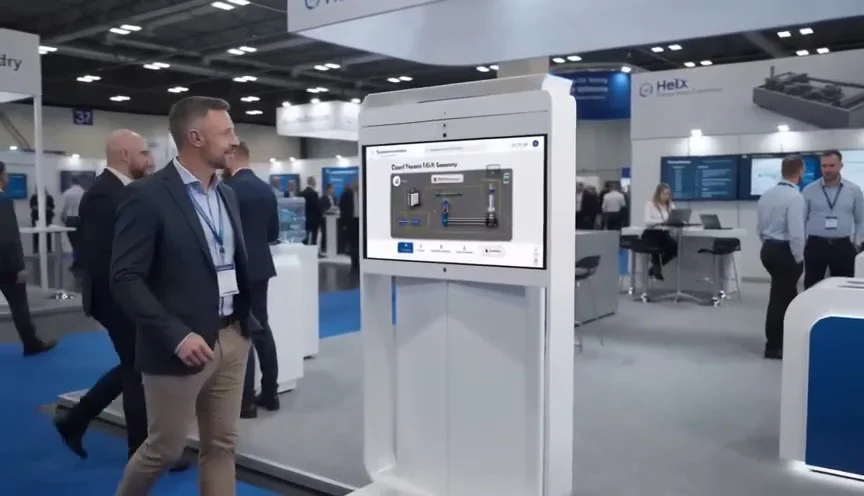
| Full-size floor-standing | Fast food, canteen, high-traffic café | Relieves the checkout, speeds up service, increases the average check through upselling |
| Tabletop / countertop | Coffee shop, bakery, small café | Saves space, quick to install, convenient for takeaway orders |
| Menu kiosk with interactive display | Food court, self-service restaurant | The guest sees dishes, builds combinations, and pays without a cashier |
| Wall-mounted / on a stand | Locations with limited space and a secondary sales channel | Takes minimal space, works as an additional ordering method during peak hours |
How to choose for your establishment
First, assess the guest flow and the space. For a busy fast-food place with queues, floor-standing terminals are suitable — they take on the bulk of orders. A coffee shop with a bar counter is fine with a compact tabletop kiosk that does not get in the way of guests or staff.
Next, determine what task the menu kiosk should solve: speed up service, increase the average check, or completely offload the cashier. The number of screens, the structure of the menu, and the upsell settings depend on that.
We help you choose the equipment and adapt the interface to your establishment’s kitchen and menu — without unnecessary spending on features that will not deliver results. Implementation takes from several days to a couple of weeks, and support stays with you after launch.
How the project goes: from brief to terminal launch
We understand that for a restaurant owner, introducing kiosks is not just “putting a screen in place,” but a change in how the dining area and service operate.
That is why the process is structured as a clear route: you see the timing, areas of responsibility, and the outcome of every stage.
Implementation stages
- Project brief and venue audit. We meet online or on site, study the menu, dining room traffic, and guest scenarios. We record the tasks, constraints, and deadlines — you immediately understand what you will get and when.
- Plan and commercial proposal. We calculate the number of kiosks, their location in the dining area, and the required functionality: self-ordering, payment, loyalty program. We agree on the cost estimate — the fixed budget does not change during the process.
- Design and screen prototype. We adapt the interface to the brand and menu, and show mockups before programming begins. You make changes while it is still cheap, not after launch.
- Production and setup. We assemble the terminals and integrate them with the cash register and inventory system. We test key scenarios: choosing dishes, payment, changing an order.
- Terminal launch in the dining area. We install the equipment and test it under real conditions. On the first day, our engineer is nearby so that guests and staff immediately have a positive experience.
- Staff training and support. We conduct a short training session for waiters and administrators: how to help guests and what to do in case of errors. After that, you stay in touch with the engineer — under a subscription or a one-time agreement.
What happens after launch
We do not disappear after installation: we monitor performance, collect feedback, and refine scenarios if necessary.
For you, this is a predictable project with no hidden work — the result is a working tool that speeds up service, increases the average check, and relieves the team.
What is included in the supply and setup of the equipment
For a restaurant, the important thing is not the hardware, but that the kiosk starts taking orders from day one and does not distract from the business.
Therefore, the supply includes not just a device, but a complete turnkey package: preparation, setup, integration with the cash register, launch, and support. We work from start to finish — you get a solution that can be launched on the day of installation.
- Equipment: a touchscreen kiosk with a durable body, protection against moisture and dust, and the ability to pay by card and cash. We select the model for your dining area and guest flow: a compact stand for a small café or a full-size terminal for a high-traffic restaurant.
- Interface: menu and design matching your brand, dish photos, and order logic that requires no staff involvement. The guest selects items on their own, sees the composition and the final total — the staff is relieved, and the average check grows through upselling.
- Integration with the cash register: we sync the kiosk with your POS system — orders immediately go to the kitchen and into accounting. No need to duplicate data, transfer items manually, or change familiar processes.
- Setup and launch: an engineer determines the installation spot, connects the kiosk to the internet and power supply, sets up access rights, receipt printing, payment processing, and updates. Before opening, we run a test order.
- Staff training: we train waiters, administrators, and cashiers — how to update prices, export a report, replace the receipt roll, and what to do when guests ask typical questions.
- Warranty and support: warranty on equipment and workmanship, consultations by phone and messenger, remote assistance, replacement of a faulty unit within the warranty period. If necessary — an engineer visit within one or two business days.
In the end, you get a working kiosk without your own IT department and without downtime on the first day. The restaurant team uses a clear interface, and we stay in touch: we answer questions, help update the menu, and make sure orders do not get lost.
Case study: how terminals increased the average check in a fast-food chain
A fast-food chain approached us, «Бургер-экспресс» (name changed): queues were growing at 32 locations, and the average check had hit a ceiling — guests only took the items they saw at the checkout. The task was simple: speed up service and boost sales without expanding the staff.
We conducted an audit, configured the menu and the prompt logic on the terminals, and then launched a test at five locations. Within the first month, the average check grew by 17%, and the share of orders with additional items (drinks, sauces, desserts) increased 1.5-fold.
At locations where cashiers remained, the peak-hour load fell by half, and order wait time dropped from four minutes to one and a half.
After the test, the chain rolled out terminals across all 32 locations. Overall revenue for the quarter grew by 12% — about half of that growth came specifically from the upsell mechanics on the terminals, not from an influx of new guests.
The staff focused on preparing and handing out orders, which reduced turnover and the number of mistakes.
— Previously, we were afraid that guests would not accept self-service. In the end, terminals became the favorite way to order: people get lunch faster, and for us this is a consistently higher average check.
We are also pleased that the team rolled everything out without stopping operations at the locations, — notes the chain’s operations director.
After that, we implemented similar systems for three more foodservice chains: in one case, we saw a 21% increase in the average check within two months; in another, fewer cashier errors and more accurate inventory tracking.
Every project starts with studying the menu and guest behavior, which is why the “higher average check” pattern repeats itself rather than happening by chance.
How to choose the right terminal format for your establishment?
To understand how to choose a terminal for a restaurant, start not with the model but with questions: how guests arrive at the venue, where queues form, and what the average check is.
For fast-food places and coffee shops with foot traffic at the entrance, one or two floor-standing kiosks are enough, while in a restaurant with table service, it is better to install wall-mounted tablets on each floor or in the waiting area. The main criterion is that the guest should not have to look for a way to place an order.
Also take the menu into account: if it is large and changes frequently, a terminal with a simple dish catalog will speed up the choice, while if the dishes are complex and require explanation, you need an interactive assistant that suggests add-ons and sauces.
What matters for the guest is a clear interface; for you, it is order processing speed and a higher average check.
The number of terminals depends on peak load: one machine per 30–40 orders per hour is a guideline, but it is better to calculate based on actual flow and floor space.
We help you choose the format for your establishment: we analyze foot traffic, kitchen location, and typical guest scenarios.
At the consultation, we will calculate the required number of terminals free of charge, suggest solutions for the dining area, terrace, or delivery, and also explain how to recoup your investment through a higher average check and reduced staff load.
The main thing is not to get the scale wrong: too few terminals create queues, too many create unjustified costs. We have already set up kiosks for coffee shops, burger joints, canteens, and restaurants, so we can see which format will deliver results in your particular case. Leave a request — we will find a solution and prepare a personal cost estimate.
Frequently asked questions about self-service terminals
Before ordering self-service terminals, restaurant owners tend to ask the same questions: will the equipment break, will guests be confused, when will the investment start to pay off. We answer the main concerns — briefly and to the point.
What happens if the kiosk breaks down during the busiest hour?
The equipment is designed for continuous operation, but it is impossible to completely rule out failures.
That is why repair and maintenance of terminals are included in the contract: our engineers connect remotely and resolve most issues within minutes, and if necessary, quickly bring a replacement. Professional equipment and server architecture keep downtime to a minimum.
Will guests find it difficult to figure out the screen?
The interface is built on the principle of “large buttons, minimal text, hints at every step.” Guests of all ages order — from teenagers to retirees — and no special instructions are needed.
If you have a specific menu, we adapt the scenario to it and, if necessary, train the staff to help guests in the first days.
How long will it take for the kiosk to pay for itself?
The timeline depends on the traffic and the average check.
In venues with a steady flow of visitors, terminals typically pay for themselves within a few months: they speed up service, free up the cashier for other tasks, and often increase the average check through prompts to add a drink or dessert. We can calculate the approximate payback for your restaurant during the brief stage.
Who is responsible for terminal maintenance after launch?
We take maintenance upon ourselves: we monitor the system’s condition, update the menu, and carry out preventive maintenance. If an issue arises, you write to support, we respond quickly and resolve the problem without distracting your staff. You run the restaurant, and the technical side is our concern.
You see, all fears are manageable. And to finally remove any doubts, we will tell you about real projects and what you get as part of the package — read on.Leave a request — we will calculate the cost of equipment for your establishment
Restaurant kiosks are not only a way to speed up service, but also a tool for increasing the average check. To calculate the cost of equipment for your establishment, leave a request: we will take into account the floor space, guest flow, menu, and current processes.
You will receive a customized calculation and can plan your budget before signing the contract. Many owners have already paid off restaurant kiosks within a few months — we will tell you how to do it.
After your inquiry, you will have access to:
- Calculation of the cost of equipment and software for your configuration — without hidden fees or forced options.
- Free consultation: we will advise which kiosks are suitable for your format — fast food, café, or canteen.
- Payback forecast based on your average check, number of orders, and seasonality.
- Recommendations on kiosk placement in the dining area and interface design to increase brand recognition and the average check.
- Examples of kiosk implementations in similar venues and a launch plan from delivery to staff training.
- Assistance with integration with the cash register and delivery services, so that the kiosk becomes part of your system and does not require replacement.
The request carries no obligation — you will receive a document with the calculation, recommendations, and implementation timeline.
We will respond within one business day, and together we will decide how to launch the kiosk with minimal risk to the restaurant’s current operations. Leave a request, and we will send the calculation to your preferred communication channel.