

Hotel Kiosks — Guests Are Tired of Waiting, and You're Losing Bookings
Guests don't like queues — especially in a hotel, when after a long journey they want to get to their room as fast as possible.
Peak check-in turns the front desk into a bottleneck: while some guests are filling out forms on a tablet, others are getting annoyed, and some simply leave for the hotel next door.
That scenario is not just lost bookings — it's also a blow to your reputation, because the impression of a stay begins with the welcome at the reception desk.
A hotel kiosk changes this: guests check themselves in within a couple of minutes, scan their documents, and get their key — without queues or stress.
Shorter queues ease the workload for administrators, and automating check-in reduces pressure on staff during peak check-in and check-out hours. The front office can then focus on guests who genuinely need help instead of handing out keys to a steady flow of people. Guests get control over their time, and the hotel gains loyalty and more completed bookings.
We've already helped hotel chains implement such kiosks: the system is intuitive for guests of any age, integrates easily into the existing front desk workflow, and pays for itself by reducing staff workload.
If guests are tired of waiting, that's not a whim on their part — it's a signal to automate. We solve this quickly and without disrupting hotel operations.
What You Get: Speed, Service, and New Guests
Guests at a modern hotel are not willing to wait. A queue at the reception desk during peak hours means frayed nerves, abandoned bookings, and negative reviews. Hotel kiosks change this, turning check-in into a fast and pleasant step.
Speed: Check-in in Minutes
Guests register themselves in 2–3 minutes without waiting at the front desk. This is especially valuable for late arrivals and business trips. Fewer queues mean a higher hotel rating and a greater desire to return.
Service: Attention to Every Guest
The kiosk handles the routine questions: document verification, room selection, key printing. Staff gain time for personal interaction and assistance with luggage. Guests feel cared for, not processed.
Loyalty: Guests Come Back
Fast check-in and attentive staff are the main reasons for repeat visits. According to our data, after implementing kiosks, the share of guests who return grows by 15–20%. A satisfied guest brings along 2–3 more acquaintances.
Growth in Direct Bookings
The kiosk offers upsells: breakfast, transfer, SPA. At the moment of check-in, guests are open to such offers. Plus, the kiosk collects contacts for email campaigns — that means direct bookings without aggregator commissions.
Reducing Staff Workload
Administrators no longer need to spend hours filling out paperwork and repeating the same information. The freed-up time goes toward solving real guest requests. This means a calmer team, fewer mistakes, and less staff turnover.
We've already implemented such kiosks at Grand Hotel — queues disappeared, and guests began rating the service higher. Tell us about your hotel, and we'll propose a solution tailored to your needs.
Hotel Kiosk Formats: Fitting Your Location and Guest Flow
One and the same kiosk cannot cover the lobby entrance, the poolside area, and the registration desk — each location has its own tasks and its own traffic.
For a kiosk to work for you rather than just standing there, it's important to choose a format that matches the location and guest flow.
Below we break down the main hotel kiosk formats and suggest which one fits your task. Use the table as a cheat sheet when planning — it will show you where a kiosk will deliver the greatest return.
| Kiosk Format | For Whom | What It Gives the Customer |
|---|---|---|
| Floor-standing kiosk | Lobby, large halls, waiting areas | Handles high guest flow, works as a showcase of hotel services, speeds up check-in during peak arrivals |
| Wall-mounted kiosk | Narrow corridors, elevator lobbies, SPA areas, conference rooms | Saves space, helps guests find their way around the property and learn about services without asking staff |
| Mobile kiosk | Restaurant, terrace, pool, off-site events | Moves to where the guests are, expanding options for ordering services and making payments |
| Registration kiosk | Reception desk, hotel entrance | Speeds up check-in and check-out, reduces queues, frees up staff for personal interaction with guests |
To choose a format for your location, you only need to assess traffic and purpose. For a permanent location with high traffic — choose a floor-standing or registration kiosk; for additional zones — a wall-mounted kiosk; for flexible use — a mobile kiosk.
We'll help you select the configuration and prepare a kiosk for your tasks — from the cabinet design to the interface logic.
How We Build the Project: From Brief to Launch in a Month
We rarely work "blind": we have a well-established process that eliminates surprises in terms of timeline and budget. Within a month you get a working kiosk, trained staff, and a clear instruction manual — not just "hardware with software."
We've refined this approach across dozens of projects, including the Royal Stay hotel chain — where the guest registration kiosk paid for itself within two seasons. Here's how the work is structured.
- Brief and immersion into the task — over 1–2 meetings we discuss your guests, placement points, and scenarios. You receive a commercial proposal with a fixed price.
- Design and approval — we create screen prototypes and the menu structure. We agree on the design, copy, and navigation logic before development begins.
- Development and testing — our engineers assemble the kiosk using professional equipment and test real-life scenarios: check-in, payment, service ordering.
- Launch and training — we deliver, install, connect to your system, and train administrators within 2–3 hours. You receive a simple guide for new staff.
- Support and development — after launch, we don't disappear: we update content, add features, and monitor stability.
Each stage ends with a clear document or deliverable that you can see and approve. This way you always know what will happen in a week and what you'll get in the end.
This process cuts approval time in half and allows the kiosk to be launched within a month — without rework or missed deadlines.
What's Included in the Delivery: A Package That Works From Day One
The delivery is not a "box" with a device, but a ready-made solution that goes live on installation day. We take care of everything: from equipment selection and design to integration with your hotel system and staff training.
You get a working tool — no finishing touches, no surprises, no downtime. Every component has been tested on our projects and adapted for hotel tasks.
- Hotel-grade equipment: a vandal-resistant touch kiosk that fits the lobby interior and operates reliably around the clock.
- Software: an interface in Russian and major guest languages — guests don't need to figure anything out; they immediately understand what to do.
- Integration with the hotel system: check-in, check-out, and additional services synchronize automatically, without manual entry from your booking system.
- Design and branding: styling that matches the hotel's identity — guests perceive the kiosk as part of the service, not a yellow touch pedestal.
- Documentation and training: short guides for the front desk and guests, quick-reference cards for typical questions — staff can start working right away.
- Support and development: monitoring, scheduled updates, and consultations so the kiosk doesn't become outdated or fail during high season.
The result is a package where nothing needs to be purchased or configured separately. The hotel gets modern service, the guest gets convenience, and the staff gets help in their daily work.
Case Study: We Accelerated Guest Check-in 3x
A hotelier knows: even a perfect room won't save you if a guest stands in a queue for 20 minutes after a flight. Reception inquiries grow, ratings drop, and additional staff must be hired for peak hours. This is the problem the Grand Avenue Hotels chain brought to us.
We didn't replace people with machines. Instead, we split the flow: standard check-in went to self-service kiosks, while complex questions and special requests stayed with live staff.
The kiosk checks documents itself, selects a room based on guest preferences, and issues a key within a couple of minutes.
Measured Result After One Month
Average check-in time dropped from 18 to 6 minutes. 70% of guests now go through the kiosks, the peak-hour queue has disappeared, and guest ratings of reception service in reviews rose by one and a half points. Staff stopped working "at speed" and are focusing on service again.
"Guests have stopped getting stressed in queues, and the reception desk finally handles matters that require real human attention. We got not just kiosks, but a manageable check-in process," said the chain manager.
Two months later, the client returned and asked to scale the solution to two more hotels. That's a better endorsement than any words: the system paid for itself in the very first peak season and continues to run without failures.
How to Choose the Right Format for Your Task?
Choosing an interactive kiosk format always starts not with the model but with the question: what should the kiosk simplify in your hotel's operations?
If the main goal is to speed up check-in and relieve the reception desk during peak hours, you need a full-capability terminal with registration and payment functions.
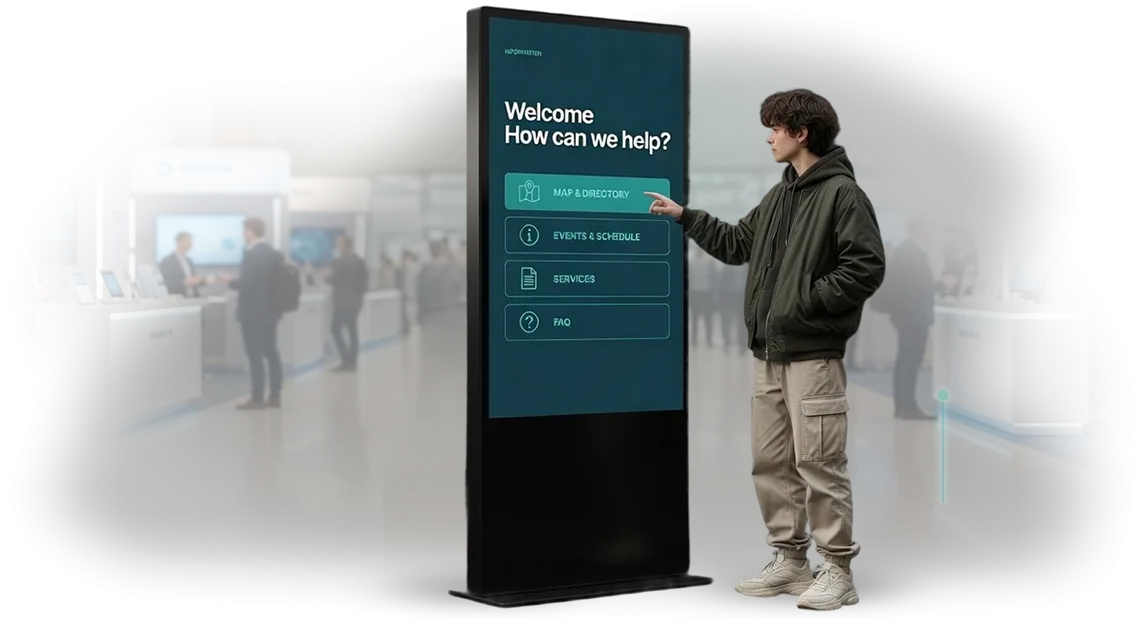
If the kiosk is planned as an information stand in the lobby or near the elevator, a compact wall-mounted screen with a floor plan, restaurant schedule, and current promotions is enough.
It's worth comparing formats across several criteria: guest flow, usage scenario, installation location, and the need for integration with your property management system.
For example, a high-traffic lobby demands fast performance and reliable hardware, while a quiet area by the bar requires a minimalist design and simple navigation.
The right format saves guest time and reduces unnecessary strain on staff; the wrong one leads to queues and unused equipment.
Pay special attention to how the kiosk will be embedded in your business processes. Our engineers configure integration with your booking and accounting systems so that check-in data appears automatically — without duplicate entry or errors.
That is the level of convenience guests appreciate and remember, and your staff, instead of routine work, gain time to care for guests.
We've been designing hotel kiosks for years, so we can quickly assess your task and suggest a suitable option — from a simple information screen to a full-fledged check-in station.
During a free consultation, we'll review usage scenarios, compare formats by price and timeline, and advise on which option will pay off faster.
Leave a request on the website — we'll tell you what solutions already work in similar hotels and answer questions about integration and support. We'll help you choose a kiosk that solves your specific problem, not just looks modern.
Addressing Common Concerns: What If the Equipment Breaks Down?
The first thing hoteliers ask is, "What if the kiosk stops working in the middle of check-in?" We understand the fear: guests are standing at the reception desk while bookings aren't going through.
That's why our core principle is not to sell equipment, but to ensure it runs smoothly. Every kiosk undergoes multi-stage checks before shipment, and after installation we provide a warranty and establish a maintenance schedule.
If a failure does occur, you're never left alone with the problem. Our engineers connect remotely, diagnose the cause, and usually resolve it during the same call.
If a part needs replacing, we deliver a new one within the agreed timeframe and offer replacement equipment during repairs so the front desk continues to operate.
What does the kiosk warranty cover?
The warranty covers hardware and software: touchscreen failures, board issues, power supply faults, and software errors. Only mechanical damage caused by careless handling is not covered. The warranty period is fixed in the contract so that you know your rights.
How quickly do you respond to a breakdown?
During business hours, we take your request within 15 minutes and immediately run remote diagnostics. Most issues are resolved remotely without us having to visit you.
If a part replacement is required, we agree on a convenient time window and deliver it within one to two days, depending on the region.
What if the kiosk breaks down at night or on a weekend?
For such cases, we have an on-call support line. A guest or administrator can report the fault — an engineer will connect remotely and resolve the issue. If physical intervention is needed, we'll come during the nearest working hours. Until then, consider a backup scenario, such as temporary check-in on the main computer.
Who is responsible for kiosk maintenance?
We are. Our engineers regularly inspect the equipment, update the system, and clean components to keep the kiosk running reliably. You don't need to find a contractor or understand technical details — all care for the hardware is on our side.
Discuss Your Project — We'll Lock in the Cost and Timeline
We know that a hotel kiosk is not just a stand with a screen, but a tool that relieves the reception desk during peak hours, speeds up check-in, and makes service more modern.
For a project to deliver value, it's important to clearly define the tasks: where the kiosk will be installed, what scenarios guests need, and how it will connect to your booking and registration system.
For most hotels, the work starts with a conversation — briefly tell us what you'd like to automate, and we'll advise on what will realistically pay off.
Then we put together a free brief: you pay nothing for the assessment, we capture the requirements, and come back with a cost range and launch timeline.
We create the brief for free, clarify details, and return with a cost calculation and a realistic launch timeline. Nothing is "pulled out of thin air": we fix the scope of work, stages, and completion date before we start.
If new ideas come up during the process, we'll discuss their impact on timeline and budget before including them.
What you receive after submitting a request:
- Project request — we contact you within one business day
- Free brief — we structure your requirements and integration questions
- Preliminary estimate — to calculate the kiosk cost for your specific task
- Implementation plan with dates — you see the timeline up to first launch
- Fixed cost — the price does not change after agreement
- Format recommendations — kiosk, stand, or a combined solution
Leave a project request — we'll discuss the task, suggest which scenarios will deliver quick results, and prepare an estimate with no hidden charges.