

Why Metallurgy Needs Interactive Kiosks
The long-standing problems of metallurgy are thousands of product items: from standard rolled metal to complex alloys, each with its own characteristics, tolerances, and delivery terms.
It is difficult for even a specialist to navigate such volume, and a buyer or new employee cannot cope at all without assistance.
That is why many plants still rely on paper catalogs, spreadsheet lists, and reference books — they become outdated faster than they are updated, and errors are easy to make.
The cost of such mistakes is not only damaged client relationships. It also means queues at the sales department, lost orders, extra clarification requests, and dozens of hours that employees spend searching for the right item instead of working on the order.
As a result, even a large manufacturing facility appears slow and unwelcoming, and the client leaves for a place where they can get an answer in a minute.
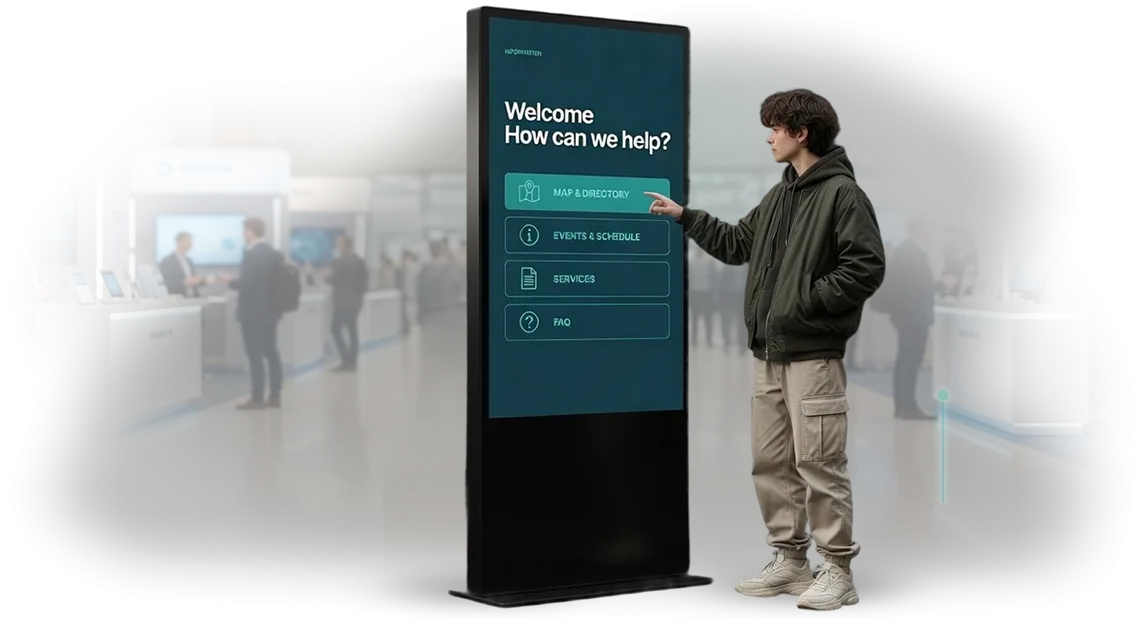
An interactive catalog for a plant solves these problems. An information kiosk with a touchscreen is placed in a workshop, showroom, or at the entrance — and the buyer can find the product in a few touches, see up-to-date specifications, and immediately submit a request.
Employees use the terminal for the plant as a quick reference guide to regulations and standards. We design such kiosks for the specific needs of each production facility — so the data is always current and visitors do not have to wait for a consultant.
What Benefits Does an Enterprise Get from an Interactive Kiosk
Automating service in metallurgy is not about "trendy hardware" but about a concrete business result: less routine for staff, faster customer service, higher loyalty.
An interactive kiosk handles typical requests — product search, stock availability, order submission — and frees specialists for tasks where a human is truly needed.
The main indicator is time. The kiosk reduces customer waiting time from several minutes to seconds: the catalog, specifications, current balances, and cost calculation are available immediately on the screen, without phone calls or queues.
For a metallurgical enterprise, this means a reduced load on the sales department and higher customer satisfaction — they receive answers instantly, at any time the plant is operating.
Business Benefits
Staff time savings. Typical questions like "is it in stock," "what is the price," "what are the delivery times" no longer take up employees' working hours.
Managers are not distracted by routine and can focus on negotiations, complex orders, and developing relationships with key clients.
Increased customer loyalty. Clients value predictability and speed. The kiosk provides up-to-date information at any time, independent of a specific manager's schedule. Confirmation, specification, or invoice — the customer gets the needed data independently and immediately.
Improved accuracy and precision. The system automatically pulls data from accounting systems and eliminates the human factor: outdated price lists, errors in specifications, forgotten order items. This directly affects trust and the number of repeat inquiries.
We build such solutions on professional equipment and proven tools, so the kiosk can be managed remotely and its content easily updated when the product range changes.
The enterprise receives a stable tool that works as part of the overall sales infrastructure, not just a separate "screen in the lobby."
Interactive Kiosk Formats for Metallurgy
In metallurgy, an interactive kiosk solves several tasks at once: introduces clients to the product range, displays product specifications, and collects requests. But the installation location determines what the terminal itself should be like.
At the checkpoint you need a durable enclosure, in the office — a compact solution, at an exhibition — a noticeable structure.
We use three basic formats — a desktop kiosk, a floor-standing terminal, and a built-in terminal. The choice depends on floor space, traffic, and usage scenario. In all cases, you get an up-to-date catalog, a convenient interface, and a unified contact collection system.
| Format | Where It Works | What It Gives the Enterprise |
|---|---|---|
| Desktop kiosk | Sales office, reception area, meeting room | Allows a visitor to independently review the catalog and prices without waiting for a manager. Saves employees' working time. |
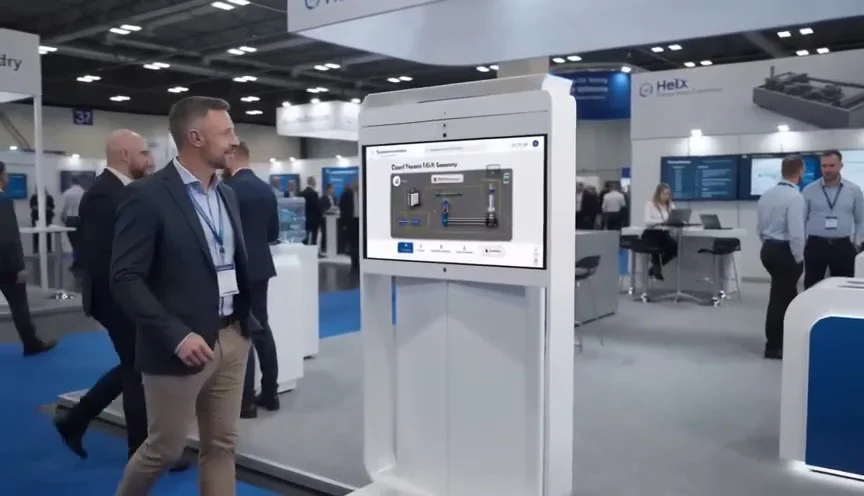
| Floor-standing terminal | Checkpoint, workshop, exhibition stand | Withstands constant visitor flow, attracts attention, and works as an independent product showcase. |
| Built-in terminal | Reception desk, wall panel, next to products | Blends into the interior, takes up no extra space, and maintains the site's corporate style. |
Whichever format you choose, we adapt the interface to your product range and workflow. A visitor or employee can see the products and technical specifications in a couple of touches and submit a request for a batch quote. For the enterprise, this means fewer "price check" calls and more qualified inquiries.
How Kiosk Implementation Works: Stages and Timelines
You get a transparent process where every stage is agreed upon and clear. We do not "take the project and disappear" — you see what stage the kiosk is at, when the mockups will be ready, and when the terminal will start working at your site.
-
Brief and task analysis. We record exactly what the catalog should give visitors: quick product search, specification comparison, request submission. Based on this, we define the menu structure and equipment list.
-
Prototype and approval. We create a clickable mockup of the future interface. You see how the sections and transitions will look before programming begins. We make edits until approval — this avoids rework at later stages.
-
Development and content. We build the interface, connect your product catalog, configure search and filters. In parallel, you provide texts and images — we help adapt them for the kiosk screen.
-
Testing and debugging. We check the operation on real equipment: response speed, reliability during prolonged operation, correctness of all scenarios. You receive a stable system, not a "raw" prototype.
-
Terminal launch. We deliver, install, and configure the kiosk at your site. We conduct a short training session for employees so they can assist visitors if needed.
-
Support and updates. The catalog lives on: items are added, prices change, promotions appear. We handle content updates remotely and remain available for prompt support.
On average, the full cycle — from brief to launch — takes 3–6 weeks depending on the size of the catalog and the number of approvals. Each stage ends with a clear result that you check and accept.
This way you control the timeline, and we make sure the terminal starts delivering benefits from day one.
What Is Included in the Supply and Installation of a Kiosk
You receive a complete "turnkey" solution — from mockup design to installation at your site. You do not need to hire contractors or watch over every detail: we handle the entire cycle and deliver a working terminal with a catalog of your products.
Here is what is included in the supply and installation of an interactive kiosk:
- Development of the interactive catalog layout and structure for your product range — taking into account how your clients search for products.
- Supply and configuration of professional equipment adapted to workshop or warehouse conditions (dust, vibration, temperature fluctuations).
- On-site installation of the terminal: mounting, connection to power and local systems, verification of all operating scenarios.
- Training for your employees: they will be able to independently update prices, add items, and manage content without programmers.
- Integration with your accounting system or database — the catalog always reflects current stock levels and prices.
- A complete documentation package: user manual, maintenance instructions, information update procedures.
- Warranty on equipment and software — you are protected from sudden failures and downtime throughout the entire service life.
We also provide access to an analytics system: you see which items are viewed most often, how much time a visitor spends at the screen, and which queries remain unanswered. This helps improve the catalog and understand real customer interest in your products.
In the end, you get not just a terminal but a full-fledged sales tool that works immediately after installation. Your staff are not distracted by technical issues, and guests quickly find the products they need without manager assistance.
Case Study: Growth in Orders and Shorter Queues After Kiosk Launch
Before the kiosk launch, the plant's dispatch office was drowning in a stream of similar requests: clients waited 15–20 minutes for a consultation, some orders were lost during hand-offs between departments, and managers spent up to a third of their working day on questions that automation can easily handle.
For the steel plant, this meant direct revenue losses — potential buyers left to competitors without waiting for an answer.
We proposed a solution for StalProm — an interactive kiosk with a product catalog, prices, and an order form. Implementation took three weeks: from analyzing typical questions to installing the terminal in the waiting area.
The kiosk took over the routine — selecting product range, calculating estimated costs, and forwarding requests to the sales department.
Results After Launch
The average client waiting time dropped from 14 to 3 minutes — the queue was no longer a bottleneck. The share of repeat orders increased by 23%: visitors returned because the service became predictable and fast. Operators switched to complex negotiations and large contracts instead of answering inquiries.
Most importantly, the kiosk paid for itself in four months thanks to additional orders that previously got lost in the flow. Clients appreciate the convenience: they can calmly review the product range, compare items, and submit a request without intermediaries.
At the same time, the terminal is fully integrated with the internal accounting system — order data flows into the CRM automatically.
Metrics That Speak for Themselves
After the first six months of operation, the kiosk consistently generates a quarter of incoming requests and maintains a higher visitor-to-order conversion than the website's online catalog.
The plant's management has already ordered a second terminal for a branch office — the best evidence that the solution works and brings tangible business results.
| Metric | Before Implementation | After Implementation |
|---|---|---|
| Client waiting time | 14 minutes | 3 minutes |
| Repeat order share | baseline level | +23% |
| Kiosk payback | — | 4 months |
Frequently Asked Questions About Creating Interactive Kiosks
Before launching an interactive kiosk, clients ask the same questions: what happens to the equipment after installation, how quickly the catalog can be updated, and whether the solution can be adapted to the specifics of a workshop. We answer the key ones — so you can make a decision without hidden risks.
What warranty is provided for the kiosk and what does it cover?
We provide an official warranty on all equipment and installation. If a failure occurs during the warranty period, we will come, diagnose, and resolve it at our expense. The warranty covers the touchscreen, enclosure, control module, and software.
What happens if the terminal breaks down at the busiest moment?
For metallurgical enterprises, downtime means lost orders, so we design kiosks with a safety margin and protection against voltage fluctuations. Settings and the catalog can be restored from a backup in a few minutes.
In addition, remote diagnostics are available — often we resolve the issue remotely, without a site visit.
How do we update the product and service catalog after launch?
You change prices, availability, specifications, and promotions yourself through a simple interface. No programmers are needed for edits — just load new data into the system. The update takes minutes, and the information on the kiosk screen changes immediately. If needed, we can set up automatic synchronization with your accounting system.
Can you adapt the kiosk to non-standard workshop tasks?
Yes. We have built solutions for special conditions in metallurgical production: aggressive environments, high temperatures, size constraints, and unique navigation scenarios. We discuss the task, select the enclosure protection and interface for your processes. If the standard configuration is not enough, we develop a custom version.
Who is responsible for terminal maintenance after implementation?
We take on full support: scheduled maintenance, preventive checks, content updates, and consultations. We work remotely and visit the site if necessary. You always know who to contact — and you are not dependent on random contractors.
Order the Development of an Interactive Kiosk for Your Task
Submit your request now — and within a few business days we will show you what your interactive kiosk will look like. We handle the entire journey: from brief to terminal launch and staff training.
You get a ready-made "turnkey" solution adapted to the specifics of the metallurgical industry.
A typical project takes 2–4 weeks — the timeline depends on the number of catalogs and the complexity of integration with your databases. The stages look like this:
- Briefing: you describe the task, we clarify usage scenarios and kiosk placement points.
- Prototype: we propose the screen structure and search logic — you see and refine it before development starts.
- Design approval: an interface in your corporate style, adapted for the terminal.
- Development and content: we load product catalogs, services, price lists, and site maps.
- Testing: we check scenarios on real equipment, including abnormal situations.
- Launch and support: we install the kiosk, train employees, and hand over instructions.
Why it is convenient to order kiosk development from us:
- One contractor for the entire cycle — from design to technical support, with no intermediaries.
- Clear result: you see the prototype and design in advance, and after launch you get a working terminal.
- Visitor-friendly adaptation: the interface is understandable for both your employees and clients, even if they are using a kiosk for the first time.
- Quick content replacement: updating catalogs and prices takes minutes — no need to wait for developers.
- Safety and stability: the terminal operates reliably around the clock, and we can visit the site if needed.
- We work throughout the CIS — remotely and with on-site installation.
Submit your request, and we will lock in the timeline and cost for your task. We will call you back within a business day, answer your questions, and propose a solution that will measurably improve service speed and convenience in dealing with your services.
How to Choose the Right Kiosk Format for Your Industry?
Selecting a terminal is not about picking a nice-looking enclosure but about finding a solution for a specific enterprise task. Before looking at models, answer three questions: where will it stand, how many people will use it, and what operations must it perform. These selection criteria determine which kiosk pays off and which sits idle.
Floor space sets the dimensions and placement method. In a spacious lobby or near a checkpoint, a floor-standing kiosk with a large screen that is visible from afar makes sense. In a narrow corridor or at a reception desk, a compact wall-mounted option is more convenient.
If space is limited, consider models with an adjustable tilt angle — they save space and suit users of different heights.
The number of users affects the load and operating scenario. For a flow of several dozen people per day, a standard terminal is enough. If hundreds of employees and guests pass by, you need a reinforced structure and an interface that does not make people wait.
The speed of information updates is also important: a static promotional screen is one case, a searchable catalog is quite another.
The types of tasks determine functionality. For a metallurgical enterprise, this is often an interactive catalog of products and services: price lists, certificates, manager contacts.
The terminal may operate in a workshop with an aggressive environment — a protected enclosure and a screen readable in bright lighting are needed.
It is also important that you can update the content yourself without a programmer and that integration with the accounting system happens without delays.
Combine these three criteria — and you get a technical specification for selecting a terminal. We analyze your premises for free, assess user flows, and offer 2–3 options with differences in price and functionality. You choose the format that solves the task, rather than overpaying for extra features.