


Interactive Kiosks for the Oil and Gas Industry: The Customer Journey
The entrance area of an oil and gas enterprise is not always a place where a buyer can quickly get their bearings. A visitor arrives for a specific product or service but faces a large assortment, queues at the sales department, and the need to wait for a consultant. Time is lost, some customers leave without placing an order — and that is a direct loss of revenue.
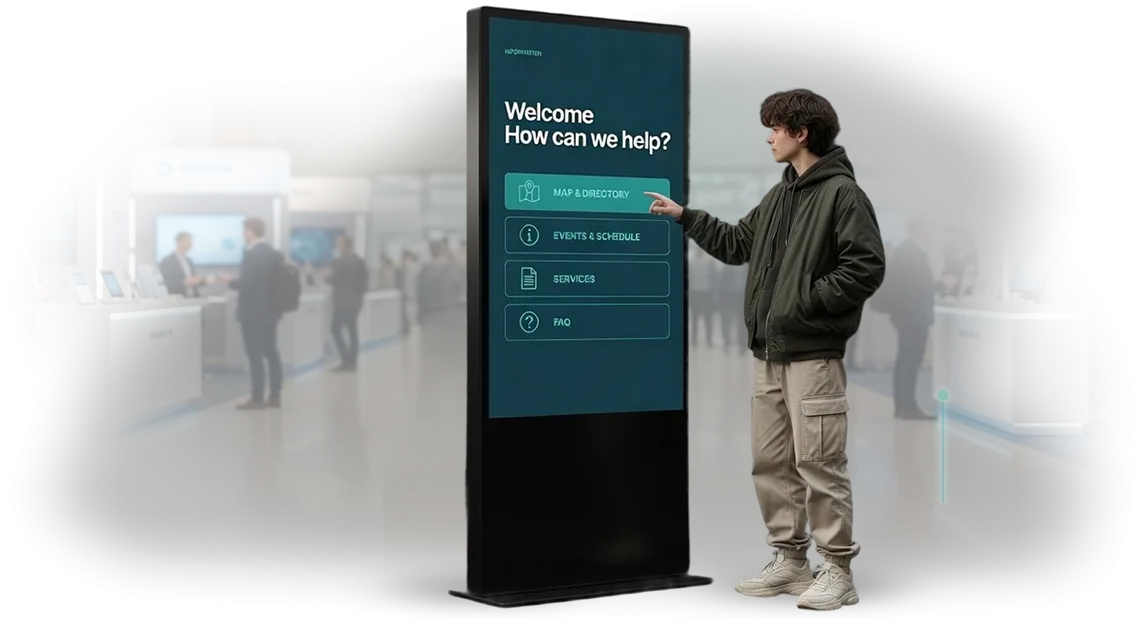
An interactive kiosk with a product and service catalog solves this pain point.
On the touch terminal, a customer finds the needed item by name, category, or purpose within a couple of minutes, sees availability, specifications, and cost, and then immediately submits a sales request or proceeds to a specialist with ready data. The customer journey shrinks from a half-hour wait to a short dialogue at the screen.
For the oil and gas industry, such a catalog is especially valuable: the industry's specifics require precise selection of equipment, materials, and services. Without up-to-date information at hand, buyers rely on the manager's memory and paper price lists.
An interactive kiosk provides a structured database that is always current: new products, related items, technical parameters in a convenient format. Customers make decisions faster, and your employees are freed from routine answers to recurring questions.
Also important is the fact that the customer terminal operates around the clock and does not require staff involvement. Even at peak hours at the registration desk, a visitor can independently review the assortment, choose an alternative, and obtain a document for ordering.
This increases the throughput of the sales department and raises the share of completed requests from the first visit.
We handle the implementation of an interactive catalog as a turnkey project: we study the specifics of your product range, design the search logic, populate the product database, and install the equipment on site.
You get a tool that pays off through the growth of repeat inquiries and customer trust — and the enterprise's guests see modern service instead of outdated stands and queues to the manager.
What an Interactive Catalog on a Terminal Gives the Customer
For a customer in the oil and gas industry, an information kiosk is not just a screen with information, but a tool that turns waiting into useful interaction.
A visitor to an office or production site finds the needed product, specifications, certificates, or contacts of the responsible specialist within a minute — without searching for a manager or paper catalogs.
This is where sales growth comes from: when a customer independently sees the current assortment and available options, they decide to order faster.
For your team, this reduces staff workload — employees answer calls and support deals instead of repeating the same basic information to every visitor.
The kiosk also works as an analytics collection tool. The system records which products and services were searched most often, how much time guests spent at each category, and which requests remained unanswered.
This data shows real demand, helps adjust the assortment, and plan warehouse stock — so decisions are made based on facts, not guesses.
An additional bonus is visitor engagement. The interactive format is perceived as care for the customer: a person does not wait but receives answers at a comfortable pace and chooses the depth of information themselves.
Such companies are remembered and recommended to partners — an additional reputation channel that does not require advertising costs.
Formats of Interactive Kiosks for the Oil and Gas Industry
At oil and gas facilities, time is the most expensive resource. Employees and contractors spend hours searching for materials, equipment, and buildings, while paper catalogs and signs become outdated. A compact touch terminal covers all three tasks — from catalog to navigation.
The equipment is adapted for industrial conditions: a durable housing, resistance to dust and temperature fluctuations.
Kiosk Formats
The choice depends on what your team needs more often: to find a product quickly, get instructions, or reach a workshop. The main options:
| Format | For whom | What it gives the customer |
|---|---|---|
| Product and service catalog | Supply specialists, storekeepers, purchasers | Search by specifications, current availability and prices — requests are prepared several times faster |
| Information terminal | New employees, contractors, guests | Safety instructions, rules and operating hours — without distracting staff |
| On-site navigation | Workers on a large territory | Route to a warehouse or workshop, hazardous zones, less travel time and lower risks |
All formats work on the same equipment and are easily combined. For example, after selecting the needed item in the catalog, the kiosk shows the route to the pickup point. You can start with one scenario and then expand without replacing the terminal. Data updates happen centrally — you always control the relevance of the catalog and maps.
How the Development and Launch of Your Kiosk Proceeds
Approval is the most common point of delay in such projects. We built the process so that you see the result in advance and make edits before production, not after installation.
You don't need to understand the technical part — at each stage you receive a clear status and specific deadlines.
-
Brief and task analysis — we record which products and services will be in the catalog, who will be the kiosk user, and which work scenarios must be covered. The output is a technical specification that both you and our team understand.
-
Layout and catalog structure development — we show how the kiosk will look and how the user will move through sections. You see the menu logic, button placement, and search hints before launch.
-
Approval and revisions — we work in iterations: you give comments, we make changes, and return an updated layout. No "surprises" at the final stage — you approve every detail.
-
Delivery and installation — we bring the finished kiosk to your site, install it, and connect it. Everything happens within agreed deadlines, without the need to stop your facility operations.
-
Setup for operation — we load current data and check the operation of all sections and updates. The kiosk is ready to work from day one.
-
Staff training — we conduct a short session for your employees: how to turn on the kiosk, replace consumables, and quickly resolve typical visitor questions.
-
Post-launch support — we stay in touch, update content at your request, and ensure the kiosk operates stably. If something changes in the catalog, you simply send new data.
What Is Included in an Interactive Kiosk Project
An interactive kiosk project is not "put a terminal in the lobby," but a ready-made solution that starts working from day one. We assemble it for the oil and gas industry's tasks: from the housing to staff instructions.
Below is the full scope of delivery so you understand what you pay for and what you receive on site.
-
Housing and touch kiosk — a durable metal housing with dust and moisture protection, adapted for aggressive environments. The touch screen with anti-vandal glass is designed for 24/7 operation in high-traffic areas — checkpoints, control rooms, waiting zones.
-
Software package — pre-installed interactive software with an interface for oil and gas industry tasks: product catalog, regulations, route map, contractor contacts. Easily updated without reinstallation.
-
Design layout — we develop branded screens in your style: logo, corporate colors, menu structure. You get not a template but an interface that your employees and customers recognize.
-
Instructions and documentation — a set of operational materials for the administrator and staff: power-on, basic settings, consumable replacement. Plus a short user guide.
-
Commissioning and training — a specialist visit to the site, installation, setup, and testing of all scenarios. We train your staff to work with the terminal so you don't depend on us for daily tasks.
-
Warranty and support — service support for the entire operational life: consultations, diagnostics, on-site visits in case of failure. Response protocol — from 2 hours, so kiosk downtime does not affect your operations.
What matters for the oil and gas industry: the kiosk operates in conditions where ordinary electronics fail — temperature fluctuations, vibration, dustiness, rough handling.
Therefore, the delivery includes only industrial-grade equipment, and the software part undergoes continuous operation testing.
Final result — you receive a fully ready-to-use terminal. You only need to plug it into a power outlet and network: housing, screen, software, design, and documents are already included. Nothing needs to be purchased separately, designed, or arranged for compatibility.
Case Study: How a Kiosk Paid Off in a Production Holding
At production sites, employees spend up to half an hour a day searching for current regulations, equipment maps, and contractor contacts. This time is spent not on work but on switching between spreadsheets and internal chats.
An interactive kiosk with a product and service catalog solves this problem — but only if a clear data structure stands behind it.
How We Built the Catalog
For an oil and gas facility, we installed a kiosk and turned the client's scattered documents into a single entry point in two weeks.
The catalog was divided by roles: an operator needs quick access to production instructions, a supply specialist to material specifications, an engineer to the list of contractor services.
Search was configured for natural phrases that employees actually use in speech, not formal codes from documents.
In the production holding VostokNefteGaz, such a kiosk started working at a site with 400 employees. A month after launch, the number of catalog requests grew by 40% — even though we did not conduct mandatory training. People began using the terminal on their own because it answered questions in 10–15 seconds.
Implementation Results
The growth in requests led to three business effects. First, the load on the internal phone line decreased: typical questions like "where is the document" stopped reaching specialized specialists.
Then downtime was reduced — employees get the needed information faster and return to tasks. Finally, management received clear statistics: which catalog items are in highest demand and which should be expanded or removed.
After the first two months, the client ordered the same kiosks for two more facilities of the holding. According to their assessment, the payback of one terminal took less than a quarter — thanks to freed staff time and accelerated internal processes.
How to Choose a Kiosk Format for Your Business Tasks?
A kiosk format is not a design question but an efficiency question.
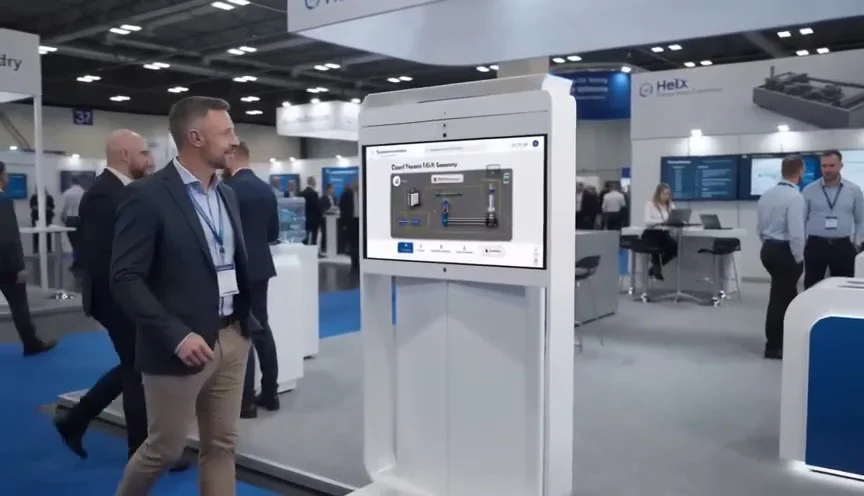
The same product catalog in the oil and gas industry can work differently: a floor-standing terminal is convenient in a spacious lobby, a wall-mounted one saves space in a narrow passage, and a compact desktop one suits an operator's workstation. The main thing is to start from three parameters: area, traffic, and tasks.
If a large flow of visitors passes through the zone — employees, contractors, guests — you need a floor-standing kiosk with a large screen and a stable housing. It is convenient for simultaneously browsing the service catalog, finding the needed product, and sending a request.
In a limited space — at a checkpoint, in a corridor, near a warehouse — a wall-mounted option is better: it does not take up floor space but remains accessible.
Tasks determine the interface logic.
For an interactive catalog with search by categories and specifications, a simple scenario is enough: "selected — viewed — sent a request." If the kiosk must also schedule maintenance, check request status, or provide reference information, the format stays the same, but the content structure and number of steps change. Here, what matters is not the housing but a well-thought-out scenario.
Practice shows that clients often choose a large universal kiosk even though they actually need a functional one, not a big one.
We help avoid overpayment: we analyze the premises, calculate traffic, and select a format that solves your specific task — catalog, navigation, or request intake.
As a result, you get not a "kiosk for the sake of a kiosk" but a working tool that pays off from the first days.
Frequently Asked Questions About Interactive Kiosks and Terminals
For oil and gas enterprises, an interactive kiosk is a working tool that determines the speed of service for employees and counterparties. That is why we hear the same questions: will the equipment fail, how long will launch take, who will update the catalog. We answer the main ones so you can make a decision without uncertainty.
What is the warranty on the kiosk?
Kiosks come with an official warranty of 12 months or more. If a malfunction occurs during this period, we will replace components for free or provide replacement equipment while repairs are underway.
What to do if the terminal breaks down?
You don't need to disassemble the device yourself. You call our support — we run remote diagnostics and, if necessary, visit the site. A typical terminal repair takes from one to three days.
Is it difficult to update the product and service catalog?
No. You can change the catalog composition, prices, and promotions yourself through a simple control panel. If you don't have time, we will set up regular updates at your request — in compliance with internal regulations.
What are the installation timelines?
We launch a standard kiosk within 2–3 weeks after approving the design and content. Projects with custom housings require more time, but we approve the exact schedule before work starts and meet it.
Order the Development of an Interactive Kiosk for Your Industry
In the oil and gas industry, every facility has dozens of regulations, instructions, and areas where an employee or contractor needs to quickly find their bearings. Lost minutes searching for the needed information turn into downtime and additional risks.
An interactive kiosk solves this problem: a user finds a route map, responsible person's contacts, current regulation, or equipment catalog in a couple of touches.
We will prepare a concept and project estimate for your facility — without abstract estimates and long approvals.
Based on your tasks, we will select the functionality, placement, and format that fits into the enterprise's operations and is useful for employees, contractors, and guests.
Leave a request — and within one business day you will receive:
- Kiosk consultation: we will review your facility's tasks, audience, and usage scenarios.
- Site analysis: we will account for operating conditions — from office to workshop or open area.
- Project concept: catalog structure, navigation, and information presentation logic for your tasks.
- Project estimate: a transparent calculation of timelines, equipment, and development within your budget.
- Solution demonstration: examples of kiosks for industrial enterprises and oil and gas facilities.
- Launch and support: we will help with installation, setup, and regular content updates after handover.
The result is a turnkey solution that relieves staff workload and accelerates work processes on site. You can order a kiosk right now: leave a request on the website, and we will prepare a preliminary estimate considering your facility's specifics.