

Queues Eat Into Profits: Kiosks for Bakery and Confectionery Production
During peak hours, bakeries and confectioneries lose up to a third of potential customers: the queue at the display case grows, people glance at their watches and leave. Each such walkaway is not only a lost sale — it's a customer who will choose a competitor next time.
Contrary to expectations, the problem is usually not the staff's speed, but the selection process itself.
When the assortment is large and the customer only sees names on a paper sign, they spend minutes asking questions: what's inside, what size, is there something cheaper. The cashier gets distracted, service stalls, and the queue grows even faster.
This is especially noticeable in bakery and confectionery production: dozens of items, seasonal newcomers, custom orders — none of this can be conveyed through a regular menu.
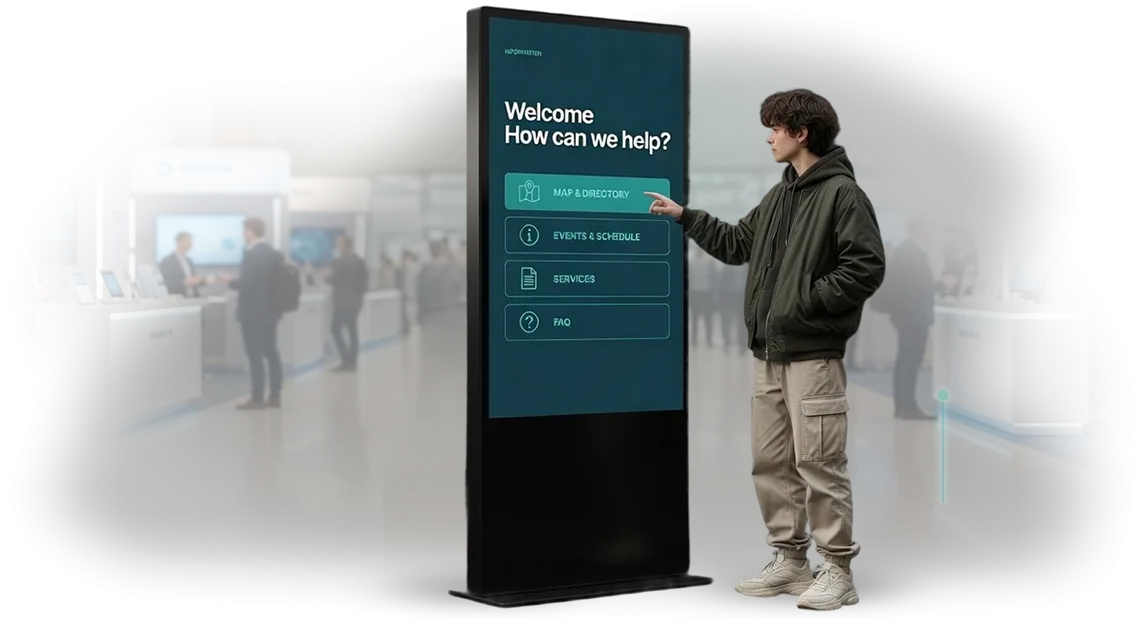
An interactive product catalog on a touchscreen kiosk takes the load off the staff and speeds up service several times over. Customers explore photos, ingredients, weight, and price on their own — without help from the cashier.
They make decisions faster, while employees only handle order processing and handoff. As a result, the queue moves noticeably faster, and guests don't leave — they come back again.
We've already helped bakeries and confectioneries implement such kiosks. Clients note that service time during peak hours drops by 30–40%, and repeat visits become regular.
The catalog is easy to update for seasonal items and promotions, so the assortment is always displayed correctly.
The intuitive interface requires no training: even elderly customers and children manage it in a few seconds. The kiosk runs on professional equipment and connects to your POS system — for you, that means minimal changes to your processes and maximum benefit to your revenue. Queues in the bakery stop being a problem, and service reaches a new level.
What an Interactive Kiosk Gives Your Bakery
In a bakery and confectionery, every visitor is a potential regular customer. Queues create tension, and choosing without guidance lowers the average ticket. An interactive kiosk solves both tasks: it speeds up service and helps the guest pick more tasty items.
During peak hours, the terminal accepts orders in parallel with the cashier's work, cutting wait time by 2–3 times. Guests get their hot coffee and fresh pastries faster, and the staff isn't distracted by recurring questions — work flows rhythmically and without stress.
The interactive catalog shows dishes with appetizing photos and suggests add-ons: coffee with a croissant, sauce with pizza, or a dessert with tea. This kind of menu quietly raises the average ticket by 15–20% — extra revenue without spending on advertising.
A guest remembers a place where they quickly and easily chose their favorite dessert — and where a new item was suggested to them. The kiosk's loyalty program accumulates bonuses, so the customer returns again and brings friends.
In the end, an interactive kiosk isn't just a screen in the dining area — it's a tool that boosts sales, relieves the staff, and creates a positive impression of the bakery. And we take on all the development — from design to launch and support.
Kiosk Formats for Different Tasks
A bakery customer makes decisions in seconds, and a terminal for a bakery should fit into the flow, not get in the way.
The kiosk format determines how quickly guests start using the catalog, how comfortable it is for the cashier to work nearby, and how much space remains for display cases and queues.
That's why we select the design for each specific location — floor area, foot traffic, and purchasing scenario.
We use three basic formats: floor-standing kiosk, built-in, and wall-mounted. Each solves its own task — from a high-traffic display window to a compact coffee shop with a narrow aisle. Below is a cheat sheet to help you choose the right option in a couple of minutes.
| Format | Who it's for | What it gives the customer |
|---|---|---|
| Floor-standing kiosk | Bakeries with high traffic and an open area | Draws attention, doesn't take up the counter, easily visible from the queue |
| Built-in | Locations with a niche in the counter or furniture | Saves space, looks neat, fits into the interior |
| Wall-mounted | Small bakeries and coffee shops with a narrow aisle | Frees up floor space, always in sight, easy to install |
If you're not sure which format suits you, send us a floor plan and photos of your display case — we'll propose a configuration that preserves free space for guests and doesn't require remodeling.
And if the format changes after opening, the kiosk can be reconfigured or relocated without losing your investment. You get a solution that works for your foot traffic and doesn't hinder sales.
How We Roll Out a Project in 4 Weeks
A transparent process is a guarantee that in 4 weeks you'll get a working kiosk, not a "nearly finished" mockup. We document the result of each stage, so you always see where the project stands, what's already done, and what comes next. No hidden work and no surprise edits on the last day.
Launch Stages
-
Brief and assortment audit. In 1–2 days, we study your catalog, sales points, and customer choice logic. We determine which products should be on the first screen and which should be hidden in search.
-
Interface prototype. We show the kiosk structure: how customers will search, compare, and choose. You approve the logic before we start the visual design.
-
Design in your bakery's style. We adapt the visuals to your brand identity so the terminal looks like an extension of your space, not a foreign device.
-
Assembly and content. We connect the equipment, load the catalog, and set up price and stock updates. At this stage, you can already touch the kiosk and press the buttons.
-
Testing in real scenarios. We check how the kiosk performs under peak load, how quickly products are found, and whether payment is convenient. We fix everything before launch.
-
Launch and staff training. We deliver, install, and connect. We also show your cashiers how to handle unusual situations and how to export statistics.
Each stage ends with a concrete artifact: from an approved prototype to a configured terminal. You're not waiting for a result blindly — you see progress every week.
And if edits come up along the way, we incorporate them at the nearest stage without breaking the overall deadline.
In the end, you get not a "program," but a ready-made sales tool that works for your revenue from day one. Timeline: 4 weeks from the moment the brief is approved.
What's Included in the Kiosk Delivery for a Bakery
A bakery kiosk isn't "hardware in a box" — it's a ready-made tool for growing the average ticket.
We put together the package based on your assortment and space: from a design mockup to staff training, so you don't have to hunt for contractors or dive into technical details.
Here's what's included in the delivery:
- Design mockup in your brand style: the kiosk stands out in the sales area, harmonizes with the interior, and draws attention to your baked goods and desserts.
- Assembly and installation: delivery, placement in a convenient spot, power connection — the terminal works right away, without involving your technician.
- Interactive product catalog: a showcase with bread, cakes, and drinks, cards with ingredients and prices, quick search for the right item.
- Catalog management panel: change prices, add new items, launch promotions yourself — no programmer or waiting required.
- Vandal-resistant housing and crash protection: the equipment withstands a constant flow of customers and runs stably all day long.
- Staff training: in 30–40 minutes, cashiers and administrators learn to manage the kiosk, get a reference card, and ongoing support.
- Warranty and maintenance: consultations, catalog updates, and on-site technician visits — you're never left alone with the equipment.
The result is a complete "turnkey" package: plug in the power, the kiosk boots up, and immediately helps customers choose. From then on, it brings in revenue while your team focuses on their own tasks.
Case Study: A Bakery Chain Halved Its Queues
The bakery chain “Good Bakery” came to us with a pain typical for the format: during peak hours, queues piled up at the counter, some customers left without waiting, and the staff worked at their limit.
The problem wasn't product quality — the queue was eating up both guests' time and potential revenue.
We suggested installing interactive self-service kiosks next to the checkout. Guests choose items on the touchscreen and pay by card, while employees assemble the order.
For the first week, a consultant stood by to help visitors get comfortable, and then the kiosks operated fully autonomously.
A month later, we compared the metrics with the data from before the launch. Queues were cut in half: average wait time dropped from six minutes to three.
The average ticket grew by 18% — the kiosk suggests additional items with the order: a drink with pastries, a dessert with coffee. Guests who used to leave now wait calmly for their order, and cashiers manage to serve more people during peak hours.
According to the chain's owner, the main unexpected effect was the growth in average ticket thanks to automatic suggestions: guests are more likely to agree to an add-on when they see it on the screen.
The investment in the kiosks paid off in four months, and the chain is now rolling the solution out to new locations.
We didn't just supply equipment — we helped restructure the service process so that every terminal worked to reduce queues and increase revenue.
How to Choose a Kiosk for Bakery and Confectionery Production
Choosing a kiosk for bakery and confectionery production starts not with equipment specs, but with the format of your location.
A small bakery with counter service needs one option, a production facility with a branded store needs another, and a confectionery with a high flow of customers needs a third.
The main thing is that the terminal helps sell: displays the assortment, takes orders, and reduces queues.
If you have self-service or a mixed format, a kiosk with an interactive catalog becomes your extra salesperson. The guest sees all products on the screen, picks what they want, and immediately moves to checkout.
This cuts time at the register and lets staff focus on baking and serving instead of explaining every menu item.
The terminal configuration is matched to your physical space and load. For limited areas, compact tabletop solutions work well; for spacious halls, floor-standing units that don't obstruct visitor flow are a good fit.
It's important to plan the installation spot so the kiosk is visible and doesn't create a bottleneck at the entrance. Professional equipment withstands intensive daily use — stable operation without downtime during peak hours.
The key point is integration with your inventory system and cash register. We configure the terminal so that orders from the kiosk flow straight into the overall workflow: to the kitchen, to the warehouse, and into reports.
You won't have to transfer data manually or fight discrepancies. The entire chain — from the customer choosing a croissant to payment — is automated.
We help you decide on the kiosk type and configuration for your format: we assess foot traffic, layout, and assortment, propose a suitable solution, and handle the launch.
In the end, you get a tool that increases the average ticket through upsells and reduces the load on staff — not just "one more screen in the dining area."
Frequently Asked Questions and Concerns About Kiosks
Before ordering a kiosk, bakery and confectionery owners tend to have the same concerns: will the terminal break down, will guests figure it out, and when will it pay for itself. It's better to ask these questions before launch than to solve problems on the fly.
We've been working with food production facilities for years, so these concerns are familiar to us. In every project, we include a warranty, maintenance, and a clear payback calculation — we answer the main fears honestly.
What if the kiosk breaks down in the first month of operation?
The terminal comes with an official warranty: we repair or replace the equipment for free. We accept service requests remotely, and in most cases we resolve the issue without downtime for your location.
Who services the terminal every day?
We handle the maintenance: catalog updates, screen monitoring, preventive care, and replacement of consumables. You don't need to find a specialist — just report a task, and we take care of the rest.
When will the kiosk pay for itself in a bakery or confectionery?
Payback depends on visitor traffic. On average, a terminal pays for itself in 3–6 months through order automation, a higher average ticket, and staff relief. Before launch, we calculate a forecast specifically for your location.
What about guests who are afraid of terminals?
We make the interface simple: large product cards, a path to ordering in two or three taps. Elderly guests get help from on-screen hints and staff, but in practice visitors figure it out on their own faster than the owner expects.
Order an Interactive Kiosk for Your Business
Leave a request for a kiosk consultation — we'll tell you how an interactive catalog will fit into your bakery or confectionery. In 15 minutes, we'll analyze your location, visitor flow, and assortment, then propose a solution that starts working from the first weeks.
What you get after reaching out:
- Payback calculation for your format: how many orders you need to take for the kiosk to pay for itself, and when you'll turn a profit.
- Selection of housing and placement for your space — from compact stands at the register to dedicated self-service zones, accounting for queues.
- A catalog with your products: assortment upload, descriptions, photos, promotions, and loyalty program already configured for you.
- Integration with your POS and delivery services — orders go into your accounting system without manual entry or errors.
- Staff training in one day and a clear instruction manual, so your cashiers help guests instead of figuring out the tech.
- Post-launch support: menu updates, troubleshooting help, and refinements as your business grows.
We work remotely and have implemented kiosks for bakeries and confectioneries — from a dessert showcase to a full-fledged catalog with loyalty programs.
These locations cut queues during peak hours, increase the average ticket, and stop losing orders when every employee is busy at the register.
To order a kiosk, leave a request through the form or write to us in a messenger. We'll call you back within one business day, answer your questions, and show you project examples for your industry. The process starts with a free consultation — it's completely non-binding.