

Why Customers Get Lost in Crop Production Without an Interactive Catalog
In crop production, the assortment is especially wide: seeds, fertilizers, crop protection products, growth stimulants, and related goods. A customer arrives with a specific need — to treat a field, feed a crop, protect seedlings.
But without guidance, they easily get lost among hundreds of items and agronomic terms. Every minute of fruitless search reduces the likelihood of a purchase and pushes them to leave for competitors.
The situation is aggravated at a point of sale or warehouse where a self-service terminal operates. Salespeople are busy with other customers, and the client’s need requires a quick answer: what suits their task, whether it is in stock, what volume and packaging are needed.
If the answer is not received here and now, the terminal does not fulfill its main function — helping to sell. The visitor leaves empty-handed, and sometimes with a feeling that shopping here is inconvenient.
Losing one crop production customer results in missed repeat orders: such buyers return regularly throughout the season and bring stable revenue. Negative search experience makes them look for alternatives — through distributors, online catalogs, and marketplaces.
As a result, conversion, average check, and loyalty decrease, and marketing investments in attracting visitors fail to pay off.
An interactive catalog on a terminal solves this problem: the customer independently finds the right product within a few minutes — they see availability, price, specifications, and suitable alternatives.
We design the catalog structure and search scenario to fit the specific business needs, so visitors spend less time and make a purchase. That is why we develop interactive catalogs for crop production — so customers don’t get lost and sales grow.
What an Interactive Kiosk Brings to Your Business
For a crop production company, an interactive kiosk solves a key task: presenting products in the best light without having to take the customer to the field. Seeds, fertilizers, equipment — all of this is difficult to fit into one office or display case.
The kiosk brings together a catalog, photos, videos, and specifications in one place, where the buyer selects the category they are interested in.
The main benefit is engagement. Instead of passively flipping through a paper catalog, a person interacts with the screen: they zoom in on photos, compare specifications, watch a demonstration.
Such participation holds attention 3-4 times longer than a standard presentation, which means you have more time to communicate the value of the product.
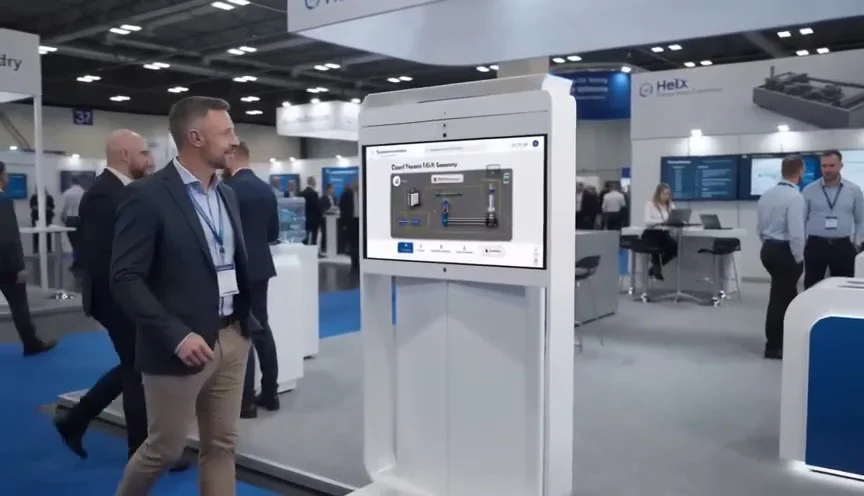
Another result is recognition. A stylish touch terminal with branded design is memorable. A trade show visitor or a client in the office sees a modern approach to sales and associates your brand with technological advancement.
The kiosk becomes part of the image, building trust even before a conversation with a manager begins.
The third effect is leads. An interactive catalog collects contacts right at the point of contact: the visitor leaves a phone number to get a consultation or price list, and you get a database of interested buyers.
Unlike a random visitor, such a lead has already shown interest in a specific item, which simplifies the work of the sales department.
Ultimately, the kiosk works toward your revenue: it increases time spent with the customer, boosts brand recall, and creates a flow of warm inquiries. It is an investment in sales that pays off through a higher average check and repeat orders.
Interactive Kiosk Formats for Crop Production Tasks
The choice of an interactive kiosk format in crop production depends on where it will operate and what task it will solve: informing about crops, showing a product catalog, or assisting at a trade show.
The correct geometry and installation location determine whether the kiosk will be noticed and whether people will want to use it.
| Format | For whom and where | What it gives the customer |
|---|---|---|
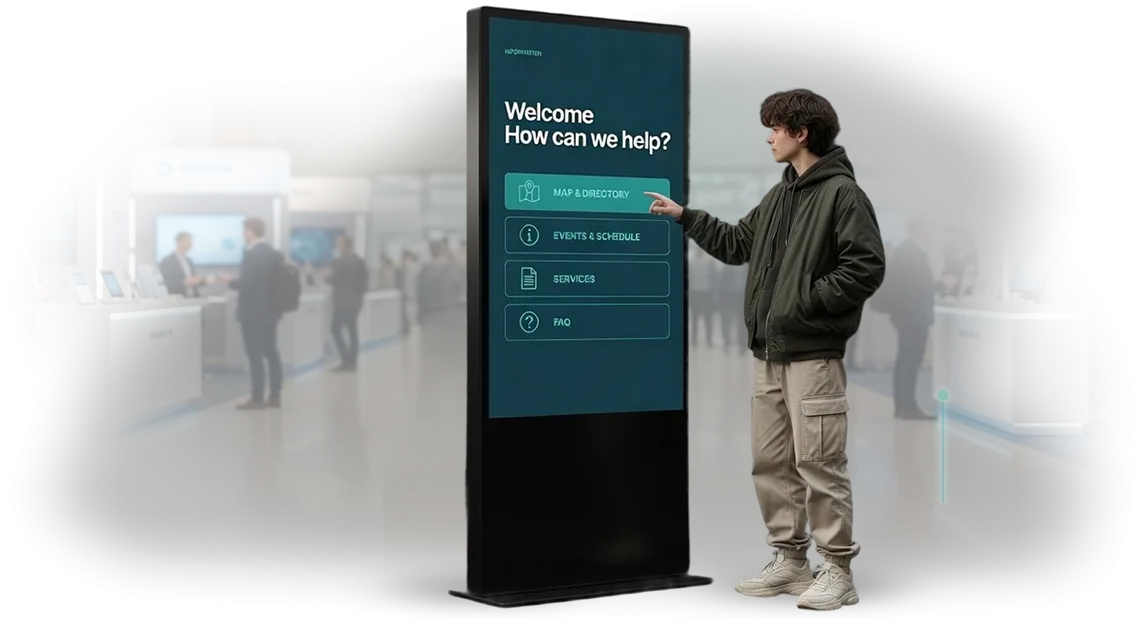
| Floor-standing kiosk | Terminal halls, agricultural exhibitions, central store areas | Attracts attention from the first seconds, allows visitors to independently explore the catalog of varieties, fertilizers, and services. Increases time spent with the brand. |
| Wall-mounted screen | Waiting areas, high-traffic passageways, entrances to warehouses and greenhouses | Saves space and works without staff involvement. Suitable for site navigation and rapid delivery of information about current promotions and new products. |
| Countertop touch panel | Workspace for a consultant or salesperson in an equipment showroom | Helps quickly select products based on crop parameters, clearly present service compositions, and compare options in dialogue with the buyer. |
All formats share one thing: the interface adapts to the tasks of a crop production business, not the other way around. The kiosk becomes a full-fledged team member that reduces staff workload, answers common questions, and guides the customer toward a purchase.
We help choose the right format based on location and usage scenarios. At the engineering stage, we account for lighting, traffic, and even dust load — so the screen remains readable in any conditions.
We prepare the content structure of the catalog and launch the kiosk turnkey: all you have to do is watch inquiries and orders grow.
How Kiosk Development Works: From Brief to Launch
Let us explain how we organize the process so that you see results at every step.
The process takes from two to four weeks and always begins with an in-depth look at your task — whether it is a catalog of fertilizers, crop protection products, or planting material for crop production.
- Brief and assortment immersion. You send a catalog, price list, or simply tell us about the products. We clarify who will use the kiosk and what questions a visitor should answer within a minute.
- Structure design. We group products by crops, product types, and tasks. This allows customers to quickly find the right item without staff assistance.
- Prototype and design development. We show a screen mockup — how product cards, search, and navigation will look. You make edits before we begin assembling the system.
- Content filling. We transfer your descriptions, specifications, and prices. We add photos, application diagrams, dosage recommendations — everything that helps customers make a purchase decision.
- Assembly and testing on hardware. We install the system on the terminal and test scenarios: search, cart, printing. You receive a kiosk that works without failures on opening day.
- Launch and training. We deliver and install the terminal and provide brief training for your staff. They will be able to update the catalog themselves.
- Post-launch support. We answer questions, update content on request, and monitor stable performance. You can expand the kiosk functionality at any time.
We take on all stages — from idea to working terminal. Your team focuses on sales rather than technical details.
What Is Included in the Delivery of Your Crop Production Terminal
The delivery set for a crop production terminal is not just equipment, but a ready-made solution that starts working immediately after installation.
You receive a kiosk interface customized for your catalog, as well as everything needed for employees to quickly learn the system and for customers to easily find products.
The basic package includes:
- Kiosk interface — adapted to the product catalog for crop production. Large sections such as “Seeds,” “Fertilizers,” and “Crop Protection,” along with convenient search by name or article number, help customers navigate without a sales assistant.
- Content and filling — we transfer your product items with prices, photos, and descriptions. If needed, we add promotional blocks and informational pages about crops.
- Instructions for staff and customers — short guides on powering on, basic operations, and resolving common issues. Any employee can figure out how to operate the terminal within a day.
- Warranty on equipment and work — during the warranty period, we fix issues and update the interface for new agribusiness tasks free of charge.
- Training and support — we conduct a demonstration for your team, answer questions, and help with first launch so the terminal does not sit idle.
- Additional on-screen materials — banners, presentations, and informational slides to draw attention to the kiosk and the products you feature.
Such a package covers everything: from the first touch of the screen to regular catalog updates. You get not just a terminal, but a full-fledged sales tool that reduces staff workload and helps customers choose crop production products faster.
Case Study: How Our Kiosk Increased Sales at an Agricultural Holding
A visitor to an agricultural holding comes for a specific solution: they need to choose fertilizer, seeds, or crop protection products for their crop. But managers are busy, part of the catalog is in paper folders, and a queue forms at the entrance. While the client waits, they lose interest and leave for competitors.
We encountered this in a project for a major crop production manufacturer, YugAgroTrade. The head of sales set a simple task: relieve consultants and increase conversion of visitors into orders.
Instead of a static display, we installed an interactive kiosk — with navigation by crops, a convenient task filter, and product cards with application recommendations.
We saw results within the first month. Average time at the screen was four and a half minutes — customers were not just looking, but comparing products and saving their selections.
The number of targeted inquiries increased by 40%, and the share of orders through the catalog — by almost a third. Managers stopped explaining basic specifications over and over and focused on complex questions and closing deals.
The key indicator was repeat orders. A month and a half after launch, the director of the agricultural holding asked to install a second unit at another warehouse, and then added a section with promotions and new products. That means the kiosk became a working sales tool rather than an “exhibit.”
For a crop production business, this is direct revenue: customers find the right item faster, depend less on manager experience, and buy more. We track metrics for every project and are ready to show a similar case study for your products.
Answering Frequently Asked Questions About Kiosk Operation
Many clients ask the same questions before installing a kiosk: will the equipment break down in the middle of the season, will employees be able to easily change prices or the catalog composition, will we be ready to launch by the start of an exhibition.
These concerns are understandable, especially when it comes to crop production — the terminal often stands right in a store selling seeds, fertilizers, or crop protection products, and customers need to quickly find the right item.
We design kiosks for intensive use. Over 10 years, we have completed hundreds of projects, so we know all the weak points and eliminate them in advance: we use industrial components, set up automatic content updates, and provide a clear interface. Breakdowns are rare, and if something goes wrong — the client has our contact for a quick solution.
What should we do if the kiosk stops working?
There is no need to panic. Most failures have a simple solution: restart, check power or network. A short instruction is included in the delivery set. If the problem is more serious — the administrator contacts our support, and we help remotely or visit the site.
Who services the kiosk and how often?
Maintenance is minimal — just wipe the screen and periodically update the catalog. Your employee can do this. If you wish, we sign a contract for regular service maintenance: every few months we check the equipment, update the software and content.
How long does launch take?
On average, a project takes 2–4 weeks: brief, design, catalog filling, and installation. If deadlines are tight — for example, you need to make it to an agricultural exhibition — an accelerated format is available. The key is to send us your mockups and product list on time.
Below, we look at a few more situations. If you have a non-standard question — just contact us. We will help you make the kiosk convenient for your specific business.Order an Interactive Kiosk for Your Crop Production Segment
Leave a request for a kiosk order — and we will prepare a proposal for your crop production task: from a catalog of seeds and fertilizers to navigation for an agricultural enterprise or a training terminal for staff.
You will get a ready-made turnkey solution that helps customers find the right products and services faster from day one.
What you get after contacting us:
- Free consultation: we will determine which kiosk format will deliver results for your specific crop production segment.
- Calculation of timelines and cost within two working days — no hidden payments or confusing estimates.
- A transparent process: brief, plan, mockup approval, production, launch, and staff training.
- Warranty on equipment and post-launch support — we answer questions within one business day.
- Integration with your catalogs and accounting systems so that data on the terminal is always up to date.
- Content assistance: photos, descriptions, promotions — you will be able to update them yourself, without involving developers.
- Delivery and installation, if needed for your location.
A kiosk like this in crop production pays off through a higher average check and staff time savings: customers find answers themselves, and managers focus on sales. Leave a request on the website or call us — it will take a couple of minutes. We will call you back, answer your questions, and offer a solution for your task.
How to Choose a Kiosk Format for Your Task?
Choosing a kiosk starts not with the model, but with the task. First, determine what exactly should happen at the terminal: a visitor browses a catalog, compares products, submits a request, or receives a consultation.
In crop production, this is often an interactive catalog of seeds, fertilizers, or crop protection products with filters by crop, growth stages, and climatic conditions — so the customer can find the right solution on their own without a manager's help.
The second important criterion is the installation location and audience. A kiosk in a sales floor or at an exhibition must attract attention and operate in self-service mode, because a consultant is not always nearby.
In an office or warehouse, where employees work with the terminal, the interface can be denser and the functions broader — for example, checking stock balances, generating invoices, or printing specifications. An outdoor kiosk requires a protected housing, while indoors design and compactness matter more.
Practical advice: do not overpay for features that will not be used. If the task is to show the assortment and allow visitors to leave a request, a floor-standing or wall-mounted kiosk with a touchscreen is enough.
If you need to accept payments, print documents, or collect marketing data — we will add the appropriate modules. We help you choose the housing, screen size, and functionality for your scenario, rather than offering a standard solution just to tick a box.
Take the first step — describe where the kiosk will be placed, who will use it, and what actions a visitor should perform. That is enough to choose a format and calculate a realistic estimate.
Our team develops kiosks from scratch: housing, software, interface, and integration with your accounting system are all designed around a specific goal.
As a result, you get not just a screen with a menu, but a tool that reduces sales staff time, speeds up service, and makes your catalog available at any point of sale. Tell us about your task — we will recommend the optimal format and show how it will work in your business.