


Jewelry retail loses customers without interactive catalogs
A customer in a jewelry store often arrives without a clear request: a gift, engagement rings, or a piece "for a night out." As they look at the displays, attention scatters — hundreds of items, different metals, stones, and prices.
A sales consultant physically cannot show the entire assortment, and some pieces are kept in locked cells. Without a convenient catalog, the customer gets lost, leaves "to think it over," and ultimately chooses a competitor — that is how a jewelry store loses customers.
Today's customer is used to a smartphone: they want to filter products on their own by their own criteria, not wait for the salesperson to guess their preferences. Walk into any jewelry salon — visitors increasingly take out their phones to find the right model online.
If the sales floor has no interactive kiosk for a jewelry store, you are giving that time to doubts and to third-party websites where they can instantly compare and choose.
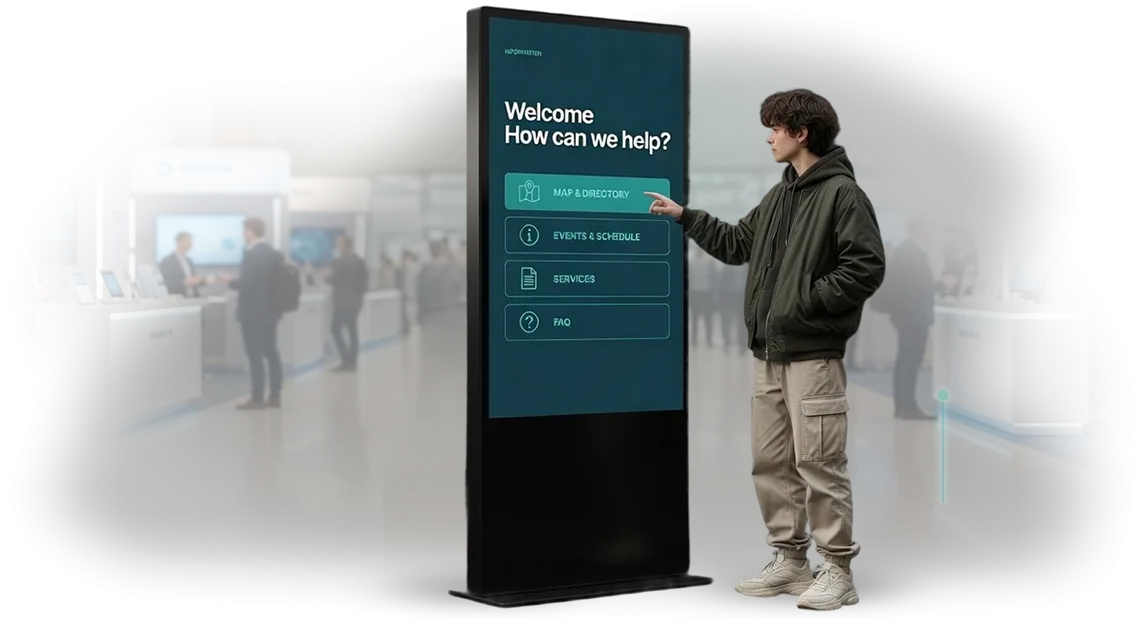
An interactive kiosk closes this gap: on a large screen, the client opens the jewelry store catalog, selects a category — rings, earrings, pendants — sets the metal, stone type, and budget.
Close-up images, 3D viewing, availability in the display case and in stock, the ability to send a selection to the consultant's screen. The buyer gets full control over the choice, and the store gets a chance to keep them until the purchase.
When a visitor controls the selection themselves, they spend more time on the sales floor and look at more items. The kiosk tells the consultant what interested the client, shortening the path to trying on and checkout.
This is a direct contribution to revenue: an increase in the number of purchases, a higher average ticket, and fewer lost positions.
An interactive kiosk does not replace staff — it strengthens them: the salesperson stops being a "walking catalog" and focuses on live communication, trust, and closing the deal.
A jewelry store with such a solution looks tech-savvy, inspires trust, and stays in the customer's memory. Implement an interactive kiosk — and you will stop losing customers at the selection stage.
What an interactive kiosk will give your customers and sales staff
Customers in jewelry stores often get lost among the display cases: dozens of rings, chains, and pendants, while the salesperson has only two hands and a queue.
Instead of calmly comparing models and choosing "the one," the client gets tired and leaves without buying or takes whatever is offered first.
An interactive catalog changes the scenario: a person studies the assortment themselves, filters by metal, stone, or price, saves the items they like, and calls a consultant when the decision is almost made.
The tech solution from our team turns the kiosk into a personal virtual stylist: it suggests combinations, shows large photos of jewelry on a model, and reminds customers of items from their viewing history.
For a jewelry business, this is a direct increase in the average ticket — a client more often chooses a more expensive piece when they see it in the context of an outfit rather than behind glass.
At the same time, salespeople are freed from routine "show me this" requests and spend time on live consultations where they actually close the deal.
Customer loyalty also grows: the kiosk remembers the preferences of regular guests, helps quickly find a gift by budget, and delivers up-to-date offers after the purchase.
This experience makes the store progressive and attentive to the client, so people return and recommend the boutique to friends.
The kiosk itself, with an exclusive design, becomes part of the interior and creates a reason for photos — which adds brand recognition without advertising costs.
Implementation takes a few weeks, and the effect is measured in money: higher average ticket, more repeat visits, and greater online reach. We take on the project turnkey — from scenarios to launch — and train the staff so the kiosk works for your results from day one.
Interactive kiosk formats for jewelry retail
In jewelry retail, choosing an item is an emotion and trust. The customer wants to look, compare models, and understand the price, but a physical display case shows only part of the assortment.
An interactive kiosk helps a visitor independently explore the catalog, filter jewelry by metal, stones, and budget, and then call a consultant with the choice already made.
The kiosk format depends on the size of the location and the tasks — from a compact catalog stand to a display case with a touchscreen that works as a digital presentation of the collection.
| Kiosk format | Who it is for | What it gives the client |
|---|---|---|
| Catalog stand | Small salons and departments in shopping centers | Introduces the full assortment with limited display space, reduces selection time, and lowers the load on the salesperson |
| Display case with touchscreen | Boutiques and flagship stores | Shows the collection in close-up, complements a regular display case, and increases the average ticket through accessory matching |
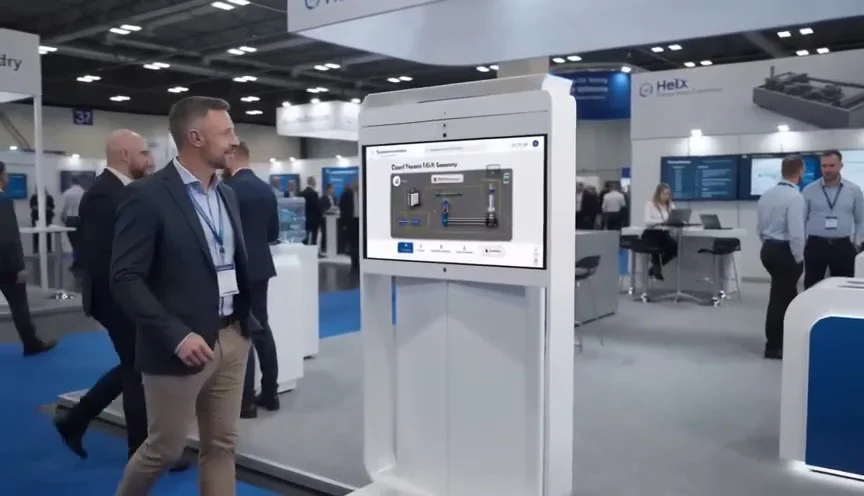
| Floor-standing kiosk | Large jewelry centers | Attracts attention, reduces queues for consultants, and increases the customer's time in the store |
| Wall-mounted kiosk | Chains with frequent promotions and collection updates | Quickly changes prices and promotions without taking up sales floor space or requiring new display stands |
Implementing a kiosk is not a replacement for live consultation but its reinforcement. The customer arrives understanding what they want, and the consultant confirms the choice and offers a fitting.
For the business owner, this means higher conversion and repeat sales: the client returns because it was convenient to search and compare in the store. We select the kiosk format based on the location layout and audience behavior, then take on the interface design and launch.
How we run the project: stages for the client
In jewelry retail, trust and the impression of the display case decide everything. An interactive catalog in the sales floor helps a customer quickly find a piece — and helps you show more products than fit in the displays.
To launch the project right on schedule, we have built transparent development stages — you always see what stage the work is at and what you will get in the end.
- Kiosk brief. You tell us about the assortment, the customer profile, and the terminal installation location. We record the requirements and propose a solution for your format — from boutique to jewelry salon.
- Project approval. We show the catalog structure, search logic, and visual style. You make edits before development starts — this eliminates misunderstandings and unnecessary costs.
- Development and content. We upload products with photos, descriptions, prices, and stock levels. We set up filtering — by metal, hallmark, product type, budget — so customers find jewelry on their own.
- Testing and launch. We test the catalog on a real terminal, train the staff, and install the kiosk in the sales floor. You receive a ready-made sales tool.
- Support and updates. We update the assortment, add collections and promotions, and monitor stability. The kiosk does not become outdated along with the display case.
Each stage has clear timelines and a measurable result. You control the process, and we handle the technical part — that is how an interactive catalog becomes a growth point for your jewelry business.
What is included in the interactive kiosk delivery
When you order an interactive kiosk, you get not just a screen with a program, but a complete tool for increasing sales. The delivery package includes everything you need to start working from day one: from the terminal enclosure to staff training.
We put together the kiosk configuration for your store's tasks. If you need an interactive catalog of jewelry items, we will develop the structure, upload products, and configure filters and search.
As a result, a visitor independently finds a piece by collection, article number, or price range, while the consultant spends time on live consultations instead of going through display cases.
The standard delivery includes:
- A touchscreen terminal in a protective enclosure — resistant to dust and accidental impacts, built for constant touch.
- An interactive product and service catalog — with display cases, photos, specifications, and the ability to add an item to an order.
- Management software — you update prices, add new arrivals, and run promotions yourself, without a programmer.
- Installation and connection at your site — we deliver, install, and check everything before the store opens.
- Staff training and instructional materials — the team quickly learns the system and helps guests.
- Warranty and technical support — we answer questions, update the catalog, and repair equipment when needed.
- Enclosure branding — the kiosk looks like part of the interior and increases recognition of your jewelry brand.
After project completion, you are left with a ready solution, not a "kit." All materials, training, and support are documented in the contract, so the kiosk works like a full-fledged member of your sales team from day one.
Case study: how we increased sales in a jewelry salon
An ordinary jewelry salon loses customers even with good traffic: visitors approach the display case, look for a minute, and leave without buying. Consultants cannot give every person enough attention — especially on holidays when the flow doubles. The result is lost sales, even though people were interested.
We solved this problem for the jewelry salon chain Adamas. Instead of expanding the staff, we installed an interactive catalog on a touchscreen terminal in the sales floor. The visitor chooses metal, stone, and budget themselves, and sees availability and price.
The consultant steps in when the client has already decided — with a ready request, not an empty conversation.
Implementation result
In the very first month of the terminal's operation, the average ticket grew by 22%, and the share of repeat visits increased by 1.5 times.
Clients who used to leave "just looking" now return with a specific request — many save items they like to favorites and come back to choose within a day or two.
The most telling effect is the increase in purchase conversion: it rose from 14% to 26%. A buyer spends three times longer at the terminal than at the display case and gets to see what they would not have noticed behind glass. For the salon, this means additional sales without expanding staff or the advertising budget.
The chain ordered the catalog for three more salons — for us, that is the main proof the solution works. We support the project after launch: update the assortment, add seasonal categories, and make sure the terminal actually sells.
How to choose a kiosk format for your store's tasks?
The kiosk format is not a technical specification but an answer to the question of how it will help your sales.
For a jewelry store, it is important that the terminal does not just show pictures but works like a competent consultant: suggesting, comparing, and matching by parameters.
First, decide what the kiosk should do for you. If the assortment is large and frequently updated — you need a full catalog with fast search and filters. If clients come for a specific item — it is better to focus on a display with detailed photos and descriptions. If sales go through salespeople — the kiosk can become a consultant's assistant, not a replacement.
Jewelry retail has its own specifics: the products are premium, and guests expect beautiful presentation and trust. Therefore, the screen must accurately convey the color of stones and metal, and the interface must be understandable even to those who rarely use technology.
Security is also important: price and stock data must be protected, and the kiosk itself must be resistant to accidental damage.
We select the format for your store: from a compact tabletop model to a floor-standing unit. We consider where it will be placed, how it fits the design, and how easily the content can be updated. Our specialists visit the site, study customer flow, and propose a solution that delivers value.
In the end, you get not "just a terminal" but a working tool that increases the average ticket and reduces the load on staff. Tell us about your tasks — we will help you choose the format that fits your requirements.
Common client concerns: answering before you start
Before any project starts, every client has concerns: how much it will cost, when the kiosk will be up and running, whether the staff can update the catalog. We answer honestly — before you make a decision.
In jewelry retail, product presentation and speed of response to changes matter, so we address the most frequent questions in advance.
How much does development cost?
The cost depends on the number of product items, design complexity, and whether additional screens need to be connected. We prepare an estimate after a short brief and fix it in the contract — it does not change during the process.
You see exactly what you are paying for: design mockups, programming, terminal setup, and training for your staff.
What are the launch timelines?
A typical project takes two to four weeks: from the brief to a working kiosk. During this time, we prepare the design, upload products, and test the system on your equipment. Delivery happens only after you have personally verified that everything works. If you need it faster — we will discuss an accelerated launch.
Is it difficult to update the catalog?
Updates are done through a simple control panel: you change prices, add new arrivals, and hide sold-out items. No programmers and no contractor calls needed. Training takes an hour, and after that you work on your own.
Who is responsible for uninterrupted operation?
We support the project after launch: monitor the kiosk, update the software, and help upload new collections. In case of a failure, a specialist is available — usually with a response within a business day.
Get a cost estimate for an interactive kiosk tailored to your task
Every task in jewelry retail is different: some need a catalog with filters by metal and stone, some need a display of new arrivals, and some need a consultant that works without breaks.
A ready-made standard scheme is not always suitable here, so we calculate each project individually and show a transparent estimate before work begins.
Leave a request — we will review your situation, advise which interactive kiosk format will deliver the most value, and name the exact cost calculated after audit for your assortment and tasks.
What is included in the estimate and consultation:
- Kiosk request — you briefly describe the task, the number of products, and the installation location; we take the analysis from there.
- Cost estimate — we fix the price for your display setup: no hidden surcharges for "unexpected" work.
- Interactive catalog consultation — we explain which scenarios will help you sell at a higher margin: matching by characteristics, model comparison, personalized recommendations.
- Format and equipment selection — we will advise whether you need a touchscreen terminal, a display case table, or a kiosk with protection against external impact, and how this affects the budget.
- Launch timelines — we give realistic dates based on your schedule: from interface development to installation and staff training.
- Test on your traffic — before launch, we show how the catalog works live, so you can make a decision without risk.
The next step is a short request. We will call you back, clarify the details, and prepare an estimate with options for your budget. It is free and non-binding: you get a clear picture and decide whether to move forward or not.