

Losing Livestock Customers Because of an Inconvenient Catalog?
A livestock buyer rarely comes “just to look” — they need to quickly find the right product, compare prices, and place an order between milking, farm rounds, or scheduled vaccination.
When the product catalog is inconvenient, the livestock terminal becomes another obstacle: the customer wastes time, gets frustrated, and leaves for a competitor who respects their time.
Losing a customer because of a poorly designed interface doesn’t show up in reports, but it hits revenue. A person who couldn’t quickly find their way around the assortment is unlikely to return.
And if a buyer has already arrived with a specific request, our job is to help them place the order right here, right now, rather than putting it off until later.
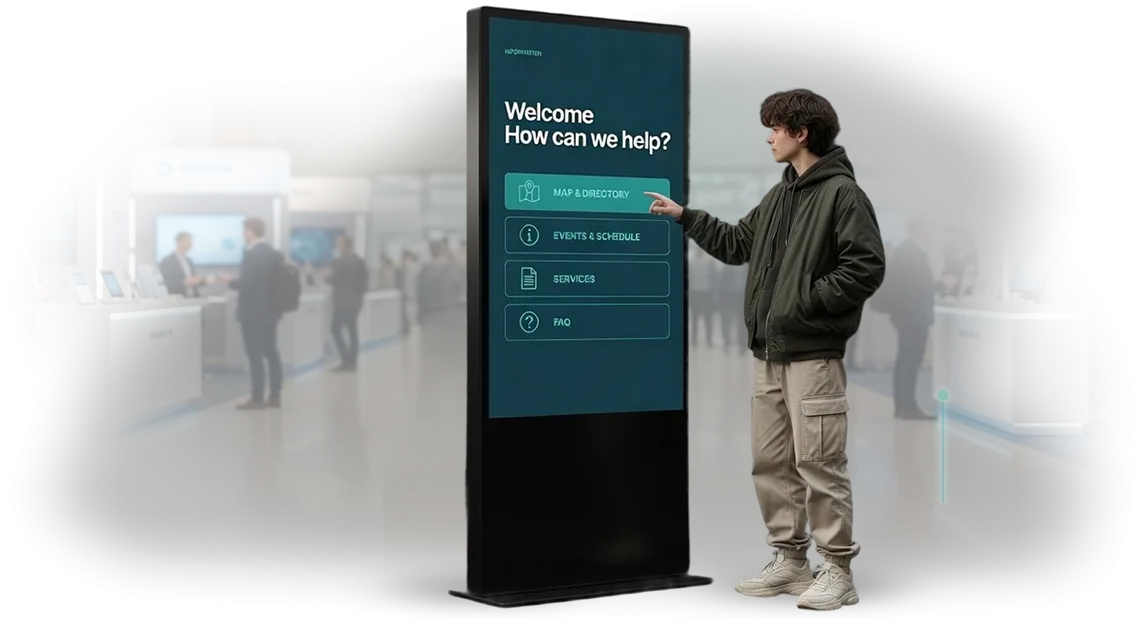
An interactive kiosk solves this problem: clear categories, search by name or SKU, clear product cards with price and stock. The buyer chooses the right section themselves, compares items, and sends an order in one tap. No paper red tape, no queues, no endless questions for staff.
Such a product catalog delivers measurable results for the business: higher visitor-to-buyer conversion, a larger average order value thanks to related-product prompts, and staff spend their time selling instead of explaining where a particular item is. The livestock terminal becomes a full-fledged sales channel, not just an information stand.
We develop interactive kiosks for agribusiness with the industry’s specifics and real buyer behavior in mind. We configure the interface so your catalog sells — quickly, clearly, and without losing the customer.
What Changes After Launching an Interactive Catalog
Launching an interactive catalog of products and services in livestock farming changes not only the storefront — the entire sales process is restructured.
We have launched such kiosks for trading houses and agricultural holdings, so we put together a checklist of what you’ll notice in the first weeks of operation.
- Higher sales and average order value. The catalog shows products by task: feed, veterinary drugs, components. Buyers see more items than on a shelf and add related products more often.
- More repeat visits. The kiosk remembers order history and prompts customers when it’s time to reorder feed or supplements. Clients come back sooner, and loyalty grows without discounts.
- Queueless service speed. The kiosk handles search and price/stock comparison. Consultants deal with complex questions instead of reciting the assortment.
- Fewer ordering errors. Prices and stock are synchronized with the accounting system — buyers see real availability, and items don’t have to be rebooked after the sale.
- Buyer behavior analytics. It’s clear which categories are viewed most often, what gets bought together, and where customers linger longer. This is a ready-made basis for purchase planning and storefront updates.
- Sales without breaks. The kiosk takes orders during peak hours, never gets tired, and doesn’t need breaks. As long as the store is open, the ordering channel is active.
This list isn’t theory — it’s a result visible within the first month. The catalog must be tailored to your assortment and your customers — then every item turns into measurable revenue growth.
Kiosk Formats for Livestock Tasks
At a livestock enterprise, information is needed in many different places: in the workshop, at the warehouse, at the veterinary control point, at the shipping area, at an exhibition. Each location has its own conditions — available space, humidity, dust, intensity of use.
That’s why we offer three formats of interactive kiosks and match them to the specific task, not the other way around.
| Kiosk format | Livestock use cases | What it gives the customer |
|---|---|---|
| Tabletop kiosk | Catalog of feed, supplements, and veterinary drugs at a point of sale, reception area, or office | Fast item selection, fewer staff questions, simplified request submission |
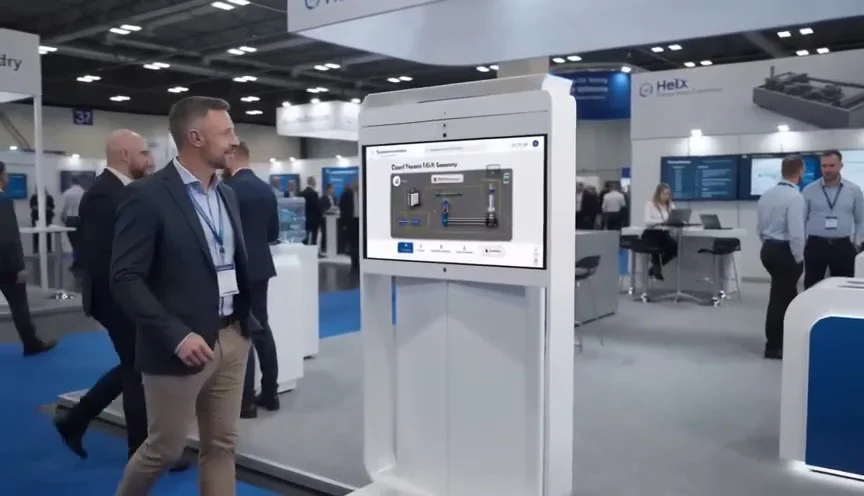
| Floor-standing terminal | Entrance zone, checkpoint, exhibition booth: navigation, farm information, visitor registration | Durable under heavy use, highly visible, operates without staff supervision |
| Built-in kiosk | Fits into a counter, panel, or existing structure — for tight spaces and stationary points | Saves floor space, neat appearance, turnkey solution for non-standard locations |
The choice of format directly affects staff convenience and how quickly people can work with the catalog.
A tabletop kiosk doesn’t take up floor space and sits on a counter; a floor-standing terminal suits high-traffic areas; and a built-in kiosk works when you need to fit it into existing furniture or already installed equipment.
What matters to the customer isn’t the enclosure itself, but the result: people distract specialists with routine questions less often, find the right product or location faster, and make fewer errors when placing requests.
We help you select a kiosk format for your space and the scenario you need — from a tabletop catalog to a floor-standing terminal for high-traffic navigation.
How Terminal Development Works for Your Business
In livestock farming, time is critical: an employee at a point of sale or warehouse shouldn’t have to search through paper catalogs for the right product or service. An interactive terminal reduces that path to a few screen touches. We structure the work so you control every stage and get a result that pays off right away.
Our approach isn’t “deliver a box and leave” — it’s step-by-step development for your tasks. Below is how kiosk implementation goes in a typical project for an agricultural holding, farm, or veterinary clinic.
- Brief and task analysis. We record what the terminal needs to do specifically for you: feed and veterinary drug catalog, promotions, supplier contacts, reference information for staff. We measure the installation point, load, and use scenarios.
- Plan and estimate. We prepare a stage plan, describe the section structure, and propose a design mockup. You see what the kiosk will look like and which features will be in the first version before development starts.
- Project approval. We approve the mockup, texts, and search and navigation logic. This is a key stage: the more precise your edits now, the faster the launch and the fewer refinements after installation. We sign the approval protocol and proceed to implementation.
- Implementation and content. We assemble the kiosk using professional equipment, configure the software, and upload your catalog with prices, photos, and descriptions. We check that everything works reliably in dust, humidity, and temperature fluctuations — as happens in livestock facilities.
- Terminal launch. We install the kiosk in the agreed location, connect it to power and the network, and run final testing. We train your employees: how to use the interface, update prices, and replace information blocks.
- Support and development. After launch, we stay in touch: we update the catalog, change promotional materials, and monitor stable operation. On request, we add new sections and functions — for example, integration with the accounting system or collection of statistics on popular products.
This process avoids surprises on site and gives you transparent control over timelines at every step. As a result, you get a working tool that helps employees find information faster and increases related product sales.
What’s Included in the Interactive Kiosk Delivery
You receive a turnkey interactive kiosk ready for operation — without having to assemble a solution from various contractors. We’ll agree on details, supply the equipment, configure the interface, and train your staff. After that, you simply use a tool that helps customers quickly find your products and services.
The standard delivery package includes:
- Kiosk equipment — a touchscreen terminal in a protective housing, installed at your facility. Adapted for operation in a livestock complex.
- Catalog interface — a product and service navigation system built around your assortment and brand identity. Customers find what they need in a couple of taps.
- Content filling — loading current items, photos, descriptions, and prices. The catalog is ready to use immediately.
- Control panel — a simple tool for updating prices and assortment yourself. An employee can master it in one day.
- Instructions and procedures — clear materials for staff: starting the kiosk, replacing content, typical actions in non-standard situations.
- Staff training — a hands-on session so your employees confidently work with the kiosk and the control panel.
- Warranty and support — official warranty on the equipment and software, direct contact with our technical support team.
After launch, we don’t disappear: we consult, help update content, and refine the catalog as your assortment grows. You get a single working tool that sells your products around the clock.
Real Project: How the Kiosk Paid for Itself in 4 Months
Task
The agricultural enterprise AgroHolding ‘Niva’ sold feed, veterinary drugs, and spare parts through one manager. Serving a customer took 15–20 minutes; queues piled up during the season, and some buyers left without waiting.
Livestock sales directly depended on service speed, and hiring an additional employee meant extra costs. So instead of expanding the staff, we proposed a kiosk with an interactive catalog.
Solution and Result
The terminal was installed right in the order-taking area: the buyer sees products, availability, and prices and creates a request. The manager gets involved only at the delivery processing stage — which freed up time for large orders.
Within 4 months, orders grew by 38%, the average order value by 14%, and service time fell from 20 to 7 minutes.
Queues disappeared even in peak season, and the enterprise gained transparent demand statistics: which items are requested more often and which are worth removing from the assortment.
The bottom line: the kiosk fully paid for itself in 4 months. The farm ordered two more terminals for other sites and a loyalty module, and we continue to support the project: updating the catalog, monitoring load, and helping with content.
If you want to understand how quickly such a kiosk will pay off for you, we’ll send you an estimate based on the same figures — adjusted for your assortment and customer flow.
Frequently Asked Questions About Implementing Kiosks
Implementing an interactive kiosk at a livestock enterprise often comes up against the same questions: will it require remodeling the premises, who will service the terminal, and how quickly will staff learn to use it.
We answer the main objections — so you understand what you’ll receive, not just “another piece of equipment.”
Is it difficult to place a kiosk on a farm?
No. The kiosk is a self-contained stand with a touchscreen; it only needs a power outlet and space about the size of a small side table. It can be placed in the lobby, at the entrance to a workshop, or next to the document issue point.
No remodeling, installation, or special conditions are required — plug it in, upload the catalog, and the terminal is ready to go.
What if the equipment breaks down?
The equipment is covered by warranty, and we stay in touch after launch. In case of a breakdown, a specialist will remotely check the kiosk’s condition; if replacement parts are needed, we’ll send them or come to the site. Terminal downtime is rare because we use proven industrial components.
Will staff need to be trained?
No, no special training is required. Staff figure it out in 15–20 minutes: the on-screen navigation is simple and every section is clearly labeled. Your employees just need to know how to turn the kiosk on and who to call if they have questions. Visitors and customers do the rest themselves.
What if the kiosk doesn’t suit our product catalog?
We adapt the structure to your product range: feed, veterinary drugs, services, breeding stock. When defining the task, we’ll lock down the list of sections and the required fields — price, availability, description. So the kiosk will reflect exactly your assortment, not a template list.
This is what our work looks like: you get a tool that requires no repairs or construction work, and visitors get fast access to up-to-date information about your products.Order an Interactive Kiosk for Your Business
Leave a request, and we’ll prepare an individual proposal for you within one business day. You’ll receive a consultation on terminal implementation, an accurate cost estimate for your tasks, and a demo showing how the kiosk works in a real livestock farm scenario.
Here’s what the path from request to launch looks like:
- Consultation on your task — we figure out exactly where the kiosk will be useful: in the workshop, at the warehouse, at a feed or veterinary drug point of sale.
- Cost calculation — we provide the cost calculated after audit for your configuration and number of terminals. No hidden payments.
- Terminal demo — we show an interactive prototype: how a visitor selects a product, reviews its composition, and submits a request. You see the interface before development starts.
- Implementation plan — we propose a delivery, installation, and setup schedule so your farm’s operations aren’t interrupted.
- Staff training — a short instruction for personnel: how to update the catalog, change prices, and track statistics.
- Post-launch support — support, assortment updates, and screen refinements as your business grows.
We work remotely and have been creating interactive catalogs for agribusiness companies for over 10 years.
That’s why when you order, you get not a “raw” development, but a solution proven across dozens of projects — accounting for seasonal demand, different suppliers, and your customers’ needs.
Fill out the form or call us — we’ll answer your questions, give you timelines, and offer options. We’ll start with a free consultation and estimate, and then show the demo at our next meeting.
What If You Have Specific Requirements for the Terminal?
Individual requirements aren’t a reason to avoid automation; they’re a standard task for our team. We don’t sell “boxed” solutions: we design each kiosk for specific operating conditions, business tasks, and audience.
If the farm needs a terminal that will work in a dusty room, temperature fluctuations, or a high-humidity area, we adapt the design, protection, and internal components to those conditions.
The specifics of livestock farming often require an unconventional approach: the terminal must be mechanically robust, convenient to use with gloves, with large buttons and an interface that is understandable for employees who have no experience with touchscreens.
We take all of this into account at the design stage: we select optimal materials, consider mountings, connector placement, and protection from the external environment.
Terminal adaptation isn’t limited to the “hardware” — it also covers operating logic.
For example, an interactive catalog of products and services for livestock farming can be integrated with the farm’s accounting system, support SKU search, or generate requests directly from the screen.
We adjust the functionality to your business process — from a simple reference tool to a full-fledged operator tool.
So if you’re not sure whether a standard solution will work, bring us your task. We’ll propose an option that meets exactly your needs: a non-standard kiosk, non-standard placement, non-standard operating conditions.
All of this is our daily work, and the result is always tested in practice: the terminal performs its functions reliably and doesn’t require frequent maintenance.
Most importantly, we take responsibility for the result: from the first measurement to launch and further support.
You get a device that solves your task, not just a “nice screen.” Let’s discuss your requirements today — we’ll find a solution that saves time and makes your farm’s operations more transparent.