



Clients are leaving bank or financial institution branches: what's the reason?
The client does not wait.
Walk into a branch where there are no interactive kiosks for the bank — and you will see a queue at the information desk, a tired employee, and visitors wasting time on basic questions: "where is the ATM," "what is the deposit rate," "how do I get a statement." Every such minute of waiting is a minute of irritation.
And a huge reputational risk: the modern client compares your service to any digital experience — from a competitor bank's app to a marketplace where answers arrive instantly.
New and young clients are especially sensitive to lost time. They are less likely to resolve issues through an employee — they look for information themselves.
If they encounter an outdated information stand with static posters that is inconvenient to read and lacks the answer they need, the person makes a simple decision: don't bother, leave, or switch to another bank.
Retirees, on the contrary, are not ready to figure out digital services on their own, but they also need a simple and clear answer — without queues and stress.
Losing a client is not just a missed transaction. It is a missed opportunity to build long-term relationships: open a deposit, issue a card, set up a loan or installment plan.
According to market statistics, most decisions to purchase financial products are made at the moment when a person is already in the branch. An outdated information stand is literally a "wall" between your product and the client. It does not explain, sell, or strengthen the brand. It just takes up space.
The moment of truth comes in the first minutes of being in the branch. If a client quickly gets a clear answer to their question, they feel the bank's care and competence. If not, they remember the negative experience and share it with those around them.
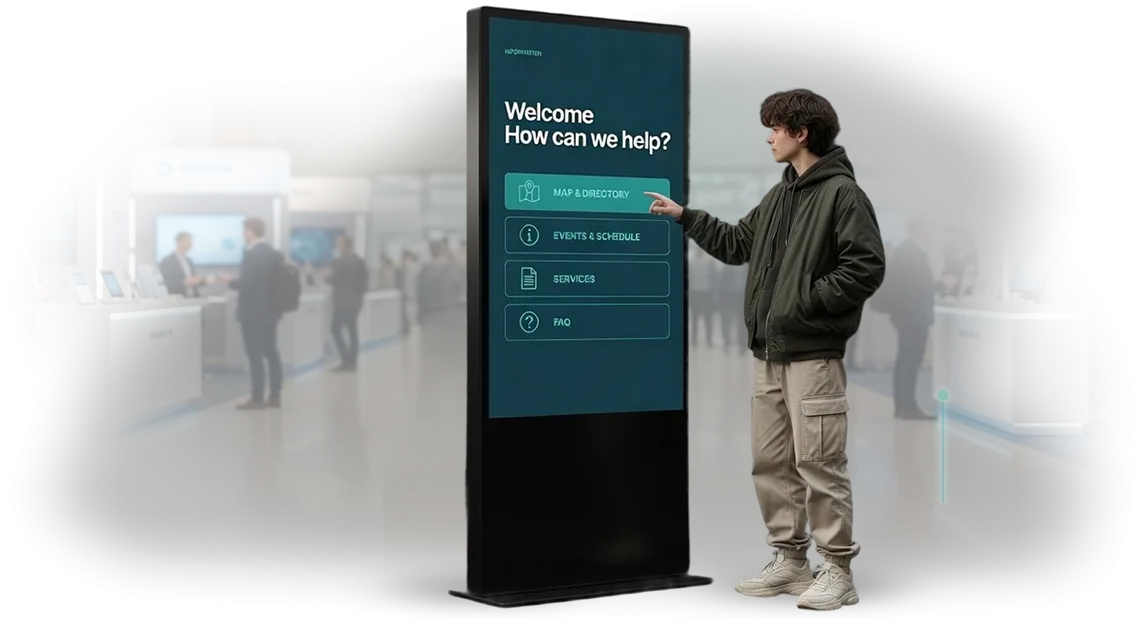
That is why we fill this need with an interactive presentation on a touch panel.
A modern interactive kiosk for a bank does not just inform — it guides the client through products, relieves the burden on staff, and turns waiting into a useful and pleasant interaction with the brand.
We work with professional equipment and proven development tools so you get a reliable solution that pays off through increased conversion and service quality, rather than requiring constant attention from specialists.
5 benefits of an interactive presentation for banks and financial institutions
Bank visitors do not like to wait long and rarely read brochures. While the client stands in line, an interactive presentation on a touch panel introduces them to products and takes part of the questions off the staff.
At our team we have been developing such presentations for more than ten years. Here are five benefits a bank or financial institution gets.
1. Increased engagement
A touchscreen holds attention many times longer than paper materials. The client chooses the topic of interest themselves and does not leave until they get an answer.
2. Conversion into products
The presentation shows the terms of deposits and loans and immediately offers to leave a request. This way the client moves from "browsing" to "applying" without a manager's involvement.
3. Staff relief
Typical questions — exchange rates, working hours, document requirements — are handled by the kiosk. Managers handle live negotiations and complex deals instead of repeating the same information.
4. Bank image
A modern touch panel creates the impression of a tech-savvy institution. This increases trust and loyalty, and visitors more often recommend the bank to acquaintances.
5. Analytics for decisions
The system shows which products are chosen most often and at what step visitors leave. This data helps improve the service catalog and branch workflows.
Comparing touch kiosk formats: which one fits the task
The kiosk format you choose determines how quickly clients can navigate the bank's products and complete a service without a consultant's help. A properly selected option reduces staff load, shortens queues, and strengthens the image of a tech-savvy financial institution. Let us compare key formats by the tasks they solve in a branch.
| Format | Where to place | For what tasks | What it gives the bank |
|---|---|---|---|
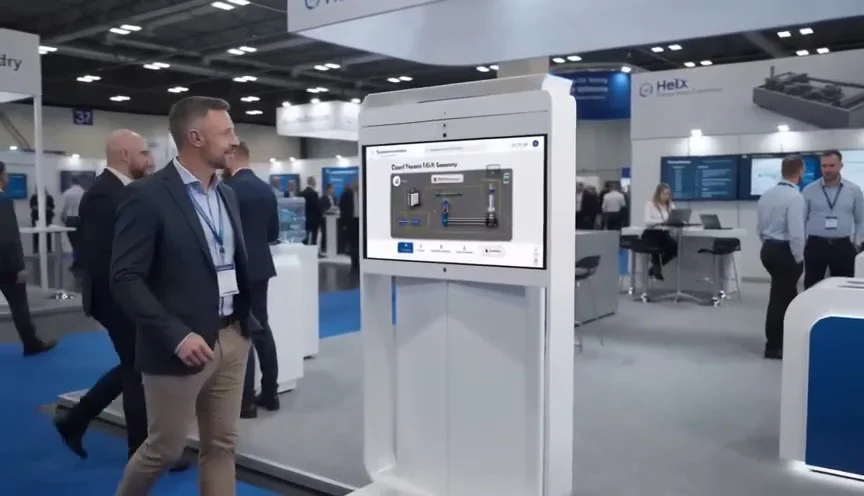
| Floor-standing kiosk | Entrance area, waiting zone | Product introduction, service appointment booking, branch map, surveys | Reduces queues, engages clients while waiting, builds the image of a modern bank |
| Wall-mounted kiosk | Service hall, near ATMs, in hallways | Rates, exchange rates, statements, certificates, branch locator | Saves space, information is always up to date, client handles simple questions on their own |
| Countertop kiosk | At the consultant's desk, in a meeting room | Demonstrating terms, submitting applications, surveys, calculators | Boosts sales during personal consultations, makes presentations visual |
| Built-in touch panel | Into furniture, wall, or information stand | Product registration, interactive service presentation, navigation | Blends into the interior, looks premium, easily upgraded |
Each format addresses its own business task. For example, a floor-standing kiosk in the waiting area engages clients while they wait and immediately introduces new products. A wall-mounted kiosk helps get a statement in a couple of touches without distracting a manager. And a touch panel in a meeting room makes discussing terms visual and convincing.
To choose the right option, we assess client flow, branch area, and implementation goals. We develop the screen structure, design, and interface logic for a specific kiosk format — from floor-standing to built-in.
The client gets a solution that is easy to update and immediately delivers value: more self-service products and fewer queues.
Development stages of an interactive kiosk: from brief to launch
We have structured the process so that you understand at every stage what is happening and what you are paying for. No "black boxes": you get clear timelines, approval points, and a verifiable result. Below is the standard path from the first call to a working kiosk in your branch.
-
Brief and task immersion. We gather requirements: where the kiosk will stand, who the audience is, what tasks we are solving — consultation, application submission, product presentation. The output is a technical specification that captures expectations.
-
Analysis and concept. We study usage scenarios so the interface is understandable to a person without training. We propose a screen structure and navigation logic — you see how a visitor will move toward the desired service.
-
Layout approval. We show a prototype of the future interface with real data. At this stage it is easy to change the order of sections or texts — edits are made before development starts, so they do not require extra costs.
-
Design and software development. We create a visual style for your brand and a program that runs stably on the touchscreen. We use professional tools — for you this means predictable quality without "surprises" in the middle of a busy workday.
-
Testing on real equipment. We check all scenarios: from finger touches to long-term operation without rebooting. We fix issues before the kiosk sees its first visitor.
-
Launch and setup. We deliver, mount, install the program, and set up connectivity with your systems. We provide a short training session for staff — they will confidently help clients.
-
Support and evolution. We stay in touch after launch. We update content, add new services, and monitor stability. If something changes in the business — the kiosk changes with you.
Ultimately, you get not just a "screen with buttons" but a tool that genuinely relieves staff and speeds up service. Each stage is closed with a clear document or demonstration, so you always control the process and budget.
What is included in the interactive solution delivery: the complete package
You get not just a touch panel but a fully ready-to-use solution for a bank or financial institution. We handle all stages — from equipment selection to staff training — so you do not have to deal with technical details or coordinate multiple contractors.
The standard delivery package includes:
- Kiosk equipment — a professional touch panel and housing selected for your tasks and usage intensity. This is reliable hardware that withstands daily load and does not let you down at the most important moment.
- Software — an interface adapted to your products and services. It is intuitive, loads quickly, and requires no complex maintenance, while content updates take minutes.
- Design content — screen design in your brand style, with your logo and up-to-date materials. We develop the structure and content so visitors easily find the information they need and do not have to approach staff unnecessarily.
- Installation and setup — delivery, installation, connection, and on-site verification. You get a working kiosk without your involvement: arrive, turn it on, use it.
- Staff training — a short session for personnel: how to manage content, add news, and resolve typical issues. Your people will quickly get the hang of it and maintain up-to-date information on their own.
- Equipment and work warranty — in case of an unforeseen breakdown, you are protected. We stand behind quality and are ready to replace or repair the device as quickly as possible.
- Support and maintenance — after launch, you can contact us with any questions: consultations, content updates, preventive maintenance. This keeps the kiosk running constantly and without failures.
Thus, the entire responsibility for the result lies with us. All you have to do is choose an installation location and get a tool that boosts client loyalty, reduces staff load, and makes the bank's services more accessible at any time.
Case study: an interactive kiosk in a bank or financial institution branch
Clients come to a bank branch with a specific question but often leave without an answer: queues, overloaded tellers, unclear product terms.
We encountered this in a project for a network of bank branches FinansGroup and solved the problem with an interactive kiosk — it became the first consultant a visitor sees.
The kiosk itself guides the client through products: shows terms, calculates an approximate payment, helps submit an application and book an appointment with a specialist.
Staff get involved at the stage of a ready-made request — they do not have to explain the same thing ten times.
What changed after installation
After two months of kiosk operation, the number of clients choosing self-service nearly doubled.
Peak-hour queues shortened, tellers were freed up for complex consultations, and visitors stopped leaving "to think it over." The main business result — conversion into loan products grew by 23%.
The branch effectively became a digital office: a client arrives with an already completed application, an employee verifies the data and closes the deal. This increased both service speed and the average check. Convinced of its effectiveness, the bank ordered kiosks for two more branches.
Why it worked
The secret is in the scenario that guides the client without extra steps. On every screen — only a useful action: choose a product, calculate a payment, leave contacts.
The kiosk does not overload with information but prompts the next step, so the visitor is left with a feeling of ease and control. And the bank gets a ready application instead of a lost client.
Frequently asked questions about interactive kiosks for the financial sector
At our team we have been developing interactive kiosks for banks and financial organizations for more than ten years. During this time, clients most often ask how to avoid losing data and not exposing the branch if equipment fails or does not fit into existing processes.
Below are answers to common questions. If your case is not covered, send a request — we will look into it individually.
How reliable are kiosks?
We use industrial touch panels designed for round-the-clock operation. The equipment is not afraid of dust, temperature fluctuations, or accidental impacts, so failures are rare.
Is it difficult to manage the content?
No. Upload materials through the admin panel: changed a rate, added a promo, updated a schedule — the information appears instantly without a programmer.
How does the kiosk integrate into banking infrastructure?
We provide open interfaces for connecting to your systems: CRM, accounting platform, front office. The kiosk pulls data, loads personalized offers, and sends applications to the relevant department — together with your security team.
What about cost and maintenance?
The cost depends on the tasks: an informational kiosk or a terminal with service appointment booking. In the project, we include scheduled maintenance and remote monitoring, and we will prepare a cost estimate after the brief.
Let's discuss your project? Get a cost estimate for an interactive kiosk
Leave a request on the website — and on the next working day you will receive a cost estimate for an interactive kiosk for a bank or financial institution.
The initial consultation is free: we will clarify the tasks, audience, and expected result to offer a solution for your budget, not an "industry average."
Here is what the work looks like after you reach out:
- Request — you leave your contacts, we get in touch within a working day.
- Free consultation — we discuss the scenario, number of locations, design expectations, and integrations.
- Cost estimate — you get a transparent quote with no hidden fees.
- Preliminary plan — we set development timelines, stages, and responsible people.
- Prototype — we show how the kiosk will work before full development.
- Launch and support — we install the solution, train staff, and stay in touch.
After you reach out, you receive:
- a cost estimate and commercial proposal;
- a preliminary plan with specific timelines;
- a key screen prototype for approval;
- recommendations on content and menu structure;
- warranties and support terms after launch.
You can order a kiosk with a minimal budget at the first stage — we will offer a format that pays off through client service speed. You do not spend time on technical details: you get a turnkey solution with a clear plan and a fixed estimate.
Leave a request — and in a day you will know how much your project costs and when it can be launched.
How to choose the right interactive presentation format for a bank?
When a bank or financial institution chooses an interactive presentation, the first question is the format. In fact, the choice comes down not to screen size or panel model, but to two things: what tasks the system must solve and what budget is allocated for it.
These are the criteria that help avoid overpaying for unnecessary features and get a solution that pays off in the first month of operation.
If the goal is to reduce queues and relieve staff, a compact kiosk with navigation and branch opening hours is enough.
When deposits, loans, or investment products need to be presented, the format should be different: a large touchscreen with an interactive scenario that holds the client's attention for 5–7 minutes and helps them understand the terms on their own.
For high-traffic branches, consider a floor-standing kiosk or a counter-top panel — the presentation will be visible and accessible.
Budget also determines the format. If it is limited, you can start with a single touch panel with a basic scenario: product descriptions, calculator, application form.
As the budget grows, the system is easy to scale — add more touchpoints, CRM integration, or appointment booking. Flexible scaling allows you to launch a pilot, get first results, and then decide on project development based on them.
It is also important to understand who will use the kiosk: your employees or clients. For internal use, a panel with closed content and quick access to instructions is suitable.
For clients, you need an intuitive interface, large buttons, hints, and the ability to get a consultation in a couple of touches. In any case, the system should be easy to update — then the presentation is always current, and promos and rates change without involving developers.
We help you choose a format for your tasks: we analyze visitor flow, branch workflows, and budget. Based on this, we propose the optimal configuration — from a single touch panel to a network of kiosks across all locations. The key is that the presentation solves a business task, not just looks modern.