



Why libraries are losing readers and how to bring interest back
Modern readers live in a digital environment: online catalogs, e-books, instant search. Meanwhile, the library often remains a place with paper card indexes and lines at the librarian's desk, so a drop in attendance is an expected reaction. People haven't stopped reading — they simply went where it's faster and easier.
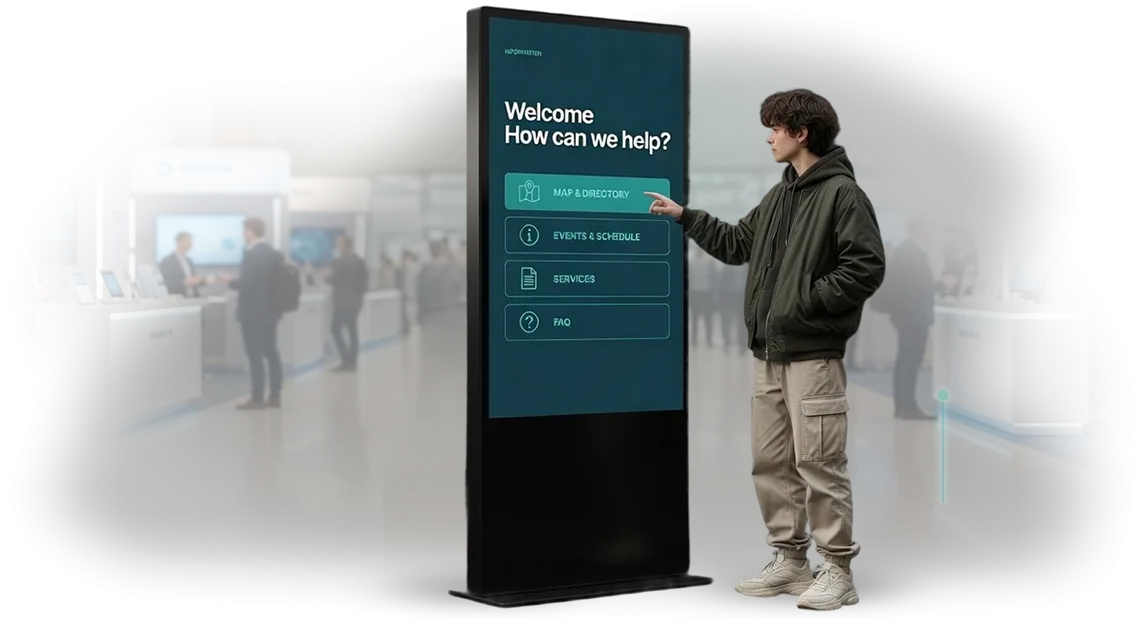
You can bring readers back by making the library convenient again. An interactive kiosk for a library is a digital storefront, navigation, and reference service all in one.
Visitors find the book they need on their own, learn about events and new arrivals, and spend minutes on it rather than standing in line.
Digitizing a library doesn't replace the librarian — it frees them up for live communication with readers. The kiosk handles routine requests: genre selection, availability checks, reservation, and route to the shelf. Readers in the library feel more confident when they can find their way without assistance.
When a library becomes an interactive space, attendance grows thanks to the new experience — children come for the touchscreens, parents for convenience, young people for a modern atmosphere.
This is exactly what turns a library from an archival storage into a community center where people want to stay. We address this need by designing a kiosk for the specific tasks of your library and its visitors.
What an interactive kiosk delivers: convenience, engagement, greater reach
Library visitors often don't realize what books and services are hidden behind the shelves, while staff spend time on repetitive questions instead of helping readers.
An interactive kiosk with a touch panel solves both problems: it becomes a convenient catalog navigator and an engaging guide for guests.
Here's what you get by installing a touch panel in a library:
- Convenient book search — visitors find the edition they need on their own by title, author, or topic, and see the shelf and status (available / checked out). Lines at the desk shrink, and readers find what they need faster.
- Visitor engagement — interactive scenarios, quizzes, and reviews attract attention even from those who came just for the atmosphere. Guests stay longer and discover new books.
- Greater reach — the kiosk helps announce events, new releases, and thematic collections. Visitors learn about library events, so they come more often and bring friends.
- Less staff workload — routine requests (“where can I find?”, “what do you have on this topic?”) are resolved automatically, and staff focus on more important work — consulting and developing the collection.
Our experience confirms this in practice. At the Mayakovsky LibraryMayakovsky Library, after launching an interactive kiosk, interest in rare and specialized publications grew noticeably, and librarians stopped acting as a reference desk.
Readers explored the collection on their own, while staff gained time for individual work with visitors.
Ready to make your library more convenient and modern? We'll help you choose a kiosk scenario for your tasks — from navigation to event promotion. Leave a request, and we'll prepare an implementation plan.
Kiosk formats for libraries: choose the one for your task
In a library, an information kiosk covers several tasks at once: it helps visitors find their way, shows the event board, and accepts registrations for events.
But every library has its own space and its own visitor flow — so we offer three kiosk formats that are easy to fit into any interior and tailor to a specific area.
Format comparison
| Format | Who it's for | What it gives the client |
|---|---|---|
| Wall-mounted kiosk | Entry area, lobbies, narrow corridors | Saves space, always visible, works as a navigator and event board |
| Floor-standing kiosk | Spacious halls, waiting areas | Attracts attention, convenient for catalog search and self-service registration |
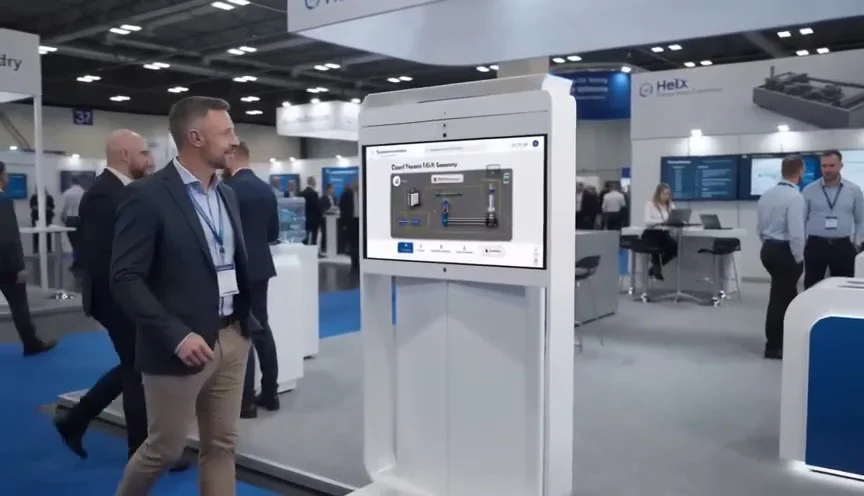
| Interactive table | Children's areas, exhibition zones | Gathers a group around it, turns exploring the collection into a game |
Each format offers the same set of features: catalog, library map, schedule, feedback. The only difference is how the kiosk fits into the visitor flow and which usage scenarios are most comfortable for it.
At the same time, all formats are managed through a single panel — update the event board and book list without a programmer.
For example, at the Dostoevsky Library we created a hybrid solution: a wall-mounted kiosk at the entrance shows navigation and events, while an interactive table in the children's room became a magnet for young readers.
In this way, each format works toward its own task — and the library gets maximum benefit from every square meter.
Kiosk launch stages: from brief to grand opening
We work according to a transparent process: you know what happens at each stage and when you'll receive the finished kiosk. Typical project stages look like this — from the first brief to the grand opening in the library. We fix the timeline in the contract, and you control the result through checkpoints.
- Brief and task audit. We discuss where the kiosk will stand, which functions matter to visitors and staff, and what content already exists. A short survey takes 30–40 minutes and provides the basis for an accurate cost estimate and timeline.
- Concept and scenarios. We propose a menu structure, navigation logic, and an approximate visitor path: from selecting a section to getting the needed information. We approve the approach before any money is invested in production.
- Layout approval. We show the visual style: colors, fonts, button placement. You see the future screen in advance and make edits without rework or wasted time.
- Production and assembly. We manufacture the enclosure and install the equipment. The kiosk undergoes a stability check so it runs without failures even during peak hours — during breaks and at events.
- Content filling. We upload information about the library, the event board, a map of the halls, and usage rules. If there is a lot of material, we help structure it and make the text easy to read on screen.
- Test launch. We check all scenarios: how a guest searches for a book, registers for an event, and finds the right room. We fix any issues before the official opening.
- Kiosk launch and handover. We install the device, train the staff, and hand over instructions. We stay in touch for prompt support.
This sequence eliminates surprises: you see the design in advance, understand the timeline, and get a working kiosk by the set date. For the library, this is a modern navigation point that saves time for both staff and visitors.
What's included in delivery: from enclosure to staff training
A kiosk that simply stands in a library lobby solves only half the problem. The other half is making sure it runs reliably and staff can manage it without calling a technician. That's why we assemble a turnkey package and hand it over to your team fully operational.
### What's included in the package
- Touch panel with a protected enclosure, anti-vandal design, and cooling system for round-the-clock operation. The enclosure isn't about design; it's about the kiosk lasting for years even with heavy use.
- Kiosk software — an interactive presentation, catalog, and navigation are combined into a single system. Your staff member can update content without programming knowledge: change the event board, add a new author, save — and it appears on the screen.
- Ready-made content — section structure, texts, images, and videos adapted to your library's tasks. You don't need to hire a designer: the content will look professional from day one.
- Design layout development that fits the interior. Colors, fonts, element placement — everything is agreed with you before production begins.
- Kiosk installation — we deliver, install, connect, configure, and check it. All we need from you is access to the premises and a power outlet.
### Training and warranty
- Staff training — a short practical session: how to switch it on, restart it, replace content, and resolve minor issues on your own. One library employee will be able to fully administer the kiosk.
- Warranty and support — if a failure occurs, we connect remotely to the system and resolve the problem, usually without an on-site visit. This saves your time and budget.
As a result, you get not “hardware” but a ready-to-use tool: a showcase of your collection, event poster, and hall navigation — all in one device, with a trained team and tech support on call.
How the Nekrasov Library kiosk increased book circulation by 40%
When readers come to the library, they want to quickly find the book they need, not study hall layouts or wait for help at the desk.
At the Nekrasov Library, the situation was typical: visitors got lost in the catalogs, spent 10–15 minutes searching for a single title, and often left empty-handed.
Staff answered the same questions over and over instead of working with the collection, and book circulation stood still for months.
We installed an interactive kiosk with a touch panel in the lobby — intuitive navigation through the halls, a catalog with search by title, author, and topic. Readers find a book on their own in a minute, see availability and the exact shelf location. No more waiting in line for information, no more pressure on staff during peak hours.
The result was noticeable within the first month: book circulation grew by 40%, and evening attendance increased by about a quarter.
Readers began ordering publications more often because they stopped seeing the library as a place where “it takes too long to find things.” Staff were freed from routine requests and directed their time toward expanding the collection, live consultations, and working with new readers.
This case confirms a simple pattern: navigation directly affects circulation. When visitors find what they need quickly, they don't leave empty-handed — they take a book, come back again, and recommend the library to friends.
The kiosk pays off not in an abstract “service improvement,” but in concrete circulation numbers and growth in regular readers.
The same result is achievable in any library, regardless of collection size or hall area. Simply place one navigation point in the lobby — and in a month you'll be able to compare circulation figures before and after.
How to choose a kiosk format for non-standard requirements?
Choosing a kiosk for a library starts not with a catalog of ready-made models, but with two questions: what tasks it should solve and what space it will fit into.
When non-standard requirements arise — columns, niches, unusual layouts, the need to blend into the interior or combine navigation with an event board — a standard solution often doesn't work.
In such cases, we offer a custom format: first we study the premises, visitor flow, and typical usage scenarios. Based on that, we select the structure, size, and type of touch panel, as well as the structure of the interactive presentation.
It's important that the kiosk doesn't look like an add-on but becomes a natural part of the library space.
We build the kiosk turnkey: from enclosure and interface design to installation and configuration. You get not just a device, but a fully ready scenario — library registration, book search, event schedule, hall navigation. All of it is customized to your library's specifics and managed without a programmer.
The main principle: the earlier we learn about non-standard requirements, the more accurate the solution will be. At the brief stage, we record the constraints and capabilities of the space, then offer an option that fits in size, style, and functions. This way, you avoid compromises and get a kiosk that works specifically for your tasks.
Answering common questions about kiosks for cultural spaces
When ordering a kiosk for a library or cultural center, it's easy to imagine problems in advance: what if the equipment breaks down, the content becomes outdated, and updating it will require a programmer?
In practice, these fears are resolved at the launch stage: we handle maintenance, provide easy-to-use management tools, and stay in touch not just during the first weeks, but for the entire service life.
Below are answers to the questions we hear most often. Briefly and without unnecessary technical complexity.
What if the kiosk breaks down?
We design kiosks to run reliably for years. But if something does happen, you don't need to find a technician — just call us. Remote diagnostics quickly identify the cause, and if necessary, we promptly arrange equipment replacement. Warranty and post-warranty service are included in the support package.
How do we update content if we don't have a programmer?
You don't need a developer for this. You get a simple admin panel: add a new announcement, change the schedule, or upload an event board in minutes through a regular browser. We train your staff in one day — and from then on, they handle it on their own.
Do we need an IT specialist to support the kiosk?
No. We handle the technical side: we monitor performance, update software, and provide guidance on any questions. Your staff only need to know how to turn the kiosk on and use the control panel — the rest is on our side.
Will this kiosk suit our specific cultural space?
Yes, we adapt the interface, navigation structure, and design to the tasks of a particular library or museum: from a simple schedule to an interactive map and multimedia guide. The kiosk doesn't look “out of place” — it becomes part of the space and complements its atmosphere.
If you still have a question of your own — ask us directly, and we'll explain how we'll solve your specific task.Get a ready-made kiosk for your library in just one month
Can you already imagine library visitors quickly finding the book they need through a touch kiosk, instead of standing in lines and dealing with paper forms? This is not just a modern screen — it's a way to relieve staff and make the library a place people want to return to.
Order a library kiosk at our team, and we'll take care of the entire journey: from concept to launch. The average production time is one month, including design, programming, and testing. You get a complete turnkey solution, not a set of parts.
Immediately after launch, you get:
- a ready-to-use touch kiosk with an interactive library map and catalog search;
- a simple navigation system — visitors find the department, book, or event they need on their own;
- the ability to update content without a programmer — staff change event boards, opening hours, and new arrivals themselves;
- a user-friendly interface for readers of all ages — from schoolchildren to retirees;
- clear request statistics — you see what visitors are most interested in;
- one-day training for your staff and an operating manual;
- technical support after launch — we're on call if anything needs to be refined.
The project launch takes no more than a month because we have a well-tuned process and ready-made modules for standard library tasks. You don't invest in lengthy development — you get a result within the agreed timeframe.
Leave a request on the website — we'll have a short discussion, propose a solution for your tasks, and give you an exact launch date. In just a month, your readers will be using a modern kiosk, and you'll be saving staff time and effort.