

Why a permanent exhibition needs an interactive kiosk
A permanent exhibition lives for years, but visitors stop noticing static stands. Posters and display cases grow tiresome, the eye glides past them, and the key idea of the exhibition gets lost. Such a stand becomes part of the interior — people walk past it without stopping.
The second pain point is the strain on staff. Docents repeat the same stories dozens of times, and visitors still leave with different impressions. An interactive kiosk changes the model: the visitor becomes an explorer.
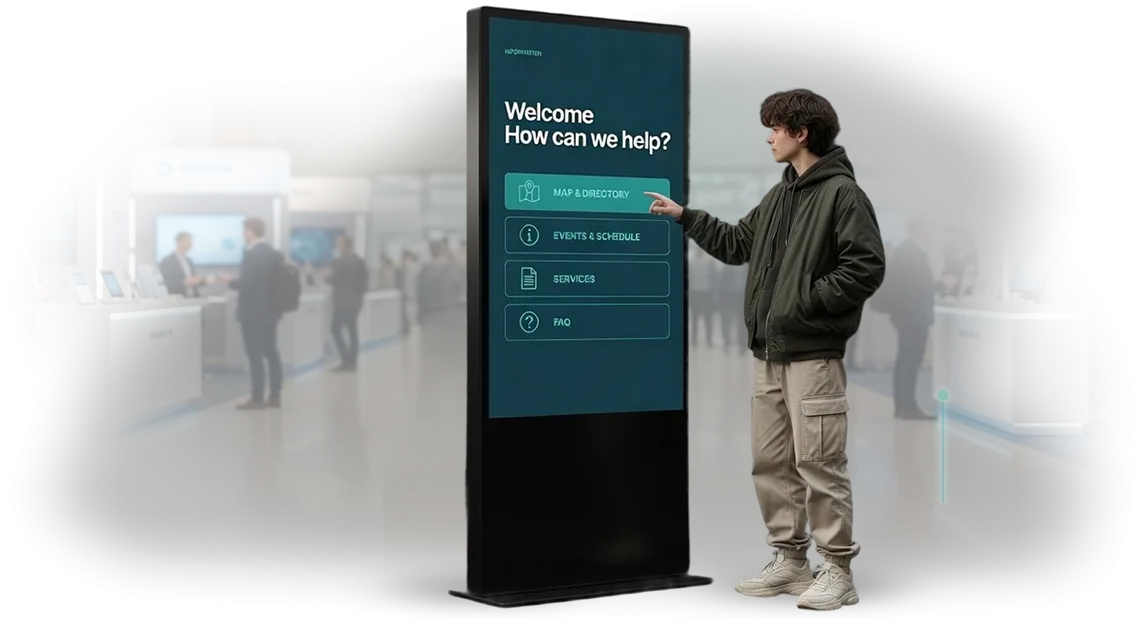
They choose a scenario on the touchscreen, browse materials, zoom in on details — and find the answers themselves.
This is what continuously attracts attention and keeps guests at the stand. Instead of passive reading, a person becomes involved in the process, which is why the material is remembered far better.
For a permanent exhibition, a kiosk is also a way to refresh the display without printed materials: content is changed in hours, not days.
Visitors get a consistently high-quality story at any time — even if staff are busy or have already left. This reduces the load on staff and increases the pleasure of the visit.
For the exhibition owner, an interactive presentation on a touchscreen panel becomes a growth point: it boosts recognition, keeps visitors engaged, and gives them a reason to return.
We have been developing interactive kiosks for permanent exhibitions for ten years. We know how to make an interface understandable to any audience and how to build a scenario that conveys the brand's main message. You get a reliable solution that attracts attention every day without human involvement.
What an interactive kiosk brings to your exhibition
An interactive kiosk turns a permanent exhibition from a static showcase into a living space. Visitors choose their own scenario for getting to know the material rather than just reading signs. This holds attention and increases the time spent at the stand.
Visitor engagement
Visitors remember what they participated in. The touchscreen panel offers touching, selecting, and swiping — simple actions that turn viewing into a small exploration. After this interaction, a visitor leaves with a concrete impression and shares it with others more often.
Visual clarity of the exhibition
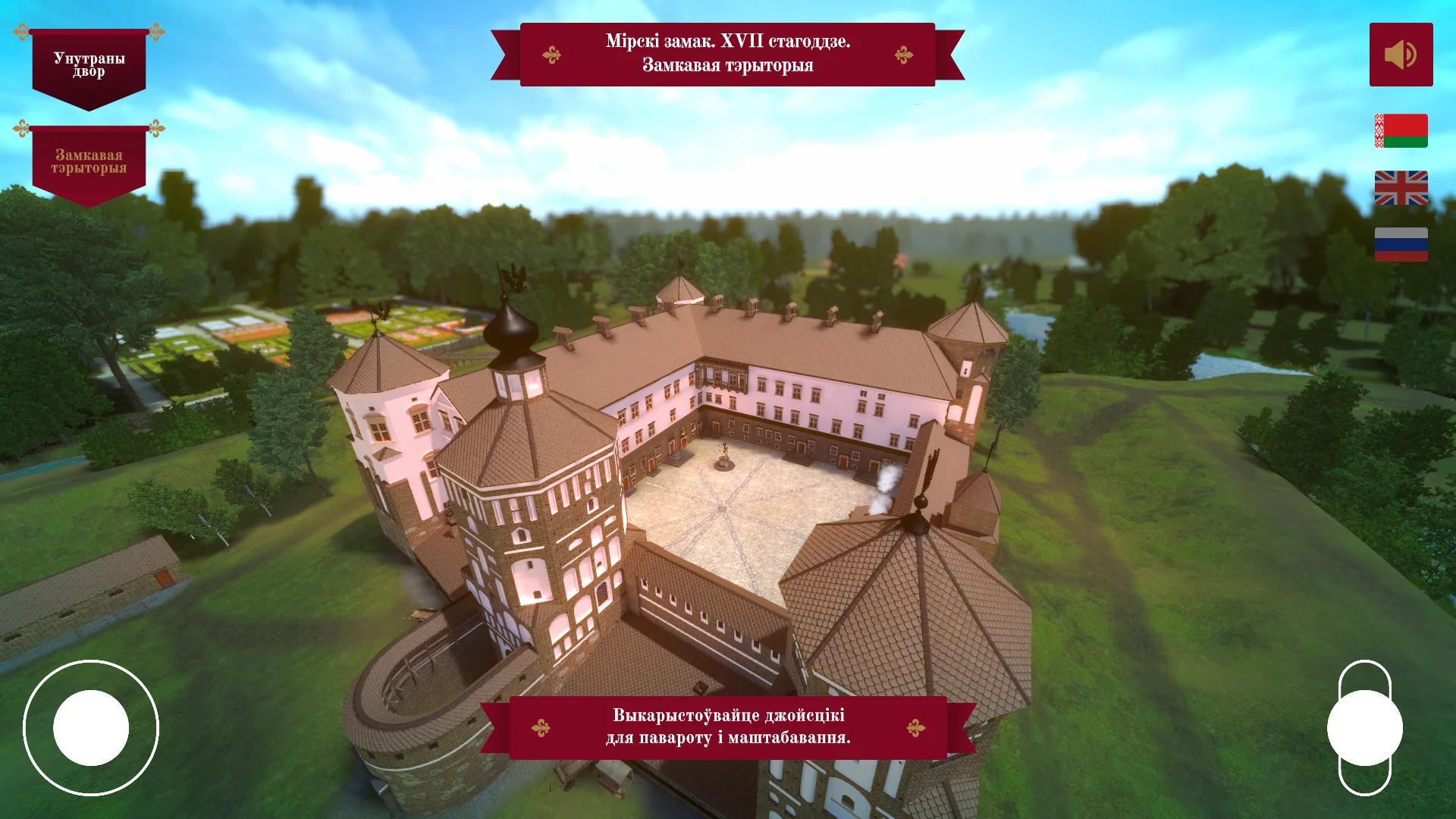
Complex products, a company's history, the inner workings of processes — all of this is hard to show on static posters. On a kiosk screen, information is delivered in measured portions: diagrams, photos, videos, short scenarios.
The organizer does not need to expand the physical space — it is enough to structure the content and give the guest control.
Navigation convenience
The kiosk works as a clear guide around the exhibition: it points out where key zones are located and answers frequently asked questions. This reduces the load on staff and makes the exhibition accessible for self-guided viewing. Visitors find what they need faster and keep a positive impression of their visit.
Our team creates interactive content for your exhibition with your venue's objectives in mind: from the interface to the logic of presenting materials.
We are responsible for the kiosk working stably throughout the entire exhibition period and for the kiosk's benefits being visible to both visitors and organizers.
Interactive kiosk formats for a permanent exhibition
Choosing a kiosk for a permanent exhibition is easier than it seems if you immediately understand the key point: it must serve your task and not require constant supervision.
Some need to orient visitors in the space, others need to show the full assortment or surprise guests and draw them into the brand story. The kiosk format determines how visitors interact with the exhibition and how quickly they get the information they need.
Below is a table of the main formats. Use it as a checklist: match your goal, audience, and placement — and you will see which option fits best.
| Format | For whom | What it gives the client |
|---|---|---|
| Information kiosk | For navigation around the exhibition, opening hours, contacts, and a quick reference | Visitors find answers themselves without distracting staff; the guest becomes more independent |
| Multimedia kiosk | For immersion in the brand story, showing videos, interactive maps, and 3D models | Holds attention 2–3 times longer, creates emotion, and strengthens the impression of the exhibition |
| Electronic product catalogue | For fast product search, parameter filters, and viewing specifications | The client quickly finds what they need, the path to purchase is shortened, and the sales department gets an interested visitor |
| Presentation on a touchscreen panel | For a permanent showcase where the product needs to be shown from different angles: photos, videos, diagrams, benefits | Replaces paper brochures, information is always current, and easy to update without reworking the kiosk |
The main criterion is what the visitor should do after touching the screen. If the goal is simple ("find out where the hall is"), an information kiosk is enough. If you need to encourage a purchase or show a complex product, choose the catalogue or multimedia format.
For a permanent exhibition, it is especially important that content can be updated independently — we always provide a simple interface for managing the content.
We help determine the right format before development even begins, and combine options if needed. As a result, you get a kiosk that delivers value from day one and easily adapts to new exhibition tasks.
How kiosk development and launch work
For a kiosk at a permanent exhibition to work for years, what matters is not only a bright design and a touchscreen panel, but also a well-tuned launch process.
We run the project from the first brief to post-installation support — you control every stage and understand what you are paying for.
- Brief and task analysis. You tell us about the exhibition's goals, audience, and key messages. We propose the structure of the future kiosk and a scenario that solves your specific task — from an information reference to an interactive quiz.
- Scenario and design development. We create user-friendly navigation, a visual style that matches your brand, and a logical content layout. You receive mockups before development begins and can make changes without losing budget.
- Prototype approval. You see how visitors will interact with the kiosk, check the navigation logic, and approve the final interface. This eliminates unpleasant surprises after launch.
- Development and content creation. We use professional equipment and server architecture so the kiosk runs steadily all day without freezing. You provide texts, photos, and videos — we integrate them and set up standalone operation.
- Testing and launch. We check usage scenarios, response speed, and resilience to visitor errors. Then we install the kiosk at the venue, connect it to the network, and train your staff on the basic operations.
- Project support. After launch, we stay in touch: we update content, monitor performance, and quickly fix any issues. You do not have to think about the technology — the kiosk always works as it should, and visitors get the information they need.
What is included in the interactive kiosk delivery package
For a permanent exhibition, the delivery package is not just a housing with a screen. The full kiosk composition includes everything needed to work from day one: from hardware to content that can be managed without a programmer.
-
Kiosk hardware — touchscreen panel, housing, bracket, and cables. Everything is tested for round-the-clock operation and matched in design to your exhibition.
-
Software — a preinstalled environment for running interactive content, with autostart on power-up and protection against accidental exit.
-
Kiosk content — an interactive presentation tailored to your permanent exhibition: splash screen, menu, pages, videos, and photo gallery. We agree on the structure at the brief stage and make revisions before launch.
-
Admin panel for updates — you change texts, photos, and announcements yourself without developers. Edits are uploaded via a browser or USB drive in a couple of minutes.
-
Documentation and instructions — clear guides on switching on, maintenance, and content replacement. For staff, a short checklist of actions for any situation.
-
Installation and launch — we deliver, connect, and configure the kiosk at your venue. Initial setup is included in the cost.
-
Warranty and support — warranty on hardware and software, consultations, and remote assistance throughout the entire operating life of the kiosk.
Such a delivery package covers the needs of a permanent exhibition: visitors get a clear scenario, you get a manageable tool, and the technical team gets a simple system without complex maintenance.
Implementation example for an existing exhibition
When a permanent exhibition has been around for several years, the main task is to hold visitor attention and reveal something new each time.
That is exactly the request that came from the Museum of Modern Technology: a kiosk case study that helped bring an existing exhibition to life and increase guest engagement.
Below is an example implementation that shows how interactive content turns into a measurable result for the organizer.
The task
The museum faced a typical problem: visitors passed static stands in a minute or two, and docents could not manage to tell the story of every exhibit. A solution was needed that would let visitors explore the materials independently without overloading the staff.
At the same time, it was important to preserve the atmosphere of the exhibition and not break the existing layout of the hall.
The solution
We installed an interactive kiosk with a touchscreen panel at a central point of the exhibition. Instead of long text descriptions — a visual interactive presentation: large images, short videos, the story behind each exhibit, and cross-links between exhibition zones. The guest chooses what to watch, and the interface is adapted for different ages.
Results of the interactive kiosk
In the first two months of operation, the kiosk recorded over 12,000 sessions — nearly a quarter of all exhibition visitors. The average interaction time was four minutes, three times longer than visitors previously spent at static stands.
Museum specialists noted that queues at the kiosk became an element of genuine interest, and a repeat order to update content for new exhibits came within six months.
This implementation example confirms the main point: interactivity at a permanent exhibition solves not a technical but a business task — it holds attention, increases the depth of engagement with the exhibition, and provides clear metrics for further project development.
How to choose the right format for your task?
Choosing a kiosk format is not a technical decision but a marketing one. Before looking at specifications, determine what task the kiosk should solve: introduce a product, help visitors orient in the space, entertain the guest, or collect contacts. Everything else depends on this.
The selection criteria are simple. First is the goal: an information kiosk suits quick reference lookups, an interactive presentation suits immersion in the brand story, and game mechanics suit drawing attention.
Second is the placement: in a high-traffic area you need a compact housing and large control elements, while in a separate niche you can use widescreen displays and gestures.
Third is the audience: if both children and elderly people approach the kiosk, the interface should be as simple as possible.
We help with format selection at the brief stage. We analyze your tasks, the premises, and the target audience, and offer the optimal configuration — from a floor kiosk to a wall-mounted panel.
Then we model the usage scenario: how the visitor approaches, what they see on the screen, how much time they spend, and how they perform the target action.
This approach eliminates the mistake of "we bought the hardware and it does not fit." The focus is on visitor behavior and business metrics: time at the screen, depth of section viewing, share of completed contacts.
That is why we deliver most projects turnkey, including analysis, design, production, and maintenance.
If you are unsure which format fits — describe your task, and we will offer an option with a justification. This is a free preparation stage that saves budget and time.
Frequently asked questions and concerns before ordering
Before ordering an interactive kiosk for a permanent exhibition, many clients have similar questions: how quickly everything will be done, whether the information is easy to update, and whether the equipment will fail at the worst possible moment. Doubts are normal. We will cover the most common ones so that you can make a decision calmly and without hidden risks.
How long does kiosk development take?
A standard project takes from 2 to 4 weeks: from brief to launch. We give the exact timeline after the structure and design are approved. If you need to make it for the exhibition opening, we can focus on the key screens and speed up the work.
What to do when the content becomes outdated?
Content is updated without a developer: you change texts, photos, and prices in a convenient editor. Automatic synchronization with your databases can be set up — then the content is always up to date, and you do not depend on us after the project is delivered.
What guarantees are there on the software and hardware?
We give a one-year warranty on the software part: we fix errors and adapt it to new versions of browsers and systems. The hardware has the manufacturer's warranty, and we take care of setup and fast replacement in case of a malfunction — so the exhibition does not sit idle.
How reliable is the kiosk with round-the-clock operation?
We design for 24/7 mode: we use industrial components, plan cooling and overheating protection. Built-in monitoring will warn in advance about a possible problem, so a failure won't catch you or your visitors off guard.
If you still have doubts — ask us. We will answer before the contract is signed, without hiding anything or forcing unnecessary options.Submit a request — we will prepare a solution for your exhibition
Planning an interactive kiosk for a permanent exhibition? Tell us about your task, and we will prepare a solution that works for you every day. We will handle the design, content creation, installation, and maintenance — all that's left for you is to welcome visitors.
When you contact us, you get a ready-made plan — from budget assessment to launch. Here is what we will do after the first contact:
- Preliminary estimate — we will calculate the cost for your task and offer options from a compact terminal to a full multimedia zone. No hidden surcharges or "unexpected" items.
- Format consultation — we will recommend the optimal kiosk configuration: screen size, placement, interaction scenario. We will explain how this affects reach and guest engagement.
- Mockup and scenario — we will develop the menu logic and an interactive presentation that helps visitors quickly find what they need, learn about key exhibits, and stay longer at the stand.
- Launch plan with timelines — we will agree on the stages, give realistic dates, and set milestones based on your calendar. No "we'll get it done somehow" phrases.
- Demo version — we will show the future kiosk with your content before installation. You will see how it works and can adjust the details.
- Turnkey kiosk — we will deliver, assemble, configure, and test the equipment before the opening. You get a working solution, not "a base that still needs finishing."
- Post-launch support — we stay in touch: we update content, calibrate the touchscreen, and resolve any operational issues. The kiosk will work stably throughout the entire exhibition.
Submitting a request takes a minute — and you get a clear commercial proposal and an action plan within the next few days. Describe your task in the form, and we will contact you, clarify the details, and prepare a solution that strengthens your exhibition.