

Why Do Clients Leave an Insurance Company Office Without a Consultation?
Every day, clients come to an insurance company office to sort out rates or take out a policy, and they leave empty-handed without even waiting for a consultation.
The reason is simple: lines at the office — and a person who has already spent time on travel and waiting loses the motivation to stay any longer. For the business, this is not just an inconvenience but a direct loss of clients and missed revenue.
When a visitor does not get an answer to their question within a reasonable time, they start looking for a solution elsewhere. Competitors let customers take out a policy online, while your office is left with an unserved line and stressed employees.
At the same time, insurance services are a product that is hard to understand without expert help: terms, risks, additional options. Without a consultation, a person is not ready to make a decision, so they simply turn around and leave.
It is especially painful to lose such clients because they have already shown intent to buy. They came with a specific request, but due to staff overload or a lack of clear information, they could not follow through.
Over time, this forms a steady habit: first, the person goes to another office, and then they switch entirely to online services. As a result, not only does the number of signed contracts drop, but loyalty also falls — negative experiences are remembered for a long time.
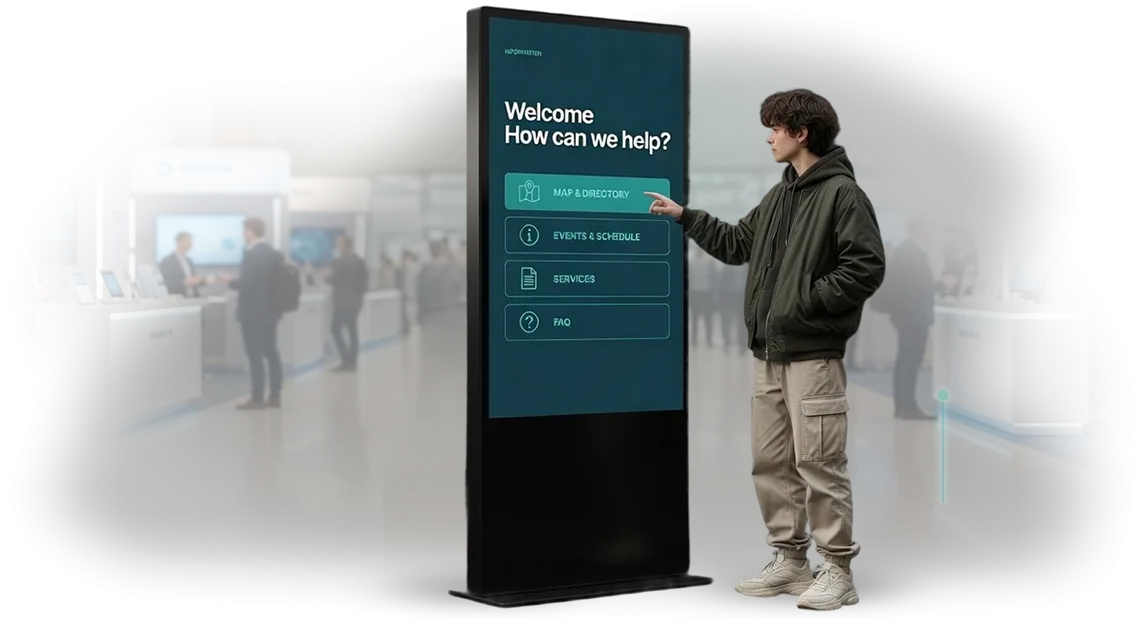
We solve this problem by installing interactive information kiosks that handle the initial consultation. Visitors independently explore programs, compare terms, and get answers to common questions without waiting in line.
This is not a replacement for a live consultant but a way to relieve peak loads and retain the client at the moment they are ready to make a decision. As a result, the office stops losing sales, and the service starts working for you even when all managers are busy.
What an Interactive Kiosk Gives Your Sales Office
Insurance company clients do not like waiting long and are shy about asking "stupid" questions. An interactive kiosk relieves this tension: visitors explore products at their own pace, and a manager steps in only at the stage when the person is ready to talk.
Service speed increases immediately — part of the typical questions (rates, terms, list of documents, preliminary calculation) is resolved on the screen without employee involvement.
Product information is always up to date: updates are made centrally, with no need to reprint booklets or give staff long instructions.
The load on managers decreases: they stop repeating the same things and focus on complex consultations and sales. Visitors feel more independent — this increases trust in the company.
For the insurance business, the kiosk also works as an image tool: the client sees a modern office where technology takes care of them.
Most importantly, the kiosk delivers measurable results: shorter queue waiting times, more processed applications, and a higher share of clients who reach the point of taking out a policy.
This is not an "expensive screen for the sake of technology" but a tool that eliminates losses at every sales stage and quickly pays for itself.
Interactive Kiosk Formats for an Insurance Company
The visitor flow in an insurance company is hard to predict: during peak hours clients wait for consultations, while in quiet moments the manager sits idle.
An interactive kiosk removes this load — visitors explore products and rates on their own, and an employee steps in at the stage of a specific request.
We make kiosks in different formats so they fit into any scenario — from a small sales office to a large exhibition. Below are the standard options and the results the company gets.
Which Format to Choose
| Format | For Whom | What It Gives the Client |
|---|---|---|
| Stationary kiosk | Sales office, service point, client zone | Visitors explore products, rates, and terms without help from an employee. The line moves faster, and the manager works with those who really need a conversation. |
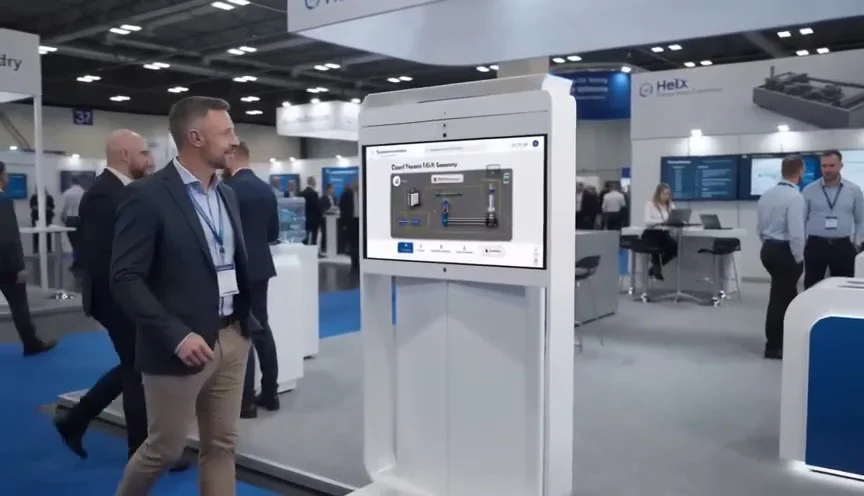
| Mobile stand | Exhibitions, forums, conferences, promotions | The compact structure is easy to install at a booth. Bright screens attract attention, and the interactive presentation helps collect potential clients' contacts right on the spot. |
| Touch panel | Meeting room, waiting area, agent's desk | Visual product demonstration in a conversation with a client. The panel strengthens the agent's arguments, increases trust, and highlights the company's technological edge. |
All formats run on a single platform: we develop the interactive presentation once and then adapt it to the needed screen. Updating information — rates, promotions, or office addresses — happens through an easy-to-use admin panel, without involving a programmer.
As a result, you get a tool that relieves employees, speeds up service, and creates a modern image for the company. And we handle everything: selecting the configuration for your task, developing the design, and launching the system.
How We Develop a Kiosk: From Brief to Launch
Developing a kiosk for an insurance company is not just installing a touch panel. It is a way to help clients understand products, calculate a policy, and leave a request. To ensure the device solves these tasks, we have built a clear process — from brief to launch.
Stages of Work on a Kiosk
-
Brief and immersion. We study the insurance company's goals, target audience, and installation location. We agree on objectives — increasing the number of requests, reducing the queue, selling additional products.
-
Plan and timeline. We prepare a plan, fix deadlines and cost. We define key scenarios: consultation, policy calculation, booking an appointment with an agent.
-
Design and mockup approval. We create a concept in the corporate style. You approve the mockup before development begins — this excludes expensive edits later.
-
Development and content. We build the interface on professional equipment and adapt it for the touch screen. We fill it with current rates, programs, and contacts.
-
Testing. We check user scenarios, speed, and stability — the kiosk must not fail during peak hours.
-
Launch and support. We install the kiosk, train employees, and hand over the instructions. We update content and promptly resolve failures.
The kiosk development time is two to four weeks depending on complexity. We give the exact date after the brief, and the project status is visible in your personal account at every stage. This way, the launch runs predictably and on time.
What Is Included in the Interactive Kiosk Delivery
The interactive kiosk delivery package includes everything needed to launch the device in your office on the day of installation. You get a ready-to-use client interaction point, not just equipment that needs additional setup and connection.
- Touch equipment — an industrial touch panel in an anti-vandal housing, adapted to your interior and installation location. Such a device withstands heavy visitor flow and works without failures.
- Software — an interactive presentation designed for your services and corporate style. The software is installed and configured; content can be updated without developer involvement.
- Kiosk installation — an engineer visit, panel mounting, connection to the power supply and local network, and verification of all functions. The kiosk goes live the same day.
- Instructions and documentation — short guides for staff and a maintenance schedule. Your employees will quickly understand how the device works.
- Staff training — a practical training session for administrators and managers: how to turn on the kiosk, update information, and help visitors.
- Warranty and service support — an official warranty on the equipment and software, plus assistance throughout the entire service life. If anything needs maintenance, we handle it quickly and without unnecessary approvals.
This delivery package covers all issues: from purchase and installation to daily operation and maintenance. All you have to do is use the kiosk as a full-fledged communication channel with clients.
Real Case: Interactive Kiosk Doubled Conversion
We implemented an interactive kiosk for an insurance company where clients got lost in waiting and often left without a consultation. The live queue, typical questions, and peak load created tension and reduced loyalty. The task was simple: help visitors quickly understand products and relieve employees.
The solution was a touch panel with an interactive presentation of insurance programs. Visitors choose their own scenario: OSAGO, CASCO, property or health insurance. The kiosk asks two or three clarifying questions, shows suitable rates, and calls a consultant if needed. A few weeks passed from brief to launch.
During three months of kiosk operation in the sales office, we achieved measurable results. Visitor conversion into a completed request doubled — from 18% to 36%. The average consultation waiting time was halved, and employees stopped answering the same questions.
According to the client's assessment, the kiosk paid for itself in four months and began generating profit as an additional sales channel.
The marketing department head of the insurance company "Garant" noted: "We expected the kiosk would just entertain clients, but it became a full-fledged sales tool.
Now visitors arrive prepared and make decisions faster." After the successful launch, the company ordered three more kiosks for regional offices.
This case is not a one-off story. We adapt scenarios to the specifics of each business and always build in clear metrics so you can see the return on your investment.
How to Choose a Kiosk Format for Your Company's Goals?
The kiosk format should be chosen not by appearance but by the usage scenario: where and how the client will get to know your insurance programs.
Each option solves a specific task, so first determine what matters more — covering visitor flow in the office, saving space, or being impressive at an exhibition.
A floor-standing kiosk is the choice for sales offices and waiting areas. It is visible from afar and works as a "digital consultant": while the client waits for a manager, they explore products and leave a request. This format reduces consultation time and increases visit conversion.
A wall-mounted kiosk suits spaces with limited floor area: corridors, reception areas, zones near the checkout. It does not block passage, is always in view, and helps clients quickly find the right product — from OSAGO to business programs. It is a standalone point of access to information without extra equipment.
A touch table is a format for exhibitions and demonstration zones. Several people can use it at once: a family or representatives of a partner company can compare rates and choose the best option. Such a table is memorable and strengthens brand recognition.
Whichever format you choose, we will adapt the scenario to your products and help you decide on placement and content. As a result, the kiosk becomes not an "exhibit" but a working tool that generates requests and increases client loyalty.
Answers to Common Questions About Kiosk Development
When an insurance company needs to install touch kiosks, questions most often arise about reliability, maintenance, and data protection. We answer the main ones — without technical details, only what affects your work and reputation.
What if the kiosk breaks at the worst possible moment?
We use industrial components designed for 24/7 operation in high-traffic locations. This is not a regular tablet — the housing is protected against dust, moisture, and accidental impacts.
But even in an emergency, you will not be left alone with the problem: every project includes warranty service and remote monitoring. A specialist sees the failure before a visitor notices the issue and takes action.
How do we update content? Will we have to call a contractor?
No, everything is updated remotely without stopping the kiosk. You change rates, promotions, product descriptions, and add news or videos through a simple control panel. The data appears on all kiosks in the network within minutes. Employee training takes no more than an hour, and you set access rights yourself.
Who will do repairs and how fast?
The average response time is one business day. We have a spare parts warehouse and a partner service network in the regions. If the cause is a software failure, we fix it remotely without an on-site visit.
If it is hardware, we replace the module right on the spot without taking the kiosk away. For an insurance company, this means minimal downtime and no lines at the stand.
How secure is client data entered in the kiosk?
Data entry on the touch panel is protected the same way as internet banking: the connection is encrypted, information is not stored on the device itself, but is immediately transmitted to your information system.
Access to the server side is strictly segmented — you decide which employees can view statistics or change content. In addition, the kiosk saves all visitor actions in a log, which helps in disputes.
Can the project be scaled if there are several kiosks in different cities?
Yes, all devices connect to a single platform with centralized control. You see the status of each kiosk in real time and receive reports on reach and popular sections.
This is especially important for a regional network of insurance offices: you control all locations from the head office and quickly update general information — from rates to contacts.
The main thing to know is that kiosk reliability is ensured at the design stage, not when a breakdown occurs. We take on warranty maintenance, staff training, and support throughout the entire service life — so you get predictable equipment operation without distracting your IT team.Discuss Your Project with an Engineer — We Will Calculate a Solution in 1 Day
To calculate a kiosk for your insurance company, you do not need to prepare a brief and wait several days. Simply submit a request for development — an engineer is available during working hours, will clarify the details, and prepare a solution.
Leave your contacts — get a free consultation and a personal offer within one business day. We will review your visitor interaction scenario and suggest a format that will reduce queues, relieve employees, and increase service speed.
What you get after contacting us:
- Cost and timeline calculation in three options — from a compact stand to a full-format kiosk to fit your budget.
- An engineer's consultation — without "sales fog", straight to the point: how the kiosk will fit your office or event.
- A screen structure mockup — how visitors will find rates, offices, programs, and get the information they need.
- An implementation plan with stages and responsible parties — you understand who does what and when the kiosk will start working.
- Integration with your system — current data without manual updates every day.
- A personal support offer — content updates and quick assistance after launch.
No "fluff" or vague promises. Fill out the request — tomorrow you will receive the calculation and can make a decision.