


Why employees get lost in the warehouse and how to fix it
In a warehouse where every hour is expensive, employees lose up to a third of their working time searching for cargo. The reason is chaotic movement: it is unclear where the required cell is, and paper diagrams are outdated.
This is not just an inconvenience, but direct losses: assembly delays, equipment downtime, and staff frustration.
When a worker searches for a pallet without clear navigation, the number of picking errors increases. Wrong product, wrong zone, repeated checks—all of this increases workload and reduces order processing speed.
Over time, stress adds to the problem: newcomers are afraid to ask, and experienced employees waste effort on unnecessary routes.
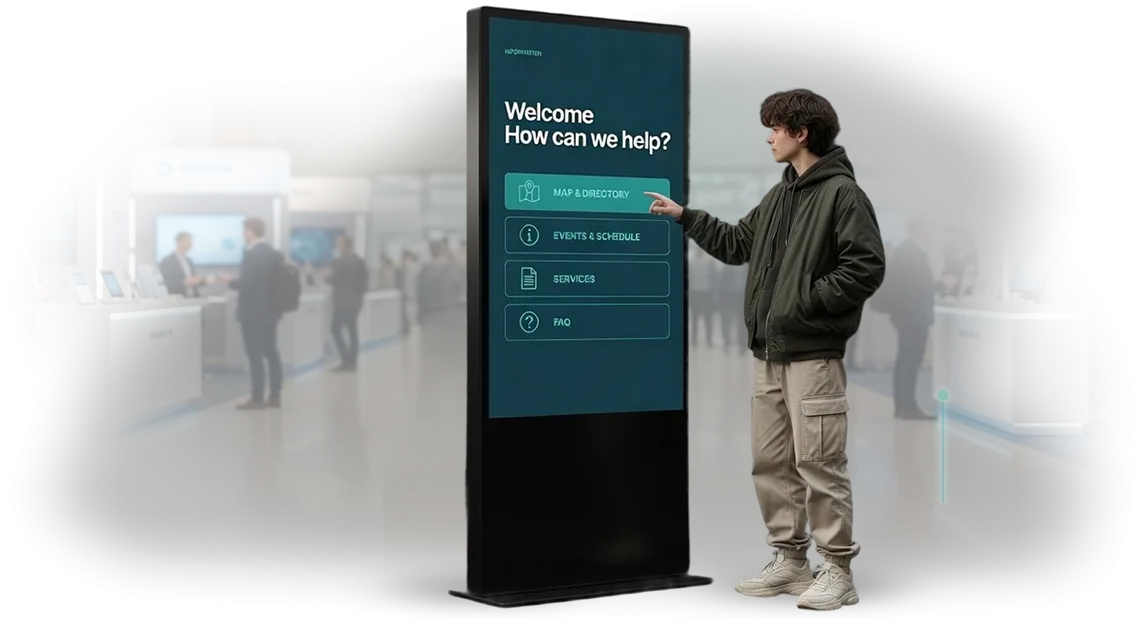
The solution is interactive kiosks with a clear warehouse map that show the shortest route to the required zone. An employee enters an order number or SKU and immediately sees where to go, while the system updates data in real time. This makes warehouse navigation a natural part of the workflow rather than a separate task.
We cover this: interactive kiosks turn cargo search into a clear scenario, and you notice the reduction in lost working time on the very first day of launch.
What you get from implementing interactive kiosks
In a warehouse, every minute of downtime costs money. An employee who searches for goods from memory or in paper documents is lost time and a risk of shipping errors. An interactive kiosk gives an answer in seconds: where the required item is and how to get there fastest.
Accuracy is the second key benefit. The kiosk shows not only the cell number but also up-to-date information on the quantity and status of the product. This eliminates situations where an employee arrives at the location and finds it empty or with the wrong SKU. Shipment proceeds without mis-sorting or returns.
Operational transparency is what managers value. The system records every action: who took the task and when, and how long search and assembly took. You see bottlenecks and can redistribute workload rather than relying on employee reports.
Training new employees ceases to be a problem. To start working, you no longer need to spend a week memorizing rack locations—the kiosk guides step by step and prompts at the right moment. Costs for mentors and onboarding time are reduced many times over.
As a result, kiosks increase overall warehouse efficiency: less downtime, more accurate shipments, a transparent view of operations, and rapid onboarding of new employees into the working rhythm. This pays off within the first months of operation.
Interactive kiosk formats for your task
Every warehouse operates by its own rules: somewhere access control is needed, somewhere routes for new employees, somewhere quick information about safety standards.
Therefore, we select the kiosk format not just for show, but for a specific operational scenario: management, navigation, or reference information.
| Format | Placement | Tasks | What it gives the client |
|---|---|---|---|
| Floor-standing kiosk | Entrance area, receiving zone, aisle intersections | Navigation kiosk, product search, route to the rack, warehouse map | Employee finds the right point on their own—fewer questions to the dispatcher and less downtime |
| Wall-mounted kiosk | Near racks, in the picking zone, near the exit | Information: safety standards, task status, instructions | Rules and regulations always in sight, faster onboarding for newcomers |
| Stationary kiosk | Dispatcher desk, checkpoint, break room | Management: arrival log, requests, status changes | Electronic journal without paper, operational transparency, shift control |
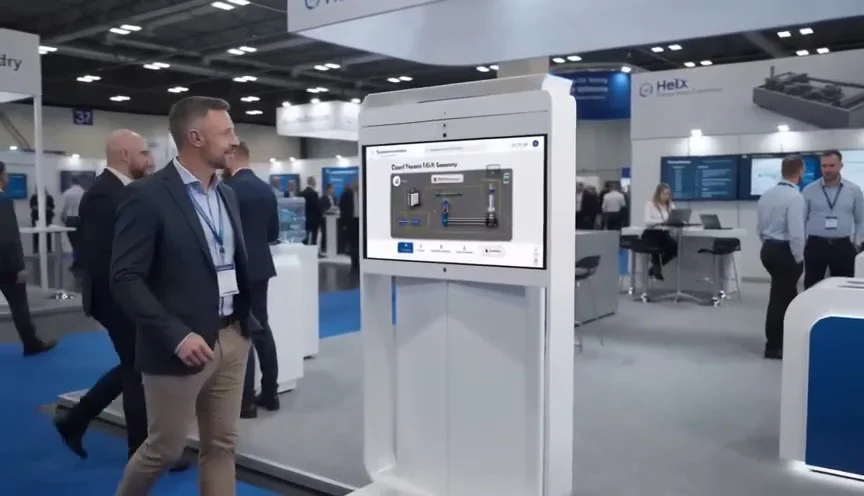
For a warehouse, floor-standing and wall-mounted options are important: they do not take up workspace, withstand a dense flow of employees, and easily fit into existing logistics.
A touchscreen kiosk with large buttons and clear labels works even with gloves, and the durable enclosure is resistant to dust and accidental forklift impacts.
We use professional equipment and proven development tools—so the system works reliably in warehouse conditions and does not “crash” at the busiest hour.
We will design the number of points for your format, think through scenarios for different employee categories, and prepare content that actually accelerates processes.
As a result, the company gets a single point of navigation and information that pays for itself through reduced downtime and fast staff adaptation.
How we implement kiosks in your warehouse
Implementing touchscreen kiosks in a warehouse is a project that affects employee productivity and shipping accuracy. We break the implementation into stages so you can see progress at each step and make adjustments without extra costs. Below is how we structure our work.
- Brief and warehouse audit — We start by reviewing your objectives and warehouse specifics: storage zones, traffic routes, and issue points. We identify problem areas where employees lose time and determine optimal kiosk locations.
- Navigation design — Based on the audit, we develop the menu structure and warehouse map. We work out search scenarios: by cell number, SKU, zone, or name. We agree on the prototype with you so the interface is intuitive.
- Kiosk setup and integration — We install touchscreen kiosks at selected points, configure the navigation system, and connect it to your warehouse management system. Thanks to integration, data on products and cells updates automatically—without manual intervention.
- Testing on real routes — We check how quickly an employee finds the required cargo and walk typical routes. We identify inaccuracies in the map or prompts and correct them before launch.
- Kiosk launch and staff training — We place the kiosks, launch them, and train employees. We explain how to use the system, how to assist visitors, and how to handle non-standard requests.
- Post-launch support — We stay in touch: monitor system performance, update navigation when storage zones or product ranges change, and collect feedback from staff.
What is included in the interactive kiosk delivery package
You receive not just a device, but a complete turnkey solution—from the enclosure to staff instructions. No self-assembly or hunting for missing parts: the entire package is delivered assembled and ready to operate in your warehouse.
The basic interactive kiosk includes:
- Enclosure, designed for intensive use in warehouse conditions—resistant to vibration, dust, and accidental forklift impacts.
- Touchscreen with a bright display that remains readable even under overhead lighting and near window openings.
- Software — a navigation interface with a warehouse map, product search, and route to the required zone. The composition and logic of the software are agreed separately and adapted to your product range and storage layout.
- Power supply system with surge protection so the kiosk operates reliably throughout the working day.
- Installation and connection — our specialists install the kiosk at the required location, configure the network, and verify operation on site.
- Instructions and warranty — clear documentation for employees, staff training, and an official warranty on the equipment and software.
This is a single package: you get a working navigation system, not a set of disparate components. Everything is already configured, tested, and ready to use—you just need to power on the kiosk and enter products into the system.
Real case: how we made cargo search three times faster
In logistics, time is money. While a warehouse worker searches for the required pallet using a paper diagram or asks colleagues, order picking comes to a standstill.
We received a task from a large logistics center: to ensure employees found cargo quickly and without errors, and that new workers no longer depended on "old-timers." On average, searching took 15–20 minutes, and even longer under heavy load.
How we changed the process
We installed interactive kiosks with touchscreens in the warehouse and developed a simple navigation system. An employee enters the order number or cargo name—the kiosk shows the point on the warehouse map and plots a route to the required cell.
The interface was deliberately simplified: even an employee seeing the kiosk for the first time needs only two taps. No paper diagrams, no dispatcher queues, no guesswork.
Implementation results
After two weeks of operation, cargo search time was reduced threefold: from 15–20 minutes to 5 minutes per operation. Picking errors dropped to nearly zero because the system suggested not only the location but also the sequence of actions when picking multiple items. The logistics center was able to accept more orders without expanding its staff.
The case showed that interactive warehouse navigation pays off not as a "lobby screen" but as a working tool that accelerates processes and reduces costs.
After the launch, the client ordered three more kiosks for the neighboring terminal—the same system now operates there.
How to choose the right kiosk format for your site?
Choosing a kiosk starts not with the model but with the site's tasks. For warehouse navigation, it is important to understand who will use the system and how: employees search for goods, drivers look for the unloading zone, visitors look for the exit. The kiosk type and placement depend on this.
The selection criteria are simple: area, traffic flow, operating conditions, and scenario.
In a large warehouse with a constant flow of employees, a floor-standing kiosk with a large screen is convenient—it is visible from afar, does not obstruct passage, and withstands intensive use.
In narrow aisles or rack areas, compact wall-mounted information panels work better: they save space and are always within sight.
It is also worth considering that the kiosk must cope with dust, temperature fluctuations, and accidental impacts. Therefore, for warehouses, protected enclosures are chosen, and for mobile tasks, portable stands that can be moved to the loading area.
The key is that the selected kiosk type is convenient for people and does not require constant supervision.
It is easier to select the right format together with the contractor: we analyze the traffic flow and the areas where navigation is most needed, and propose the optimal solution.
This way you get a kiosk that genuinely speeds up employee work and reduces search time, rather than just occupying space on the site.
Frequently asked questions about interactive kiosk development and support
Before ordering an interactive navigation system for a warehouse, every manager has the same questions: will the launch delay operations, is the kiosk strong enough, who will service the equipment.
We answer briefly and to the point—so you understand that you are working with a reliable contractor and getting a turnkey result.
We manufacture, configure, and support kiosks ourselves, so we provide honest timelines and a warranty on equipment and software. Below we address the most common client concerns—if your question is not on the list, just contact us.
How long does it take to implement a kiosk in a warehouse?
The standard time frame is 2 to 4 weeks after approval of layouts and the navigation structure. If a simple kiosk with a warehouse map and storage zone search is needed, we do it faster.
The timeline is affected by the number of navigation points, integration with your accounting system, and the design layout.
We work according to a clear plan: brief → approval → assembly and configuration → testing → installation. At each stage, you see progress and understand the launch date.
What warranty covers the kiosk and what does it include?
We provide a warranty on the enclosure, touchscreen, and electronics. During the warranty period, we repair the equipment and update the software for free. If the kiosk fails, we come to the warehouse or, in most cases, restore operation remotely.
We also sign a separate post-warranty service agreement—this is cheaper than buying a new kiosk after a breakdown.
Will the kiosk withstand warehouse conditions: dust, impacts, and continuous operation?
Yes, the enclosure and screen are designed for intensive use in industrial facilities. Tempered glass resists scratches and accidental impacts, and dust and moisture protection allows operation in unheated or dusty areas.
The touchscreen responds to touches even with gloves—this is important for warehouse employees. The equipment is designed for 24/7 operation, so the kiosk does not overheat or freeze.
Who will service the kiosk after launch?
We take on technical support: operators contact you by phone and remotely check the system status. If the problem cannot be resolved remotely, we visit the site.
For your team, it is enough to train one employee once on how to power on the kiosk and change information materials—we handle the rest.
What is included in the cost besides the kiosk itself?
The price includes structural design, navigation interface development, installation, configuration, and staff training. You also get access to a control panel where you can independently update the warehouse map and zone list without contacting developers.
Additionally, we can configure integration with your accounting system and enable analytics—how many people used the kiosk and what they searched for most often.
**Still have questions about a kiosk for your warehouse?** Leave a request—we will advise on timelines and cost for your task.Get a cost estimate for an interactive kiosk tailored to your task
An interactive kiosk in a warehouse must solve a specific problem: quickly find goods, suggest a route, accept requests. Leave a request for a free cost estimate—and we will prepare a proposal tailored to your specifics, without averaged figures or unnecessary options.
During the consultation, we will clarify where the kiosks will be placed, who will use them, and which storage zones the navigation will cover. Based on this, we will select the equipment, interface, and system composition. You will receive an estimate and a launch plan, not generic brochures.
What you get after contacting us:
- a free cost estimate for your task—we fix the scope of work after you describe the task;
- configuration selection: from an information reference to navigation across all warehouse zones;
- recommendations on the number of points and their placement to cover employee and guest traffic;
- clear project timelines and stages—from layout to launch;
- consultation on connecting to the accounting system and data exchange;
- post-launch support and a warranty on the entire system.
The estimate will be transparent: you know what you are paying for and what result you get at each stage. Leave a request for a kiosk—we will call you back within one business day, answer your questions, and prepare a customized proposal.