


Passengers get lost in the metro — how to restore their comfort and speed up the flow
Every day, thousands of passengers waste extra minutes looking for the right exit, transfer, or platform. A person in an unfamiliar subway feels stress, loses their bearings, and turns to staff or random passersby.
For the metro, this means not only passenger dissatisfaction but also slower flows during peak hours — people crowd corridors, create bottlenecks, and increase the load on personnel.
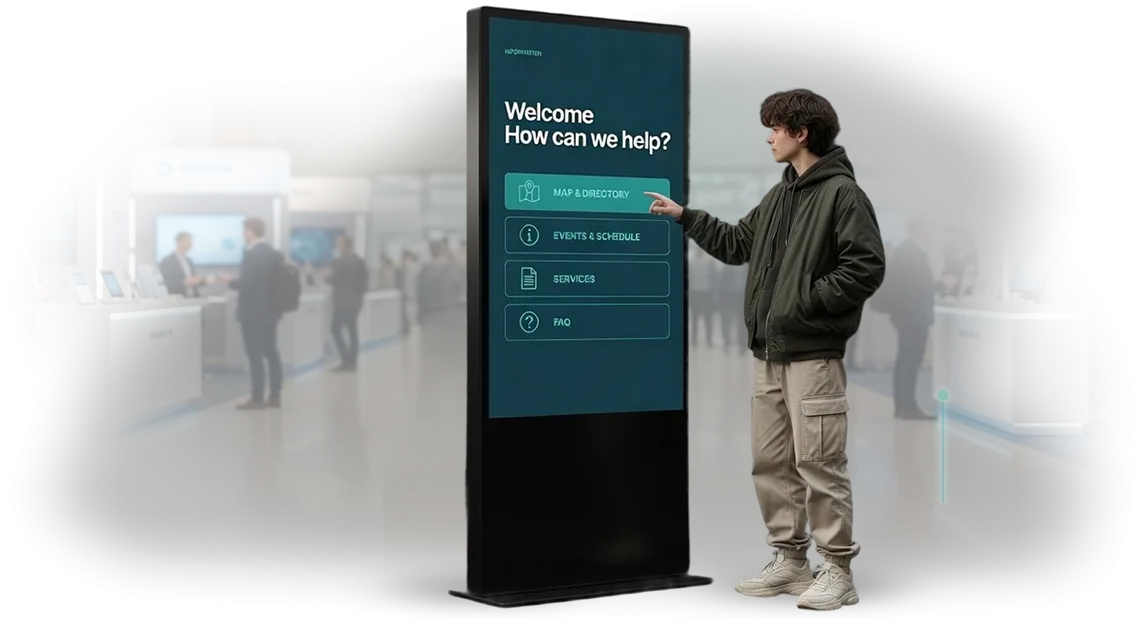
Clear metro navigation is not just signage but a system that guides a passenger from the entrance to their destination without unnecessary questions. An interactive kiosk helps build a route in 10–15 seconds, show the time until the train, and offer alternative paths.
The touch terminal works around the clock, never gets tired, and needs no breaks — a reliable digital assistant that relieves staff and accelerates passenger flow.
When a person easily finds their way, they return to the metro again and recommend it to others. The number of late arrivals drops, trip satisfaction grows, and the metro operator gains the ability to understand which destinations are in highest demand.
Passengers stop getting lost, the station runs faster — everyone gets comfort, and the operator gets efficient infrastructure.
We help metro systems and transport operators close this issue with interactive kiosks adapted to a specific station. We design scenarios based on passenger movement logic and deliver a turnkey solution — from interface setup to installation and support.
What the interactive kiosk gives passengers and the building owner
Metro passengers value speed: during rush hour there is no time to search for signs or stand in line at the information desk.
An interactive kiosk solves the issue in seconds — a person finds the right exit, transfer, or nearest facility on their own, and the building owner gets relieved staff and loyal visitors.
At our team we design kiosks that integrate into metro infrastructure and benefit both sides. Here is what the client gets:
- Convenience for passengers. A simple interface with no instructions: even someone using a touchscreen for the first time gets a route to the right place in 2-3 taps.
- Relief for the information desk. The kiosk handles typical questions: "where is the exit?", "how do I get to the transfer?". Staff deal with urgent tasks instead of repeating the same thing.
- Speed during peak hours. Fast response and clear prompts shorten the line at the navigation point, passengers reach trains more quickly, and the overall load on the lobby decreases.
- Visit analytics. Anonymized data on popular destinations shows which routes are used most often. This is the basis for improving navigation, rental decisions, and sign placement.
- Increased loyalty. Passengers remember that this building took care of them — they come back and recommend the venue to others.
Each item addresses a specific task: from guest comfort to benefits for facility management. The kiosk becomes not just a screen but part of the passenger service system.
Interactive kiosk formats for metro and transport
A metro passenger is not ready to stop: in a couple of minutes they need to figure out where to go, where the exit is, and how to transfer to another line. That is why the kiosk format must match the logic of the space — lobby, corridor, platform, or ticket area. Whether the kiosk is noticed and used depends on how well the enclosure and placement are chosen.
The decision is made in 2-3 seconds on the go. If the structure gets lost among columns or blocks the flow, even an excellent interface will bring no benefit. We select a format for the specific station's tasks so that navigation becomes a natural part of the route.
Which format solves your task
| Format | Who it suits | What it gives the client |
|---|---|---|
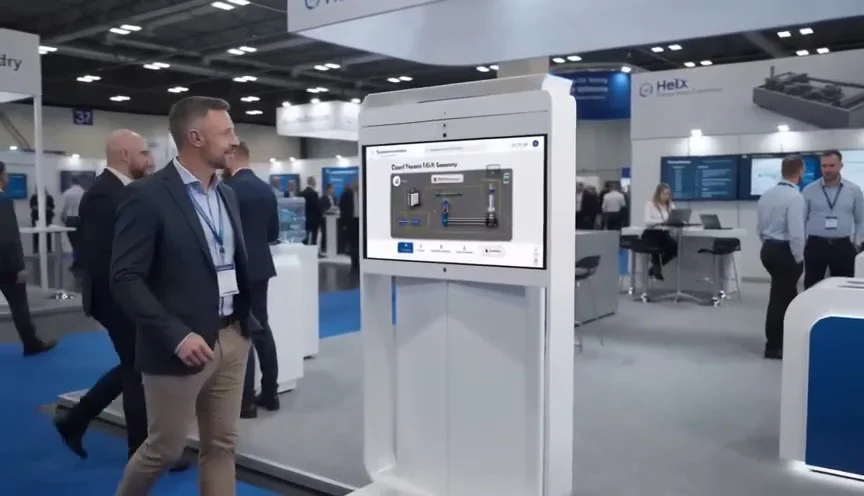
| Floor-standing kiosk | Lobbies and high-traffic areas | Visible from afar, relieves the information desk |
| Wall-mounted kiosk | Corridors, platforms, areas near escalators | Takes up no floor space, convenient for quick inquiries |
| Counter with touchscreen | Entrance areas, zones near ticket offices | Detailed requests: route, travel time, exits |
| Kiosk with route map printing | Large transfer hubs, railway stations | Passenger leaves with a map — fewer repeat questions |
We start every project with a space audit: we analyze passenger flows, visibility zones, load resistance, and vandal protection.
If several kiosks operate at one hub, they are combined into a single transport navigation system — data updates once and immediately appears on all screens.
How we develop an interactive kiosk: project stages
Developing a kiosk for the metro is a process where it is important not to miss a single stage: from the first brief to launch and maintenance. We have built a transparent path so that you understand what is happening and what result you get at each step. This saves time and budget at every stage.
- Brief and task analysis — we define goals, passenger flow, placement area, and kiosk usage scenarios, as well as the work plan and timeline.
- Kiosk and navigation design — we develop the screen structure, route map, and search logic so that a passenger finds what they need in a couple of taps.
- Project approval — we show an interactive mockup of the future kiosk before production and make changes without extra costs.
- Production and installation — we manufacture the enclosure, install the equipment, and configure it for the specific station without stopping passenger flow.
- Launch and training — we put the kiosk into operation, train the staff, and hand over clear instructions.
- Maintenance and development — we regularly update content, monitor the kiosk's condition, and refine navigation when infrastructure changes.
This approach removes the risks of an unapproved mockup, missed deadlines, and a kiosk that does not meet passenger needs. You get a predictable turnkey result — no surprises and no hidden work. As a result, the kiosk works for passengers instead of demanding constant attention.
What is included in the interactive kiosk delivery
When you order an interactive kiosk, it is important to understand in advance what is included in the delivery. We put together a turnkey package so that no unresolved questions or hidden costs remain.
- Kiosk software. A full navigation system with metro maps, station and route search. It is easy to update and configure to the metro's needs.
- Interface design. Clear screens with large buttons and contrasting colors — visible even in bright light. We adapt the design to your corporate style.
- Kiosk hardware. A touch device with a protected enclosure, moisture protection, and a bright screen. Suitable for intensive use in public spaces.
- Kiosk installation. Delivery, floor or wall mounting, connection to power and network, configuration, and testing. You receive a kiosk ready to work.
- Staff training. Instructions for employees: how to update data, change maps, and handle typical situations. Training takes a few hours.
- Support and warranty. A year of free maintenance: updates, remote support, and replacement of components if needed.
In the end, you get a single package — from idea to a working kiosk. You don't need to look for separate contractors or dive into technical details.
Case study: how a kiosk reduced queues in the lobby
A metro lobby during rush hour is always a load on ticket offices and information desks. Passengers waste time, staff answer the same questions, and queues grow at the ticket offices during peak hours.
We took on the task of shifting part of the inquiries to interactive kiosks: so that a passenger could find a route, fare, or map on their own — without waiting at the window.
The result exceeded expectations. After the kiosks were launched in the lobby, queues at the information desk shrank by almost half, and the average time to get information dropped from three to five minutes down to one.
Over a month, each kiosk served several thousand passengers, and most visitors handled it without staff help. For the metro, that means reduced staff load and higher passenger satisfaction.
The director of passenger service highlighted the main point:
Metro
Passengers stopped crowding around the information desk and ticket offices, and our staff gained time to help people who really need assistance. Queues in the lobby became shorter even during the busiest hours.
The case showed that interactive kiosks are not a replacement for live communication but a way to remove routine. A passenger solves simple questions on their own in 30-60 seconds, while staff focus on complex situations. The same result can be replicated at any transport hub — from a railway station to an airport.
What if the kiosk is needed in an unusual location or with special requirements?
A kiosk rarely lands in an ideal spot: columns, sloped walls, electrical limitations, safety requirements, and in the metro — also high traffic, vibrations, temperature changes, and humidity. This is a normal situation, and we are ready for it.
We have experience installing kiosks in unusual places — from metro lobbies to historic buildings where walls cannot be drilled or layouts changed.
Individual requirements do not scare us; they are engineered. We start with a site survey: we measure the space, study people flows, check access to network and power, and identify restrictions.
Based on this, we propose a solution that fits the interior, does not disturb passengers, and passes approval.
If a standard enclosure does not work, adapting the kiosk to the site is a regular part of the job: we change the size, shape, and materials, add vandal-resistant construction, and select mounting for the floor, wall, or ceiling.
The technical side is also our responsibility. We handle the software development, remote monitoring setup, and content updates. You don't need to understand how everything works: you get a turnkey kiosk — with installation, launch, and support.
The system stays flexible: if tomorrow you need to change the map, add a new route, or change the screen design, it can be done without stopping the kiosk.
So we answer directly: yes, a non-standard kiosk with special requirements is a solvable task. We take on all the complexity — from surveying the unusual site to commissioning. You get a working tool that solves the navigation task and requires no engineering expertise from you.
We answer common questions about kiosk reliability
A kiosk in the metro operates around the clock in high-traffic conditions. Equipment failure means disrupted navigation and unhappy passengers. Our team answer the key questions about reliability so that you can make a decision without doubt.
How is 24/7 kiosk operation ensured?
We use industrial components designed for round-the-clock operation. The enclosure protects against dust and moisture, and the monitoring system warns about failures. The kiosk runs without reboots even during peak hours.
What is the kiosk's service life?
The service life is 7–10 years of active use. The metal structure and touchscreen withstand intensive loads. With timely maintenance, the kiosk keeps its appearance and functions for the entire expected period.
What does kiosk maintenance include?
Maintenance includes equipment inspection, navigation software updates, and replacement of consumables. We can take on support ourselves — this will reduce your costs and extend the life of the kiosk.
What warranty applies?
We provide an official warranty on equipment and installation. If a fault occurs, we resolve it promptly. The warranty can be extended — this will protect the budget from unexpected expenses.
If you still have questions about reliability, maintenance, or warranty — just write to us. We will advise you on how to extend the kiosk's service life and reduce operating costs.Shall we discuss your interactive navigation project?
Shall we discuss your interactive navigation project? Then you can assess how the kiosk will fit into the passenger flow, which usage scenarios will bring maximum benefit, and how long development will take. This is free and non-binding — you get specifics, not general words.
After the initial consultation, you will receive:
- A preliminary estimate for the navigation project: timeline, stages, scope of work, and recommendations on the kiosk format for your tasks.
- A selection of scenarios for passengers — from route building to finding the right exit, taking into account the specifics of your facility.
- Placement assessment: where to install the kiosk so that it does not obstruct the flow and brings maximum benefit.
- A transparent estimate without hidden items — you immediately see what you are paying for and can compare it with alternatives.
- Examples of our completed projects and contacts of clients who are ready to confirm the results.
- A clear action plan: what is needed from you, what we do, and what data will be required at the start.
This approach lets you order a kiosk with confidence that it will be useful to passengers and will not cause trouble for your team. We use professional equipment and take on the entire development — from interface to launch and support.
Leave a request for a kiosk consultation. We will contact you within one business day, answer your questions, and prepare a personal proposal. It will take no more than 15 minutes and will save you weeks of back-and-forth.