


Why guests get lost in a model home and don’t come back
In a model home, from the very first minute a visitor encounters dozens of zones, samples, and formats: furniture, finishes, lighting, plumbing — it’s overwhelming.
The right department or product is often tucked away at the back of the hall, and there aren’t enough signs and landmarks to quickly choose a route.
As a result, the guest wanders in circles, wastes time, and leaves without buying — thus the company loses customers who had already arrived with the intention to choose.
The problem is not the assortment but visitor navigation: when the route isn’t obvious, a person trusts first impressions. They lack a quick answer to simple questions: where is the needed category, how to get to the exit, how long the tour will take.
If there is no answer, the guest decides it’s too confusing and goes elsewhere to find what they need.
The consequences show up in business metrics: conversion to sales drops, repeat visits become rarer, word of mouth weakens. Guests who didn’t find what they wanted are unlikely to return — and along with them go recommendations and future orders. This is a quiet revenue leak: it isn’t obvious, but it directly affects results.
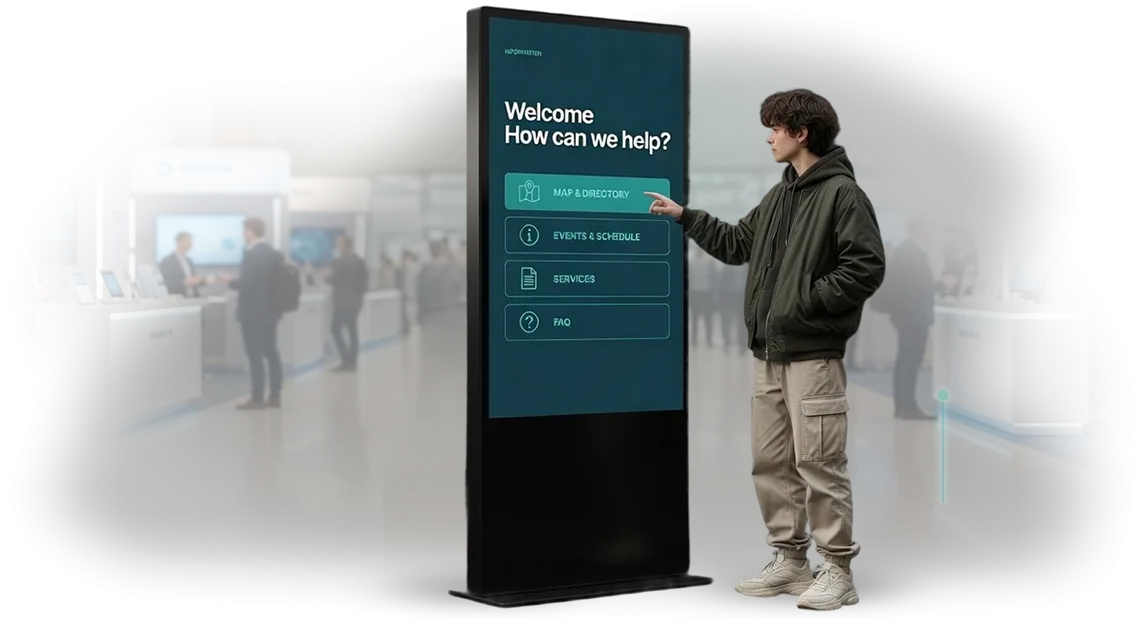
The solution is clear navigation that accompanies the guest from the first minute. Interactive kiosks help visitors quickly orient themselves in the hall, show a short route to the desired zone, and answer questions right away.
This way the space stops being intimidating and starts working to increase sales, and visitors return to exploring with interest rather than irritation.
When a guest easily finds what they need, they choose more calmly and are more willing to return — and this directly affects guest loyalty and order regularity.
A well-designed navigation system turns a one-time visit into a habit and makes the model home a place people want to return to. We help bring order to the space so every visitor leaves with a purchase.
What interactive navigation brings to your business
Fast search — better service without extra questions
Visitors to a model home arrive with a specific goal: to find the right apartment, department, showroom, or meeting room. An interactive navigation kiosk shows the route in seconds — without queues, questions, or unnecessary detours.
This reduces search time and lowers stress: people reach their destination faster, and service quality rises in their perception.
Increased brand recognition and company image
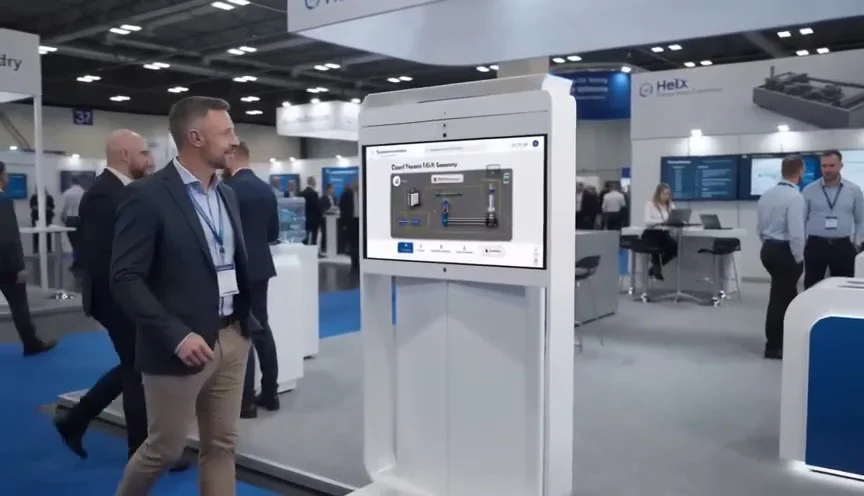
A touchscreen kiosk is immediately perceived as a sign of technological sophistication and reliability. In a model home, it sets the brand apart from competitors and becomes a point of attraction for visitors.
Guests happily photograph the unusual screens and share their impressions on social media — that’s free reach and a stronger image as a modern company.
Upselling and higher conversion
Navigation can suggest related facilities: a café, a lounge area, an accessories showroom, designer services. When visitors see additional offers on the way to their destination, some of them stay longer and explore more options.
This turns the kiosk from a directory into a tool for raising the average ticket and increasing conversion.
Reducing staff workload
Consultants stop answering the same "where is..." questions and spend time on actual sales. The kiosk handles routine navigation requests, while staff focus on warm clients. This increases team productivity and reduces the cost of additional hiring during peak hours.
Touchscreen kiosk formats for a model home
In a model home, an information kiosk isn’t just a "screen on the wall" but a full-fledged sales tool. The guest quickly understands floor plans, materials, and mortgage terms, while the manager spends time on negotiations rather than repeating standard answers. To find the best option for your facility, we distinguish four main formats.
Main formats
| Format | When to choose | What the client gets |
|---|---|---|
| Floor-standing kiosk | There is a spacious entrance area, need to greet visitors immediately | The guest immediately gets involved with the project, navigation works without staff involvement |
| Wall-mounted kiosk | Space is limited, there are free walls or narrow corridors | Saves space without losing functionality: floor plans, floors, and extra materials in a few taps |
| Window kiosk | Want to attract attention from the street or lobby | Interactive window display raises interest before any conversation, increases spontaneous visits |
| Touchscreen counter | Need an information center by the reception that people can approach | Relieves the administrator: customers explore the property on their own while the tour is being prepared |
All formats run on a single content management system, so you can update floor plans, promotions, and construction timelines without calling a contractor. We’ll help you choose the format and placement free of charge — we’ll send a layout based on your floor plan.
How the project progresses: from brief to launch and training
Navigation in a model home is a visitor’s first impression and a tool that helps them quickly find their way and stay longer. We have structured the development process so you see intermediate results at every stage and know when everything will be ready. Below is the standard project path: from brief to staff training and ongoing support.
-
Brief and immersion. We get to know the model home, find out who your visitors are, which zones need navigation, and what questions they ask most often. Based on this, we build kiosk usage scenarios — so it meets the real needs of guests.
-
Plan and approval. We prepare the menu structure, floor map, and search logic, and define implementation timelines. We approve the plan with you before starting work — you see in advance what the result will be and can make changes at this stage rather than after launch.
-
Implementation. We create the kiosk interface and fill it with information about floor plans, models, and promotions. We show you intermediate versions and make adjustments quickly so the result matches the style of your model home.
-
Testing. We test the navigation on a real touchscreen — we go through visitor scenarios, find and fix errors. By opening time, the kiosk runs without glitches, even when the lobby is crowded.
-
Kiosk launch. We install the equipment in a suitable spot, customize it to your interior and operating hours. We carry out acceptance testing together with you — you see the finished result and make sure everything works.
-
Staff training. We show your administrators how to update information about new products, change promotions, and add floor plans. Training takes a couple of hours, and then employees work independently without constantly contacting developers.
-
Support. After launch, we stay in touch: answer questions, update content, and refine features if needed. You always know who to contact — and the kiosk keeps delivering value without downtime.
What’s included in the delivery and what options can be added
We handle the entire cycle — from design to launch and ongoing support. The delivery package includes everything needed for the touchscreen kiosk to start working in your model home right after installation: equipment, interface, content, installation, and warranty service.
Below is the package contents and options that expand the kiosk’s capabilities.
- Touchscreen terminal — professional equipment with a vandal-resistant housing and bright screen, designed for heavy visitor traffic and requiring no special maintenance.
- Kiosk interface — a convenient floor plan catalog, search by floor, and filters by square footage. Visitors find the needed information in a few taps without distracting consultants.
- Content — plans, visualizations, comparisons, and descriptions of advantages. Content is easy to update: you add promotions or new projects yourself without developers.
- Installation and commissioning — we set up, connect, configure, and verify operation. Launch takes one day — the terminal is ready to use immediately.
- Warranty service — diagnostics, preventive maintenance, content updates, and quick replacement of components. A dedicated engineer resolves issues without downtime.
- Lead capture option — print floor plans or send them to the visitor’s email. The client takes materials with them, and you get a contact for follow-up communication.
- Integration with your accounting system — view and request data is automatically sent to managers. You see which floor plans interest the audience and adjust your presentation.
Example: navigation that increased conversion in a showroom
In the showroom, visitors get lost: they don’t understand which display model is where, wander in circles, and leave before they have a chance to get interested in new apartments.
This reduces the number of inquiries and forces consultants to answer simple questions instead of negotiating purchases.
The client — Model Home "Etazhi" — faced this directly: there was visitor traffic, but conversion into dialogue with a salesperson was low.
We replaced paper signs with an interactive navigation system featuring touchscreen kiosks at three locations: at the entrance, at the corridor fork, and near the children’s area.
What changed
Guests choose an interesting display model themselves, get a route, watch photos and short videos with floor plans, and save favorite options to a collection — a QR code sends them to their phone.
Concierges were freed from the "where is the bathroom?" question and focused on sales. The system adapts to hall traffic and suggests less busy routes on weekends.
Results in the first month
Average time spent grew from 15 to 40 minutes, and inquiries at the registration desk increased by 45%. The share of visitors who signed up for a consultation after a self-guided tour went up by 20%. The client ordered the same navigation for a second hall and uses it when launching new complexes.
"Guests feel that the space guides them — this directly influences the desire to stay and ask a question," noted the sales director.
What if you have specific requirements for the kiosk?
Specific requirements are not a limitation but an opportunity to make the kiosk exactly for your needs.
In a model home, a standard enclosure and typical interface often clash with the concept: sometimes dimensions don’t fit, sometimes the design conflicts with the exhibition, sometimes visitors expect different functionality. That’s why we focus on individual requirements from the start, not on ready-made templates.
The work begins with studying your space and audience. We find out where the kiosk will be placed, what tasks it should solve, and who the main user will be.
Then we propose a solution that may include a custom kiosk — an embedded panel, a floor stand, or an unusually shaped touchscreen.
If a specific design is needed, we adapt the appearance to the materials, colors, and interior style so the kiosk looks like part of the space, not a temporary technical solution.
Interface adaptation is no less important. We will configure the section structure to match the exhibition logic: large buttons for quick navigation, multilingual support for foreign guests, and additional screens with information about current projects. At the same time, we preserve the brand’s corporate style and ensure clarity for any age group.
In the end, you get navigation that solves its tasks invisibly for guests: visitors orient themselves easily and enjoy the process, while the kiosk does not argue with the room’s design.
We take care of the technical side: equipment, a well-tuned system, launch, and post-launch support. Tell us your wishes — and we’ll offer an option that works specifically in your model home.
Answering questions about reliability and ROI
The first thing clients ask is whether the kiosk will fail during a presentation in the model home and how easy it is to update floor plans. These are valid concerns: navigation affects a guest’s first impression. We address them at the design stage.
What happens if the equipment breaks down during a presentation?
The kiosks are built on professional industrial components designed for non-stop operation. We include remote monitoring: the system reports failures before the guest notices them. If a problem does occur, a replacement unit will arrive within a day — the presentation won’t stop.
Is it difficult to update information about homes and prices?
No. Content is changed through a simple control panel: you can upload new files or edit text in the browser. Your employee can do this without a programmer in a couple of minutes. The kiosk always shows current data, not last month’s information.
Are the investments in the kiosk justified?
It pays off through three things: freeing up the consultant, increasing guest time, and collecting contacts. In the low season it works as a brand showcase and does not require a salary.
our team clients report increased interest in floor plans and repeat visits thanks to clear navigation.
We support the system: warranty, updates, and consultations are included in the contract. You get a working sales tool you don’t need to worry about.Let’s discuss your interactive navigation project today
You already know how an interactive kiosk changes the impression of a model home: visitors find the right floor plan themselves, compare floors, and stay on site longer. But every facility has its own goals, budgets, and timelines.
That’s why we start with a free consultation and a cost estimate for your project, not with a template commercial proposal.
For 10+ years, we have implemented dozens of navigation kiosks for developers and showrooms, where the main thing is a customer-friendly scenario, not the technical internals.
By contacting our team, you get a team that works remotely and turnkey: from idea to installation and support.
What you get after submitting a request:
- Cost and timeline estimate for your model home — without hidden charges or "surprises" in the budget.
- A recommendation on the kiosk format: floor-standing, wall-mounted, with a touch panel, or a stationary counter.
- Launch plan: brief, design concept, manufacturing, installation, content, and testing.
- Examples of our work for similar facilities and client testimonials you can contact.
- A personal manager for the entire project — responds within a day, not "duty support."
- Post-launch support: floor plan updates, material replacements, and prompt assistance.
Leave a request on the website — we’ll call you back within a day, calculate the cost, and offer a plan that fits your timeline. Launch navigation that sells floor plans, not just shows a map.