

Lost Guests in a Hotel — a Direct Loss of Profit
A guest who cannot find the restaurant, spa, or conference room is lost profit, not a minor detail. Every minute of wandering adds irritation: guests are late for their bookings, miss the start of events, and begin to doubt the level of service.
Negative emotions turn into restrained reviews and fewer repeat visits — harming not only reputation but also revenue.
Front desk staff are forced to leave guests with "how do I get there" questions in order to explain directions and hand out paper maps.
The queue at the counter grows, calls go unanswered, and employees spend hour after hour on wayfinding instead of selling additional services. As a result, the hotel loses both time and money — from missed restaurant bookings to unnoticed spa treatments.
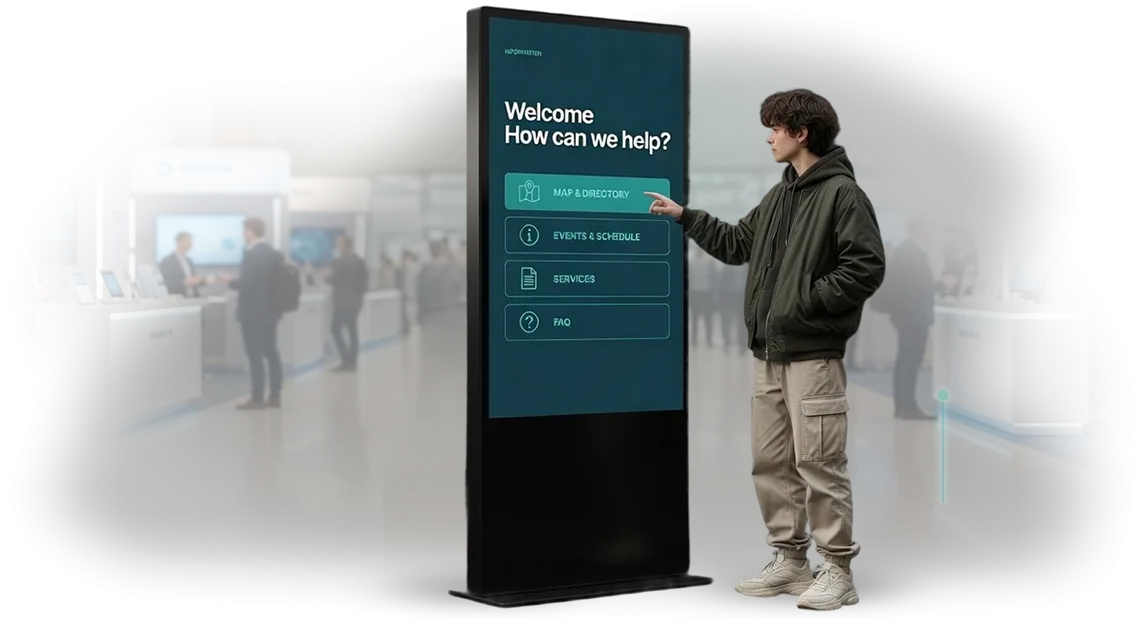
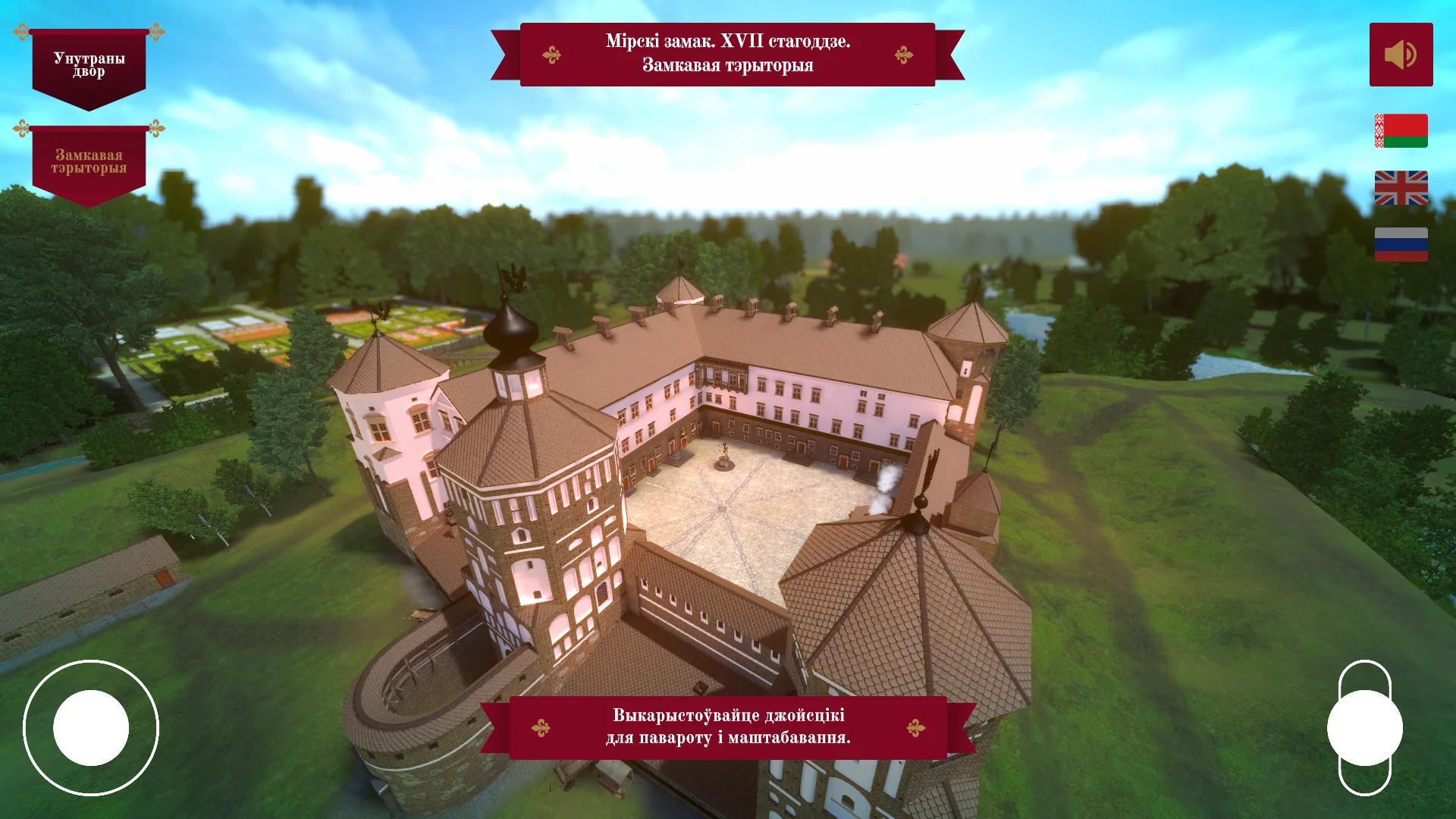
Interactive wayfinding kiosks address this pain point immediately. On the touchscreen, guests see a map, a route to the desired destination, the event schedule, and the option to book a table or a session — all in a couple of touches, without queueing or waiting. The kiosk works around the clock, answers typical questions, and relieves the front desk.
At our team we have been building such solutions for hotels and resorts for more than 10 years, so we know how to turn a simple screen counter into a tool for service and upselling. The guest is satisfied — they don't get lost, make it to their booking, and remember the care.
The hotel earns more: a higher average check, more orders for additional services, and calmer staff.
What an Interactive Kiosk Brings to Your Business
Every guest arrives at a hotel to check in quickly and start their rest or work. But it is at the front desk that queues most often arise: registration, finding a booking, and handing out keys take 10–15 minutes per person.
The interactive kiosk takes the routine work upon itself — the guest completes identification in a couple of minutes, and the administrator gets involved only in non-standard situations.
The desk stops being a bottleneck: guests don't accumulate frustration, and you have time for live communication with those who need help.
The kiosk also works as an upselling tool. At check-in, the guest sees offers that are hard to ignore: a room upgrade, breakfast at the restaurant, a spa treatment, a transfer, or an excursion.
The hotel gets a recommendation channel that doesn't depend on how busy the administrator is. This is convenient for the guest, and every additional order increases the average check of the stay.
Front desk automation frees staff from repetitive actions. Instead of printing forms and transcribing passport data, the administrator focuses on guest care: welcoming, advising, and resolving issues.
The kiosk collects statistics on check-ins and preferences, helping to plan occupancy more accurately and personally offer services on the next visit.
An additional benefit is the impression. A high-tech kiosk looks modern and creates the feeling that the hotel is keeping up with the times. Guests more often return to places where they were welcomed without fuss and queues, and recommend such places to acquaintances.
In this way, an interactive wayfinding system works for loyalty not only at check-in but also after departure.
In the end, the kiosk pays for itself through faster check-in, additional sales, and more repeat visits. It is not a replacement for staff but a tool that makes the hotel run faster and more profitably.
Interactive Kiosk Formats for Hotel Tasks
Hotel guests value independence: quickly finding a restaurant, booking a spa session, or calling a taxi without queueing at the front desk. But the same kiosk format is not convenient both in the lobby and by the pool — each scenario needs its own variant.
We select the construction to match the tasks of a specific zone, so that the technology simplifies life for guests and relieves staff.
| Kiosk format | Where to place | What it gives guests and the hotel |
|---|---|---|
| Floor-standing kiosk | Lobby, entrance area, front desk zone | Helps guests independently build a route: room, restaurant, meeting rooms, spa. Reduces the flow of repeated questions to the administrator and creates the image of a high-tech hotel. |
| Wall-mounted kiosk | Corridors, elevator lobbies, spa entrance | A compact touch panel for point-to-point wayfinding and booking treatments. Takes up no usable floor space and is located where the guest has a question. |
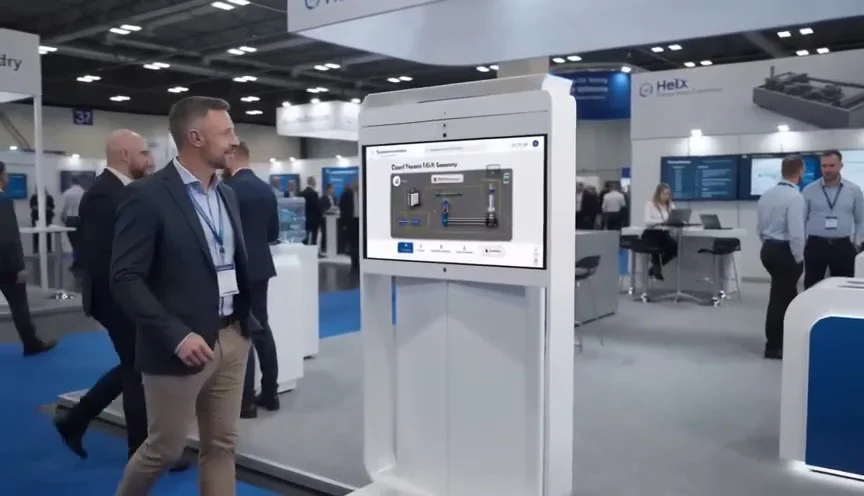
| Touch panel on a counter | Restaurant, lobby bar, lounge area | Quick viewing of menus, additional services, and table reservations. Speeds up service, increases the average check, and reduces the load on waiters. |
Formats are easy to combine: a floor-standing kiosk in the lobby, wall panels in the corridors, and a touch panel in the restaurant create a unified wayfinding system. The guest sees the same interface at every point and doesn't waste time learning it again.
We design the interface and select the construction to fit the layout and style of your hotel, and after launch we support the system — we update maps, add services, and monitor stable operation.
How the Project Works: From Brief to Launch
We have structured the process so that you deal not with technical details but with controlling the result.
The development stages are clear and the timelines are transparent — from the first brief to a working kiosk usually takes three to four weeks, depending on the scope of content.
- Brief and needs audit. We meet and discuss guest flow, key hotel zones, wayfinding scenarios, and the tasks the system should solve. You receive a clear project plan with the scope of work and timeline milestones.
- Concept and scenario prototype. We propose the menu structure, search logic, and sections: restaurant, spa, conference rooms, services. We agree on the "skeleton" of the future system before resources are invested in the design.
- Design mockups and approval. We create visual mockups in the hotel's style — your logo, brand colors, photographs. Mockup approval goes quickly: edits are made at this stage, not after launch.
- Development and content. We build the kiosk project and upload the information: maps, service descriptions, contacts, special offers. You receive test access and see how the system works with real content.
- Testing and adjustments. We check guest scenarios, response speed, navigation convenience, and the absence of errors. You give feedback, and we refine the interface to the expected result.
- Kiosk installation and launch. We deliver the equipment, install it, connect it, and configure the system on site. We conduct training for staff so they can help guests and quickly resolve minor issues.
- Technical support. We stay in touch after launch: we update information, monitor stability, and respond promptly to requests. The kiosk becomes part of the hotel's service and works without your involvement in the technical side.
What's Included in the Delivery: A Launch Kit
When a hotel orders interactive wayfinding, it's important to understand: you are getting not just "hardware" but a ready-made solution. We have put together a package that already contains everything needed for launch — from interface design to staff training. All that's left is to turn the kiosk on in the lobby.
The standard delivery includes not only a touchscreen kiosk in a protective housing, but also licensed software and an interface designed around your brand. Here is the full checklist of what you receive.
-
Licensed software — already installed and configured for your hotel's map. Updates and technical support are included; you don't need to understand the technical details.
-
Interface design — developed in the hotel's brand style: floor plans, signage to rooms and restaurants, information about services. The interface is intuitive for guests of any age — they find what they need in a couple of touches.
-
Touchscreen kiosk and installation — we deliver and install the equipment in the lobby or front desk area. We connect, configure, and verify operation — you get a turnkey solution without involving your own IT department.
-
Instructions and regulations — short guides for staff and guests. No complicated documents: only what's needed for daily work and a quick start.
-
Staff training — we conduct a session for administrators and the reception team. After training, your employees can independently update information on the kiosk: change promotions, event schedules, and important announcements.
-
Warranty and post-warranty service — the equipment and software are covered by warranty, and phone and remote support are available throughout operation. If anything happens — we're in touch.
All of this is part of the standard package, with no hidden surcharges. You get a measurable result: guests find their way around the hotel faster, approach the front desk less often, and your team has more time for guest care.
Case Study: Wayfinding for a 150-Room Hotel
Guests at a 150-room hotel constantly ask the same questions: where is breakfast, how do I get to the spa, when does the pool open.
Front desk administrators spend most of their shift on these questions — and don't get to the main work: check-ins, handling non-standard situations, and offering additional services.
We installed a touchscreen kiosk in the lobby of the Sea Pier hotel — and it took over the routine requests. The guest finds the answer on the screen in 30–40 seconds without distracting the staff.
The kiosk showed the property map, restaurant and spa schedules, and offered guests things they didn't know about: excursions, a rooftop dinner, late checkout.
What Changed in Numbers
- Peak-hour front desk load dropped by 40% — administrators stopped being an "information bureau."
- The guest satisfaction index grew by 18%: quick answers and clear wayfinding removed the main source of irritation.
- Upselling of spa and restaurant services grew by a quarter — the kiosk became an additional offer channel that works without staff involvement.
Two months later, the hotel ordered an expansion of the system: floor plans and an events menu were added.
According to the general manager, the kiosk paid for itself in one season, and most importantly, guests began coming to the desk less often with trivial questions, and service stopped "slowing down" on busy days.
Now this wayfinding format is the standard for hotels that value both guests' time and employees' time.
How to Choose a Kiosk Format for Your Task?
Choosing a kiosk format starts not with the model but with the task it must solve in your hotel. If guests most often look for restaurants, the spa, and check-in times, a compact touchscreen kiosk with wayfinding and a map is enough.
If you need self-check-in, payment for additional services, and document printing, you will need a configuration with additional modules.
Therefore, the main criterion is the usage scenario: the more actions the guest performs independently, the more functional the kiosk should be.
The second criterion is the installation location and intensity of use. A kiosk in the lobby near the administrator's desk operates constantly and must handle a high load.
For this, we use professional equipment with a protected screen and a durable housing — it doesn't overheat, doesn't glare, and doesn't fail after hundreds of touches a day.
For an area near the elevator or restaurant, a lighter model will do; the main thing is that the interface is large and clear even for guests seeing the kiosk for the first time.
Budget also affects the choice, but here it's important to look not at the device price but at the economics of the whole system. A kiosk that takes the load off the front desk saves hours of staff time every day.
If it frees the administrator for at least 20–30 minutes per shift, it pays for itself faster than it seems. So before the purchase, we calculate with you which operations should be moved to the kiosk and which are better left to the staff.
Finally, consider the future: the format should be easy to update. The restaurant menu, the entertainment schedule, the property map — all of this changes.
An ideal kiosk doesn't require rewriting the system — you or our team update the content remotely, without calling out a specialist or downtime.
This is the approach we build into every project: you choose not just hardware, but a system that will serve your hotel in a year and in three.
Frequently Asked Questions About Kiosk Implementation
Implementing touchscreen kiosks often raises questions at the discussion stage. It seems complicated: you need to change processes, connect new systems, train staff.
In practice, most concerns are resolved before launch — if you are working with a team that has already done such projects.
We have gathered answers to the most common questions we hear from hoteliers. No magic — only clear stages, realistic timelines, and a result that guests and administrators feel right away.
Is it difficult to install a kiosk in the hotel lobby?
Installation takes one day and doesn't require stopping front desk operations. The kiosk is placed near the entrance or the waiting area — where it's convenient for guests and no queue is created.
All the connection comes down to a power outlet and internet access, and the housing is stable and safe for children.
How does the kiosk connect to our hotel management system?
We integrate the kiosk with your current system (PMS) — this is a standard task for our team. The guest checks in, books, or receives information, and the data immediately flows into the relevant management systems. Staff won't have to re-enter data or duplicate operations manually.
What happens if the kiosk stops working?
It keeps operating autonomously: even if the network is lost, the main scenarios remain available, and data is saved and transmitted once the connection is restored. Round-the-clock monitoring and quick equipment replacement in an emergency are provided. You won't be left without the system on your busiest day.
How long does implementation take?
From contract signing to launch usually takes two to four weeks. This period includes scenario setup, integration with your system, testing, and staff training. If the hotel already works with a modern management system, the timeline can be even shorter.
Will the staff handle the new tool?
We don't just install the kiosk — we train administrators and housekeeping staff, which takes a couple of hours. The interface is intuitive: guests can manage without prompts, and employees use the panel to manage the front desk and monitor occupancy. No complicated regulations.
Order Interactive Kiosk Development
Ordering an interactive kiosk for a hotel is simple. Leave a request on the website, and by the next business day you will receive a free estimate of the cost and timeline. No obligations: we will analyze the task and offer the optimal solution for your budget.
The development process takes from 10 business days and consists of clear stages:
- Request and a short brief — 10–15 minutes.
- Free estimate and commercial proposal — 1 business day.
- Contract, interface refinement, and design mockup — 2–3 days.
- Feature development and content — 5–7 days.
- Testing on real equipment, installation in the lobby, and staff training — 1–2 days.
What you get when ordering a kiosk from our team:
- For guests — an interactive hotel map and clear wayfinding without front desk questions.
- For the administrator — a simple content update system without a programmer.
- For the brand — brand style and special offers that increase sales of additional services.
- For you — stable equipment operation and a warranty on software and service.
- Technical support and functionality refinements after launch.
The development cost depends on the number of languages, the complexity of the map, and integrations (booking, staff call). You can clarify the price and timeline at the free estimate. Leave a request — we will send a personal proposal within one business day.