

Visitors get lost in the shopping mall and leave without buying
Every visitor who cannot quickly find the store or café they need is lost revenue. They arrived with the intention to buy, but after a few minutes of wandering the floors, they leave empty-handed with a bitter aftertaste.
For the shopping mall, this is not just an inconvenience — it's a direct threat to conversion: the guest remembers the negative experience and returns less often.
Complex layouts, multi-level galleries and dozens of boutiques make navigation a real challenge even for experienced visitors. On average, a person spends 10–15 minutes just getting their bearings — time stolen from browsing storefronts and talking to sales staff.
In the end, both tenants, whose products go unnoticed, and the mall itself suffer, as the complex loses repeat visitors and its appeal to new tenants.
Traditional paper signs and static floor plans at the entrance are a passive solution. They cannot suggest a shorter route, react to closed walkways or offer an alternative path.
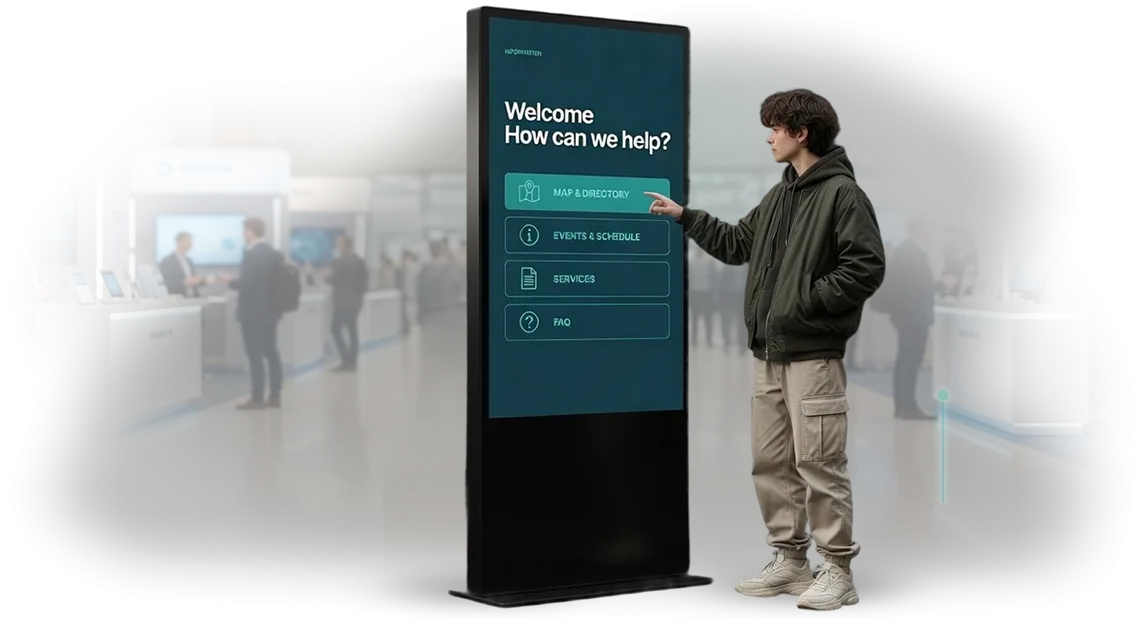
Interactive navigation on touchscreen kiosks is a live assistant for every guest: it instantly finds a store by name or category, shows the route on a map and accompanies the visitor along the entire journey.
A visitor who navigates with ease spends more time in the mall, manages to stop by additional departments and makes more impulse purchases. They leave satisfied, return more often and recommend the mall to friends and family.
That is why well-thought-out navigation is not a technical convenience but a working tool for customer retention and higher sales for all tenants.
We help shopping malls solve this challenge systematically: we develop interactive kiosks that are clear to guests of any age, withstand heavy use and run without failures.
The main thing for us is that every visitor finds the store they need without effort — and the mall owner sees growing satisfaction and a steady increase in revenue.
What an interactive kiosk brings to your business
A mall visitor arrives with a specific goal — to find a store, a café or a restroom. When they waste time searching, it causes irritation, and the brand loses value in their eyes.
An interactive wayfinding kiosk solves this instantly: the guest chooses a category, sees the map and follows the optimal route. For you, this is not just convenience but a tool for managing attention.
The kiosk's main advantages are visitor engagement and brand recognition. A bright touchscreen catches the eye; the person spends a few minutes with it, browses the store directory, checks promotions and special offers.
An ordinary route turns into a small journey through your tenants, and every screen works to etch your name into memory.
Upselling deserves a separate mention. Banners, coupons or a loyalty card can easily be placed on the kiosk, and the guest can send them to their phone.
This turns navigation into a personal promotional channel: you don't just show the way — you nudge visitors toward a target action, such as visiting a particular store or promotion.
To keep the system running without failures at peak hours, we at our team use industrial touchscreens and rugged enclosures built for round-the-clock operation.
For more than 10 years we have been developing such kiosks for shopping malls and know how to make an interface clear even to those using a touchscreen for the first time.
As a result, the kiosk becomes an independent communication channel: it boosts loyalty, increases the average ticket and benefits every tenant. You get not just a technical solution but a growth point for your business.
Interactive kiosk formats for a shopping mall
Each kiosk in a shopping mall serves its own purpose: one helps find a store quickly, another introduces promotions, a third entertains guests while they wait. There is no universal solution — the key is matching the format to the floor area, foot traffic and goals of your mall.
We tailor the configuration to specific zones and guest scenarios. Below are the standard formats that already deliver results in our projects.
| Kiosk format | What mall tasks it addresses | What the client gets |
|---|---|---|
| Floor-standing touchscreen kiosk | Central wayfinding, search for stores, cafés and services | The guest quickly finds the right location; fewer inquiries to administrators |
| Wall-mounted terminal | Elevator zones, walkways, long corridors | Orientation without a crowd around a single point; better flow distribution |
| Interactive table | Kids' zone, food court, waiting area | Entertainment for guests; extra minutes spent in the mall |
| Showcase kiosk with a game scenario | Promotion of sales, special offers, new boutiques | Engagement of passers-by; growing interest in brands |
| Information kiosk for tenants | Reference information, vacancies, mall rules | Less strain on the information desk; always up-to-date data |
These are the baseline scenarios, but to match your goals we can combine formats or add game mechanics — for example, a mall quest with checkpoints on the map.
The key requirement is that the guest gets the needed information within 10–15 seconds and comes back to the kiosk on their next visit.
A well-chosen kiosk format works as an element of navigation, advertising and analytics collection all at once. Write to us — we'll recommend a solution that fits your mall specifically.
How we develop a kiosk: project stages
To ensure the kiosk in your mall works efficiently and never becomes a source of problems, we have built a transparent process of seven stages. At every step you know what is happening and make the key decisions — from the first ideas to launch and further development.
-
Technical specification and analysis — we define the kiosk's objectives: which zones and tenants require wayfinding and which scenarios matter to visitors. You get a clear understanding of scope, timeline and budget before the work even begins.
-
Kiosk design — we develop the section structure and navigation logic so a visitor finds the right store in a couple of taps. We take into account pedestrian flows and the specifics of your particular mall.
-
Layout approval — we present the design concept and sample screens for sign-off. You make changes before development starts — no unnecessary rework or delays.
-
Development and content — while programming is under way, we prepare the content in parallel: the map, store directory, promotions and events. You receive a kiosk preloaded with up-to-date information.
-
Testing — we verify every navigation scenario, response speed and display accuracy. We fix any issues before installation so the launch goes off without surprises.
-
Kiosk launch — we install and configure the equipment at the mall and train your staff. The kiosk starts delivering value from day one.
-
Kiosk support — we update content, monitor performance and respond promptly to inquiries. The kiosk never becomes outdated and keeps improving visitor navigation.
This approach lets you launch the project on schedule and be confident in its stable operation. And when new requirements emerge, we simply add the necessary features.
What you get as a result
You don't need to understand the technology — you get a ready solution that works from day one. We take care of everything needed to launch wayfinding in your mall: from interface design to physical installation of the kiosk and staff training.
The result includes:
- A ready-to-use touchscreen kiosk — housing, display, professional hardware and reinforced protection against wear, designed for high-traffic locations.
- Navigation software — a map of the mall, store and category search, routes to destinations, and information about promotions and events.
- A content management panel — you update promotions, add new tenants or modify the map yourself, without involving programmers and without extra costs.
- Installation and commissioning — delivery, placement at the desired location, connection to power and network, equipment configuration and verification of all operating scenarios.
- Staff training — a short guide for administrators and facility teams: how to switch the kiosk on, update information and handle typical visitor questions.
- Technical support and warranty — remote monitoring and rapid response to failures so the kiosk never sits idle or lets visitors down during peak hours.
| Format | Who it's for | What it delivers |
|---|---|---|
| One kiosk at the main entrance | Malls with up to 60 stores | Fast wayfinding; fewer questions for administrators |
| Several kiosks across floors | Large malls and shopping centers | Visitors always find the right store in a couple of taps |
| Kiosk with advertising banners | Management companies and landlords | An additional channel for selling advertising to tenants |
We stay with the project after launch: we keep the system updated, help with content and respond quickly to inquiries. Delivery, installation, configuration and staff training are included in the cost — you get a turnkey solution with no hidden work and no surprises.
Case study: how we increased visits to the Vesna shopping mall
The Vesna shopping mall brings together more than 150 stores, cafés and an entertainment zone. At this scale, visitors often get lost: they can't find the department they need, waste time searching and leave without buying.
This affected tenants' revenue and created a negative impression. Management noticed a decline in repeat visits and came to us for a wayfinding system.
We audited visitor flows on weekdays and weekends, developed clear route logic and installed touchscreen kiosks at key points in the building. The project went live in three weeks — including staff training and map configuration.
Results after one month
- More than 12,000 kiosk interactions — one in three visitors used the wayfinding;
- Visitor dwell time grew by 18 minutes: people stopped wandering and started buying more;
- Repeat visits increased by 22% compared with the previous quarter — the mall became associated with comfort;
- The load on administrators dropped by 40%, and tenants' average ticket grew by 9%.
What's especially important is that these results have held for several months, not just right after launch.
Six months later, the management of Vesna ordered an expansion of the system to new floors — proof that the wayfinding pays off and works as a growth tool for tenants and the mall itself.
We continue to support the system: we update maps, add new stores and monitor kiosk stability. For Vesna, this means the navigation never becomes outdated and keeps delivering value.
Frequently asked questions and client concerns
Owners and managers of shopping malls most often ask the same things: how much does the project cost, how quickly will it pay off, and will they need to rebuild their entire IT infrastructure.
These concerns are understandable — the kiosk becomes part of customer service and therefore must run without failures at peak hours.
We hear these questions at every brief, so we have collected the typical scenarios and explain what the solution looks like in practice. Below are answers to the main doubts that arise before a wayfinding system goes live.
How much does an interactive kiosk cost to develop?
We don't pull a price out of thin air — the final cost depends on screen size, housing, the number of navigation points and the level of integration with your backend. At the first brief you receive a detailed estimate showing what each stage covers.
The client always understands the scope of work and can cut what isn't needed without losing quality.
How quickly can a kiosk be launched in a shopping mall?
The standard cycle is four to eight weeks after the approval of layouts. The timeline covers interface design, enclosure assembly and software tuning.
If it needs to be ready by a specific date — for example, the start of the season or the November holidays — we build in a buffer and deliver the project ahead of time.
Do we need to change our existing IT infrastructure?
No — the kiosk integrates with your current processes. It can work with your product and service directories, send data to third-party systems and update content remotely. We handle the setup of all integrations and don't require replacing servers or laying new networks.
How quickly will the system pay off in a shopping mall?
The kiosk pays for itself by reducing the load on the information desk and increasing tenant visibility. Visitors find the right store faster, and you get statistics on how in-demand different spaces are.
With the right placement scheme and regular content updates, the project becomes profitable within the first season of operation.
What will happen to the kiosk after several years?
We use professional components and a modular design, which allows individual parts to be replaced rather than replacing the whole unit. Post-warranty service stays with us: we come on request, update the software and check the sensors. You are never left on your own with the hardware after launch.
If you still have questions about cost, timelines or the technical side — leave a request and we'll analyze your specific case. We'll explain how the kiosk will fit into the layout of your mall and what results it will deliver for your tenants in the very first months of operation.Shall we discuss your project? Get a quote and timeline
A touchscreen kiosk in a shopping mall is a tool that directs visitor flow, reduces questions to staff and creates a modern image for the venue. To ensure it solves these tasks, it's important to calculate scenarios, loads and placement points from the very start. We — the team at our team— take that on ourselves.
You can order a kiosk and receive a commercial proposal in one day:
- Request. You leave your contact details and describe the task — that's enough to get started.
- Brief. We discuss who will use the kiosk and how, the important sections and your brand identity.
- Project quote. We prepare a transparent estimate and timeline broken down into design, development and hardware.
- Approval. We lock in the stages, checkpoints and support terms — you see everything.
- Launch. We install the kiosk, set up the system, train your staff and hand over the documentation.
After your inquiry you receive:
- a personalized estimate tailored to your mall's objectives;
- realistic timelines that account for venue load;
- design and navigation recommendations so visitors find the right department;
- a contract with warranty and technical support;
- room to expand: new tenants, promotions, floor plans.
We don't take prepayment before the estimate is approved. Leave a request — within one business day you'll get a quote, timeline and consultation, without needing to dig into technical details.
How to choose an interactive kiosk format for your task?
The first step is not choosing a model but defining the task the kiosk must solve in your mall. The unit can quickly provide a route to a store, showcase promotions, collect requests or work as an entertainment element.
Each task requires its own configuration: screen size, installation point, mounting type and even volume level. That's why the same equipment performs differently in two different complexes.
To suggest the right format, we study the specific requirements of your venue. We factor in mall traffic, anchor tenants, audience age, architectural constraints and design code.
For example, a food court suits a compact stand with a quick menu and café search, while the main entrance calls for a large floor-standing kiosk with floor maps and store opening status.
We account for these details before production starts, so the design doesn't need to be reworked after installation.
If an off-the-shelf option doesn't fit, we create a custom project.
We design the housing and interface around a specific installation point, add drivers for loyalty card scanners, a catalog display linked to your product database, or a "call a consultant" button for a boutique.
The kiosk becomes part of the customer infrastructure, not just a screen with a map. The timeline is clear: after the brief we fix the stages, approve the layout and deliver a turnkey system.
The best way to choose is a consultation. Tell us about your mall's tasks, and we'll propose two or three formats based on your budget and implementation timeline.
An engineer will assess the installation point free of charge, and a manager will assess integration with your services. This way you get not an abstract model but a solution your customers will welcome from the very first days of operation.