


Touchscreen Kiosks at Universities: Why You Lose Prospective Students Without Them?
When a prospective student first arrives at a large university, they are faced with dozens of questions: where is the admissions office, how do I find the right lecture hall, where do I go for the schedule?
Amid the chaos of open house days, it's easy to get lost — and along with that comes a feeling of uncertainty that lingers long after the visit.
From the perspective of the admissions campaign, this is a direct loss of potential students.
If a prospective student wastes an extra 15 minutes looking for an office and gets stress instead of genuine interest in the university, they are unlikely to want to come back — even if the academic program is a perfect fit.
Parents who accompany prospective students also notice the navigational chaos. Every such moment of discomfort reduces the chance of receiving an application.
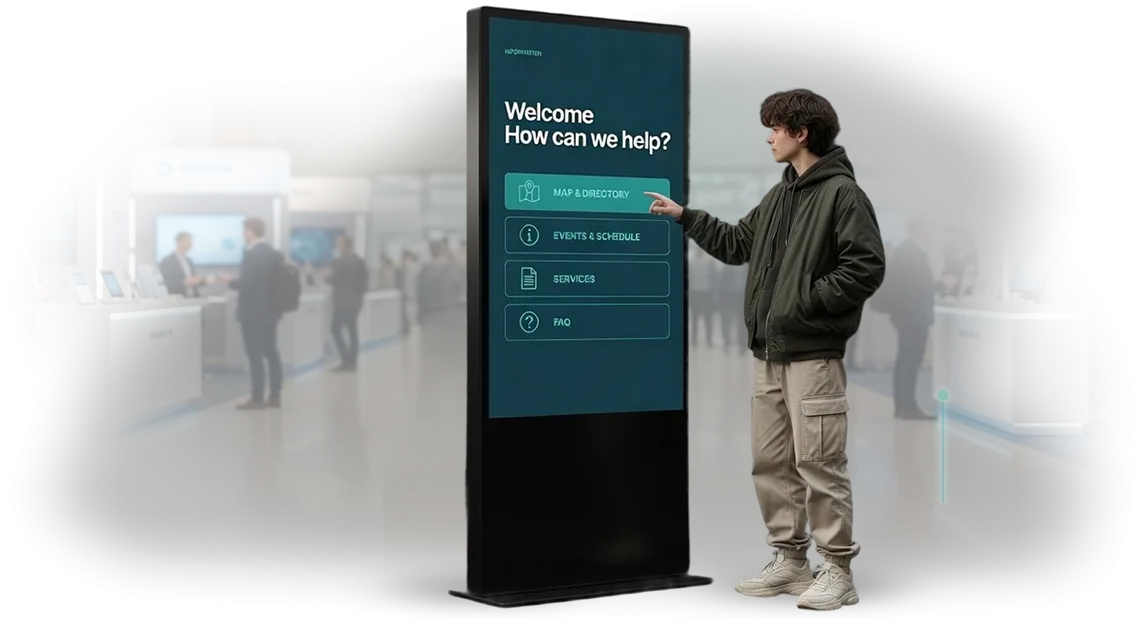
Touchscreen kiosks with interactive navigation change this scenario. Prospective students can independently find any building, lecture hall, or admissions office without help from staff — quickly, in just a couple of touches.
Kiosks are equally useful on open house days, during entrance exams, and on regular academic days when guests and new students need help finding their way.
Such a system not only makes life easier for visitors but also shapes the image of a modern university where every detail is thought through.
And importantly, it works without interruptions: we at our team configure kiosks to run reliably year-round, while staff members without technical training can update the information.
What Interactive Kiosks Offer Universities: 5 Measurable Benefits
The admissions office is drowning in questions like "how do I get to room 305?" while guests wander through buildings, creating crowds in the lobbies. Interactive kiosks relieve this burden, turning navigation into a fast and intuitive digital tool. Here are 5 measurable benefits a university gains after installation.
-
Speed in finding the right place. Finding a lecture hall, department, or dean's office takes seconds instead of 10–15 minutes of wandering. This reduces lateness to lectures and lowers visitor frustration.
-
Relieving staff workload. Administrators, security guards, and volunteers stop answering repetitive questions — freeing up time for organizational tasks. This is especially noticeable during open house days and the admissions campaign.
-
Strengthening the university's image. Touchscreen kiosks are a visible sign of digital development that prospective students, their parents, and partners immediately notice. Modern navigation sets the university apart from competitors.
-
Increased number of inquiries. The kiosk can display information about programs, admission rules, and even an application form.
Prospective students get the data they need without waiting in line and are more likely to leave their contact details — these are direct leads for the admissions office.
-
Analytics for improving operations. The system records which buildings and which programs are searched most often. This data helps redistribute visitor flows, adjust signage, and refine marketing materials.
Each of these benefits is proven in practice — we at our team have already implemented such solutions for universities and know how to adapt kiosks to a specific institution. And if you complement them with schedule and website integration, the effect is even more noticeable.
Touchscreen Kiosk Formats: Which One Suits Your University
For a university, the kiosk format is not a question of design but a question of how quickly a visitor gets the information they need.
In the admissions office lobby at the height of document submission, visibility matters, as does the ability for people in line to independently find the right office.
In a corridor of an academic building, compactness and speed matter, so a student can check a room number in 20 seconds between classes.
We select the format based on the university's goal: relieve administrators, orient prospective students, or guide event guests. To do this, let's compare the main options.
| Format | Who it's for | What it offers the client |
|---|---|---|
| Floor-standing kiosk | Lobbies, atriums, waiting areas | Draws attention, works as a personal navigator, and takes the load off the front desk |
| Wall-mounted kiosk | Corridors, walkways, areas near elevators | Takes up minimal space, allows quick lookup of lecture halls, schedules, or staff contacts |
| Mobile kiosk | Admissions campaigns, forums, open house days | Moves between venues, collects applications, and displays information right where the guest is |
Choosing a format is not a permanent decision. You can start with a floor-standing kiosk in the central lobby and add wall-mounted panels in academic buildings a year later.
All formats run on the same management system, so schedules and news are updated centrally, without involving a programmer.
We will prepare a specific recommendation on the number of kiosks and their placement based on your building layout and visitor flows. Tell us about your goals — we'll propose a format that pays for itself within the first month.
How the Project Works: 7 Steps to Developing a Touchscreen Kiosk
Developing a kiosk for a university is not just installing equipment. We structure our work so you understand the project status at every step and can control the timeline. Below is a typical 7-stage cycle, from brief to support.
-
Brief and discovery — we listen to your task: what should visitors find — buildings, schedules, dean's offices? We determine kiosk placement points and the audience: prospective students, current students, or guests.
-
Plan and timeline — we lock in the stages, scope of work, and launch date. You get a clear plan without technical details, while we get goals for the team.
-
Structure design — we design the menu and screen logic. The goal is for a visitor to find the information they need in three steps, without getting confused.
-
Content collection and preparation — together with you, we gather information about faculties, faculty members, and events. If needed, we connect the schedule — it will update on the kiosk automatically.
-
Design in the university's style — we style the screens with the university's branding, add a campus map and photographs. The kiosk looks like part of the infrastructure, not a temporary stand.
-
Setup and acceptance testing — we install the solution on the kiosk and test real user scenarios. We bring in students or staff to identify any awkward moments before launch.
-
Launch and support — we mount the kiosk at the designated location and train the responsible staff member. After that comes warranty support and information updates on your request.
What's Included in the Delivery: Complete Information Kiosk Package
Turnkey means a single complete package for an information kiosk — not parts from different contractors. You won't have to coordinate suppliers or figure out who's responsible for the result: we deliver a ready-made system. Here's what's included:
-
Enclosure. A durable structure that fits into the university's interior: lobby, corridor, library. The enclosure is safe for students and requires no special maintenance.
-
Touchscreen display. A bright screen with anti-glare coating — the map and schedule remain readable even in bright light. The display is built for constant use by hundreds of visitors.
-
Software. A configured navigation system: interactive building map, search for lecture halls and departments, class schedule. Sections are pre-populated with your data at launch.
-
Content management panel. A simple interface where staff can update schedules, news, and announcements themselves. No need to wait for a programmer or go through lengthy approvals.
-
Accessibility mode. Large fonts, high-contrast colors, and voice guidance — the kiosk is comfortable for prospective students and older visitors alike.
-
Installation and launch. We deliver, install, configure, and train your staff. On launch day, the kiosk is already working and processing the first requests.
-
Warranty and support. We provide a warranty on hardware and software and service the kiosks for their entire lifespan. In case of a malfunction, we promptly provide a replacement — navigation never sits idle.
The result: you get a well-thought-out kiosk package and a single point of responsibility. Every element is proven in real projects — you're protected from hidden costs and missed deadlines.
Case Study: University Navigation After Kiosk Launch
When the team at ITMO decided to update campus navigation, the task before us was not just to put up signs but to make it so students, faculty, and guests could quickly find lecture halls, laboratories, and administrative offices without staff assistance.
Previously, during peak hours, queues formed at the cloakroom and security desk from people asking for directions. Prospective students got lost in the corridors on open house days, spending 10–15 minutes finding the right room and being late for meetings.
We proposed installing interactive kiosks in the lobbies and on the first floor — with touchscreens, building maps, and search by room or department name.
Within two months of launch, 78% of visitors were independently finding their route.
Search time dropped from 12 minutes to 2, and the load on administrators decreased by roughly half — they stopped being distracted by questions like "where is room 305" and focused on their core duties.
Satisfaction also improved noticeably: in a survey after the open house day, guests rated navigation 4.8 out of 5. The university ordered two more kiosks from us for the new building — a clear sign that the project works not just on paper.
The kiosks continue to run without failures and require no constant maintenance, so the investment pays for itself every day.
How to Choose the Right Touchscreen Kiosk Format for Your University's Needs?
There is no universal "best" format — the right kiosk is the one that solves a specific university task. So equipment selection doesn't start with specifications but with the question: where and who will use the kiosk? The answer divides solutions into two classes: stationary and mobile.
The first step in the algorithm: assess the stability of the location. If the kiosk is needed in the main building's foyer, near the admissions office, or in the library lobby, this is a permanent location operating daily.
You need a stationary format: a sturdy enclosure, damage protection, mains power, and resilience to prolonged continuous operation.
The second step: consider how often the location changes. Open house days, faculty exhibitions, conferences, admissions campaigns — these are temporary scenarios. A mobile kiosk is convenient for them: it runs on battery, moves between buildings, and requires no installation. It's indispensable when you need to cover multiple venues in a single month.
The third step: tie the kiosk choice to the content. Content updated once a month suits any kiosk; daily changes require remote management. In practice, universities often use a combination: one stationary kiosk at the entrance and two mobile kiosks for events. This gives the university permanent navigation and flexibility without overpaying for extra units.
We help match equipment to university needs: we analyze visitor flows and scenarios and propose a solution that pays off from the first weeks. With 10 years of experience working with universities, we know which formats actually work.
Frequently Asked Questions About Interactive Kiosk Development
Before starting a project, clients tend to ask the same questions. They're not about technical details but practical matters: how kiosks will fit into operations, how long development will take, and what happens if something breaks. Let's address the main concerns.
Is it difficult to integrate kiosks into an existing system?
No, this is a standard task. We work remotely, connect to your network, and configure the kiosks so they don't interfere with existing services. Administrators get an intuitive management interface — no retraining or complex code to deal with.
How long does development take?
A typical project takes from three weeks to a month and a half. We give the exact timeline after the brief, once we can see the volume of content and the number of locations.
We usually manage to launch kiosks by the start of the academic year or a major event, so we agree on deadlines in advance and include them in the contract.
What happens if the kiosk breaks down?
We provide a warranty on hardware and software. During the warranty period, we resolve issues promptly — often remotely, without sending a technician on site. Additionally, we can set up monitoring so you learn about a problem before visitors report it.
These are just some of the topics that concern clients. If you still have questions — write to us, and we'll walk you through every stage of the project and the guarantees we provide.Let's Discuss Your Project: Submit a Request for a University Kiosk
It's not easy for a university to choose an interactive kiosk: the market has many offerings, and each promises something different.
Without technical consultation, it's easy to overpay for unnecessary features or, conversely, miss important details — from a vandal-resistant enclosure to class schedule integration. We help settle this in one short conversation.
After your request, we call you back within one business day and conduct a free consultation. You tell us where you plan to install the kiosk, what visitor traffic to expect, and which scenarios need to work: building navigation, schedules, reference information.
An expert clarifies the details, suggests the right format, and immediately calculates the cost of the solution. Based on the conversation, we prepare several options and confirm the timeline in writing so you can plan the purchase and installation.
After the first call, you receive:
- a preliminary project estimate tailored to your needs;
- indicative development and delivery timelines;
- recommendations: floor-standing, wall-mounted, or outdoor kiosk;
- functionality proposals aligned with the university's budget;
- an implementation plan: from launch to staff training;
- answers to questions about warranty and technical support.
No imposed options or obligations — just information for a well-considered decision. Submit a request for a university kiosk, and we'll calculate the project on the same day. Then it's your call: we build the kiosk turnkey or adapt a ready-made solution to your needs.