

Visitors Get Lost at the Exhibition Center — Are You Losing Exhibitors?
A visitor arrives at an exhibition with a specific goal: to find a certain booth, attend a talk, meet a partner.
But if instead they wander the corridors, study confusing signs, and waste time asking staff for directions — the impression of the event is spoiled within the first minutes.
Poor infographics and a lack of clear exhibition navigation turn even a well-organized event into a source of frustration.
Then simple arithmetic kicks in: lost visitors mean unviewed exhibits, missed sessions, and fewer contacts for exhibitors. Booth rental costs money, and if a participant sees that traffic past their location is low, next year they choose a different venue. So you lose not only guests but also key partners who drive the event's revenue.
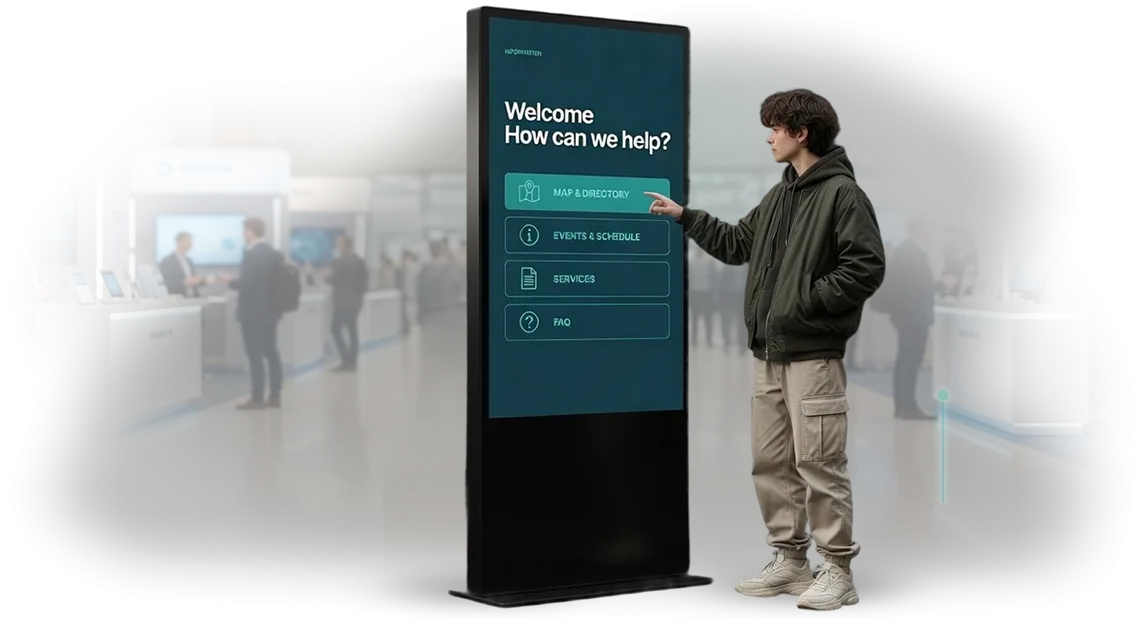
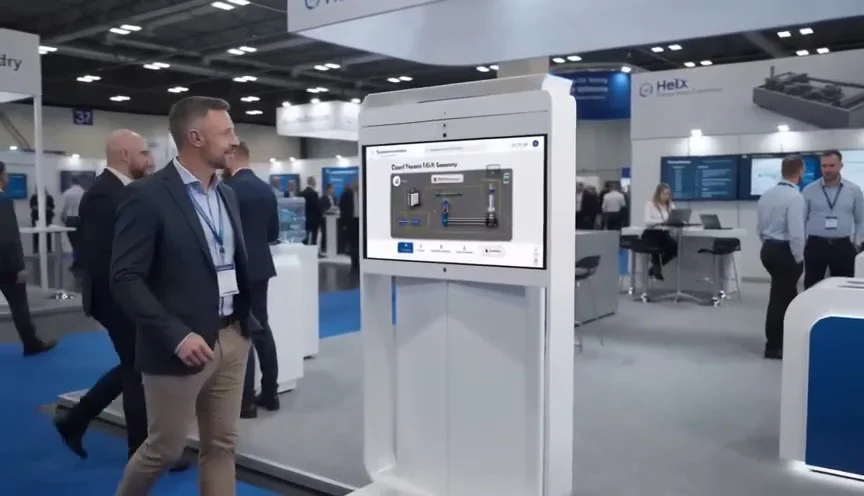
The solution is information kiosks — convenient navigation points that work around the clock and never get tired. Instead of paper maps and floor arrows — an interactive guide: a visitor enters the desired company or hall and instantly gets a route.
This takes the load off the registration desk and staff, while guests reach their destination faster and stay at the exhibition longer.
When every guest has a clear digital assistant, exhibitors see a steady flow at their booths and associate it with your venue. Retaining exhibitors means predictable floor space sales and a growing business reputation for the center.
This is exactly why we develop interactive kiosks that solve exhibition navigation challenges and turn movement chaos into clear scenarios.
We handle scenario design, interface design, and installation — you get a working system that pays for itself through satisfied guests and repeat contracts with participants.
Benefits for the Exhibition Center: From Navigation to Leads
Interactive kiosks in an exhibition center are not just "touch panels with a floor plan" but a working tool that solves organizer challenges: from managing visitor flows to collecting participant contacts. Below are five key benefits you get right after launching the navigation system from our team.
-
Increased guest loyalty. Visitors spend less time finding the right booth or zone, get less tired, and gain more value from the event. Convenient navigation creates a positive impression of exhibition organization — guests come back and recommend the event to colleagues.
-
Exhibition growth. When the route through the exhibition center is properly planned, visitors don't get stuck at the entrance and reach remote pavilions. By optimizing flows, every booth gets more visitors — you can show participants real growth in their reach.
-
Lead generation. Touch kiosks collect guest contacts through registration, surveys, or virtual business cards.
For exhibitors this is a base of potential clients; for you — an argument for selling floor space: exhibitors see how many visitors passed through their section and how many left inquiries.
-
Image of a modern organizer. An interactive navigation system is a noticeable sign of a tech-forward exhibition. Sponsors and participants perceive the venue as progressive, which raises the event's status and simplifies negotiations with new partners.
-
Flow optimization. Panels with an up-to-date map and hall occupancy allow you to distribute visitors and avoid crowds during peak hours. You see where lines form and quickly adjust the traffic plan — while staff spend less time giving directions and work more calmly.
Each benefit directly affects the exhibition's commercial performance: more satisfied guests, higher exhibition quality, and clear ROI for participants. Tell us about your event's challenges — we'll select the kiosk configuration and navigation logic for your format.
Which Interactive Kiosk Formats Suit Events?
At an exhibition, one and the same touchpoint can perform different tasks: help a visitor find a booth, show the business program schedule, collect contacts, or simply impress.
There is no universal kiosk that works equally well in every zone — so we match the format to the specific scenario.
Here are the main formats we use in exhibition spaces:
| Format | Which tasks it handles | What it gives the client |
|---|---|---|
| Floor-standing touch kiosk | Exhibition navigation, map, schedule, booth information | Visitors find what they need on their own — staff are not distracted by repetitive questions |
| Wall-mounted touch screen | Information zones at entrances, lobbies, high-traffic areas | Saves floor space, doesn't obstruct walkways, looks neat in the interior |
| Mobile stand | Welcome zones, road shows, venues with frequent reconfiguration | Easy to move, change operating logic for different events and audiences |
| Contactless kiosk | Places where hygiene matters or visitors have their hands full | Interaction without touching the screen — faster and safer for guests |
We combine all formats into a single system: visitors get equally clear navigation from the floor-standing kiosk, wall-mounted screen, and contactless display.
This simplifies usage and reduces support costs — you update information once, and it appears across all touchpoints immediately.
How Does Kiosk Implementation into Venue Infrastructure Work?
Kiosk implementation is not just equipment installation but a structured process where the client sees every step. Our team work on a transparent basis: from the initial brief to launch and ongoing support.
This helps avoid surprises, meet deadlines, and get a working tool that immediately benefits visitors. You always know where the project stands and what comes next.
The main stages look like this:
- Venue audit and task definition — we establish goals, study visitor flows, placement points, and existing infrastructure, taking peak loads into account.
- Prototype and design approval — we show how the kiosk will look and work, make revisions before production begins, and align it with the venue's brand style.
- Equipment preparation and installation — we set up the stands, connect power and network, configure remote management, and carry out work outside business hours.
- Navigation testing — we verify maps, routes, and scenarios using real examples, refine screen performance, and eliminate errors before opening.
- Launch into operation — we bring the kiosk into working mode, train venue staff, and hand over instructions.
- Support and development — we update the map, add sections, monitor stability, and respond quickly to requests.
At each stage you receive a clear progress report. These are not vague promises but specific checkpoints — so you understand what's happening with the project and can influence the outcome.
The result is a kiosk that fits organically into the infrastructure and solves your venue's tasks. And after launch we stay in touch: updating content, improving navigation, and ensuring the equipment runs without interruptions.
What's Included in the Interactive Navigation System Delivery?
When you order an interactive navigation system, you get not just a touch kiosk but a fully ready turnkey solution. We handle all stages — from equipment selection to launch and staff training — so you don't need to dive into technical details.
The standard delivery package includes:
- An interactive touchscreen with dust and moisture protection — suitable for 24/7 operation in high-traffic zones.
- Software: a navigation interface with an exhibition center map, search for pavilions, booths, cafés, and restrooms.
- Content development: floor plans, routes, reference information — everything the visitor sees on screen.
- Remote management and information updates — you change texts, add booths, or move objects yourself.
- Staff training: administrators know how to update content from day one and handle common issues without calling the contractor.
- Warranty on equipment and software. During the warranty period we fix issues and update the system free of charge.
The entire delivery is secured by a single contract — you don't need to look for an equipment supplier, developer, and installation contractor separately.
You get one point of contact, clear launch deadlines, and exhibition center visitors get clear, convenient navigation from day one.
Real Case Study: How We Helped the "Techno Plus" Forum
Techno Plus is a major industry forum occupying four pavilions of an exhibition center. Guests got lost, and queues piled up at the information desk — a classic story for large events without well-planned navigation.
The client approached us with a request: make it so that visitors find their way to the right booth on their own, without spending time on consultants.
What We Did
We installed touch kiosks at key points and combined them into a single system: a forum map, company search, route planning, and the business program schedule.
The interface is adapted for simultaneous use by several guests — large elements, clear prompts, protection against accidental touches. The client wanted a "plug in and it works" solution, so we chose a stable server architecture with redundancy.
Result Metrics
The load on the information desk dropped by 40% — guests stopped waiting for directions and consultants focused on complex requests. Attendance grew by 25% compared to the previous event, and average pavilion search time dropped from 15 to 3 minutes.
Each kiosk handled up to 500 inquiries per day, and guests returned to them several times — first to find the right booth, then to check program details. The kiosks ran without a single failure throughout the forum days, confirming the reliability of the solution.
This case became one of the most successful projects in the portfolio: after the forum, the organizers ordered navigation from us for two more of their events. They learned that good navigation is not a cost but an investment in guest experience and brand loyalty. The analytics on popular routes also helped them better distribute visitor flows next time.
Frequently Asked Questions About Interactive Kiosks
Before launching interactive navigation, clients always have the same questions: how quickly will it be installed, will it disrupt the event schedule, what happens if a visitor accidentally damages the screen. We've collected answers to the main concerns so you know what to expect and how we work.
Below are typical scenarios an exhibition center faces. Short and to the point, without technical details.
Is the kiosk difficult to install and how long does it take?
Installation takes from one day. We prepare all mounts, cables, and settings in advance, then on-site we simply assemble the unit and connect it to power. If needed, we install at night or between shifts — this doesn't affect exhibition operations. We manage the whole process: you won't have to find contractors or hire a separate crew.
Can the kiosk be styled to match the event's brand identity?
Yes, this is a standard part of the project. Colors, logos, fonts, and even the cabinet shape are adapted to your brand — visitors see a unified exhibition image rather than a "foreign" screen. Before launch you receive a mockup and approve it, so the result matches expectations exactly.
What if the kiosk breaks down or a visitor damages it?
We use vandal-resistant housings and protected screens that withstand accidental impacts and scratches. But even if something happens, the system is designed so that one kiosk won't stop the entire navigation.
We provide a backup kit and remote monitoring — if a failure occurs, a specialist sees the issue and helps remotely or quickly dispatches to the site.
How do we update information on the kiosks?
Content can be changed without programmers. You upload new files, exhibit changes, or schedules through a simple panel — everything updates on all kiosks simultaneously. If information becomes outdated, you can make edits from the office without approaching the screen. This is convenient when the exhibition plan changes at the last moment.
Will the kiosks stop working during peak event hours?
No. Kiosks operate autonomously and don't depend on the shared network: even if the internet goes down, navigation keeps working. We also back up data and provide protection against power surges. Your visitors always get accurate information, and you get stable service without surprises.
If you have questions about a specific project — write to us and we'll review your situation. We'll suggest the best option for your tasks and budget.Order an Interactive Kiosk for Your Project
Leave a request to develop an interactive kiosk for your exhibition center — and a manager will contact you within one business day. We'll discuss your tasks, attendance, pavilion layout, and answer the questions that matter to you.
Immediately after your inquiry you'll receive:
- cost calculated after audit for your project — no hidden fees or fine print;
- a manager consultation — we'll help you choose the kiosk format, its location, and feature set;
- a preliminary interface mockup — you'll see how visitors will search for pavilions, booths, and events;
- individual terms — we work with permanent exhibitions, temporary shows, and multi-brand spaces;
- a project application — we set deadlines, scope of work, and commitments.
The process then takes minimal time. You send us the floor plan and event map — we prepare a brief and propose a solution. Then we approve the mockup, produce the kiosk in 2–3 weeks, and launch navigation together with your team.
After launch you're not left alone with the equipment: we provide staff instructions, remote support, and the ability to update content without programmers.
This approach has already helped exhibition centers halve visitor questions to administrators and increase footfall to remote exhibits.
Submit a request for kiosk design — this is non-binding. You'll get an estimate, mockup, and consultation, and then you decide how convenient it is to work with us.
How to Choose a Kiosk Format for Your Budget and Tasks?
The main guide when choosing a kiosk is not the device price but the tasks it solves at your exhibition. If you just need to show a map and list of participants, a standard stand with a touchscreen is enough.
If you want to impress visitors, engage them in navigation, and collect contacts — you'll need a more thoughtful solution with a custom interface and integration with your accounting system.
Budget and the number of devices always go hand in hand. For a small one-to-two-day exhibition, one or two kiosks in the entrance area and near key booths are enough.
For a large forum with hundreds of participants, it's better to distribute navigation points throughout the territory — but then what matters more is not the number of screens but content convenience and information update speed.
We help find the balance so you don't pay for the unnecessary but also don't create queues at a single terminal.
Interface complexity determines implementation time. A basic map with search by organization list can be assembled in a couple of weeks. If you need multimedia zones, a route planner, or mobile app integration — plan for a month or more.
The key point is that all work runs in parallel with the exhibition's own preparation, so we deliver the project exactly by the opening date, not after it.
Our experience shows: the optimal solution always lies between "cheap and fast" and "expensive and feature-rich." At the start, we do a short audit of your event: number of guests, logistics, entry points, exhibition composition.
Then we propose a concrete format — from simple information panels to a full interactive system with attendance analytics. You get a clear estimate and timeline forecast before work begins.