


Why passengers waste time in airports and leave without buying
In any airport, passengers are the main source of revenue: shopping areas, cafes, restaurants, paid lounges. But when airport navigation is outdated, finding your gate or security checkpoint becomes a real quest.
A passenger spends 15–20 minutes searching, gets nervous, fears missing their flight — and is no longer in the mood for shopping.
Instead of calmly walking through the terminal, popping into a store, or having a meal, they rush with a suitcase to the gate, bypassing everything along the way. They leave the airport thinking, “good thing I made it,” but are unlikely to return to that airport by choice.
This is a systemic loss of passengers — effectively a loss of profit. Every coffee, souvenir, or bottle from duty-free that goes unbought is a direct missed opportunity for landlords and the airport as a whole.
According to expert estimates, up to a third of passengers skip purchases precisely because of the stress and lack of time caused by poor navigation.
Negative experience affects loyalty to the airport: if a passenger struggled to find the exit last time, they will avoid that airport, choosing alternative destinations with clearer infrastructure.
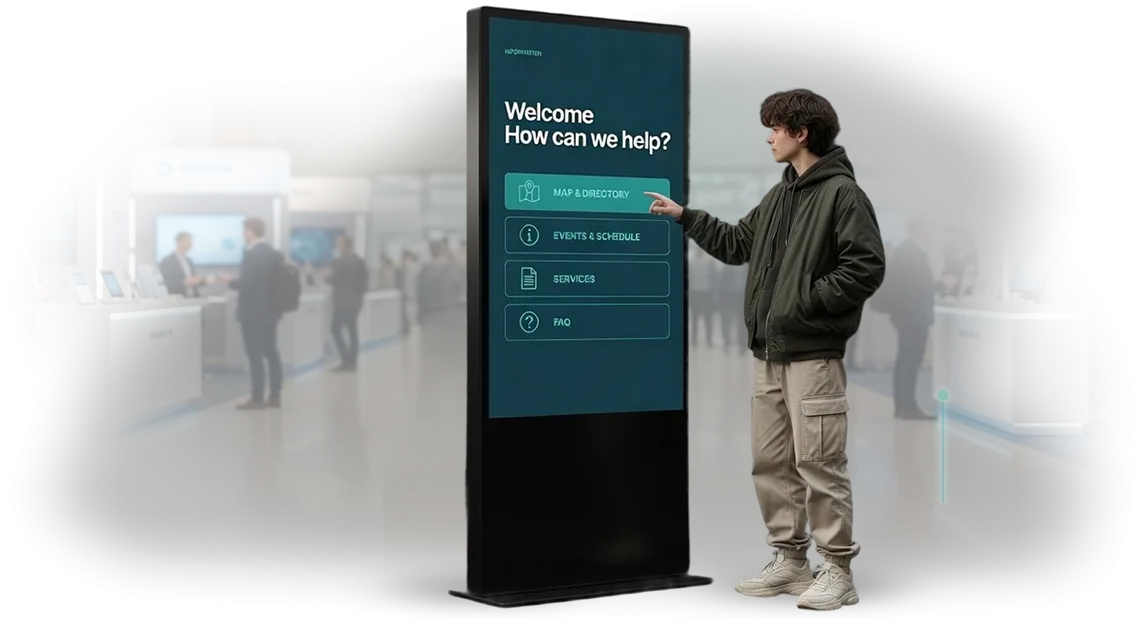
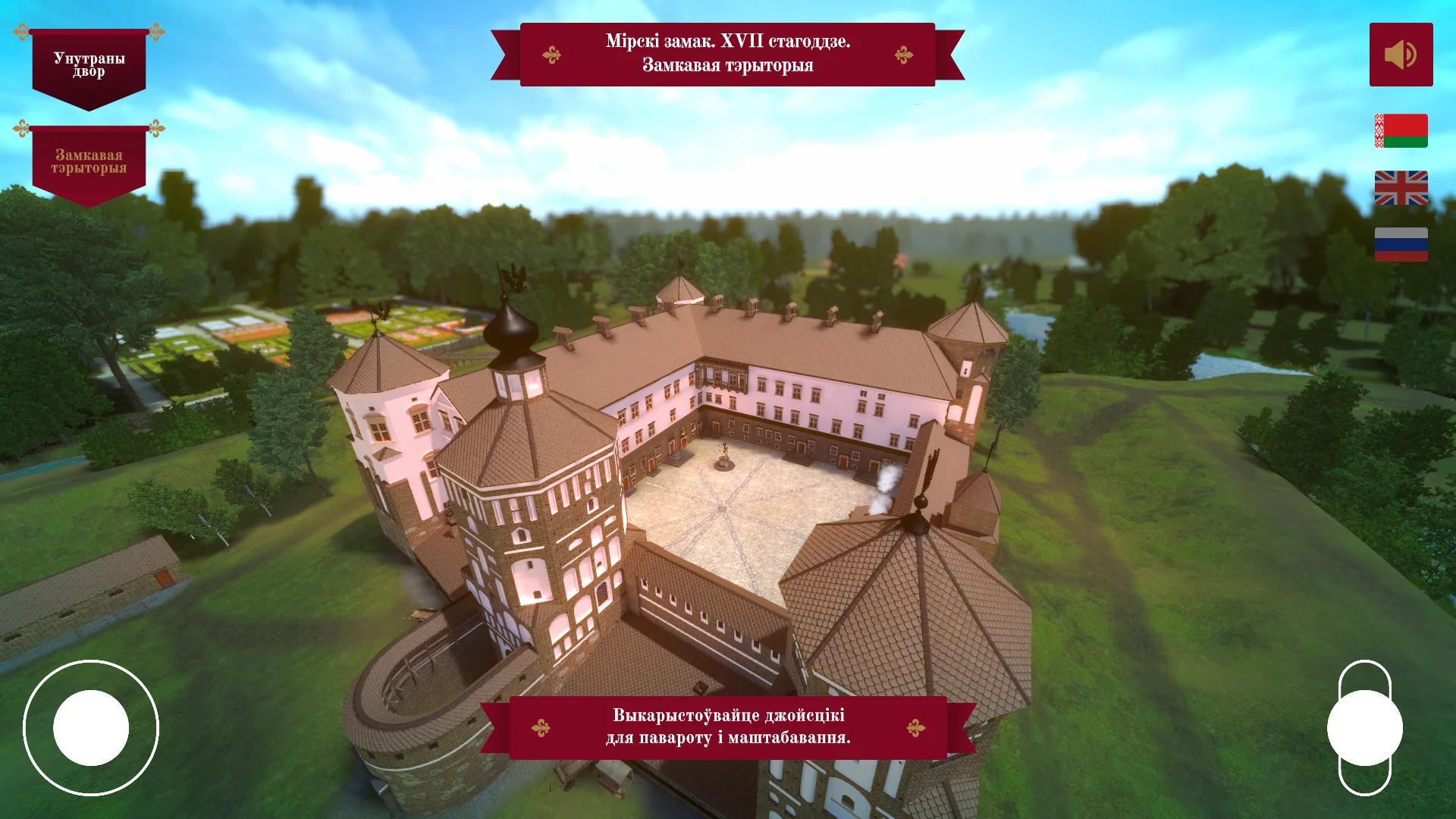
The solution is an interactive kiosk that replaces dozens of static signs and makes airport navigation simple and intuitive. A passenger enters a flight number or selects a point on the map — and gets a short route that accounts for security zones and current restrictions.
The information kiosk shows time to boarding, nearby cafes and shops, helps them find their way around an unfamiliar terminal without stress, and even tells them how many free minutes remain — with the conclusion: head to the gate or take time to shop.
For over 10 years, we at our team have been developing navigation solutions for airports.
Our interactive kiosks have already helped passengers reduce the time it takes to find an exit by 30%, and helped operators increase revenue from shopping areas because people have time to visit stores between flights.
This is not just a screen with a map — it is a tool that turns idle time into sales, increases passenger loyalty, and makes the airport a place people want to return to.
What the terminal gets from an interactive kiosk
An interactive kiosk in a terminal pays off not only through passenger convenience, but also as an independent revenue channel. It solves several tasks at once: helps with wayfinding, relieves staff, and opens new points of contact with the audience.
- Navigation speed. A passenger finds the right zone in a couple of touches without going to the information desk. The terminal relieves peak load from employees, reduces queues, and decreases the number of errors during transfers.
- Growth of non-aviation revenue. The kiosk screen is a showcase for cafes, shops, and terminal services. Offers appear at the right moment when a passenger is looking for somewhere to eat or shop — turning the kiosk into a point of sale without staff involvement.
- Increased loyalty. A well-thought-out interface and attention to detail create an impression of the terminal as modern and friendly. Passengers are more likely to choose an airport that has taken care of them and to return again.
- Brand recognition. The branded screen design makes the kiosk a carrier of the terminal’s style. It is memorable, ends up in passengers’ photos and social media — free advertising that continues to work long after the trip.
We deliver these kiosks turnkey — from interface design to launch and round-the-clock support. You get a tool that simultaneously generates revenue and improves the quality of service in the terminal.
Formats of interactive kiosks for airports
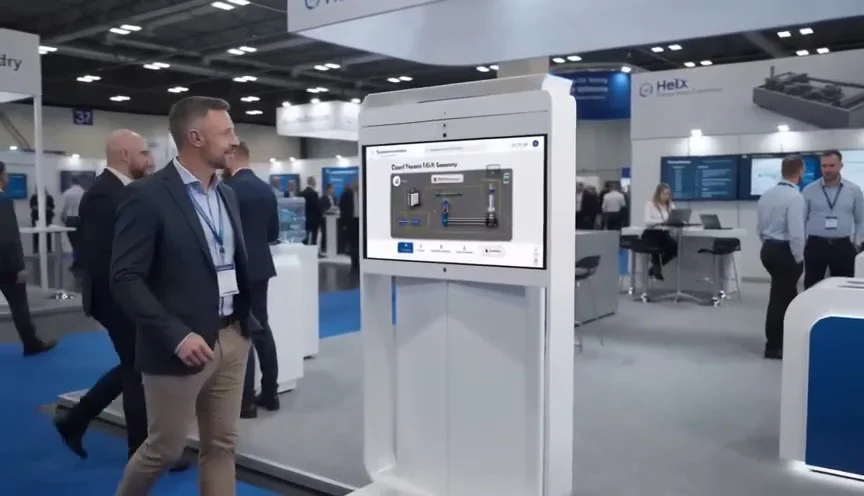
Interactive kiosks in airports handle different tasks: they help passengers reach their gate faster, take over the flow of routine questions from the information desk, and turn waiting areas into a source of additional revenue.
There is no universal “one kiosk” — navigation, information, and advertising require different formats and placements. We identify three main formats, selecting equipment and interface logic for each.
| Format | When needed | What it provides |
|---|---|---|
| Navigation kiosk | Transit passengers, junctions, boarding gates | Passenger builds a route in 10–15 seconds — fewer delays and less staff load |
| Info desk | Terminal entrance, arrivals hall, waiting area | Instant information on flights, transport, services — staff handle truly complex questions |
| Advertising showcase | Escalators, walkways, high-traffic zones | Brands hold attention for 30–60 seconds, and the airport earns ongoing advertising revenue |
The formats are easy to combine: a navigation kiosk can be paired with an advertising showcase, and an info desk with charging stations.
We implement such projects on professional equipment that withstands round-the-clock operation in public spaces, and we handle support — from launch to regular content updates.
How a project unfolds: from brief to launch
For an airport, predictability and timelines matter: the kiosk must start working without failures or downtime. That is why the process is structured so the client understands what is happening at each stage and controls the outcome, rather than diving into technical details.
Work stages
- Brief and immersion — we discuss kiosk scenarios: passenger flow, tasks, installation location. We record goals and success criteria.
- Plan and estimate — we prepare a work plan, timelines, and team composition. You receive a clear document with stages and outcomes.
- Layout approval — we show the screen structure and scenarios before development. You see the future kiosk and make edits without rework.
- Development — we build the interface, connect flight schedules, navigation, and your materials. Iterations — you see intermediate versions.
- Testing — we verify all scenarios on real equipment, including peak loads and emergency situations. Acceptance is based on a pre-agreed checklist.
- Launch and training — we install the kiosk, set up monitoring, train your team. We support the first days of operation.
- Support — we update content, add features, and monitor stability. You get a working tool with a warranty.
This sequence eliminates surprises: you always know at which stage the project is and what comes next. If needed, we can speed up the launch on a tight schedule — without losing quality.
What is included in delivery and support
The delivery package for an information kiosk is a ready-made solution for an airport: equipment, interface, documentation, and staff training. You won’t have to hire multiple contractors and coordinate their work — everything is thought through and bundled into one contract.
Reliability during peak hours is especially important for an airport, so the package also includes technical support. Engineers monitor the system’s operation and update flight information without your involvement.
- Kiosk equipment with a touchscreen: installation, configuration, and pre-launch verification.
- Interface with terminal maps, flight schedules, and navigation — tailored to the airport’s brand style.
- Instructions for staff on powering on, daily maintenance, and routine operations.
- On-site staff training: practice with real scenarios and Q&A.
- Technical support for the kiosk: monitoring, scheduled content updates, and backup.
- A communication channel with engineering support — quick resolution of issues during business hours and in emergency situations.
Staff training takes one day and is conducted on site. After that, employees work with the system confidently, and if difficulties arise, they have support contacts and clear procedures.
As a result, you get a turnkey working kiosk that improves passenger service quality and reduces the load on the information desk. All that remains is for you to make the decision — we’ll take care of the rest.
Case study: how a navigation kiosk paid off at a terminal
We developed an interactive navigation kiosk for a regional airport. The task: relieve the information service and help passengers quickly find gates, check-in counters, and waiting areas.
Previously, navigation was based on paper signs and staff consultations — during peak hours this created queues and stress.
our team designed the kiosk with a “three touches to answer” logic. A passenger chooses a destination — gate, cafe, restroom — and sees a route with landmarks. The system suggests the nearest path taking closed zones into account. This is not just a map screen but a working tool that saves time and reduces staff load.
Business numbers
Within two months of operation, the average time to find the exit was cut in half. The kiosk processes up to 300 requests per day, and repeat passenger visits account for a third. The key point is return on investment: we rented out the free advertising space on the screen. Rental revenue covers the cost of equipment and support already in the first quarter.
Passenger-side negative feedback about navigation decreased, and the airport gained an additional communication channel with its audience. The interactive kiosk operates around the clock and does not require staff presence.
The solution is scalable — in the future, similar terminals can be installed in other zones and connected to the central schedule.
Want the same result? We’ll audit your space and calculate the projected impact for your terminal. Write to us — we’ll show how a kiosk will pay off in your conditions.
How to choose the right format for your task?
A frequent question from airports: which information kiosk will suit your terminal? The answer starts not with the model but with passenger needs: some need to quickly find their departure gate, others need to check schedules, check in, or pay for an extra service. The use case determines the format, location, and configuration, not the other way around.
For example, in passenger-flow distribution zones, kiosks with large screens and clear navigation work best — they can be read even on the go. In places with queues, self-service check-in counters with document scanners and boarding pass printing are more often needed.
In waiting areas and near gates, compact touch panels are convenient — they don’t obstruct passage and fit easily into the interior.
When selecting, we consider several criteria: the area and lighting of the location, passenger flow intensity, convenience for people with luggage and small children, as well as terminal security requirements.
Sometimes the right solution is a built-in model, sometimes a freestanding one, and in some cases a combination of formats at different points of the building. There is no universal “best” kiosk — only the optimal one for your task.
Our consultation is not an attempt to sell you an “average” kiosk, but a selection of a solution for your specific terminal. We analyze the layout, ask clarifying questions about passenger logistics, and prepare a placement plan with justification for each format.
It’s free and non-binding: you receive a transparent calculation — which kiosk will deliver the needed result within a reasonable budget.
Leave a request on the website — within one business day, we’ll help you choose a format that simplifies terminal navigation, reduces staff load, and pays off quickly through passenger self-service.
Frequently asked questions about development and operation
Before developing an information kiosk for an airport, clients tend to have the same concerns: how quickly the project will pay off, whether the kiosk will break down in the middle of the day, and how hard it is to integrate into an operating terminal.
The kiosk must work around the clock, withstand passenger flow, and not require constant supervision — any downtime means inconvenience for travelers and extra load on staff.
We don’t just install equipment — we take responsibility for warranty, maintenance, and repairs throughout the entire service life. Below, we answer the questions that managers ask us most often.
All terms are fixed in the contract, so you know your expenses and the scope of our responsibility in advance.
What does the warranty and service maintenance include?
The warranty covers the entire package: enclosure, touchscreen, control module, and software. During the warranty period, we fix any faults free of charge and perform scheduled maintenance — usually at night when passenger flow is minimal.
The terms are fixed in the contract, so you know in advance what is included in the service and what is not.
What should we do if the kiosk breaks down in the middle of the day?
The kiosk is designed so that it does not stop the entire information hub: when one module fails, the others continue to operate, and the system automatically sends a signal to an engineer.
Remote diagnostics can identify the cause without a site visit, and in complex cases a specialist arrives with a replacement unit. As a rule, the kiosk is back up within a few hours.
Is it difficult to integrate the kiosk into the airport infrastructure?
The kiosk integrates with existing infrastructure through standard network interfaces — our team handles this, so you don’t need to involve third-party contractors. We coordinate installation with your schedule: main work is done at night or during minimum load hours. Updating content does not require redoing walls or laying new cables — everything is done remotely.
What determines the cost and when does the kiosk pay off?
The estimate is prepared transparently: development, delivery, installation, launch, and annual maintenance. No hidden payments — you understand the cost structure and can forecast your budget.
Payback comes sooner than expected because the kiosk relieves the information desk and reduces spending on printed materials.
Order a calculation for an interactive kiosk for your terminal
Before investing in equipment and design, it’s important to understand what exactly a kiosk will give your terminal and how quickly it will pay off.
We’ll prepare a project calculation based on your objectives: passenger navigation, reducing queues at information desks, placing advertising, or offering additional services.
You’ll get a transparent picture of timelines and scope of work — without needing to dig into technical details.
Leave a request on the website, and within one business day we’ll get back to you with a project calculation and a commercial proposal. Here’s what this document includes:
- An audit of current navigation problems and typical passenger routes in your terminal.
- Recommendations on the number of kiosks and placement locations, taking passenger flow and points of interest into account.
- A description of the kiosk’s operation logic: flight search, terminal map, reference information, advertising blocks.
- A launch plan: interface preparation, installation, configuration, and staff training.
- A transparent commercial proposal with stages, timelines, and support terms.
We’ve been working remotely for over 10 years, so the calculation will take into account your airport’s requirements and offer a solution that is easy to scale — from a single kiosk in the waiting hall to a network of terminals.
No hidden terms or asterisks: after receiving the calculation, you make a decision with no obligation.
To order a kiosk for your terminal or simply discuss your task, write to us via the form. Attach a floor plan or describe passenger flows — this way we’ll prepare an accurate calculation and commercial proposal faster.
Stop thinking “everything is already clear in the airport”: check how much a kiosk reduces staff load and increases passenger satisfaction.