


Information Kiosk for an Auto Service: How to Retain Customers
Customers leave while waiting for repairs — not because they dislike the service, but because waiting at an auto service center feels empty and confusing. A customer doesn't know how much longer they’ll wait, what to do, or which services they actually need.
As a result, they drive away thinking, “Next time I’ll try another service,” and you lose not only the current order but also future visits.
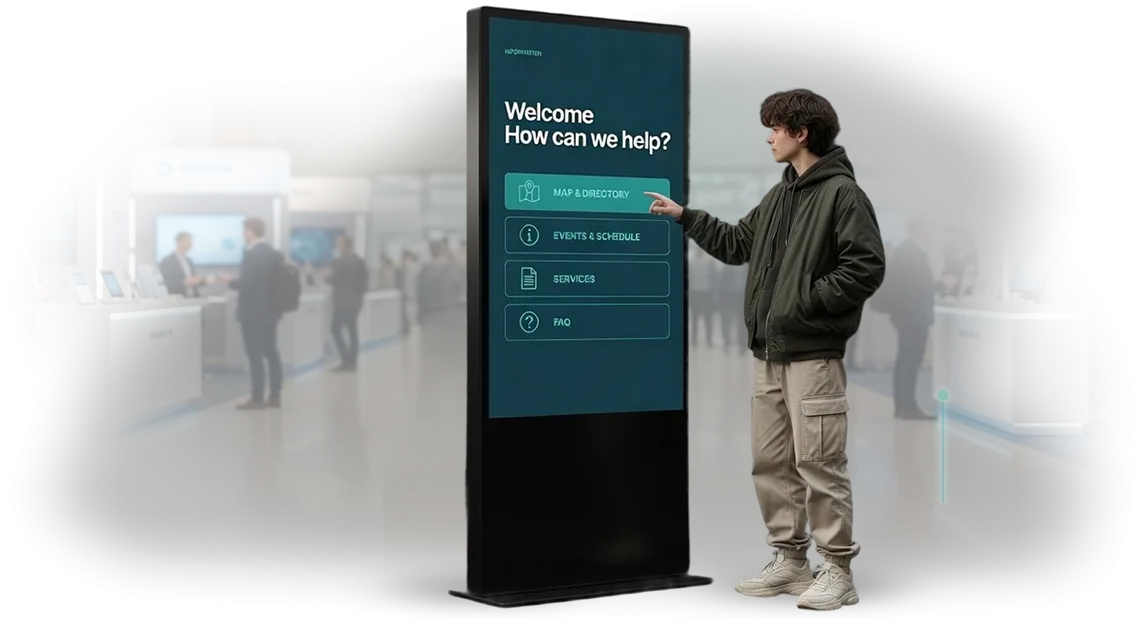
An information kiosk for an auto service turns the waiting area into a place where customers spend their time productively. On the touchscreen, they see the status of their car, useful maintenance tips, promotions, and additional services.
While repairs are underway, visitors can review the price list, choose a convenient time for the next scheduled maintenance, or immediately book an oil change — all without involving an administrator.
The key thing is that the kiosk encourages repeat bookings. Customer retention is built on giving the person a clear next step: a reminder about scheduled maintenance, a personalized offer, or a fixed visit time.
The kiosk shows what work will be needed in 5,000–10,000 kilometers and offers to book a slot right away — so you win the customer away from competitors before they start looking for alternatives.
In addition, the information kiosk relieves staff: instead of repeating the same answers, employees focus on work that generates revenue. Guests see that the service cares about their time and comfort — this increases loyalty and the desire to return.
Professional equipment and a clear interface operate around the clock and are not affected by staff mood.
The conclusion is simple: the waiting area stops being a place of losses and becomes a sales tool. We design the information kiosk to suit your auto service’s needs — from design and content to installation and support. As a result, you retain customers, increase occupancy, and get a steady flow of repeat bookings.
What Tasks an Information Kiosk in the Waiting Area Solves
Customers in an auto service waiting area represent lost time: they get bored, glance at their watches, and receive no updates on work progress.
Meanwhile, the administrator gets distracted by the same questions — “When will it be ready?”, “How much longer?” — and guest contacts remain in a notebook or are lost entirely.
An interactive kiosk closes these gaps: it works like an independent employee that informs, entertains, and collects data without staff involvement.
The kiosk’s main value is removing routine work from the administrator. Instead of explaining the repair status ten times, the service displays it on the screen: the customer sees what stage their car is at, how much time is left, and what work has been completed.
This eases the tension of waiting and increases loyalty — the person understands that they’re being taken care of and is more likely to return to you.
The kiosk also solves the task of contact collection.
Instead of a boring paper survey, the guest fills out a short questionnaire on the screen: leaves a phone number, marks a convenient time for a reminder about the next scheduled maintenance, and subscribes to beneficial offers.
This way you build a database for repeat visits without being pushy or spending the administrator’s time. The feedback you receive helps improve service quality.
A separate effect is an increase in the average ticket. The kiosk unobtrusively shows customers additional services: oil changes, suspension diagnostics, seasonal tire storage.
When guests see a promotion or recommendation on the screen, they agree to extra work more often than with a verbal offer — because it looks like care, not pushiness. As a result, the service earns more revenue from each visit.
The information kiosk turns the waiting area from a passive location into a sales and service tool. It reduces staff load, accelerates information delivery, collects contacts, and increases the average ticket — all without expanding the team or spending extra on advertising. For an auto service, this is a solution that pays off not only financially but also in reputation.
Information Kiosk Formats for Auto Service Centers
The kiosk format must match the floor area, customer flow, and tasks of the auto service. A small station may only need a compact wall-mounted panel, while a large center may require a full kiosk in the waiting area.
We select the configuration for each specific location so that customers get convenient service and the owner gets less routine and more orders.
| Format | For Whom | What It Offers the Auto Service |
|---|---|---|
| Waiting area kiosk | Auto services with customers who stay for 1–3 hours | Shows repair status, entertains and informs, and sells additional services without administrator involvement |
| Reception desk kiosk | Locations with a steady visitor flow | Automatic service booking, price list, request submission without queues, and staff relief |
| Compact wall-mounted kiosk | Small spaces, car washes, tire shops | Quick access to booking and promotions, space savings, easy installation anywhere |
We design the kiosk for the task: we select the screen, stand, and operational scenario. If needed, we integrate the kiosk with the auto service’s accounting system so that order status and bookings update automatically.
Then the kiosk becomes not just a “cabinet with a screen” but a full-fledged sales and customer-care tool.
Such a kiosk is especially useful in the waiting area: while waiting for their car, customers are not glued to their phones but instead learn about services, book future work, and leave their contacts. This increases the average ticket and return rate without active effort from managers.
How a Kiosk Development Project Works
We start with a brief: we meet with you and determine what tasks the kiosk should solve at your auto service — informing customers, booking service appointments, reducing lines at the cashier.
Based on this, we prepare a clear plan with stages, timelines, and areas of responsibility so you can see what happens at every step.
-
Brief and task audit — we discuss how the service operates, where delays occur, and how the kiosk will reduce the load on administrators. At this stage, we define scenarios: booking, repair status, promotions, reviews.
-
Mockup development and design approval — we show a prototype of the future screen, buttons, and interaction scenarios. You make edits before programming begins — this saves time and gives you a clear picture of the project immediately.
-
Content and translation preparation — we fill the kiosk with up-to-date information: services, prices, contacts, directions, and create a multilingual version if needed.
-
Software development — we build the operational logic and integrate it with your accounting system if online booking is needed. We use proven solutions to ensure the kiosk runs stably without failures.
-
Equipment delivery and installation — we select a touchscreen kiosk for your premises, mount it in the waiting area, and connect power and network. You receive a ready-to-use device, not just a manual and a file.
-
Kiosk launch and on-site testing — we test all scenarios on real equipment, fix any issues, and launch for the first customers. We observe how they use it and adjust settings if necessary.
-
Staff training and support — we provide a short instruction session for employees: how to quickly update content, where to view statistics, and what to do if a question arises. After launch, we stay in touch — we provide support, update software and content.
What Is Included in the Delivery of an Information Kiosk
An auto service owner doesn’t want to dive into technical details — they need a tool that shortens queues and relieves the administrator. That’s why we deliver the kiosk “turnkey”: from mounting the enclosure to loading content and training staff. You get a complete solution, not a box of parts.
The delivery package includes:
- Touchscreen kiosk in a protected, vandal-resistant enclosure — suitable for waiting areas and reception.
- Preinstalled software — the interface starts immediately after power-on and works without daily maintenance.
- Structure configuration: repair booking, service selection, price list, promotions, contacts.
- Loading your content: service descriptions, work photos, logo, brand colors.
- Administration panel — you change prices and promotions yourself without involving developers.
- Staff training — instructions and a demonstration for administrators.
- Warranty and technical support — a dedicated engineer available for contact.
All components are coordinated with each other — you get a unified system, not a collection of separate modules. Visitors quickly find a service and book it without staff assistance, and the reception desk is relieved. This improves service quality and drives revenue.
Case Study: How a Kiosk Increased Repeat-Visit Bookings
Auto service owners know that a customer leaves after repairs and disappears if not reminded in time about the next scheduled maintenance. Staff are overloaded, phone bookings get lost, and slots sit idle.
We suggested that the auto service chain “Viaduk” install an interactive kiosk in the waiting area — and it solved exactly that problem.
Viaduk is a chain of five auto service centers in a regional capital. Previously, repeat-visit booking was done manually: the administrator answered calls, wrote entries in a journal, and the customer promised to “call back” — and never did.
The kiosk in the waiting area greets the customer after repairs, shows service history, and offers to book the next visit right away — all they need to do is confirm their phone number.
Project Metrics
After two months of kiosk operation, repeat bookings grew by 37%. Every third customer who completes repairs leaves a request for the next visit right on the spot. This gave the chain stable slot occupancy two weeks in advance and predictable revenue.
The kiosk cut booking time from ten minutes to two: customers no longer have to wait for the administrator.
In the first quarter, more than 1,200 bookings were made through the terminals, and the cancellation rate dropped by 15% — because customers choose a convenient time themselves.
Service employees got rid of routine work: they no longer have to call customers and cross-check paper records. Administrators spend the freed-up time clarifying work details, and marketing now has a database of confirmed contacts for reminders.
After the pilot launch, the chain expanded the project to all five locations. We received a repeat order after four months — “Viaduk” customers began extending visits on their own, and service owners began planning parts purchases based on actual slot occupancy.
How to Choose the Right Kiosk Format for Your Task?
The kiosk format is not about design; it’s about how visitors will interact with your service. In a small auto service with one waiting area, a compact stand is more convenient, while in a large center with multiple bays, a separate terminal frees up the administrator’s time.
The main rule: the kiosk should fit into the customer’s natural path, without creating queues or taking up unnecessary space.
When choosing a format, it’s important to consider three parameters: floor area, customer flow, and the tasks the kiosk must solve.
For example, a wall-mounted screen suits small reception areas where every meter counts, while a floor-standing kiosk suits spacious halls where visitors spend time waiting.
If the kiosk is only needed for booking diagnostics, a compact model is enough, but if it must accept payments and issue documents, a more functional solution is required.
We help you decide on the format before development begins. During the consultation, we analyze your floor space, typical traffic, and usage scenarios, then recommend a solution that will solve the specific task: shorten queues, speed up booking, or remove routine from staff. This is a free stage that helps you avoid costly implementation mistakes.
We also take industry specifics into account: at an auto service, the kiosk is often used not only by customers but also by the administrator to manage the queue.
Therefore, it’s important that the chosen format supports the required scenarios — for example, repair booking, viewing car status, or issuing waiting tickets.
A right decision at the start saves budget and time and also increases visitor loyalty, as they value clear and fast service.
Contact us — we’ll discuss your task and suggest a kiosk format that fits your auto service specifically. We’ll provide recommendations on placement and features so you get the most from your investment.
Frequently Asked Questions About Information Kiosks
Before ordering a kiosk for an auto service, many have the same questions. Let’s cover the most common ones — about operational stability, information updates, and launch timelines.
How reliable is the kiosk, and what happens if it breaks down?
We use professional equipment and industrial components designed for round-the-clock operation. If a failure somehow occurs, simply call the support service — in most cases, we resolve it remotely, and if necessary, we quickly travel to the site. Warranty and post-warranty service are documented in the contract.
How often do I need to update the information on the kiosk?
If it’s promotions, news, prices, or working hours, you can update them yourself using a simple and clear panel, without involving a programmer. We’ll set up access within one day and briefly show you how everything works. If you’d like, we’ll handle content maintenance for you, so you don’t have to deal with it at all.
How long does development and launch take?
A standard kiosk with basic functionality is ready in one to two weeks once the mockups and structure are approved. If integration with your CRM or service booking is needed, timelines are discussed separately, but they are always documented in the contract. You get a clear plan with dates and understand when you’ll start using the kiosk.
What support is provided after launch?
We don’t disappear after project delivery. We stay in touch by phone and messengers, working under a contract with clear response-time guarantees.
Information updates, backup, and section improvements — all of this is available within the selected support plan, so the kiosk continuously benefits your auto service.
Let’s Discuss a Kiosk Project for Your Tasks
Leave a request for a kiosk, and we’ll figure out what task your auto service is facing. Some need service station booking without calls to the administrator, others need service navigation, and still others need convenient customer information in the waiting area. There is no universal solution here, so we start every project by discussing your goals.
The free consultation is not a “sales pitch” but a review of your current processes and bottlenecks. We ask about customer flow, typical inquiries, service speed, and what the business wants from the kiosk.
Based on this data, we calculate the project — with timelines, scope of work, and a cost that you lock in before starting.
After contacting us, you will receive:
- free consultation on kiosk operation scenarios for an auto service;
- project estimate for your tasks — with no hidden conditions or fine print;
- recommendations on placement, content, and screen logic;
- examples of solutions for auto services with similar tasks;
- a clear implementation plan: from concept approval to launch;
- post-launch support — the kiosk continues to work without failures.
No obligations until you approve the concept and estimate. Leave a request — we’ll discuss what suits your business and suggest a solution that will pay for itself with customer flow.