




Customers Are Leaving Branches — How Can a Bank Retain Them with Kiosks?
Customers come to a branch with a specific request but often get lost right at the entrance: the queue is unclear, the specialist they need is busy, and basic operations require waiting in a shared line.
A person spends 20–30 minutes on something that should take a couple of minutes, and that experience sticks. Next time, they choose a bank that respects their time.
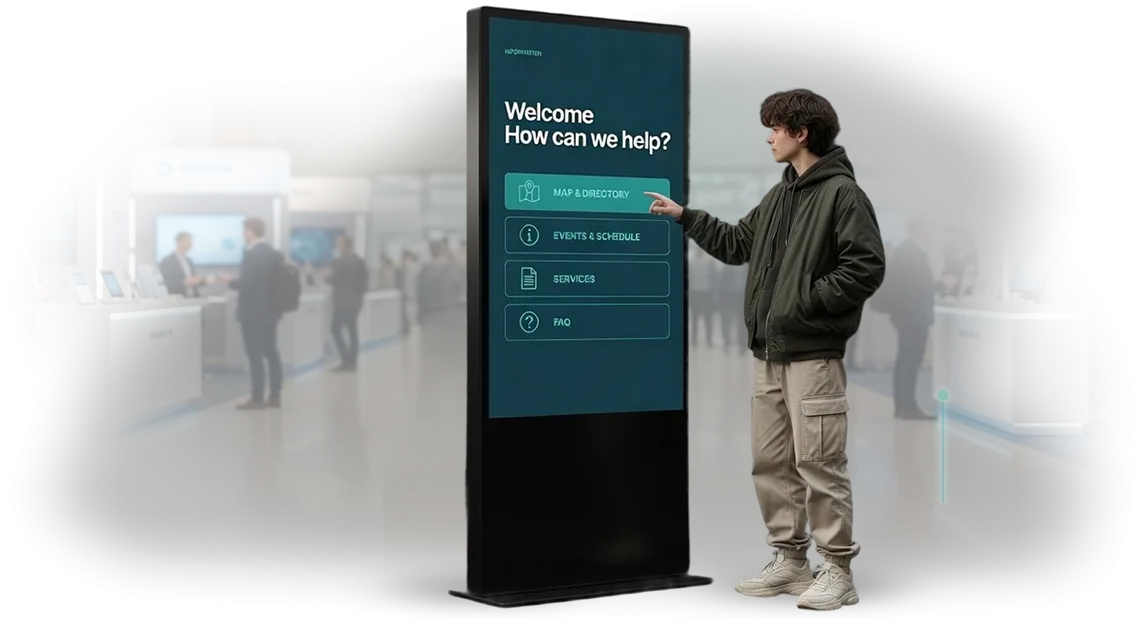
An interactive kiosk for a bank solves this problem before the visitor even speaks to a staff member. The visitor sees a clear path: where to arrange a service, what documents to prepare, how to book an appointment with a specialist.
Instead of confusion at the information desk, they get a quick start and confidence at every step. The kiosk does not replace face-to-face communication — it makes it more meaningful: the employee receives a customer who already has a clear request and a ready set of documents.
The bank wins on two fronts at once. The first is service speed: basic certificates, application status checks, and service routing are removed from the queue to the teller.
The second is behavioral data: you see which services are most often searched for at the kiosk and can adjust branch zoning, staff schedules, and promotional materials. This is not a one-time investment in a screen with a menu — it is a customer experience management tool.
When a customer leaves with their issue resolved and no time wasted, they come back — and bring others. The kiosk becomes the entry point to your service, setting the tone for the entire visit.
We develop such solutions with the specifics of bank branches in mind: reliability, a clear interface for people of all ages, and quick adaptation to your services and promotions.
Implementation takes a few weeks, and the impact is measurable within the first quarter through reduced staff workload and increased positive feedback.
What Will Change in Your Branch After Installing a Kiosk
After installing an interactive kiosk, a bank branch changes its working rhythm: part of the routine operations moves to the digital channel, and employees gain time for the tasks they were hired to do.
Customers stop standing in queues, and the bank handles more operations on the same floor space with the same headcount.
First and foremost — service speed. The kiosk handles routine operations: ordering certificates, changing payment details, checking balances, and paying for services. While the customer does this at the terminal themselves, the manager focuses on sales and consultations.
Waiting time during peak hours drops from ten to fifteen minutes to one and a half to two minutes — a noticeable difference in customer flow.
The second effect — staff workload relief. Employees stop answering the same type of requests and switch to loans, deposits, and product selection. The branch economics change: more customers are served with the same headcount, while cross-sales and the average ticket size grow.
The third result — customer loyalty. The kiosk works without breaks, never gets tired, and never gets irritated, while the customer acts at their own pace, without rush or pressure. Those who previously switched to another bank because of queues now have a reason to stay.
The fourth benefit — data. Every action at the kiosk shows which services are in demand, where the customer hesitates, and what they choose without prompting. The bank sees the real picture at the branch and adjusts its product lineup based on facts, not assumptions.
In the end, everything works as one mechanism: the kiosk removes routine tasks, employees build relationships with customers, and the bank receives accurate analytics.
Within a month, it is clear how much time was returned to the staff and which products people choose on their own — without a consultant's prompt.
Interactive Kiosk Formats for Banks
Every bank branch faces the same challenges: queues, repetitive customer questions, and a lack of staff time for live sales. A properly selected kiosk format removes these problems before the visitor even reaches a specialist. The equipment should be placed where it actually shortens the customer's path to the service.
How to Choose Between Floor-Standing, Wall-Mounted, and Desktop Kiosks
| Format | Where It Is Placed | What Tasks It Solves | Result for the Bank |
|---|---|---|---|
| Floor-standing kiosk | Entrance area, lobby, waiting zone | Navigation, appointment booking, certificate issuance, document ordering | Fewer queues, fewer routine requests, staff free for consultations |
| Wall-mounted kiosk | Near teller stations, in the meeting room, next to ATMs | Paying for services, checking balances, topping up cards, ordering cash | Space savings, faster operations, reduced workload for teller staff |
| Desktop kiosk | Manager's desk, VIP area | Product presentations, terms calculation, signing applications | Higher sales during in-person meetings, individual approach, improved service quality |
We do not just install equipment — we configure scenarios for each format and connect them to your business processes. The design is done in the bank's corporate style, the interface adapts to different screens, and data access is protected in line with security requirements.
As a result, the kiosk becomes a full-fledged digital employee that works 24/7 without breaks or vacations.
How We Build a Kiosk for a Bank: Work Stages
The process of creating a bank kiosk leaves no room for surprises: missed deadlines or an awkward scenario immediately affects the customer experience.
We have structured the kiosk development stages so that you see the result at each step and can make edits before development starts.
- Brief and task analysis — we define the kiosk's goals: which bank services it should cover and which visitor scenarios it should support.
- Interface design — we create a screen structure with a "2-3 touches to the result" logic so the customer does not need to ask staff for help.
- Prototype for approval — we present an interactive model of the future kiosk; you review the navigation and make edits without rework.
- Development and integration with bank systems — we build the software and connect the kiosk to your services: electronic queue, exchange rates, products.
- Testing — we check the kiosk under peak load and real-world scenarios, including touchscreen interaction.
- Launch and staff training — we install the kiosk, configure it, and support employees during the first days of operation.
- Post-launch support — we update content, monitor stability, and refine features as the bank grows.
As a result, you get a working kiosk and a transparent process: you always know what has been done and what comes next.
What Is Included in the Interactive Kiosk Delivery
When you order an interactive kiosk for a bank, you get not separate components but a complete turnkey solution.
Nothing needs to be purchased separately, configured, or figured out — from the enclosure to training materials, everything is already included and proven in real projects.
Here is the full delivery package:
- Touchscreen kiosk with a durable enclosure — withstands visitor traffic, dust, and moisture.
- Software with the bank's branded interface and integration with your systems.
- Content: screens, instructions, promo materials. Updated without involving a programmer.
- Installation, connection, and on-site setup: delivered, assembled, verified.
- Staff training: independent content upload, operational monitoring, standard procedures for failures.
- Warranty and technical support: we respond on business days and replace equipment in case of malfunction.
- Scheduled software and content updates — the kiosk does not become outdated in six months.
Each item reduces your risks. You do not depend on contractors for minor issues and know in advance when and how the equipment is maintained.
And most importantly — you get a working customer service channel from day one. There is no need to build integrations manually or search for contractors — one team covers all stages. All you have to do is accept the result and use it.
Case Study: How a Bank Increased Sales with a Kiosk
One of the top-10 banks (let's call it Bank) faced declining sales at its branches: queues drove customers away, and consultants spent time on routine operations. People left without ever getting help — this directly affected revenue and loyalty.
We suggested installing interactive kiosks in self-service zones. The kiosk handles routine scenarios: balance checks, mini-statements, credit or card applications, and rate plan selection. The consultant stays available for complex questions and selling additional products.
This changes the branch's operating logic: the customer solves a simple task in a couple of minutes without distracting staff.
Results for the first quarter after launch: sales of bank products grew by 25%, while the share of approved applications submitted via the kiosk turned out to be higher than those submitted through consultants.
Average waiting time at the branch dropped by 40%, and employees spent less time on routine tasks and more on quality conversations. This growth was not a one-time event: in the second month, the numbers even exceeded the plan.
The bank's management noted that the project paid for itself in less than six months and decided to roll out the solution to fifty more branches.
For us, this case is an example of how a properly designed interface and a reliable backend turn a kiosk from an additional screen into a full-fledged sales channel.
We are responsible for the entire journey: from scenarios to launch and support, which is why the bank quickly saw a measurable effect.
Frequently Asked Questions About Interactive Kiosks
Bank managers usually ask four questions about interactive kiosks: will the hardware withstand the load, can data leak, is it difficult to manage, and when will the investment pay off. We answer briefly and to the point — without technical details, only what matters for your branch.
Is the kiosk reliable under continuous operation?
The kiosk is designed for uninterrupted operation during peak hours. We use fault-tolerant components and set up automatic monitoring — the system will alert you about a potential issue before it affects customers.
How is data security ensured at the kiosk?
Security is built according to the standards accepted in the banking sector. All operations go through a secure channel, data is encrypted, and access to administrative functions is strictly separated. The kiosk does not store unnecessary information — only what is needed for the current operation.
Is it difficult to manage the kiosk and change content?
Management takes a few minutes a day. Promotions, rates, and information are updated through a simple admin panel — no need to call a programmer or wait for an update. If necessary, you can manage a network of kiosks from a single window.
When will the kiosk pay off and what benefits will it bring?
It takes routine work off the staff and speeds up service: customers get certificates, statements, and product information on their own. This reduces queues and frees up staff time for more complex tasks. In most branches, the effect is visible within the first months of operation.
If you still have questions — ask us directly, and we will show how the kiosk works in real banking scenarios and help you calculate the benefits for your specific branch.Order Development of an Interactive Kiosk
Submit a request for interactive kiosk development — and we will handle the entire cycle: from idea and design to installation and technical support.
You get a turnkey solution that immediately starts working for your business: it speeds up service, relieves staff workload, and creates a modern image of the bank in the eyes of visitors.
What is included in an interactive kiosk order:
- Free consultation: we analyze your task and help you choose a scenario — appointment booking, certificate issuance, branch navigation, or access to online services.
- Exact cost calculation for the kiosk after a short brief: we lock in the estimate and timeline before the work begins, with no hidden surcharges.
- Interface design and screen logic tailored to your business processes and the bank's visual style.
- Enclosure production and assembly on professional equipment — the kiosk withstands the demands of a waiting area.
- On-site installation, equipment setup, and remote service updates without an engineer visit.
- Warranty on the kiosk and its software, plus ongoing maintenance on request.
Thus, ordering a kiosk is not buying a "software box" but a turnkey solution with a clear result. You know that in a few weeks you will have a working tool that measurably improves customer service.
All matters of operation, updates, and possible refinements are handled by one team — you do not need to look for contractors individually.
Submit your request now — in response, we will send interface options and a kiosk cost estimate tailored to your tasks. We will resolve the matter quickly and with a guarantee.
How to Choose the Right Kiosk Format for Your Tasks?
When choosing a kiosk for a bank, it is important to understand that this is not just a device but a tool that must work toward your business goals. Branch load, service speed, and even sales conversion depend on how well the format is chosen.
That is why selecting a kiosk for a bank starts not with technical specifications but with an analysis of floor space, visitor flow, and goals — and here we are ready to be your guide.
If you have a compact branch or limited waiting space, a wall-mounted kiosk or a compact stand is a sensible solution. They take up minimal space but allow customers to get a statement, pay for a service, or book a meeting on their own.
For spacious branches and flagship offices, full-size interactive zones are a better fit — they not only serve customers but also create the image of a modern bank and draw attention to products.
A separate question is the target objectives. If the main pain point is queues at the teller, choose kiosks with an extended set of banking operations.
If you need to inform customers about deposits, loans, and cards, the focus should be on presentation content and convenient navigation. Banks often choose hybrid models: some kiosks work for self-service, others for product demonstrations. This is the optimal choice when you need to cover both objectives without unnecessary costs.
As for budget — it is important to look not at the device price but at its payback. A properly chosen kiosk frees up staff time, reduces queues, and increases sales of additional services.
Even a more expensive solution pays for itself in a few months if it is selected for the branch's specific tasks. That is why in our practice we always do a preliminary analysis and give format recommendations so that you get the maximum effect from every investment.
We help you decide on the kiosk choice based on the branch area, target objectives, and budget. You get a ready concept that can be immediately approved with management and sent into production — without unnecessary iterations or unexpected rework costs.